
A Coach for the Coach: Why the Lone Wolf Lean Practitioner Needs a Thinking Partner
The Problem Nobody Talks About
Here is a scenario that plays out in hospitals and factories every day.
An organization decides to “do Lean.” They hire one person — or reassign someone from operations — to lead the effort. That person might have the title of Lean coordinator, process improvement specialist, or continuous improvement manager. But in practice, they are a department of one.
In Lean Hospitals, I call this person the “lone wolf.” This often goes badly. A lone wolf approach most often leads to that individual leaving the role or the health system in frustration.
The reasons are predictable. The lone wolf has nobody to coach them. Nobody to challenge their thinking. Nobody to debrief with after a difficult conversation with a skeptical VP. Nobody to ask, “Have you gone and observed the process yourself?” when they are stuck theorizing at their desk.
They have training. They have tools. What they lack is a thinking partner.
Related post: From Football to Your Workplace: Why a Lone Wolf Can't Transform An Organization
Related post: Reader Question: A Lone Wolf in Lean Facilitator's Clothing
Tuesday Night Before the Kaizen Event
You are the lone wolf. You are the one person in your hospital or factory responsible for Lean. You have a kaizen event next week in the ED. Your executive sponsor is lukewarm. The nurse manager thinks Lean is the latest “flavor of the month.” You are not sure your problem statement is tight enough. And it is Tuesday night.
There is no one to call. Your external consultant's engagement ended three months ago. Your boss is supportive but does not know Lean well enough to push back on your thinking. You are on your own.
So you open the Lean Hospitals Coach. You select “Coach Me” mode. You type:
“I am facilitating a kaizen event next week in our ED, and I am not confident that we have defined the problem well enough. We want to improve patient flow.”
The coach does not hand you a revised problem statement. It asks: Where in the flow? Which patients? What does the data show? Have you gone and observed during the times when flow breaks down?
You go back and forth. The coach pushes you toward specificity. By the end of the conversation, you have not received a single answer. But your problem statement is sharper, your observation plan is clearer, and you know what questions to ask when you get to the gemba tomorrow.
You did not receive advice. You received better questions.
What Good Coaching Actually Does
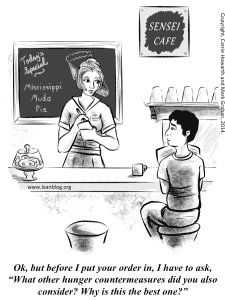
In the Toyota tradition, a coach — a sensei — does not swoop in with answers. The coach asks questions. One question at a time. The goal is not to solve your problem but to develop your problem-solving capability.
A typical coaching exchange sounds like this:
“What is your target condition?”
“Can you be more specific? What does the data show?”
“What did you observe when you went and watched the process?”
“That might work. Before we go there, can you help me understand what is happening right now?”
This is the Improvement Kata pattern. It is also the pattern of a good Lean sensei. The coach resists the urge to give answers — even when the answer seems obvious — because the person who arrives at the insight owns it in a way they never would if someone handed it to them.
Good coaching builds capability. It does not create dependency.
The problem is that good coaches are scarce, expensive, and not available at 9pm on a Tuesday.
The Constraint We Keep Misdiagnosing
When a lone wolf Lean practitioner struggles, the default organizational response is to send them to another conference. Buy them another certification. Give them another template.
We keep investing in the visible, measurable inputs — training hours, certifications earned, tools deployed — and ignoring the invisible constraint that actually determines success: the quality of coaching that happens between events. The conversation after the conversation. The moment when someone is stuck and needs a thinking partner, not a slide deck.
The lone wolf does not need a bigger training budget. They need someone who will ask them a better question at the right moment.
What This Tool Is — and Is Not
Most people hear “AI coaching tool” and immediately picture a chatbot that dispenses advice. That is not what this is.
The Lean Hospitals Coach, in its “Coach Me” mode, behaves like a Toyota senior mentor. It asks questions. One at a time. It does not tell you what to do. It does not give you a checklist. It helps you think through your own situation by pushing you toward specificity, direct observation, and structured problem-solving.
If you say, “We have a quality problem,” it will ask you to be more specific. Where? Which patients? What does the data show?
If you say, “The root cause is that people don't follow the process,” it will ask whether you have tested that hypothesis. What would you expect to see if that were really the cause?
If you say, “Just tell me what to do,” it will redirect you: What is the biggest problem you are dealing with right now? The best approach depends on what you are actually facing.
The coach holds you on the left side of the A3 longer than feels comfortable — which is what good coaching does. It does not pretend to be a human coach, generate generic best-practices lists, or store any patient health information. And it does not replace the need for human relationships, executive sponsorship, or organizational commitment.
As I wrote in the book, the coach should not be expected to come up with all of the answers or “make you Lean” without any effort of your own. That applies to human coaches. It applies to AI coaches too.
The Deeper Point
John Toussaint, former CEO of ThedaCare, once advocated that a health system's Lean department should be about 1% of total FTEs. For a 3,000-person system, that is 30 people. Most hospitals have somewhere between four and eight. Many have one.
We are not going to fix that staffing gap overnight. And an AI tool is not going to replace the 29 people that hospital does not have.
But for the lone wolf who is doing this work right now, today, with no one to coach them — having a thinking partner grounded in Lean principles is not a luxury. It is the difference between staying in the role and burning out.
The best coaching is not about giving people answers. It is about helping them ask better questions.
If you are the lone wolf in your organization, you do not have to think alone.
Start a free coaching conversation here, or get full access as a Lean Hospitals Coach subscriber.
Try the industry-agnostic Lean Coach or get full access to that.