
What Kura Sushi Teaches About Mistake-Proofing (Poka-Yoke)
Mistake-proofing at Kura Revolving Sushi offers an everyday example of process design: a plate-return slot, an automatic count, and a payment reminder each help prevent or detect different errors. My April 2024 visit also showed the limits of those safeguards.
Mistake-proofing — or poka-yoke — is about designing processes so errors are less likely to happen. It's rarely all-or-nothing. Instead, there's a spectrum: from weak safeguards (signs) to strong ones (physical barriers or automation).
The useful design question is how to make an error less likely or easier to detect before it causes harm. A reminder can help, but it still depends on someone noticing and acting on it. A physical constraint can prevent some errors even when attention slips.
I was reminded of that during a quick lunch at Kura Revolving Sushi, where small design choices quietly guide customer behavior, reduce errors, and make the experience smoother–for diners and staff alike.
What a Sushi Restaurant Taught Me About Preventing Mistakes
I love eating at Kura Revolving Sushi. It's not “the best” sushi in the Dallas area, but it's a fun experience and it's quick. These observations are from my April 2024 lunch visit; prices and processes may have changed since then.
If you're not familiar with their standard process:
1) You can take a plate off the main conveyor belt as it cycles around.
2) Take care NOT to grab an order that's going by on the special order conveyor… that special order will automatically stop right in front of you, as a clear signal that it's yours. But somebody else might grab it. Oops! Somewhat mistake-proofed.
3) When you've eaten the item, you slide the empty plate down the chute, as pictured below. Then you're charged based on the number of plates, basically.
Again, it's somewhat mistake-proofed. There's a plate-shaped template on the return slot that blocks large items that might be dropped in (either by mistake or intentionally). The soy sauce dispenser, your green tea cup, and similar items won't fit.
However, a diner (as I'm reminding myself) might drop their smartphone down that slot. I didn't do that today. I've never done it. I might do it someday. And I imagine it happens sometimes — but how often?
It seems that the risk here isn't big enough to focus on 100% perfect mistake-proofing against somebody dropping their phone, credit card, or wallet.
It's not like it flows into an incinerator. I don't know how staff recover an item from that chute, so I wouldn't assume recovery is easy.
Since it's not perfectly mistake-proofed, they have placed a warning / caution sign there… the weakest form of attempted mistake-proofing. Be more careful?
“Do not place your hand and/or other objects into the plate slot.”
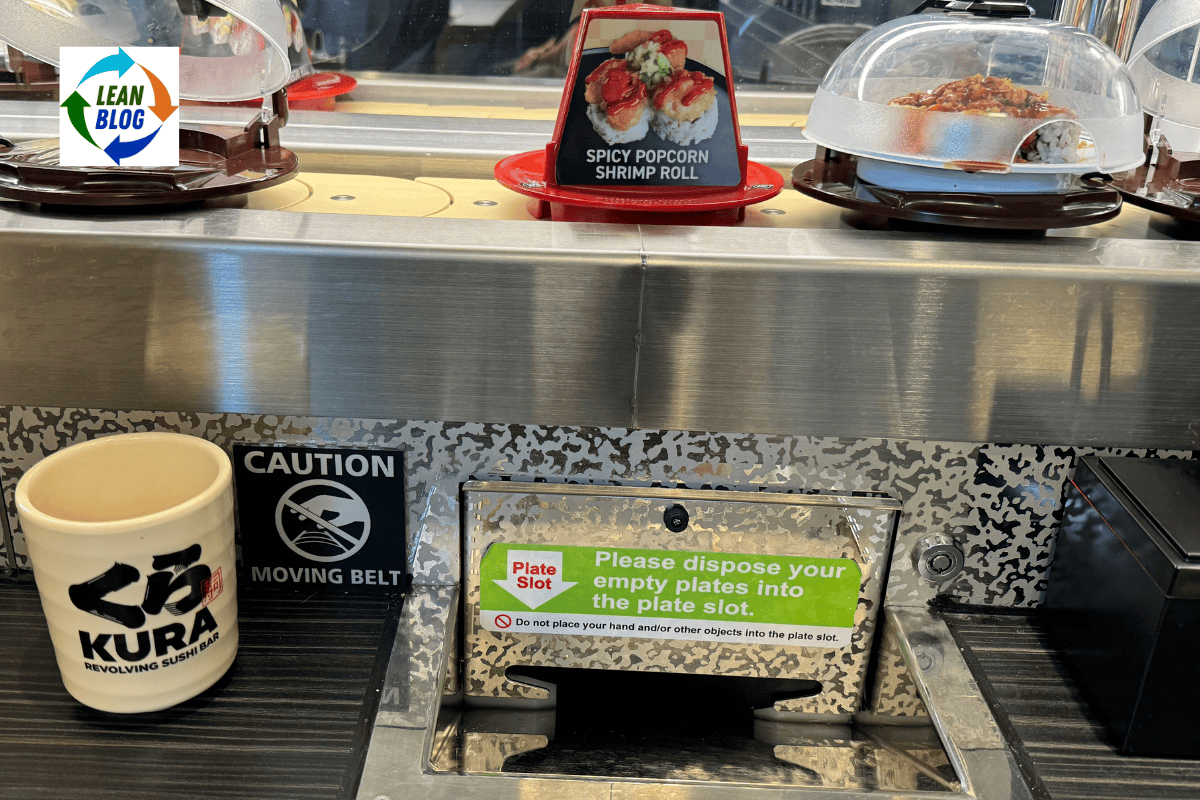
Upon second glance, it DOES seem pretty effective at keeping a customer to reach their hand in… perhaps to try to grab their phone that just fell.
Mistake-Proofing Works on a Spectrum — Not as All-or-Nothing
Watching customers interact with the system made me reflect on how we think about error prevention at work.
Do you evaluate mistake-proofing in your workplace as a binary yes/no? Or do you look at degrees of mistake-proofing, based on effectiveness? Or do you just tell people to “be careful?”
Here's a very short and probably uninteresting video of that successful plate return moment: Kampai!!
Learn more about mistake-proofing
Somewhat Mistake-Proofing the Correct Bill Tabulation
Like I mentioned, if all you're eating is sushi, the bill is :
- $3.25 per standard conveyor belt plate plus…
- Prices for beverages plus…
- Prices for items like ramen, etc. that don't come on that standardized plate
I can appreciate the simplicity of everything on the conveyor being standardized at $3.25. They apparently engineer the plates and items to hit that price point. For example, uni (sea urchin) is generally more expensive. So the uni nigiri plate only has ONE piece, where most everything else it two pieces.
When it comes time to pay the bill, Kura has an interest in making sure the customers are charged correctly. The photo below isn't perfect mistake-proofing, but there's a cautionary reminder to make sure you haven't left any plates on the table or counter:
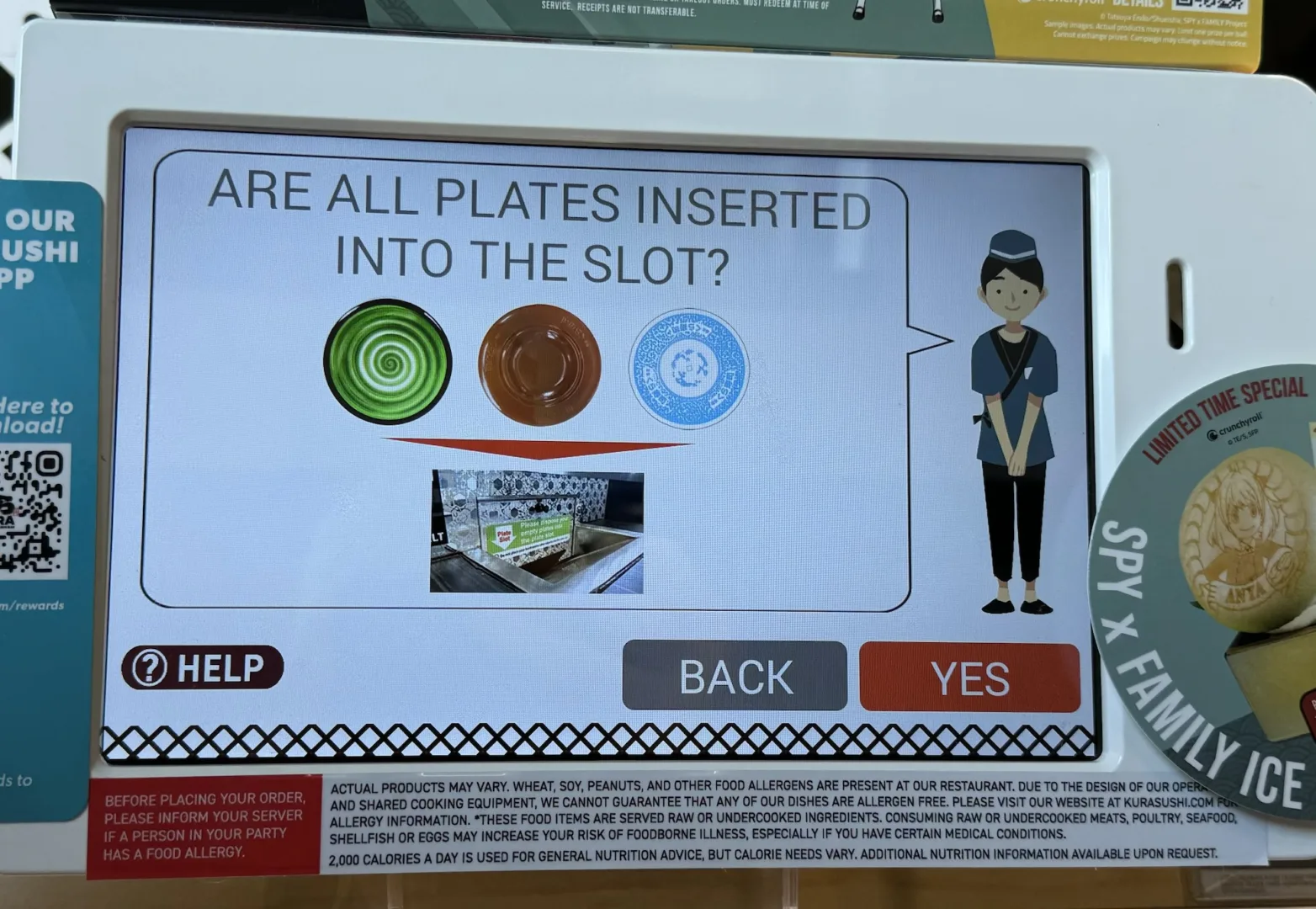
You can pay the bill through the kiosk and your smartphone. I guess there's a possibility that a customer undercharges themselves. When you pay through a server, I'm sure the server looks at the table to make sure all of the plates have gone down the slot.
By the way, as you're eating, the screen displays a count of how many plates you've put down the slot so far. They don't show the running dollar amount, which is probably smart! But customers can do the math.
When I was in Japan, some of the conveyor belt sushi restaurants didn't have a single-price standardized plate. They'd have something like four or five different colors, where premium-priced sushi was a specific color. The prices ranged from 98 yen to 598 yen (so about $1 to $6).
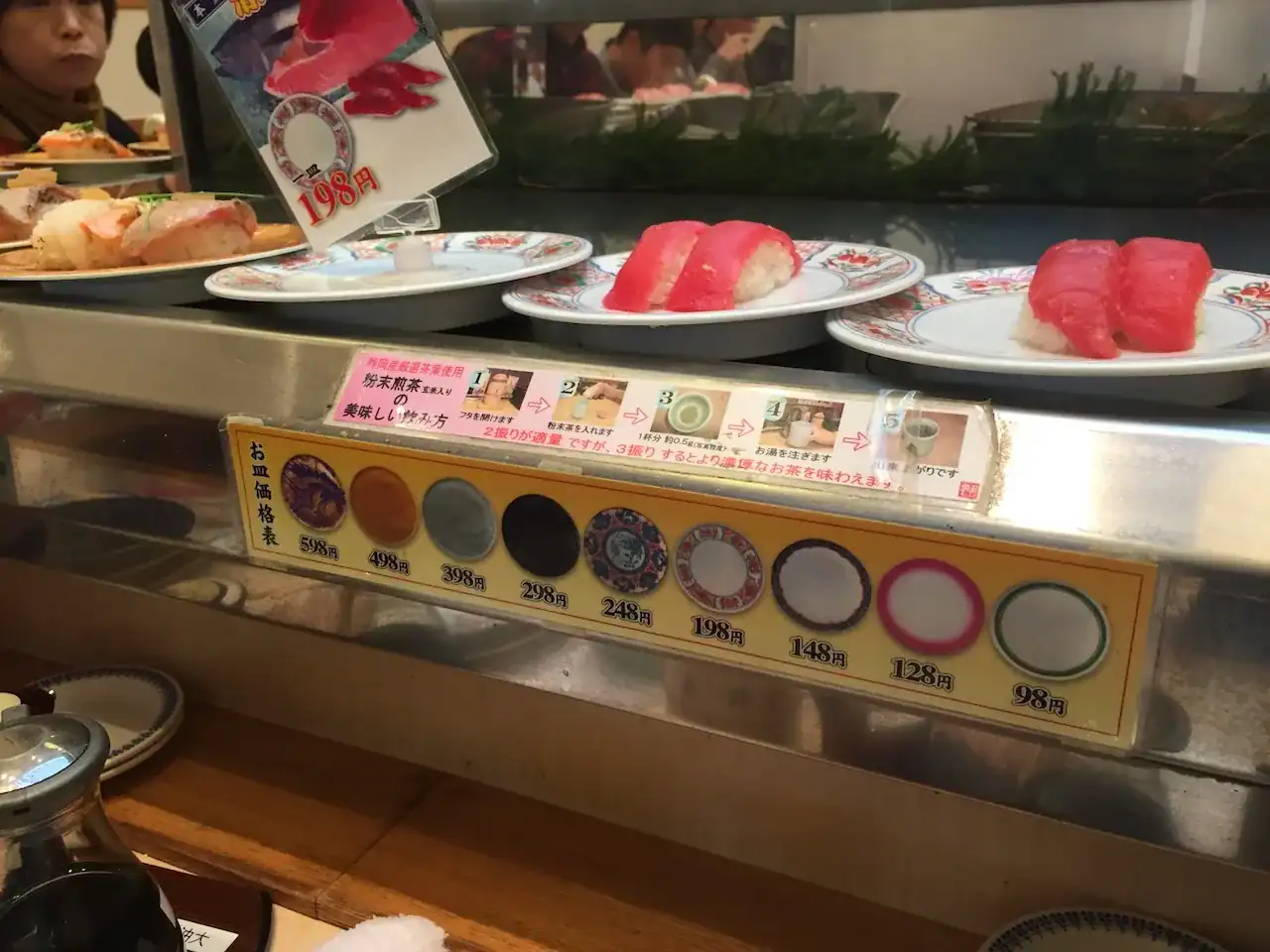
With that system, they can't simply count the plates. In Japan, the plates had an RFID chip in them, which adds a little bit of technology cost. If I remember right, I'd take a stack of plates to the register and they'd scan the stack with an RFID reader. It's certainly easier to put the plates down that slot! The RFID scanner is probably better at mistake-proofing against undercharging a customer.
Conveyor belt sushi has taught me more than one Lean lesson. On a trip to Japan, I accidentally grabbed someone else's special order because the restaurant's process wasn't mistake-proofed the way another one had been. Our guide's response stuck with me: “Leaders have a responsibility to create a system in which employees can be successful.” That applies to customers too.
I enjoy Kura… but I've to say, the quality of the uni is so much better in Japan! That's about the only thing I haven't enjoyed at Kura, so pulling that from the conveyor again would be a… mistake.
The Workplace Connection
Whether it's sushi plates or workplace processes, mistake-proofing works best when it's:
- Proportional to the risk
- Practical for the context
- Designed with the human in mind
The level of protection should reflect the possible harm and whether the error can be detected and corrected. A billing mistake and a patient-safety risk require different judgments about acceptable safeguards.
Ask yourself:
- Do we see mistake-proofing as a yes/no question, or do we consider its effectiveness on a spectrum?
- Are we over-relying on signs and reminders instead of designing processes that make the right action the easy action?
- Are we making the right trade-offs between prevention, detection, and recovery?
Designing Beyond Reminders
Perfect is rarely possible — and often not necessary. Kura's approach shows that thoughtful design, even if not flawless, can still guide behavior, reduce risk, and make life easier for both staff and customers.
A little observation (and maybe a sushi lunch) can reveal a lot about how we approach error prevention — and how we can improve it in our own work.
In a world where we still default to training and warnings, examples like this show how much better results we get when we design systems that anticipate human behavior.
What processes in your workplace still rely on people remembering instead of the system making the right action obvious?
If you'd like to explore more on learning from mistakes and designing smarter systems, check out The Mistakes That Make Us.
If you want to go deeper on mistake-proofing, I'd recommend my podcast conversation with Professor John Grout, who has studied poka-yoke for more than 30 years. One of his best points: he thinks mistake-proofing should really be called “slip-proofing,” because it's easier to prevent execution errors (slips) than bad decisions (planning mistakes). That distinction changes how you think about where to apply it.
To connect error prevention with broader process improvement, see the examples of defects and rework in my guide to the eight wastes of Lean.
Explore the book
In The Mistakes That Make Us, I explore how people and organizations learn from mistakes and improve the conditions that contribute to them. Read the preview before deciding whether it would be useful for your team.