
Are Mistakes Proof That You’re Trying? Yes – and No. Here’s How to Tell the Difference.
TL;DR: The phrase “mistakes are proof you're trying” is true in some settings and dangerously misleading in others. In innovation work — product development, marketing experiments, learning new skills — mistakes are often part of growth and should be expected, even welcomed. In stable or high-risk processes — medication administration, aviation, surgery, payroll — mistakes are signals of system failure that need to be designed out, not celebrated. A sign that fits in a classroom doesn't belong in a hospital nursing unit. Knowing which kind of mistake you're looking at is the leadership discipline.
Are Mistakes Proof That You're Trying?
Sometimes — but not always.
In learning and innovation settings, mistakes can signal experimentation and growth. In stable or high-risk processes, mistakes signal system weakness and require prevention, not celebration.
That distinction matters.
We can all make mistakes, so I advocate for learning from mistakes through my book, podcast, and speaking. I do my best to learn from my mistakes, so I don't repeat them. I fail to meet that standard sometimes, and I try to learn from those moments (as I shared in this recent post).
A few times now, a friend has sent me a photo or tagged me on a LinkedIn post about a sign similar to the one below. They assume I'd love the sign and the sentiment. Mistakes are proof that you're trying?
My reaction?
It depends on the context.
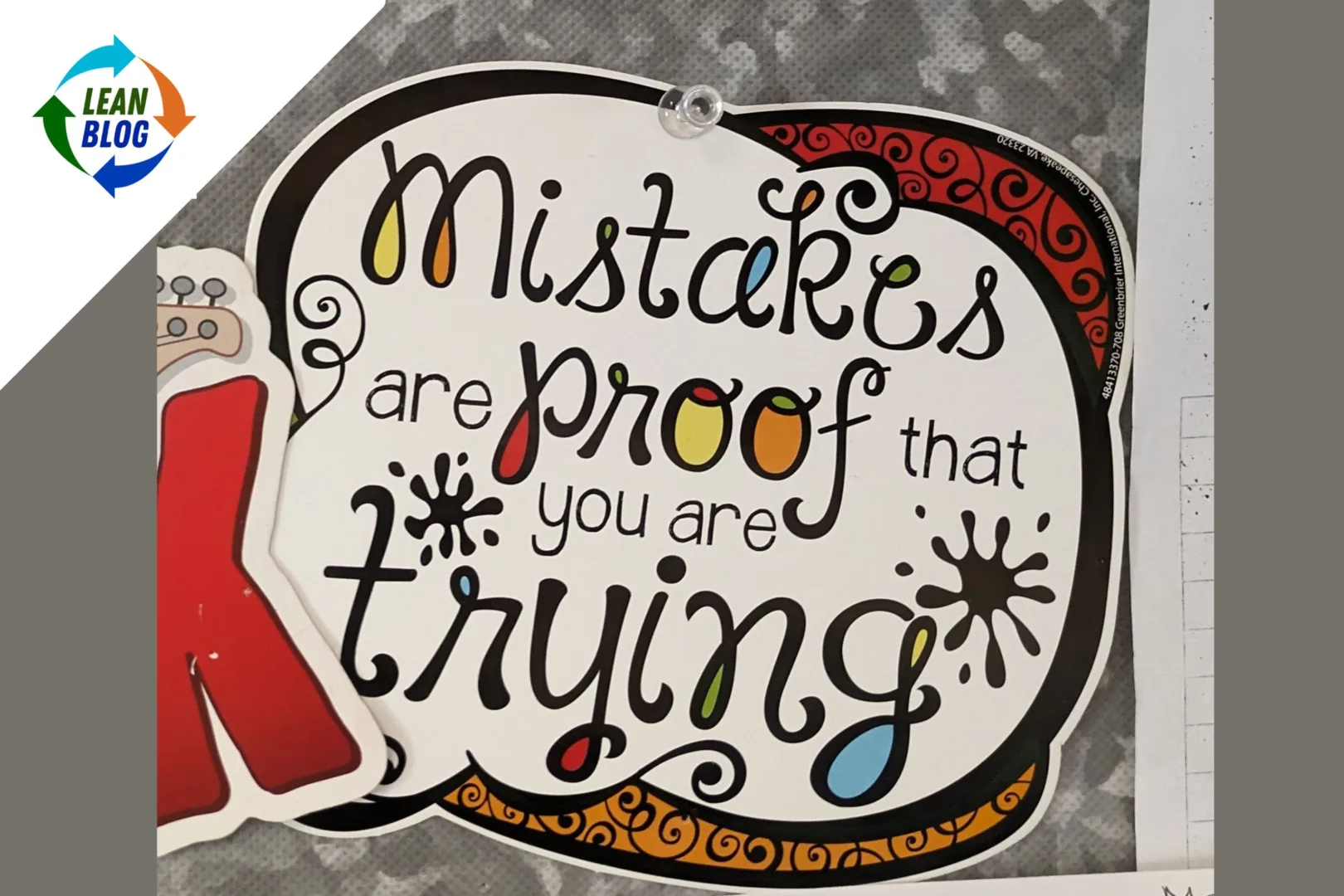
Mistakes are proof that you are trying. That's true.
The surest way to not make mistakes is to not try.
“Not trying” is usually not an option.
I don't think that sign belongs in that setting.
Hear Mark read this post — subscribe to Lean Blog Audio
Process Mistakes vs. Innovation Mistakes: Quick Reference
| Process Mistakes | Innovation Mistakes | |
|---|---|---|
| Where they happen | Stable, repeatable, high-risk work | Experimentation, new product development, learning |
| Examples | Medication errors, surgical mistakes, payroll errors, aviation incidents | Failed marketing campaigns, software features that don't land, learning-curve mistakes |
| Leader's job | Improve the system. Mistake-proof. Reduce conditions that allow errors. | Create psychological safety. Encourage experiments. Learn fast. |
| Is the sign appropriate? | No | Yes |
| Edmondson's frame | Basic and complex failures | Intelligent failures |
The leadership discipline is knowing which kind of mistake you're looking at.
Context Determines the Meaning of a Mistake
If this were posted in a classroom, I think the message would be a positive reinforcement of a “growth mindset” and a helpful reminder to students that it's natural to make mistakes when learning something new.
I would not want to see that sign in an airplane cockpit or a Boeing factory. In those environments, mistakes can cost lives. A casual slogan does not belong there.
That's why pilots learn and practice in simulators–a safe setting to make mistakes.
In some situations, healthcare also uses simulators to practice and learn. That could include any of us who learn CPR on a “dummy”–another safe setting for learning through mistakes.
I also wouldn't want to see that sign in an operating room or surrounding rooms.
The photo that I shared above was posted in a hospital nursing unit. I don't think posting such a sign in that setting is appropriate. I think it's a mistake to do so.
Why?
Everyone in that environment is already trying. Mistakes are not proof of effort.
Many mistakes in healthcare — as in aviation — can have serious consequences.
We must work really hard to prevent such mistakes, such as medication errors. Some mistakes should never happen. And that doesn't mean pressuring people to be perfect in an unachievable superhuman sort of way. It means we use mistake-proofing and other systematic methods to reduce, if not eliminate, mistakes and the bad outcomes that result.
Not All Mistakes Are Created Equal
Not all mistakes are the same. At a high level, they fall into two categories:
- Process mistakes
- Innovation mistakes
This maps closely to Amy Edmondson's framework from The Right Kind of Wrong (2023), which breaks failures into three categories:
Basic failures are single-cause errors in known territory. A nurse pulls the wrong vial. A pilot misreads a checklist. A cashier rings up the wrong item. The right answer existed, the process was known, something went wrong anyway. These are what most people mean by “mistakes” in everyday language, and they map directly to process mistakes in my framework.
Complex failures happen in familiar settings but result from multiple factors interacting in unexpected ways — a perfect storm in a known system. A hospital discharge gone wrong because three different handoffs each had a small gap. A flight delay cascading into a regional disruption. These are also process mistakes, but harder to mistake-proof because the cause is in the interactions, not any single step.
Intelligent failures happen in new territory, when the right answer wasn't known going in. A product launch that bombs because customers wanted something different. A clinical trial that doesn't show the hypothesized effect. A new teaching method that doesn't improve learning outcomes. Edmondson's argument — and I agree — is that intelligent failures are essential. You can't innovate without them. These are innovation mistakes.
Where I'd update my own book if I were rewriting it: I used “basic, complex, intelligent” as the framework, but in practice I think process vs. innovation is more useful for leaders making moment-to-moment decisions. The Edmondson taxonomy is sharper for diagnosing what happened. Both frameworks point in the same direction.
A mistake is an action or inaction. A failure is the outcome. The two are related, but not identical.
But back to the breakdown of things into two or three categories. I used the “basic, complex, intelligent” breakdown in my book, but as applied to mistakes. I think that framework is OK.
In hindsight, I think I made a mistake by not just using “process” and “innovation” as the breakdown. Maybe for a 2nd Edition of my book!
Process Mistakes
Process mistakes can be mistake-proofed. We can (and often must) work really hard (and creatively) to prevent them proactively. And when they occur (or when we have a near miss), we must learn from them, focusing on improvement instead of punishment.
Process mistakes are not proof of effort. In stable systems, effort is assumed. Reliability is expected.
Again, I think that sign is inappropriately flippant about serious mistakes.
I'm not saying we should make people feel bad about mistakes. Far from it. I'm not a fan of punishing people for mistakes. Remember that mistakes are, by definition, unintentional. Leaders can respond to mistakes with empathy. Nurses who make mistakes might need emotional support or mental health care after a mistake, as it can be traumatizing. We don't need to add more trauma through punishment… or a sign that might land badly after a serious mistake occurs.
Innovation Mistakes
Innovation mistakes often arise from decisions made while experimenting or trying something new.
As Prof. John Grout said in his recent webinar, you generally can't mistake-proof against bad decisions.
I think that sign would be appropriate and helpful in innovation settings. If we're creating innovative marketing campaigns, “mistakes are proof that you are trying” might be more appropriate. Then again, if a marketing campaign intended to be “edgy” turns out to be “highly offensive to many,” then I don't think that sentiment is great.
It's situational.
Within KaiNexus, an innovative software company, different types of work may involve both process and innovation mistakes.
Launching a new feature that does not work perfectly may be acceptable. The key is learning quickly and improving.
When you punish innovation mistakes, people will protect themselves by being very cautious. You'll get less innovation.
Now, mistakes in payroll processes are something you'd want to mistake-proof. That sign might not be appropriate in a company's billing or accounting departments. But in the product, development, and marketing teams, you might expect, encourage, and celebrate innovation mistakes.
Again, not all mistakes are created equal.
Don't celebrate process mistakes. Do acknowledge process mistakes. Do respond to them in a kind and constructive way that's focused on learning and improvement.
Innovation mistakes can be thought of and handled a little differently.
The hard part isn't deciding to punish mistakes (you shouldn't) or to celebrate them (it depends). The hard part is telling, in the moment, which kind of mistake you're looking at.
A medication error and a failed marketing experiment both involve someone trying and something going wrong. But the right leadership response is opposite. The error gets a system investigation. The experiment gets a debrief about what was learned. Mix them up, and you either traumatize people who were doing exactly what you asked them to do, or you normalize errors that should never happen again.
Psychological safety does not mean lowering standards or excusing harm. It means responding with curiosity rather than blame — while still being honest about which mistakes should be designed out of the system altogether. The leaders who get this distinction right build better systems, better outcomes, and healthier cultures. The ones who don't either run scared organizations where no one talks about problems, or normalize the kind of errors that hurt patients, customers, or employees.
The Leadership Discipline Is Discernment
The phrase “mistakes are proof that you're trying” is comforting. It reduces shame and encourages effort. But leadership isn't about slogans — it's about judgment. The same mistake, in two different settings, calls for two different responses. A sign that works in a classroom doesn't belong in a nursing unit. A leader who celebrates a missed medication the way they'd celebrate a failed marketing experiment has confused the two and is making the workplace less safe, not more humane.
The real test isn't whether mistakes occur. It's whether leaders can tell which kind they're looking at, and respond accordingly. That discernment is what builds psychological safety without lowering standards — and it's what most “mistake-friendly” cultures get wrong.
Frequently Asked Questions
Are mistakes always proof that someone is trying?
No. In innovation work — product development, marketing experiments, learning new skills — mistakes are often signs of trying and growth. In stable, high-risk processes like medication administration, aviation, or surgery, mistakes are signs of system weakness, not effort. Everyone in those settings is already trying. The right response is improving the system, not celebrating the error.
What's the difference between process mistakes and innovation mistakes?
Process mistakes happen in stable, known work where the right answer was understood going in — a wrong medication dose, a mislabeled package, a missed checklist item. These should be mistake-proofed and reduced. Innovation mistakes happen in new territory where the right answer wasn't known — a product feature that misses the market, an experimental treatment that doesn't work. These are essential to learning and should be encouraged within reasonable limits.
How does this connect to Amy Edmondson's failure framework?
Edmondson's framework, in The Right Kind of Wrong, distinguishes basic failures (single-cause errors in known territory), complex failures (multiple factors interacting in known territory), and intelligent failures (new territory, unknown answers). Basic and complex failures map to process mistakes. Intelligent failures map to innovation mistakes. Both frameworks make the same core argument: not all failures should be treated the same way.
Should you ever celebrate mistakes in healthcare?
Not the process mistakes themselves. But you should absolutely celebrate the speaking-up that surfaces them. The nurse who reports a near-miss has done something brave and important — even if the underlying error itself should never have been possible. Celebrate the reporting, the learning, and the system improvement. Don't celebrate the harm.
What does “mistake-proofing” mean?
Mistake-proofing (sometimes called poka-yoke, the Japanese term from the Toyota Production System) means designing work so that errors become harder or impossible to make. Examples: medication packaging that prevents the wrong dose from being drawn, surgical checklists that prevent steps from being skipped, software that won't let a user submit an incomplete form. The principle: don't ask humans to be perfect. Make it easy to do the right thing and hard to do the wrong thing.






Hey Mark,
I just read your blog article “Mistakes are Proof that You’re Trying? A Situational Analysis” and I thought it was an interesting and informative post on how to perceive and handle mistakes. I like how you stated that the sign had its merit’s but only in the right setting. I agree that the sign could be placed in a classroom setting to promote a growth mindset but should be kept out of places like a hospital nursing unit. I also liked the concept of “Mistake Proofing.” I am a student at URI and we have spoken about the concept of “Poke Yoke,” which, as you know, is the exact same thing. I also found it informative how you kept going with that concept by stating the importance of trying to learn from mistakes to prevent them in the future. This is extremely important because if we don’t look deeply into what caused a mistake, the same situation is likely to reoccur. I also liked the comment “Not all mistakes are created equal. Our attitude about mistakes can’t be exactly the same for all.” I fully agree with that statement because there is no “one solution fixes all,” we need to look at the causes and react accordingly to best move forward. I also liked your statement “focus on learning, improvement, and prevention instead of punishment!” I found this interesting because sometimes people just make mistakes, instead of just punishing them we must try to find ways for them to understand where it went wrong so they can move forward better in the future.
Hi David – thanks for reading the post and for sharing your reflections.