

Patients, Dignity, and Improvement: What These Charts Really Tell Us
tl;dr: A closer look at NHS patient dignity data shows that small year-to-year changes don't automatically mean improvement. By plotting the data over time and using Process Behavior Charts, we can see when a real system change occurred–and avoid misleading conclusions that confuse routine variation with meaningful progress in patient experience.
I was pointed to this tweet late last year (oops, no longer available)…
Here is the chart in question:
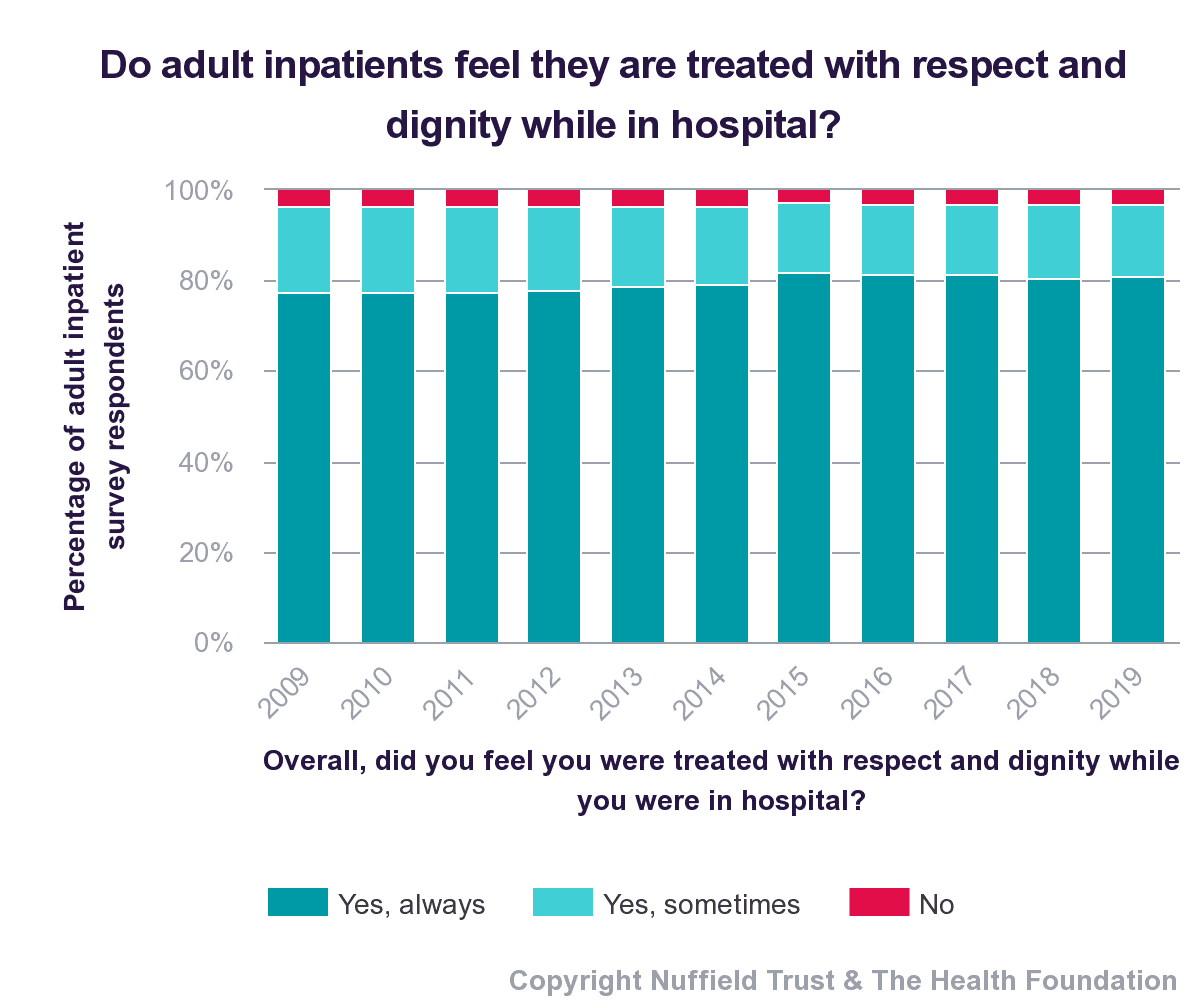
It's an important question from the British NHS — of course, we'd want patients be be treated with dignity and respect while in the hospital.
Does This Chart Really Show Improvement in Patient Dignity?
The tweet makes a claim that the percentage of respondents saying “Yes, always” had “increased slightly” from 2009 to 2019.
Now, I do appreciate that they've provided 11 data points — that's far better than a two-data-point comparison.
I look at that chart and, with my statistical training and experience, draw a different conclusion. My conclusion is,
“That might just be fluctuating around an average.”
The difference comes down to whether we're seeing a real change in the system–or just normal variation over time.
I'm not sure if there's really evidence of an increase.
How could I tell? By using a “process behavior chart,” as I write about in my book Measures of Success: React Less, Lead Better, Improve More.
When I mouse over the chart that's on the Trust website, it shows the data for each year down to one data point.
Here are those numbers:
| Data | |
| 2009 | 77.6% |
| 2010 | 77.3% |
| 2011 | 77.6% |
| 2012 | 77.8% |
| 2013 | 78.6% |
| 2014 | 79.0% |
| 2015 | 81.7% |
| 2016 | 81.3% |
| 2017 | 81.5% |
| 2018 | 80.5% |
| 2019 | 80.9% |
Even without charting it yet, you see there's not much variation in the first five years… then it seems to jump upward.
What Changes Become Visible When We Plot the Data Over Time
We could learn a lot from a simple Run Chart:
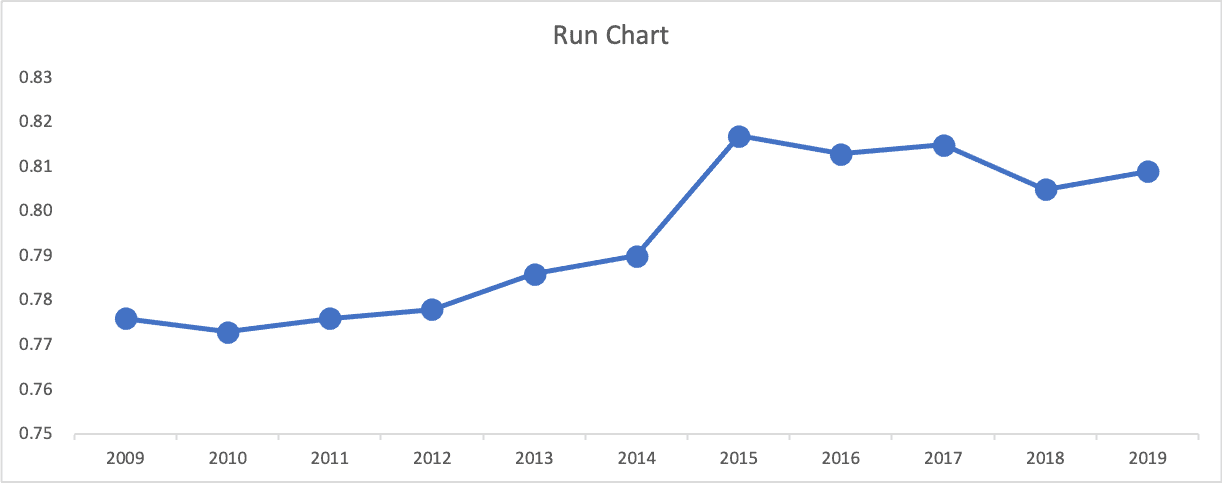
Hmmm… there's the jump ward starting in 2015. So things are better… but it's probably not as simple as “2019 is better than 2009.”
We could say “performance has been better between 2015 and 2019 than it was between 2009 and 2014.”
However, notice the Y-axis. It might be a statistically meaningful improvement, but are patients really THAT much happier? Does the Trust understand what they are doing better? Do they understand the cause-and-effect relationships between actions and results?
Here is my first attempt at a Process Behavior Chart, using all data for the baseline (calculating the average and the limits):
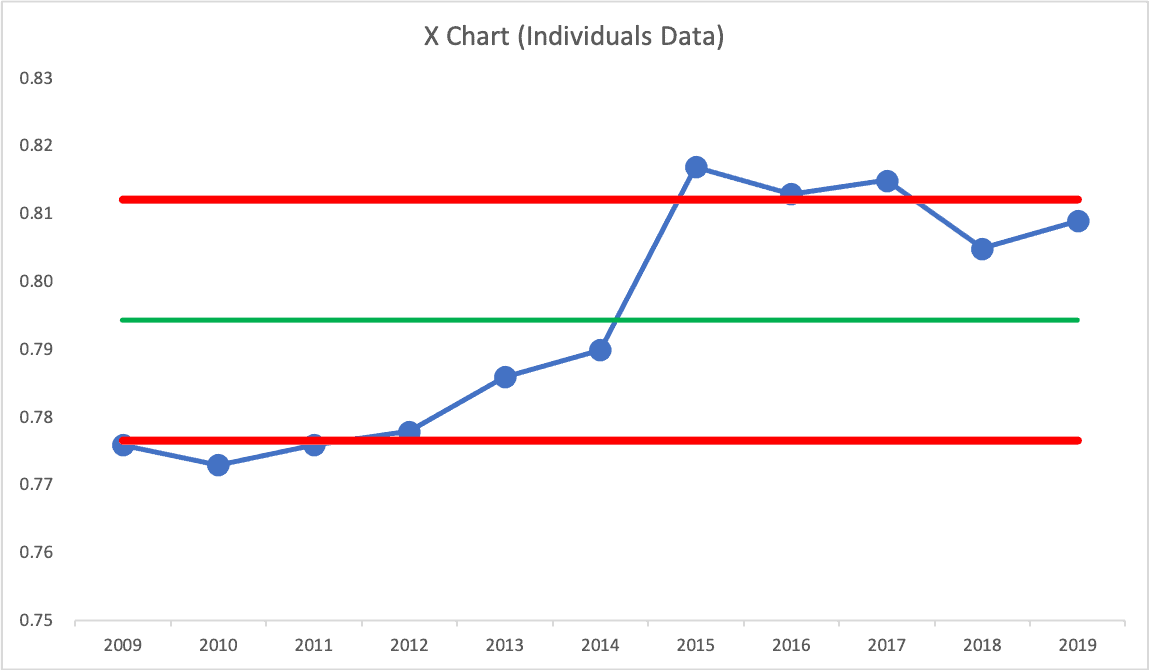
Seeing data points below the Lower Limit and above Upper Limit tells us, quite definitively, that the chart does not represent a single system over time. The system changed (apparently in 2015).
I can try again by using the first six data points to calculate the average and the limits, giving me this:
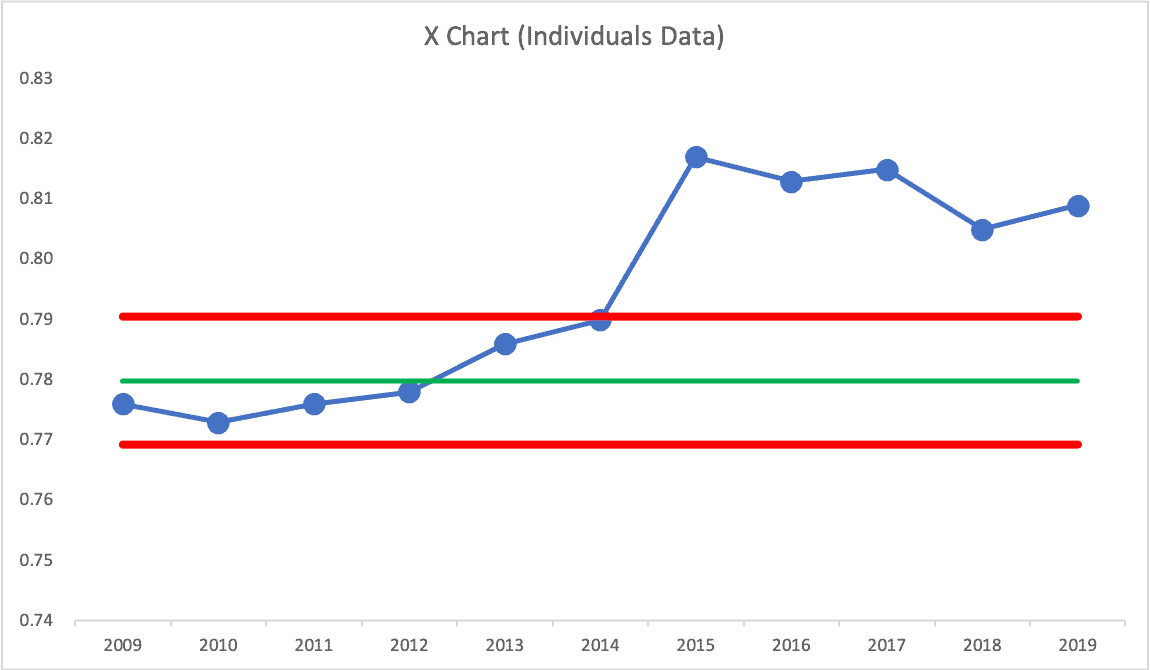
2014 was almost at the Upper Limit… but then there is clearly a shift upward. So, I can calculate a new average and limits for 2015 to 2019…
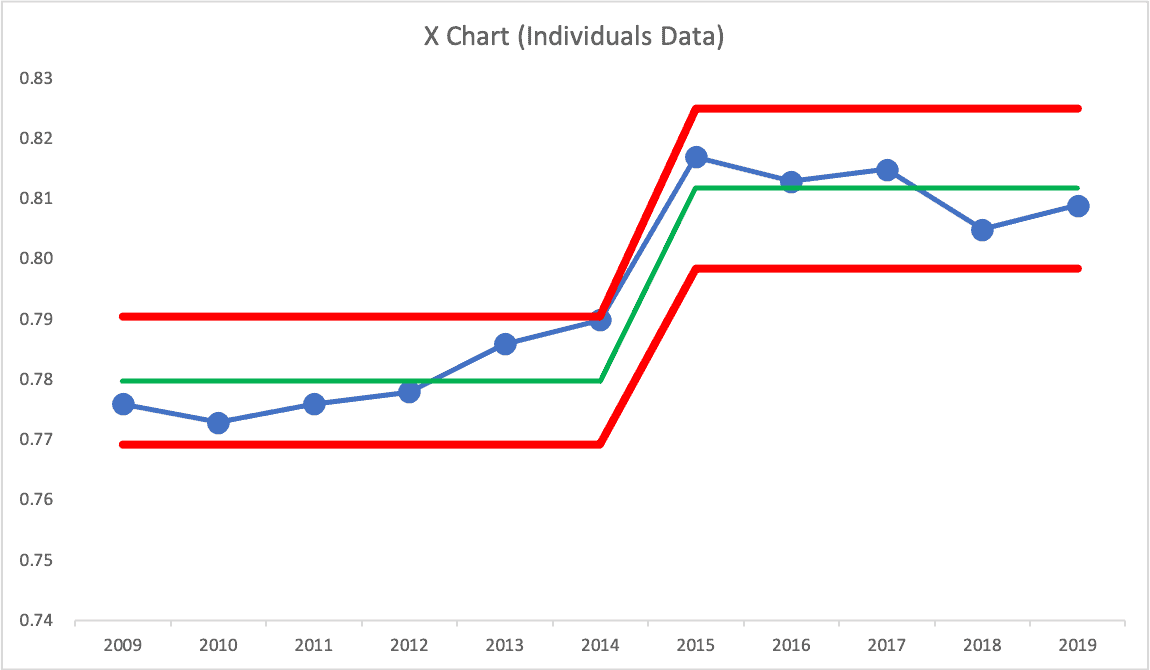
My conclusion would be that performance DID improve. But, it's now been fluctuating around a new average. I wouldn't ask, “Why was 2019 higher than 2018?” or “Why was 2019 lower than 2015?”
I also wouldn't ask, “Why was 2019 higher than 2009?”
I would ask,
“Why did it shift upward in 2015?”
I think the Process Behavior Chart shows this so much more clearly than the stacked column chart does. When we compress the Y-axis, to not show zero to 100%, we do have to be careful that we're not misleading anyone.
The % saying “Yes, always” had been fluctuating around an average of 78.0% Now it's fluctuating around an average of 81.2%.”
That's nice… but it shows that there is still room for improvement. What improvements come next?
Leading Improvement With Evidence–and Respect for Patients
For leaders, the real lesson here isn't about statistics–it's about responsibility. When we claim improvement based on charts that can't distinguish real change from routine variation, we risk misleading ourselves and others, even when our intentions are good. In areas as important as patient dignity and respect, precision matters. Overstating progress can create false confidence, while understating it can obscure what's actually working. Neither helps patients.
The discipline of plotting data over time and using Process Behavior Charts isn't about being skeptical or academic–it's about being honest. Honest with ourselves about whether the system has truly changed, honest about what we understand (and don't), and honest about where improvement is still needed. Leaders who take this approach create better decisions, better learning, and ultimately better care–by grounding improvement claims in evidence rather than hope or optics.