
My First Kaizen: A Childhood Lesson in Process Improvement
TL;DR: My first Kaizen didn't come from a Lean course or a workplace–it came from modifying a newspaper delivery bag as a kid. Small improvements, driven by the person doing the work, are where continuous improvement really begins.
What Was My First Kaizen?
When I shared a link to my post about applying Kaizen to my websites, I was asked a fascinating question on LinkedIn last week:
“What was your very first process improvement?”
A Childhood Job — and an Unexpected Improvement Opportunity
When I was a kid, my first job was actually as an independent contractor delivering papers for The Detroit News. I had the route in my neighborhood from about ages 12 to 15. I delivered papers on the street I grew up on and also on the street back behind.
The density of newspaper customers was high enough that I had about 40 customers on a few streets. Maybe 50% of the houses took the paper each weekday afternoon and weekend mornings. I imagine the numbers are much lower today.
I had a newspaper bag that was designed to go over the back of a bicycle. I forgot if I was given the bag or had to buy it.
It looked like this, but had the Detroit News logo on it.
I had a ten-speed bike, but it wasn't really sturdy enough to put on the back of a bike.
My First Kaizen: Improving the Newspaper Bag
The route was small enough that it was practical to walk. So, I cut a hole in the middle part of the bag so it would go over my head (or my mom did it). I'd put papers in both sides of the bag so it would hang with some papers on my chest and some on my back.
Here's an AI depiction of what it might have looked like. I couldn't get the Gemini photo editor to respond to my request to make the kid look a little older, like 14.
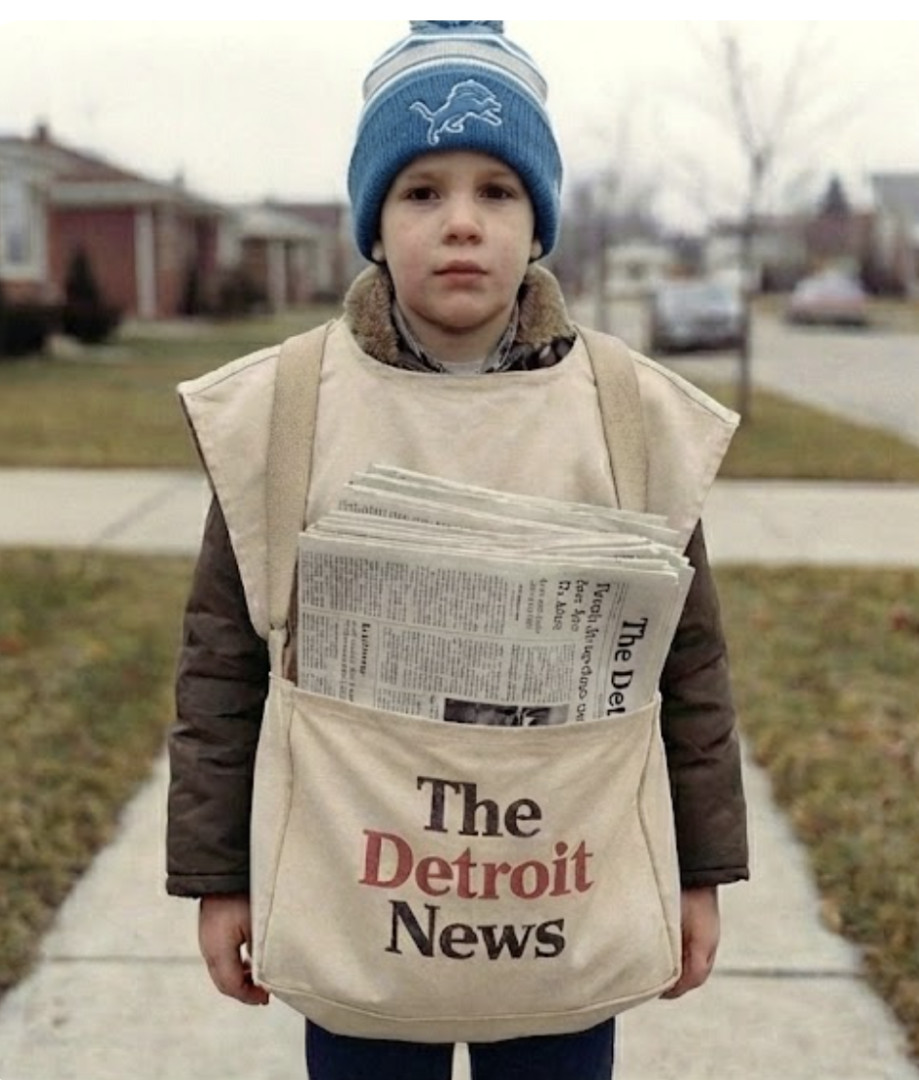
Or this (not me pictured):
I'd deliver papers out of the front pocket and, when the front was empty, I'd swing the bag around so the papers on my back were now on my chest.
Sometimes I'd ride the bike. More often, I'd walk and wear the bag that way.
Why This Simple Change Was Kaizen
I think that improvement to the bag counts as Kaizen. It didn't cost any money. It was putting creativity over capital. Sometimes, on weekends when it was early, the papers were heavier. If the weather was bad, my dad would drive me in the car to deliver them. It was their capital, but I appreciated the help.
It was also Kaizen because it made my job easier compared to using my bike or pulling stacks of papers in a red wagon, which I also did. I'll have to ask my parents, maybe I used the wagon until I was strong enough to carry the papers. I do remember pulling the papers in a wagon the day of the Chernobyl disaster in 1986 when I was 12 years old, actually.
I didn't realize I'd be blogging about it someday:
The Perils of Context-Free Data: Lessons from the Chernobyl Disaster
A 2026 Reflection
Looking back from 2026, I'm struck by how often people assume Kaizen begins with training, certification, or a formal Lean initiative. In reality, it often starts much earlier — with a kid, a job, a small annoyance, and the freedom to try something better.
That paper route improvement wasn't labeled “Lean,” measured with ROI, or approved by a committee. It was simply a human seeing friction in the work and doing something about it. That mindset — more than any tool or framework — is what I still see separating organizations that struggle from those that learn and adapt.
Kaizen isn't something we adopt later in our careers. Many of us were practicing it long before we had a name for it. The real question, for individuals and organizations alike, is whether we create environments where that instinct is encouraged… or slowly tamped down or driven out of people.
What was your first Kaizen — and are you still allowed to practice it today?







And now I will forever picture you as a freckle-faced 10-yr-old on a banana-seat bike…
But seriously, it’s a good example of how easy it can be to make small changes, and how those small changes can have a big impact on an individual’s workflow.
Hi Mark,
I helped my brother with his paper route around the same age. We moved from batch to flow in the paper route process. Instead of rolling all the papers and then loading as many fit in our bag delivering them going back to our house reloading for 2-3 more cycles (depending on the density of the paper) we shifted to flow. We’d start to roll them together and load them in the bag as we went. The point that the bag hit the max level of papers one of us would go deliver. One would stay back and continue to roll. Then reload when one got back. Eventually we bought a second back.
As far as my first kaizen. That was an early one I can remember. Another one was when I started landscaping I created point of use for all my tools and supplies using cardboard boxes. I upgraded later to plastic bins.
Thanks for sharing your story!
I’m sure this wasn’t my first Kaizen, but a memorable one: I had a job my first summer in college at an academic library. My first day, I was shown the process for making the card catalog cards (remember those?) They had printed out the database on paper and my job was to copy those paper slips onto the card stock, front and back, to cards per sheet, then take them to another facility where they had a large paper shear to cut them into half-sheet size cards.
I was shown the painful step-by-step process of copying one card at a time, front and back, onto the card stock. It took forever.
But the copying machine was one of those really big industrial jobs, with lots of autoloading and double-sided features… I asked my boss why I couldn’t just use the autoloader. Well, you might get the cards printed backwards and that would waste paper. (What? You’d rather waste my time than paper? To say nothing of how that was a preventable failure mode). And he said that the card stock didn’t work double sided.
The first day, I did as I was told. The second day, I did as I was told. The third day, when the boss left, I, *carefully* set things up and ran a trial through the autoloader to make sure it was set right. I also tried the card stock double sided.
I ended up doing the whole summer’s worth of cards in less than a week. ;-) He didn’t say he was mad, but I think he was. He struggled to find work for me the rest of the summer.
That’s a great story on many levels. It was an early lesson for you about something being rationally better doesn’t mean it will be accepted by others. People are complicated. Your Kaizen idea might have made your boss look like an idiot…