

Jiro Dreams of Sushi and the Kaizen Mindset: Lessons in Continuous Improvement
TL;DR: Jiro Dreams of Sushi is a powerful metaphor for the Kaizen mindset. The film shows how true mastery comes from humility, reflection, and never being satisfied with “good enough.” Like Lean thinking, Kaizen isn't about quick wins or flashy tools–it's a lifelong commitment to learning, continuous improvement, and respect for the craft (and the people doing the work).
On my way back from vacation, I watched the movie “Jiro Dreams of Sushi” for a second time. I first watched it in 2012 before my first study trip to Japan. You can watch the movie for free if you're an Amazon Prime member, by the way.
The documentary isn't really about sushi. It's about what lifelong improvement looks like when pride, ego, and “being done” are removed from the equation–and why that mindset is so rare (and so valuable) in Lean organizations.
The Kaizen mindset–continuous improvement through humility and reflection–is at the heart of both Lean thinking and Jiro Ono's philosophy.
The trailer:
Kaizen as a Lifelong Practice, Not a Phase
The film focuses mainly on Jiro Ono, a now 90-year old sushi chef in Tokyo who has received the rare and coveted Michelin 3-star rating for his restaurant.
As you can read in the transcript of the film
[Jiro] is always looking ahead.
He's never satisfied with his work.
He's always trying to find ways
to make the sushi better, or to improve his skills.Even now, that's what he thinks about all day, every day.
That reminds me of Lean thinking, especially the drive for Kaizen, or continuous improvement.
As Jiro says, there's always room for improvement:

I admire how somebody like Jiro can do the same thing, follow the same routine, every day for decades, trying to perfect his craft.
Jiro says:
Even at my age, after decades of work…I don't think I have achieved perfection.
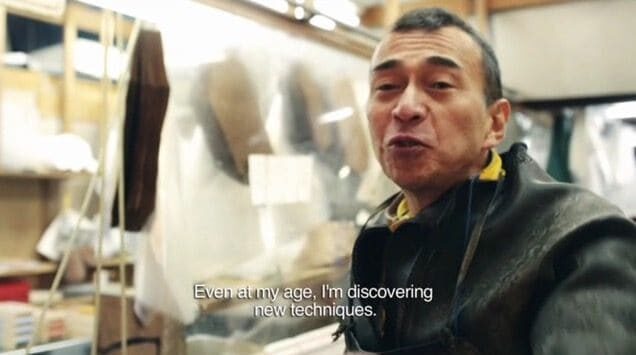
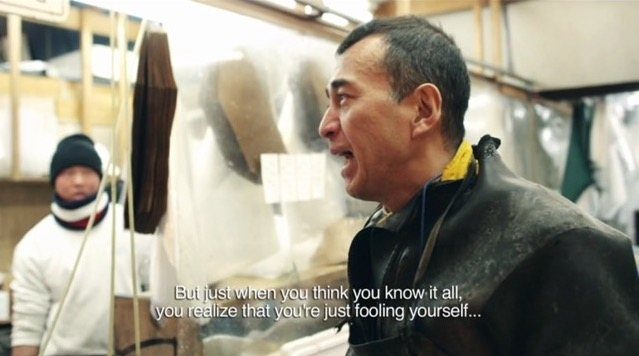
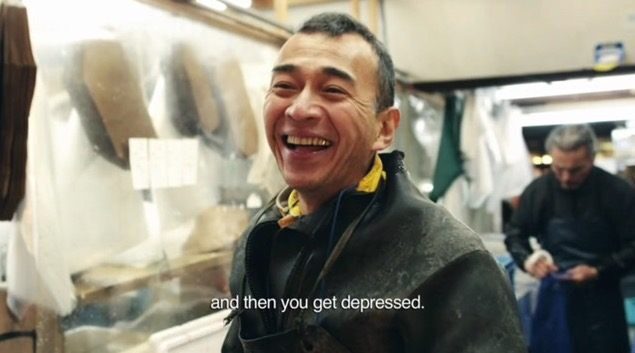
Later in the film, we also see Fujita, a tuna dealer, who talks about the need for continuous improvement and the necessity of self-reflection.
Even at my age, I'm discovering new techniques.
But just when you think you know it all, you realize that you're just fooling yourself…
and then you get depressed.
Humility, Learning, and the Dunning-Kruger Trap
Do you ever feel that way? It reminds me of the “Dunning-Kruger effect” where beginners in a field overestimate their knowledge and ability. I see this a lot with Lean or “Lean Sigma.” As they say, a little bit of knowledge can be a dangerous thing.
Dunning and Kruger proposed that, for a given skill, incompetent people will:
- fail to recognize their own lack of skill
- fail to recognize the extent of their inadequacy
- fail to accurately gauge skill in others
- recognize and acknowledge their own lack of skill only after they are exposed to training for that skill
Then, as you learn more, you realize how much you don't know. This can lead to the “imposter syndrome.”
“Psychological research done in the early 1980s estimated that two out of five successful people consider themselves frauds and other studies have found that 70 percent of all people feel like impostors at one time or another.”
Interesting thoughts for the practice of Lean and Kaizen, eh?
What Lean Leaders Can Learn from Jiro
What makes Jiro Dreams of Sushi so powerful for Lean leaders isn't the food–it's the mindset behind the work.
Jiro's story reinforces that Kaizen is not a program you complete; it's a discipline you practice. Even after decades of mastery and global recognition, Jiro doesn't talk about being “done.” He talks about what still isn't good enough. That orientation–toward learning instead of arrival–is exactly what sustains improvement over time.
For Lean leaders, a few lessons stand out:
1. Mastery begins with humility
Jiro's insistence that he hasn't reached perfection mirrors the best Lean leaders I've worked with. They don't posture as experts with all the answers. Instead, they stay curious, reflective, and open to being wrong. Improvement stalls when leaders believe they already know.
2. Standard work enables learning, not stagnation
Jiro follows the same routines every day–not because he lacks creativity, but because consistency makes improvement possible. Lean works the same way. Without stable processes, leaders can't see problems clearly, and teams can't test whether changes actually help.
3. Continuous improvement is personal before it's organizational
Jiro doesn't delegate his commitment to improvement. He embodies it. In organizations, Kaizen gains credibility when leaders model the behaviors they're asking of others–reflection, patience, discipline, and respect for the craft.
4. Real Kaizen is uncomfortable
The film shows the emotional toll of realizing how much there still is to learn. That discomfort is familiar to anyone practicing Lean seriously. As knowledge grows, confidence often dips before it rebuilds on a stronger foundation. Leaders who understand this are better equipped to support others through learning–not punish them for it.
5. Never confuse results with finality
Awards, metrics, and external validation didn't signal an endpoint for Jiro. Lean leaders face the same temptation when performance improves. The lesson: good results are feedback, not a finish line.
At its core, Jiro's story is a reminder that Kaizen is a mindset of lifelong learning, grounded in humility and sustained by discipline. Lean leaders who internalize that lesson don't just drive better results–they create cultures where improvement never has to be forced, because it's simply how people work.
Update: Finally Eating at Sukiyabashi Jiro (2024)
Nearly a decade after first writing about “Jiro Dreams of Sushi & the Kaizen Mindset”–and years after using Sukiyabashi Jiro as a metaphor for Kaizen, craftsmanship, and continuous improvement–I finally had the chance to eat there in Tokyo in 2024.
Experiencing the restaurant in person deepened–and complicated–my earlier reflections. The precision, discipline, and product quality were unmistakable. At the same time, the pace of the meal made something tangible that I had only explored conceptually in that earlier post: how easily operational efficiency can become decoupled from customer pull and the lived experience of the customer.
Seeing the system firsthand reinforced an important Lean lesson for me: excellence is multidimensional. Extraordinary product quality does not automatically guarantee an extraordinary experience, and optimizing one dimension of performance can create tradeoffs in another. That tension–between mastery, speed, hospitality, and learning–is exactly what continues to make Sukiyabashi Jiro such a rich and enduring case study for anyone practicing Lean, Kaizen, or operational excellence.
I'm grateful I finally got to experience it firsthand–and equally grateful for the new questions it raised, years after first writing about Jiro and the Kaizen mindset.







Mark – your post is timely as I’m heading back to Japan this weekend for a visit and sushi has been on my mind! I too watched “Jiro Dreams of Sushi” before moving to Japan two years ago and your post has inspired me to download it and watch in now with the perspective of having lived in Japan for 1.5 years.
Your post also made me think of Mr. Yoshino’s comments to me that learning lean is like learning to make sushi: http://kbjanderson.com/toyota-leadership-lessons-part-6-coach-like-you-are-making-sushi/
I hope you enjoy it! Thanks for sharing the link to your post.
Mark,
Another great post. It hits home as we work on improving our processes. When we see new levels of performance we realize that, after running a successful business for more than 30 years, we know nothing about manufacturing. All we really know how to do is “make stuff”. It is at once sobering, inspiring, and humbling… Which is really the perfect mindset with which to approach improvement.
Thanks for the poignant thoughts.
Don
Thanks, Don!