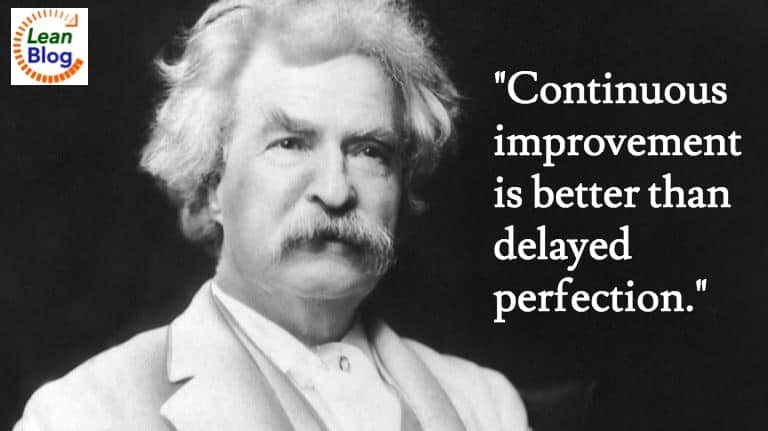
Continuous Improvement Is Better Than Delayed Perfection (A Mark Twain Lesson)
Most organizations say they want excellence.
Many say they're pursuing perfection.
But far fewer are willing to do what actually leads there: take imperfect action and improve continuously.
There's a powerful idea — often attributed to Mark Twain (Samuel Clemens) — that captures this tension beautifully:
“Continuous improvement is better than delayed perfection.”
If you work in Lean, healthcare, operations, or leadership — especially if you're trying to build a culture of continuous improvement — that sentence should stop you in your tracks.
Because the biggest barrier to improvement usually isn't lack of knowledge.
It's hesitation.
It's waiting.
It's trying to get it “just right” before doing anything at all.
And that's where continuous improvement wins.
A hat tip goes to Brian Buck for sharing this quote with me.
“Kaizen” is the Japanese word for “good change,” and it's usually used in the context of continuous improvement. See this Toyota web page about the term Kaizen, which says:
The philosophy of kaizen is one of Toyota's core values. It means ‘continuous improvement‘. No process can ever be declared perfect but it can always be improved.
Kaizen in practice means that all team members in all parts of the organisation are continuously looking for ways to improve operations, and people at every level in the company support this process of improvement.
Kaizen also requires the setting of clear objectives and targets. It is very much a matter of positive attitude, with the focus on what should be done rather than what can be done.
Many organizations, including those in healthcare, say they want a culture of continuous improvement. In reality, many fall short. The reality doesn't line up with the vision. They're far from perfect… which is understandable, as long as they are working on closing that gap between vision and reality.
Hear Mark read this post (Subscribe to the podcast series):
One chapter from the book Lean Thinking (an old book, at this point) is on perfection:

Neither Toyota nor any organization that practices Lean can be perfect. What matters is “the pursuit of perfection,” as the Lexus ad slogan says (being a part of Toyota, of course).
Womack and Jones wrote, in part, about “both approaches” to the pursuit of perfection — radical change (the Japanese word “kaikaku”) and incremental improvement (“kaizen”).

It's a relatively thin chapter — more philosophical than practical — but it reinforces an important idea: improvement is never finished.
There's nothing really actionable, except for the idea of improvement being good.
A 1996 Harvard Business Review article by Womack and Jones talks about how to “pursue perfection.”

Again, I think the key is the “pursue” part of the improvement journey.
Jeff Liker's book The Toyota Way covers the topic, saying the following (and citing Deming's influence):

“… strives for perfection…” again being the key goal.
Delayed Perfection
What does Twain mean by “delayed perfection?” I see and hear about behavior that illustrates this idea in hospitals all the time.
A team will sit and talk about an idea and possible solutions (instead of going to the gemba or workplace to see the problem and situation firsthand). But that's a different topic.
The team might talk and talk… meet and meet… without taking action.
There's either “analysis paralysis,” “fear of failure,” or something else that gets in the way of action.
Don't Be a Perfectionist About Aiming for Perfection
Being a perfectionist is sometimes our most significant barrier to perfection, if we're not willing to try new things… realizing that some of those new things won't work out well… short-term failures, but learning opportunities that we can learn from.
Here's what continuous improvement looks like in practice.
Let's say a team is working on the problem of hand hygiene compliance. As I discuss in Lean Hospitals, there's never just one root cause to a complex issue like this. Therefore, there's no single countermeasure that will “solve” the problem.
See this causal analysis I once coached a hospital through, asking why hand hygiene practices were not followed 100% of the time (click the image for a larger view).

A group might look and think that's discouraging… so many causes to address.
But a culture of continuous improvement would see the potential here. Brainstorming and testing various countermeasures might close the gap a little bit. There's no magic-bullet solution that will take us to perfection.
We have to keep working at it. That's Kaizen. That's continuous improvement.
The NICU at Franciscan St. Francis saw patient/family satisfaction scores increase from the 45th percentile to the 99th percentile. They achieved this through hundreds of Kaizen improvements over time.
Are they perfect? Of course not. Neither is Toyota. But those organizations that keep working toward perfection… while accepting they'll never be perfect… are the ones that will be more successful in the long run.
Continuous Improvement vs. Delayed Perfection: Why Action Wins
Delayed perfection feels responsible. It feels careful. It feels professional.
But in practice, it often means meetings without experiments, plans without pilots, and analysis without action.
Continuous improvement takes a different path. It favors small tests over long debates. It values learning over ego. And it understands that progress compounds — while perfection postpones.
Progress Beats Perfection — Every Time
Perfection is a direction, not a destination.
Organizations that wait for perfect solutions move slowly.
Organizations that test, learn, and adjust move forward.
Continuous improvement doesn't ignore quality. It accelerates it.
Every small experiment teaches something.
Every small adjustment builds capability.
Every small win creates momentum.
Perfection delayed is improvement denied.
The most successful Lean organizations understand this paradox:
You get closer to perfection by acting imperfectly — and improving continuously.
That's not recklessness.
That's discipline.
And that's why continuous improvement will always outperform delayed perfection.