
John Dyer on Working with W. Edwards Deming, the Facade of Management Commitment, and Firefighting in Healthcare
In this 2015 conversation, John Dyer reflects on his career at General Electric — including attending Dr. W. Edwards Deming's four-day seminar and a smaller follow-on course — and what happened when he took Deming's 14 Points back to GE executives for a scored discussion. John also shares what 24 hours in a hospital chair taught him about firefighting, broken processes behind barcode scanners, and the metrics that block improvement before it starts.

My guest for episode #229 is John Dyer, president of his consulting firm, JD&A, Inc., and a contributor for IndustryWeek.com. John started his career at General Electric and later moved to Ingersoll-Rand, where he was VP of Operations for their Security and Safety sector.
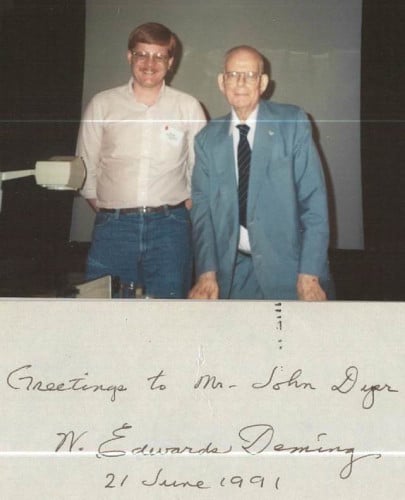
John had the good fortune to learn directly from W. Edwards Deming, as he took the famed four-day seminar (that included the Red Bead Experiment) and was also invited to take the follow on course with a smaller group. You'll also want to scroll down to see the great picture that he posted on Twitter of him and Dr. Deming.
Some of John's recent IW columns include:
- The Façade of Management Commitment — And Why It's So Destructive
- Why Your Improvement Efforts Aren't Driving Better Results: The Façade of Lean and Six Sigma
- Are You Caught in the Cost-Cutting Death Spiral?
Streaming Player (Run Time 45:48)

In the podcast, we talk about questions and topics including:
- Tell us about the early days of your career in manufacturing engineering and management… how did you get involved in operational excellence?
- While at GE, you had some experience with W. Edwards Deming, tell us about that…
- What are some of the key lessons from Dr. Deming that stick with you today?
- GE's CEO Jack Welch had once derided Deming as “too theoretical.” Was it that or did Deming's concrete suggestions just fly in the face of Jack's way?
- What did John recently witness when a relative was a hospital inpatient? How did that compared to some things Dr. Deming saw and reported as a patient in 1987?
For a link to this episode, refer people to www.leanblog.org/229.
For earlier episodes of my podcast, visit the main Podcast page, which includes information on how to subscribe via RSS, through Android apps, or via Apple Podcasts. You can also subscribe and listen via Stitcher.
Video of John Dyer
Podcast #229 — John Dyer on Working with W. Edwards Deming, the Facade of Management Commitment, and Firefighting in Healthcare
Recorded September 3, 2015, published September 10, 2015
Intro
Mark Graban: Hi, this is Mark Graban. Welcome to podcast number 229 for September 10th, 2015. My guest today is John Dyer. He's the president of his consulting firm, JD&A Inc., and he's a contributor for IndustryWeek.com.
John started his career at General Electric and later moved to Ingersoll Rand, where he was VP of Operations for their security and safety sector. Now, John had the good fortune to learn directly from W. Edwards Deming, as he took the famed four-day seminar that Dr. Deming did — that included things like the red bead experiment — and he was also invited to take the follow-on course with a smaller group.
There's a great picture John shared — if you go to leanblog.org/229, a picture of him with Dr. Deming in 1991, that includes a short handwritten note from Dr. Deming. So John has written some really interesting stuff for Industry Week. That's how we crossed paths. Recent columns include “The Facade of Management Commitment and Why It's So Destructive,” “Why Your Improvement Efforts Aren't Driving Better Results,” “The Facade of Lean and Six Sigma,” and “Are You Caught in the Cost-Cutting Death Spiral?” If you want links to those articles, again, go to leanblog.org/229. Thanks for listening.
John, thanks for being a guest here on the podcast today.
John Dyer: Thanks for having me.
Major Appliances and a Corporate Audit
Mark Graban: Can you start off, tell the listeners about some of the early days in your career in manufacturing, engineering, and management, and how you got involved in operational excellence?
John Dyer: Okay, well, my degree is actually in electrical engineering, with an emphasis on robotics, back in the mid-eighties. That's the field that I wanted to get into. But I ended up joining General Electric and got into their manufacturing management program, which is basically a two-year program with six-month assignments to learn different management styles and techniques and different functions.
But then I ended up at Major Appliances in Louisville, Kentucky, Building Five, top-mount refrigerators, as a process engineer on the shop floor. Actually started on second shift, was on second shift for about six months. Then moved to first, and ultimately ended up managing many of the process engineers that were in the building.
Throughout that time, the reason that I was asked to go to Major Appliances is they had just implemented a massive automation project, putting in several new production lines that were a mix of automation and manual labor, and they needed somebody to help them get the automated parts of the line up and running. So that really was my focus.
But things didn't go particularly well. In fact, after the project had been implemented, some research was done that showed that with all that investment, we were still experiencing some pretty major quality issues, and really weren't making much of a profit. In fact, in those days, I think we were losing some money.
Corporate ended up sending a corporate audit team in to do a thorough analysis of the plant, and they asked me to join that audit team. And so for six months we did a deep dive into how all the processes in the factory were performing. Now, remember, this is back before Lean and Six Sigma. Process mapping was just starting to be talked about. This was way in the early days.
Three Findings: Automated Junk, Resistant Employees, and 99% Firefighting
Mark Graban: Back in those days, there were a couple of different biases. One was this bias towards, well, we need to automate things. That was the big push in the Detroit automakers. General Motors, the CEO at the time, Roger Smith, really dreamed of something they called the Lights Out factory, which would literally have like no human employees. That was sort of their bleak vision of the future, as opposed to Toyota, that was working with their employees as partners instead of an annoyance or a cost.
That was really common at the time. I'm projecting a bit based on what was going on in GM. You were in GE.
John Dyer: Yeah, no, that's exactly right. That's the path that GE wanted to be on. And after doing this six-month study, we generated reams and reams of data, but really the findings boiled down to three things.
The first finding was that if you have broken processes and try to automate them, you still have broken processes. You're just basically able to make junk faster. But it's still junk.
The second finding was that they had done a poor job of getting the employees involved in all the changes. In fact, the employees greatly resisted a lot of the changes, a lot of the improvements. To the point where many were openly vocal about how they kind of hoped that the line would fail. Because they had no ownership or accountability for all the changes. So again, it showed how, by not getting the employees involved, there were great pushbacks.
I remember one night on second shift where we had a particular machine that was acting up, and myself and a few of the maintenance guys had been working on this machine and we were, you know, covered in sweat and dirt and just, for hours, trying to keep this machine going. And we finally got it running. We looked up and noticed that there was no product coming down the assembly line. We were like, gosh, what's going on here? We've been trying to keep the line running by getting this machine up and running.
So I started walking the conveyors back through the assembly areas, and there was one refrigerator stuck on the conveyor, and there must have been at least a dozen workers who could have very easily freed it up by just giving it a little bit of a push. Nobody offered to do that. Nobody lifted a hand. That kind of told me how much apathy there was to all these changes.
Mark Graban: Back in the GM culture, managers would have blamed those people. Those people don't care. Those people are lazy. Instead of looking and saying, well, why? What's wrong with our leadership and the culture and the environment we've created?
John Dyer: That's exactly right. They were good people, but they just felt like their hands were tied and they really had no interest in seeing the success of this line that they had no ownership for. It was definitely a management responsibility kind of thing. That's what we put in our report.
And then the third thing that we discovered was that there was no focus whatsoever on continuous improvement. Everything was on firefighting. We did a survey of the engineers in the plant, and it turned out that over 99% of their time was spent firefighting problems, and less than 1% was focused on permanently fixing, or doing continuous improvement type activities.
Building a Dedicated Improvement Team (Before There Was a Name for It)
That was a real eye-opener for the executives, and they asked that a team of dedicated resources be formed that would focus a hundred percent of their time on continuous improvement type activities. They asked me to lead that team. And as far as we knew at the time, there was really no other team quite like it, definitely within Major Appliances.
It was a struggle. Like I said, this was before a lot of the Lean and Six Sigma kinds of things. So we were having to make things up as we went. Even basic questions like, should we get employees from the shop floor involved on these teams? And we decided that yes, we definitely needed to get them involved. But back in the mid-eighties, that was a real controversial kind of discussion.
We had some successes with these initiatives. We also had some pretty major failures. I'll give you one quick example. We had one team that was focused on trying to improve the quality of the refrigerator, and we had about four shop floor folks on the team. Back in those days, the repair function was the highest-paid employee position on the line. After this team had met a few times, there was a real, real fear that spread throughout the factory that if the team was successful, there would be no need for repair people any longer and they would lose their job.
Mark Graban: That's threatening, yeah.
John Dyer: Yeah, exactly. They ended up almost rioting over it. They basically formed a big crowd after one of our meetings and started, you know, yelling. It was pretty scary stuff. So again, it just really emphasized the fact that if there's any fear whatsoever in these improvements, then not only are people not going to support them, they could even resist them and push back in a very heavy-handed way.
These were all great learnings, but we had enough successes to where the GE executives at the time said that there really is something to this whole continuous improvement kind of initiative, and we want to see this developed even more and spread throughout other factories.
Crotonville, Early Motorola Six Sigma, and a No Vote on Belts
They asked me to go into one of those kind of dream jobs where for two years they asked me to go around and collect best practices from other companies that were doing this continuous improvement thing pretty well, or at least getting started off well. So for two years I got to go to every division within GE. I got to spend some time up in Crotonville, New York, where the GE corporate training facility is. I got to go through the original Six Sigma training at Motorola University, well before there were any kind of belts given out for such things.
Mark Graban: Well, that's really shocking to people who are Six Sigma or Lean Sigma devotees. You mean you can learn and practice Six Sigma without the belts?
John Dyer: Yeah, exactly. Absolutely. Well, there's a whole nother story on that, maybe. Maybe that's a…
Mark Graban: Different podcast.
John Dyer: Yeah, exactly. Actually, I was involved in some of the discussions around whether GE should implement the belts or not. And I was actually a no vote in all of that. I was overridden, to say the least.
Seeing Deming at the Four-Day Seminar
And also during that time, I got to spend some time with Dr. Ed Deming. That was one of the highlights of my career. I got to go to a couple of different seminars that he gave. One that was four days in length, pretty famous seminar, it was a pretty large group, about 700 participants from what I remember. And it was crazy. He did the entire four days on his own, pretty much. At the time he was right around 90 years old, if you can imagine that.
But then I also got to go to a seminar that the four-day class was a prerequisite for, but it was a much smaller group. It was a two-day event, and I really got a chance during that time to spend some one-on-one time with him. That was fascinating. Learned a lot.
Mark Graban: What was Dr. Deming like? You know, we talk a lot about the different lessons he taught. I'm always fascinated. I've been able to do a couple of previous podcasts with some people who worked pretty closely with him. How would you describe Dr. Deming the man?
John Dyer: He clearly was adamant about his philosophies. He had experienced the successes in Japan with the implementation of a lot of his different management techniques and the different focuses on processes and getting employees involved. I really think that he was kind of surprised when he ran into a bit of a buzz saw when he came back to the U.S. to try to help U.S. manufacturing at that time implement some of the same types of philosophies.
14 Points, and the Executives Who Couldn't Hear Them
I remember, after going through the first four-day seminar, I went back and pulled together several of the top executives at GE and Major Appliances, and we went through Deming's 14 Points, one by one. Then I did a survey after we discussed each point — basically, on a scale of one to 10, how important do you think this point is? And then on a scale of one to 10, how well do you think we implemented that point?
It was not surprising, but I remember only one of the 14 points got a 10 on importance.
Mark Graban: Do you remember which that was?
John Dyer: Not specifically. I may be able to look back through my notes and find it. But I remember it was just one. Most of the 14 — over seven of the 14 — were down in the two to three range, meaning that the executives did not see any value in those points.
Some were pretty heated. We got into some really heated discussion about things like management by objectives. They absolutely did not agree with any of that. One of the points about not focusing on price when selecting suppliers, but looking at total cost — that did not sit well. Now, they've come a long way since then, obviously. Even in my time there at GE, they came a long way in their understanding and implementation of a lot of the points.
“Knowledge Without Theory Is a Waste of Time”
Mark Graban: I blogged about this recently. I discovered, in one of Jack Welch's books — I forget if it was Jack or if it was Straight from the Gut — but he talked about Dr. Deming, and he said something like, oh, there were some good ideas there, but it was too theoretical. I remember that jumped out at me. He said it was too theoretical. And I was like, well, I thought Dr. Deming was quite specific. Maybe the recommendations were just unwelcome. Like you said, management by objectives. That is still the norm in different organizations. It's a very radical idea, and it's easy to see where it could be rejected.
John Dyer: When I was looking back through some of the notes that I took recently from these seminars, it was interesting. One of the quotes was that knowledge without theory is kind of a waste of time. In other words, you can learn facts, but if you don't know what's behind those facts and really understand why that's important, then you could reach that kind of a conclusion.
On management by objectives, if you were to say, well, Dr. Deming says we should not measure people, and I don't believe that, then it'd be easy to discount. But if you really haven't taken the time to dig in and understand what's the theory behind that, why is that so important, then you can be kind of led astray.
“I Hope They Enjoyed the Flight”
One of the quotes — and I thought this was fascinating, and I'm paraphrasing it here — but basically Dr. Deming said in one of the classes that a lot of people have recently gone to Japan to try to copy what the Japanese companies have done, like Toyota. And he said that's all fine and good, but if they really don't take the time to understand the theory behind what they've done, then basically, I hope they enjoyed the flight over and back, because that's all they're going to get out of it.
Mark Graban: Well, I've seen a different version, or I think it's a related point. Dr. Deming said something like, people in America, they expect miracles, and they want to copy from Japan, but they don't know what to copy.
And we see a similar thing in healthcare here in the year 2015. Hospitals will go, whether it's to Japan or to visit a health system that's been practicing lean for 12 or 13 years, and the executives will go. Then when I see what they're doing or not doing afterwards, after that visit, I have that similar reaction. They copied a couple of things, but they don't really know what they should be copying.
One quick example is, well, you know, ThedaCare has these huddle boards, and we take pictures of the huddle board, and it's supposed to look an exact similar way. And like, no, it doesn't have to look that particular way. But they go and they'll install 75 or 80 boards throughout the hospital, and then nobody's having huddles. Nobody's really using them. Or they may just be posting the charts. Why? Oh, because management said we had to.
And in one of your earlier points about don't automate the waste — we still see, in recent years, hospital laboratories putting in all kinds of fancy automation, and they're automating the bad layout. Some of the hospitals have learned and have adjusted and realized we need to change the layout, not just automate it. But some of these situations really just sort of linger on, even in healthcare.
I know we were going to talk about healthcare. I don't know if you're ready to jump into it, or was there more you wanted to say about Dr. Deming and some of those experiences you had back then?
The CEO Who Got Told to Leave
John Dyer: Let me give you just one quick story. I highlight this in one of my Industry Week articles, a while ago. I think this really summarized for me Dr. Deming's commitment.
It was during the four-day seminar, and right before each break, they had an open-mic time where people could go up and ask Dr. Deming basically any question. This one gentleman walked up to the mic, and he was dressed in a really nice suit, and introduced himself as the CEO of a pretty good-sized company.
His question to Dr. Deming was — I remember this is mid-1980s, actually right around 1990 when this took place — but he asked Dr. Deming, he said, “Who are you to tell me how to run my company? What makes you think you know all of this stuff?”
Of course the crowd just went completely silent. Dr. Deming looked at the gentleman and said, “Sir, you clearly do not get this. It is clear to me that you'll never get this. I'm wasting your time and you're wasting my time. I think you should leave.”
The man turned beet red. I remember this like it happened yesterday. Man turned beet red, said real in a big huff, “I've never — ” and he just stormed out. And the entire place erupted in applause.
That really showed me how much commitment Dr. Deming had to these things. For me, early in my career, it left a huge impression.
24 Hours in a Hospital Chair
Mark Graban: It is easy to see why. Steering the conversation back to healthcare here — and for the listeners, I'm not putting John on the spot, we had planned to take the conversation in this direction. A lot of times, when I'm working with hospitals on lean, people will raise their hand kind of sheepishly and say they've heard of Dr. Deming and they might know a little bit about Plan Do Study Adjust cycles, or they'll call it PDCA. But the hospitals generally are not managed under a Deming philosophy.
When you do the red bead experiment and you see the impact of the variation that you can have in a stable, consistent system, and why it's sometimes unfair to blame the workers for quote-unquote poor performance — people make connections to that in healthcare, and they look and say, well, if we're all doing things sort of the same way in different hospitals, some of the things that we get in trouble for — infections, patient falls, readmissions to some extent — those are red beads. There's variation where people get labeled as a bad nurse or as a bad hospital when, all in all, it's kind of part of the same system.
So the Deming message, I don't think is really too widely embraced in healthcare. Let me bring it back to you and ask you to share what you can, what you're willing to, about some of your recent observations in a hospital.
John Dyer: I mentioned to Mark that just this past week I had the opportunity to spend 24 hours in a hospital because I was with a patient there, in a support role, as this patient was recovering. And I'm sure Mark has experienced this as well — when you've been in the process improvement business for as long as we have, it's both a blessing and a curse. The curse being that you can't help but analyze all the different processes, especially if you're sitting in a chair and the patient is sleeping and you really have not much better things to do.
So I had the opportunity to analyze some of the processes at this particular hospital. Let me couch my sayings: first, the care was terrific. In fact, they probably saved the life of the patient that I was there visiting. The staff was super nice. Most of them would go out of their way to help. So it wasn't a people issue, it wasn't a medical-related issue. But it still amazed me how many of the processes were either broken or still very antiquated.
Three Wrong Meals, and the Barcode That Doesn't Matter
To give one quick example: in the 24 hours that I was there, the patient had four meals brought to them, and three of the four meals were wrong. Had wrong items, not what was ordered. And in fact, one of the meals included an item that was specifically banned by the doctor to eat.
What fascinated me about this was that they really went overboard in making sure the patient was who they said they were. They would scan a barcode on the wristband. They would ask the patient the name and birthdate before serving the food. So it was like, okay, we really have focused on the part of the process to make sure that the patient is who they say they are — kind of overboard in a way. You would think, hey, once I scan the barcode on the wristband, that should be good enough, unless we expect that patient to exchange wristbands with other patients.
So they'd really gone overboard on that part of the process, and yet served the wrong food. Clearly there were other parts of the process that were still majorly broken.
In a hospital environment, they may not really think too much about, well, do we really need to focus on fixing food services, because that really doesn't have anything to do with drawing blood or x-rays or hospital kinds of things. But if the patient gets served the wrong food, it could be very detrimental to their recovery.
Mark Graban: Yeah, and the nutrition services people realize that, and they realize there's a big clinical component to what they do. My grandfather was in his early nineties, was in the hospital a good amount last year, and similar thing — wrong food, bringing things that he was allergic to or wasn't allowed to be having. Just repetitive error upon error.
I think what's not happening is people looking at the whole end-to-end process. Sometimes there's too much faith put into technology. Well, we do this barcode scanning, and we're scanning the medication, the bag that it's in, and the patient. But if upstream the wrong medication got into that bag, you've got a situation where you're scanning the correct barcode to the correct patient and you're just confirming the error. You're not preventing the error.
One of the things that stands out to me in reviewing Dr. Deming's work is the need to think systemically. Break down silos. A lot of this technology gets implemented within one silo, instead of looking at what we'd call a value stream in lean, or you could just think of it as the system. That's, I think, where hospitals often fall down.
Silos and the Patient Who Can't Sleep
John Dyer: It's funny you mentioned that. I've actually written an article on silos. Picture this. So here we are, middle of the night, trying to get some sleep. At 11:30 one person came in to do some medication. At two o'clock the IV bag ran dry and the machine started beeping, so they had to replace the IV bag. At 2:30, the other IV bag ran out and the machine started beeping, so they had to replace that one.
Of course I'm sitting there thinking, while I'm losing sleep here, gosh, why didn't they just replace both IV bags when the first guy came in to do the medication? If they knew it was not going to last all night, why not do that?
Mark Graban: Well, there's the firefighting again, right?
John Dyer: Exactly. Just being reactive. But anyway, then at three o'clock the person came in to draw blood. Had to turn the lights on, do all that. At four o'clock, the person came in to do the vitals. At five o'clock a person came in to do some more medication. So it was almost every hour a different department came in to do something with the patient. It just kind of went through my mind — I doubt there had been any effort to coordinate any of these different departments, so that you sit there and go, hey, let's interrupt the patient just once during the middle of the night and get it all done that one time. And then that way the patient can actually get some sleep.
Mark Graban: That would be a great example of this buzzword people talk about, quote-unquote patient-centered care. In a way it's kind of funny, like, well, what else would it be, right, if not patient centered. But you're right, it's work centered. It's department centered.
I've worked with a lot of hospitals where it was kind of taken as a given that, oh, we have to go wake the patient at 4:00 AM to collect blood. Like, well, why do you have to do it at 4:00 AM? Well, we have to get the test results on the chart by 7:00 AM, when the doctors do rounding. Well, why does it take three hours to get the lab results back when the test only actually takes 10 minutes to do? Then people start realizing, huh, we can actually improve the system. We can improve the value stream. Now we could come in and draw the blood at six, and the patient may be already awake. So some of it is just being willing to step back and challenge the way it's always been.
I'm sure for you sitting in that chair, it's all new to you. You're actually observing the work in a way that a lot of people just don't have the luxury of doing, because they're so busy and they're fighting fires.
VIP Care and the View from the Corner of the Nurse's Station
John Dyer: That's what I was kind of thinking. It'd be interesting for every hospital to get some administrator-type position to spend a night as a patient in their hospital, and just experience what a typical night might be like.
Mark Graban: There are a lot of examples where people have had that wake-up call because they've actually been thrust into that role of patient. There's a risk though — in some hospitals they have what they call VIP care, and the CEO, everyone knows it's the CEO, and what they experience might not be any more representative than it was representative for General Motors executives. They never drove a car with a quality problem. They were very much in this kind of artificial VIP system and had hand-selected vehicles, and they weren't experiencing what you or I, somebody would have experienced as a customer.
To your point though, what I've seen be very powerful is to go with an executive and even just park, just stand in the corner of a nurse's station for like 30 minutes and just observe the chaos. They never had an appreciation for that before.
John Dyer: I agree. It takes those kinds of things to wake up the need to change. Change is difficult, and the first step for making improvement, which is change, is to admit that you need to change. I feel very strongly about that. If there's not a recognition that something's broken, then nothing will ever get fixed.
The Nurse as Firefighter
One other quick comment on all that. Kind of taking this to a lean perspective, the nurse was superb in our situation last week. It was amazing to me how often the nurse got involved with firefighting problems that had occurred because of other issues. So, like in my example of the three meals being wrong, in each case the nurse had to get involved and basically track down the proper food in order to give the patient something to eat.
It just kind of hit me that the nurse in a hospital has got to be viewed as one of the most important resources. And anytime they're firefighting, that's non-value-added time. If they get caught in too many firefights, then the quality of care for the patient drops considerably. Somebody might look at this and say, well, okay, we got something wrong with the food services, that's no big deal, it's not that important. But not realizing that the ramifications of that one error multiplies manyfold as other resources have to get involved to correct the situation, which then takes them away from doing the things that they're being paid to do.
The Psychology of Heroism
Mark Graban: Yeah. In other settings, part of the catch is that oftentimes people doing the firefighting feel a sense of pride in that. They feel like they're going above and beyond. They're being a hero. What they're doing is necessary and important. But it's not quote-unquote value added from a patient standpoint, and it's maybe not necessarily the best use of that nurse's time.
That, I think, is part of the psychology of why it's hard to get that up. Earlier you told the story about the repair people who felt like they were going to be out of a job.
John Dyer: Yeah, the repair people. Right.
Mark Graban: Sometimes in healthcare, when you talk about improving systems and eliminating the firefighting, even if people don't feel like they're going to literally lose their job, they still have a sense of loss that, well, I'm no longer going to get pats on the back because I jumped through those hoops and put that fire out. So I think that's on leadership to sort of redefine what people get pats on the back for. It's very rare when someone gets a pat on the back for having prevented a problem. A lot of times management's not aware that they prevented the problem.
The Facade of Management Commitment
John Dyer: Exactly. I actually, one of my Industry Week articles is all about that phenomenon. And that's exactly right. We talk about the need for management commitment, and management commitment is a lot deeper than just providing dollars for training or hiring a few resources. It's changing the way they act all the time. Every minute of the day.
That's a great example there. If a leader of the hospital goes to that nurse and says, “Wow, thank you for putting that fire out, because that really saved our reputation, and man alive, that was a great job,” well, that now reinforces to that nurse that that's what they need to do in order to get recognized. Versus, like you said, the hospital executive saying, “Thank you for putting that fire out. Now what are we going to do to make sure it never happens again?” And that per resource, whoever comes up with that idea, that's the one that we'll recognize as employee of the month.
Idea of the Month (and a Note from the Board)
Mark Graban: Dr. Deming might have chuckled at this if he was still with us today, but you talk about employee of the month, or these different recognitions that are given. I think he used the term “lottery” — that sometimes these things are just a lottery.
But there was a hospital where, to their credit, they were using these huddle boards. They were soliciting staff ideas. They had them posted. They were working on them. Then I think at some point along the way, the unit manager, I think well-intended, decided to select an idea of the month, and they were giving an idea of the month recognition.
And I swear, one of the improvement ideas that had been tacked up on the board — because I like to pick and choose and read and take a sampling of what's up there — somebody had written down: “Please stop doing the idea of the month, because it upsets people who don't get selected, and it damages morale.” Or something like that.
John Dyer: That's very true.
Mark Graban: I don't know if that idea is going to be listened to, but I think there's something to be said for that.
When the Metric Blocks the Improvement
John Dyer: The way we measure our employees is so critically important. I totally agree that you've got to look at the ramifications of everything like that.
I'll give you one example on that. There was a service shop that I worked with, and we did the training, the lean training, and the employees were really getting into it, really liked the training. The leader of the service shop came up to me afterwards and said, “John, this is really great stuff, really enjoyed it, but we're not going to implement any of these improvement ideas.”
I was like, well, why? He said, “Well, my number one measurement is employee utilization. And if we improve these processes, all of a sudden my employees may not be fully utilized, and then my main metric is going to suffer. My pay is based on that.”
In fact, he even said this. He said, “I would rather get orders out late if that means that all my employees are fully utilized, because that's what I'm measured to the most.”
So how we measure people, how we measure things, have consequences. That needs to be thoroughly looked at.
Close
Mark Graban: To your story, people, they know they're doing things that aren't the right thing for the overall system. They know they're sub-optimizing. But I think they feel like, well, hey, what am I supposed to do? I had a hospital director admit once in a meeting that they knew they were doing things that were suboptimal, but all of their rewards and incentives were based on departmental measures. And they had a good point. Don't put people in a position where they're going to hurt their own compensation for doing the right thing.
I mean, these are system issues that people often don't speak up about. But even if they do speak up, people say, look, yeah, this is the way it is. We have to do annual performance reviews, you have to have a budget, you have to measure against targets, blah, blah, blah. These things are so taken for granted.
With that story, we'll go ahead and wrap up for today. John, maybe we can do another podcast in the future talking about some of the more current things you're observing in the worlds of lean and Six Sigma. As we wrap up, and you mentioned your Industry Week columns, how can people find you online if they want to read some of the good stuff you've been writing?
John Dyer: All right. If they want to follow me on Twitter, it's @JohnDyerPI — J-O-H-N-D-Y-E-R-P-I, all one word. You've got to add the PI on the end.
Mark Graban: That's not for private investigator, I'm thinking. Magnum PI.
John Dyer: Yeah. John Dyer PI. You'd be amazed at how many John Dyers there are out there. So you've got to include the PI on the end. And then if they're interested in reading my Industry Week articles, they can go to industryweek.com/author/john-dyer, and they'll get to my column.
Mark Graban: Okay. I'll put a link to that in the show notes for those of you who go to the blog post for this page, the URL that I announced at the top of the episode. Well, John, it's been great talking to you. For the listeners who don't realize, John and I had a really long initial conversation some while ago. We could talk about this stuff all afternoon, but for now, I think we'll have to call it a podcast. So John, thank you for taking time to chat today and being my guest.
John Dyer: I appreciate it, Mark.