
Julie Firman, a CNO’s Role in Lean Transformation

Joining me for Episode #281 of the podcast is Julie Firman, DNP, RN, FACHE, the Vice President/ System Chief Nursing Officer (CNO) at Southern Illinois Healthcare.
We have the opportunity to chat about the Lean transformation efforts at SIH thanks to my partners at Catalysis, as they are presenting the annual Lean Healthcare Transformation Summit this year in Palm Springs, June 7 and 8.
Julie and I will both be there and I'll be doing a full-day workshop called “Better Metrics.” Come join us!
In today's episode, we talk about how Lean has been helpful to nurses (and other healthcare professionals), Julie's role as a nurse leader, and different ways patients and the health system have benefitted.
Streaming Player (Run Time 44:59)

For a link to this episode, refer people to www.leanblog.org/281.
For earlier episodes of my podcast, visit the main Podcast page, which includes information on how to subscribe via RSS, through Android apps, or via Apple Podcasts. You can also subscribe and listen via Stitcher.
Topics and Questions in the Episode
- Introduce yourself and your professional background
- Tell us about Southern Illinois Healthcare and the system's Lean journey
- How did you personally get introduced to Lean?
- What role do you play as CNO in helping lead the Lean efforts?
- How do you explain the benefit of Lean to nurses?
- What improvements have you seen related to Lean for nurses, patients, etc.?
- What are some of your biggest challenges?
- Why it's important to share and spread improvements
- Why staff participation is so necessary
- Improving safety and quality
- The book On the Mend by Toussaint and Gerard
- Why Lean Daily Management was their first step and how nurses led the way with Patient Care Improvement Boards
- What are “just do it huddles” and how does that compare to deep-dive problem solving?
PDF Episode Summary
You can read a PDF summary of this post, below:
- Low-res PDF (for reading on screen)
- High-res PDF (for printing)

You can also read a summary article about the podcast on LinkedIn.
Thanks for reading and listening!
Quotes to Share
Click any image for a larger view…



Follow the Lean Blog Interviews podcast
Since 2006, I've been talking with leaders, authors, and practitioners about how Lean thinking works in the real world, in healthcare, manufacturing, and beyond. Follow the show so you don't miss new episodes.
Full Episode Summary
This summary was originally published as a PDF in May 2017. The text below is from that PDF.
Jump to a section:
- Getting Started With Lean at SIH
- Learning From Other Organizations
- Why Nurses Embraced Improvement Boards
- Lean Daily Management
- Daily Huddles and Gemba Walks
- Results From Frontline Improvements
- Why Frontline Ownership Sustains Change
- Connecting Strategy to the Bedside
- Model Cells
- A New Way to Do Work
Julie Firman, DNP, RN, FACHE joined me to give listeners a look at Lean transformation from a nursing leadership perspective in episode 281 of the Lean Blog Podcast.
Julie is the Vice President and System Chief Nursing Officer (CNO) for Southern Illinois Healthcare (SIH). In her position, she has system responsibility for all of nursing, case management, perioperative services (care of patients before, during, and after operation), and the patient experience.
Getting Started With Lean at SIH
Though Julie had some initial contact with Lean thinking around 2005 in an organization that used the General Electric (GE) change management model, it wasn't until after her first year at SIH that Lean work began there.
“In probably 2011, our CEO Rex Budde introduced the senior leadership team to the book On the Mend by John Toussaint, and as a team we read the book and then we discussed the concepts and began to visualize how this type of transformation might work in our organization. Our organization has a mission of improving the health and wellbeing of all the people in the communities we serve so finding a better way to deliver safe, quality healthcare was really important to all of us,” Julie said.
Speaking about the challenge of approaching Lean from a nursing prospective, Julie explained that she first had to start thinking about it in a new way.
“First of all, it was really a pause to think about how does this impact patient care, where we're dealing with people and not widgets. And one of the things I really had to embrace, and one of the things I try to get my team to embrace, is it's not just one more thing. Rather, it's a new way to do work that improves the care we deliver to our patients,” she said.
Learning From Other Organizations
SIH began their Lean journey by taking several field trips to other organizations using Lean, including ThedaCare and one of the Barnes-Jewish St. Peters (BJC) Hospitals in St. Peters, Missouri. Those trips cemented the idea that this was something SIH wanted to do.
The next step was to work with an organization, Next Level Partners, to help guide leaders and staff about Lean healthcare.
“But more importantly, they taught our leaders to teach others about Lean healthcare,” Julie said. “Our first major step into Lean was embracing and launching Lean daily management. So, we, as a senior team, strategically decided where we would go up first with our Lean boards, and we call them ‘patient care improvement boards' here at SIH. And I am proud to tell you that nursing lead the way on this initiative. My team embraced it and across the system nursing units were the first ones to put up their patient care improvement boards.”
Why Nurses Embraced Improvement Boards
Julie attributes this enthusiasm for improvement boards to a need for solutions.
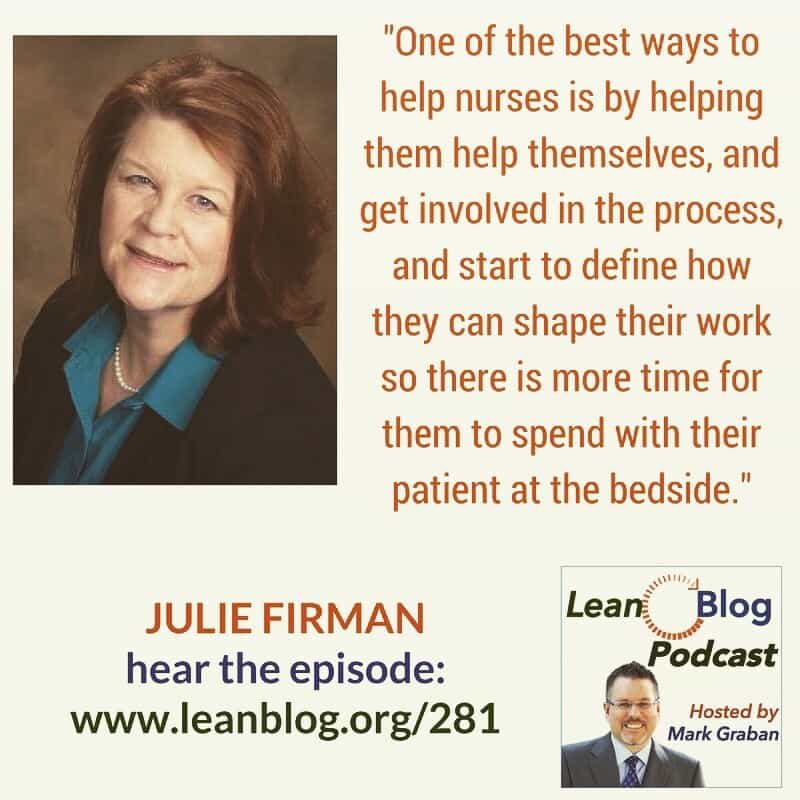
“I think the opportunity to understand what the benefits could be if we started to look at our processes and standardize workflows. I don't know how many times you could walk up onto a nursing unit and hear the nurses complain, not that nurses complain, but say how busy they are,” Julie said. “So, as a nursing leader, of course you want to help them, and one of the best ways to help them is by helping them help themselves, and get involved in the process, and start to define how they can shape their work so there is more time for them to spend with their patient at the bedside.”
Lean Daily Management
The concept of Lean daily management has been a hot topic in the past couple of years. I noted that in several recent episodes of the Lean Blog Podcast my guests have spoken about it, including:
In episode 260 Brad White, spoke about his book Lean Daily Management for Healthcare
In episode 249 Steve Leuschel, talked with me about his book Lean Culture Change: Using a Daily Management System
In episode 226 both Steve Hoeft and Dr. Robert Pryor joined me following the publication of their book The Power of Ideas to Transform Healthcare: Engaging Staff by Building Daily Lean Management Systems
Daily Huddles and Gemba Walks
For SIH, Julie explained that management makes daily visits to these patient care improvement boards, which include metrics on staff identified projects, strategic deployment process priorities, as well as Key Performance Indicators (KPIs) that need be kept at the top of the mind for everyone.
“Most boards have five measures that they're working on at any given time. Our leaders start their day with a startup huddle with each of their shifts – we work 12 hour shifts, so there's two startup huddles a day, one at 7 am and one at 7pm – they set the team up for the day so everybody understands what the initiatives are for the day and how we can all work together to make the team successful,” she explained. “Then daily they have what we call ‘just do it huddle.' That's where they really do that deep-dive into problem solving. They pick one of their metrics that they're really trying to work on and they do a deep dive, and everyone gets involved in that problem-solving process. At the end, it's recorded on the board and the one-ups and senior leaders come through for the daily gemba walk, they're able to speak to the improvement that they've been doing or what they've discovered and they may even tell us as senior leaders, what barriers they're running into, and how we can help them better the process.
“So, it's really organic, it changes every day, and, at the end of the day, the visuals on the board really show everyone where we've been and where we're headed.”
One thing management has found helpful is to outline for staff the wins they have helped management make.
“We encourage our employees to put in suggestion slips on things that they would like to see improved and/or how they would like to see them improved, and as we are able to meet the challenges that they've given us, we put them up for everyone to see look what we did, look what you did as a team. Just keep it moving forward and keep them thinking about doing it better, not perfect,” Julie said. “At the end of the day, there's a patient on the receiving end of all the good work that we're doing. And I always remind my staff that the patient that they care for could be their neighbor, their family member, even a spouse, so we want our processes to be good because you never know who's going to be in that bed.”
Results From Frontline Improvements
Since beginning to capture and record Lean activities, over 160 improvement events were conducted at SIH. Julie gave a few examples of activities, including what they call a “three in ten process.”
“As it relates to patient safety and gaining efficiency, one of our inpatient teams developed what we call a ‘three in ten process,' where a patient who needs insulin receives it at the correct time, which is just prior to their meal. The process includes coordination of the glycosometer check, the insulin dosing, and then the meal tray delivery to reduce the number of hypoglycemic events on a unit or across the system. Since we implemented the process, we had a great plan for spread, so all inpatient units system-wide are doing it, and we have seen a significant drop in the number of hypoglycemic events our patients are experiencing.”
Another improvement in the area of pre-anesthesia involved redesigning patient flow to save patients time and steps in process.
“A multidisciplinary team came together and worked on a process that allowed the patient to bypass registration and go directly to the pre-anesthesia testing area. During that visit, EKGs were done and labs were drawn to prevent these patients from having to make extra trips to those departments. So, it has really improved the efficiencies for our patients, but we're able to get more patients through in a better amount of time just by concentrating on how we delivered that care.”
Why Frontline Ownership Sustains Change
Julie stressed how important it is that those doing the work are ones who are redesigning the processes.
“That is what helps make it sustainable, is that it's them deciding what works best and it's not being pushed from the top down,” she said. “A top-down approach it may work for a matter of time. While you're watching, it may work. But, then when that's not the improvement that you're watching as closely, people have a tendency to slide back to their old ways. But, if you can go slow and have the people who are actually doing the work involved, it really does help with spread and sustainment because they see what's in it for them and they want to do it.”
Connecting Strategy to the Bedside
For the executive team, Lean has been helpful in terms of prioritizing and developing strategy at high level.
“I think our strategic deployment process that we've adopted, it all flows, it's all aligned all the way down to our Lean daily management boards. We set our strategic initiatives, and then we set what our targets to improve are going to be for the year, and then create action plans around those targets. And the action plans are those things that happen at the point of care, or the point of impact, if you will. So, that really does go down to where the patient is being cared for; that's where you start getting the staff involved in what we're trying to do as an organization from a strategic standpoint, and then it's measured by metrics on the board, which are then measured by we have what we call a nursing dashboard, and then the nursing dashboard feeds into the greater organizational dashboard that we review as senior leaders on a monthly basis. So, it all fits together. It's all really seamless back-and-forth, in my mind.”
Model Cells
One project Julie is currently working on as a greater nursing team that they're really excited about is “model cells,” or pilot environments. Julie and the executive team encountered a model cell area at ThedaCare and then launched first model cell here at SIH in the fall of 2016.
“We are working on creating a model cell in our community hospital in Herrin this year. Also, our medical group has embraced that concept and they are working to create a model cell in the SIH medical group. So, I think those are very exciting and the vision is when we have model cells, this will be the perfect place to onboard new employees, and make sure everybody's learning the same things, the right way, the first time,” she explained. “I think spread is always kind of a challenge, and what we've learned is that if we invite others in our own organization to come and experience it, to see it, and to learn about it, as opposed to just hearing about it, it has been really beneficial to us.”
A New Way to Do Work
To wrap up, Julie reemphasized that Lean is not just one more thing to add to the list of tasks for staff and management, but it's a new way to do work.
“In nursing, we have a tendency to perform some counterproductive behaviors, such things as developing workarounds for processes that aren't working for us, so you have ten people doing it ten different ways. And for our nursing leaders, they often feel like they have to rush in and rescue or fix. So, in a Lean environment, those that are closest to the bedside identify and work on solutions to the problems that they identify, and then a work unit can collectively deal with an issue and develop an sop to help eliminate the workarounds. As for the nurse leaders, I think it's really important that they see they're not the ones who have to expend all their energy trying to fix something, instead they empower the staff to do the work, and leaders support them by removing obstacles and helping them be successful.”
If you would like to hear Julie speak more about Lean transformation in nursing, she will be co-leading session especially for CNOs and nurse executives on how a Lean transformation impacts nursing at the 2017 Lean Healthcare Transformation Summit. The summit, hosted by Catalysis and the Lean Enterprise Institute, will be held June 7-8, 2017 at the JW Marriott Desert Springs Resort & Spa in Palms Springs, California.