
Highlights From Five Conversations With Karen Martin
Karen Martin has been on my Lean podcast five times over 12 years, talking through clarity, value stream mapping, whether Lean is dead, and mistake-proofing. For the 20th anniversary series, here are some of the moments from those conversations that stand out.
My friend and colleague Karen Martin has been on the podcast five times. First, in 2012, talking about The Outstanding Organization. Most recently, in 2024, talking about mistake proofing. In between: value stream mapping, a debate about whether Lean is dead, and a whole book about clarity.
That's twelve years of conversation with one person, which is long enough to watch someone's thinking continue evolving in real time. So for the 20th anniversary series, I pulled together some of what stood out across those five episodes and put the audio in one place. You can hear it in the audio player up above.
The Four Behaviors, and Why Engagement Comes Last
Back in 2012, Karen was talking about her book The Outstanding Organization, built around four behaviors she said showed up in every excellent organization she studied: clarity, focus, discipline, and full engagement.
What I remember from that conversation is her answer when I asked which one mattered most. She didn't pick. Instead, she said engagement isn't really a condition you can create directly. It's the result of getting the other three right. You can't force people to be engaged. They respond to what they're actually experiencing at work.
That's stuck with me longer than most frameworks do, mostly because it explains why so many engagement initiatives fail. You can't survey your way to it. You have to build the conditions that make it possible.
Strategic, Not Tactical
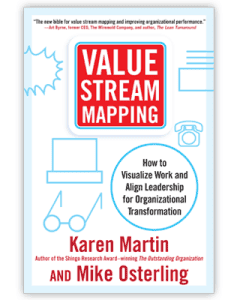
By 2014, when Karen came back to talk about her book on Value Stream Mapping, she made a point I still bring up with clients: value stream maps done at too low a level in the organization become wallpaper. Beautifully designed, proudly displayed, and never executed.
Her argument was that mapping needs directors and above in the room, not because frontline staff don't understand the work, but because the future state design often requires decisions nobody at a lower level has the authority to make. Merge two departments. Remove a step entirely. Someone has to own that call, and it can't be the person who mapped it if that person can't act on what they found.
Is Lean Dead?
The 2017 episode had the most provocative title of the bunch. Karen had noticed a wave of social media commentary declaring Lean over, replaced, or fading. Her answer, more or less: no, but there's a pattern she called the camel effect, where an organization gets real traction, a champion leaves, the momentum dies, someone new arrives, and it starts again.
She didn't think that pattern meant the methodology had failed. She thought it meant most declarations of failure came from people who tried it once, got a mediocre result because of how it was executed, and generalized from a single data point. A criticism I've made about outcome bias in other contexts, and one she made just as directly here.
Ambiguity Is Manmade
The Clarity First conversation in 2018 is the one I go back to most. Karen drew a distinction I hadn't heard framed quite that way before: ambiguity and uncertainty are not the same thing. Uncertainty is real. It's everywhere, and it isn't going away. Ambiguity, in her words, is manmade, and it needs to be gotten rid of.
Her theory for why leaders sometimes tolerate ambiguity, even prefer it, is worth thinking about with even if the phrase itself is banned from this blog. Living in a foggy state lets you avoid the pain of knowing the truth and not being able to act on it yet. Clarity forces the issue. Ambiguity gives you an out.
I think about that every time I see a job description asking for someone “comfortable with ambiguity.” Maybe what they actually want is someone comfortable with uncertainty, and nobody has bothered to make the distinction.
Don't Make Junk, Don't Accept Junk, Don't Pass Junk On
The most recent conversation, from 2024, covered a course we built together on mistake proofing. Karen's framing for quality at the source was three short rules:
- don't make junk,
- don't accept junk,
- don't pass junk on.
Simple enough to repeat from memory, which might be the point.
She also raised something I hadn't considered directly: final inspection can create a kind of psychological relaxation in the middle of a process, because people know someone downstream will catch what they miss. She noticed it in her own writing, with her own editor. The fix isn't removing the final check. It's making sure the culture in between still treats quality as everyone's job, not just the last person's.
Five Times
Somewhere in the 2024 episode, I joked that five-time guests on Saturday Night Live get a special jacket, and Karen should get one too. She said she'd rather have my zero hat, the one from the Patient Safety Movement Foundation. I didn't have a jacket to offer, so we left it there.
Twelve years of conversations with one person is its own kind of case study in how ideas mature. Which of Karen's threads feels most unfinished to you: the clarity work, the value stream strategy question, or the quality at the source piece?