What Deming and Fujio Cho Agreed On: Stop Demotivating People
TL;DR: Deming and Toyota's Fujio Cho asked the same uncomfortable question: why do management systems destroy motivation in people who started out wanting to do good work? The answer points to practices leaders can actually change.

When leaders talk about motivation, the conversation often turns quickly to incentives, engagement programs, or perks.
W. Edwards Deming and Toyota Chairman Fujio Cho came from different worlds and different eras.
Neither of them spent much time asking,
“How do we motivate people?”
They asked a different question.
Why do people lose motivation in the first place?
Deming's Question Was Never About Motivation Techniques
Deming was blunt about this. He argued that most people start their careers with intrinsic motivation, curiosity, and pride in workmanship. The problem, in his view, was not a lack of motivation. It was the steady erosion of it.
Toyota Chairman Fujio Cho made the same point–plainly and without jargon–in a 1993 talk to U.S. manufacturers:
“We do not motivate people. People are born motivated. Our job is not to demotivate them.”
That sentence could be mistaken for a Deming quote. It isn't. But that's precisely the point.
Deming and Cho were asking the same question, from different directions:
Why do capable, well-intentioned people become disengaged–and what role does management play in that?
Deming spent decades diagnosing the problem. Cho described how Toyota tried to avoid creating it in the first place.
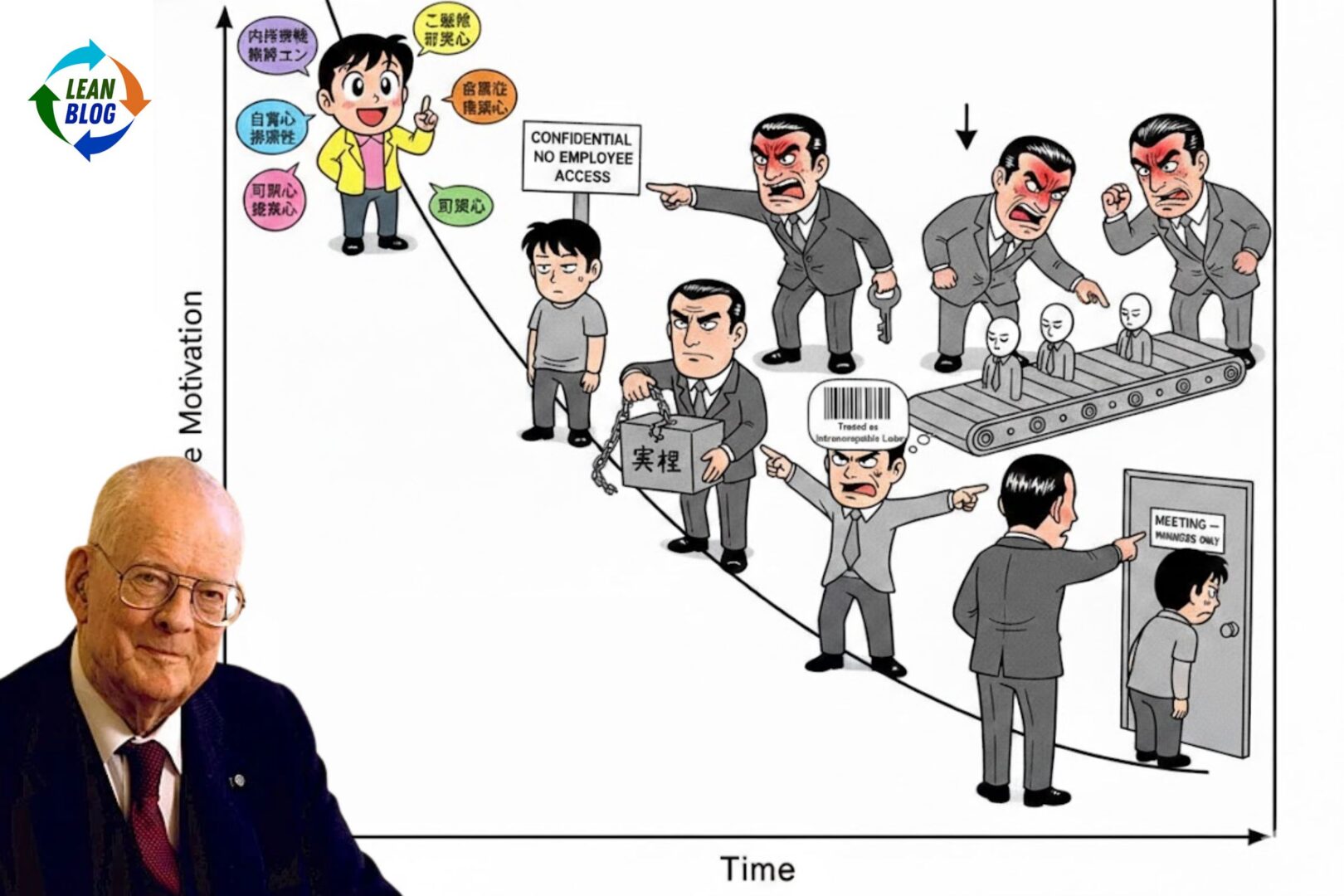
Over time, management systems replace intrinsic motivation with fear, self-protection, and extrinsic rewards. Rankings, merit pay, numerical targets without methods, and competition between people do not add motivation. They crowd it out.
Deming used this illustration:

Deming once said we should “mourn” what organizations destroy over time: dignity, joy in learning, cooperation, and pride. That is a strong word, but an intentional one.
You cannot bribe your way back to what the system has crushed.
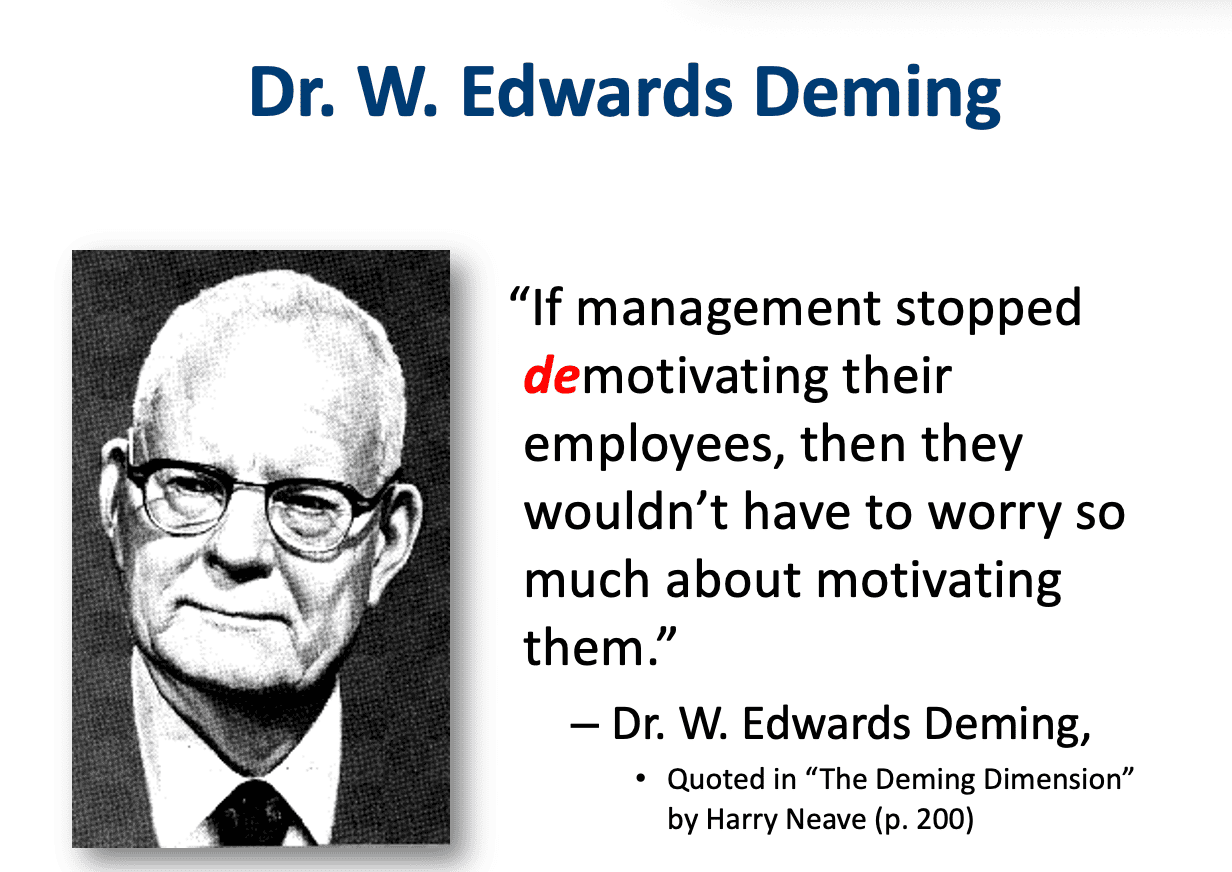
I often use this slide in talks and training sessions:
Here's an illustrated version of the forces of destruction chart:
Fujio Cho Made the Same Point, More Quietly
Decades later, Fujio Cho made a remarkably similar argument, though in a different setting and with a different tone.
In a 1993 speech to manufacturing leaders, Cho explained that Toyota did not view motivation as something leaders inject into people. He described it as something leaders too often remove.
He listed reasons people lose motivation, including:
- being excluded from decisions
- not being trusted with information
- being given responsibility without authority
- being treated as interchangeable labor rather than capable problem solvers
That list could have come straight out of a Deming seminar.
Cho did not frame this as a cultural problem or a generational issue. He framed it as a management system problem.
Stop Demotivating Is Not a Slogan
What I appreciate about both Deming and Cho is that neither offered a motivational slogan to replace the old ones.
They did not say, “Be more careful,” or “Try harder,” or “Be engaged.”
They pointed directly at management practices.
If you rank people, some will lose.
If you pit departments against each other, cooperation suffers.
If you set targets without improving the system, people will game the numbers.
If you ignore ideas from the front line, people stop offering them.
None of that is mysterious. It is predictable.
From that perspective, disengagement is not a personal failure. It is a rational response.
A Question Worth Asking Today
When leaders say, ‘Our people are unmotivated,' Deming and Cho would likely respond with a question, not advice — because motivation is an outcome of system design, not an input leaders can inject.
The question:
Why?
And they'd keep asking it.
What in the system is teaching people to protect themselves instead of improving?
That question is harder than launching a motivation program. It requires leaders to examine their own practices, incentives, and responses to problems.
But it is also more hopeful.
Because if motivation is being destroyed by the system, then it can be protected by changing the system.
And that work, as both Deming and Cho showed, begins not with motivation techniques, but with respect for people and a willingness to learn.
Author's note: The Fujio Cho quote is from a 1993 talk to U.S. manufacturers; I've had the source document for years, originally shared with me by a former Toyota person.
Scanned PDF of the Document:
With my underlining and markup:
What Leaders Ask — and What Deming and Cho Would Say
Did W. Edwards Deming believe leaders should motivate employees?
No. Deming argued that people begin their careers with intrinsic motivation and pride in their work. The problem, in his view, was not a lack of motivation but the gradual erosion of it by management practices — including rankings, merit pay, numerical targets without methods, and internal competition.
What did Fujio Cho say about motivation?
In a 1993 speech to U.S. manufacturers, Toyota Chairman Fujio Cho said: “We do not motivate people. People are born motivated. Our job is not to demotivate them.” He identified specific management behaviors — excluding people from decisions, withholding information, giving responsibility without authority — as the primary causes of lost motivation.
What is Deming's “forces of destruction” concept?
Deming used the term “forces of destruction” to describe management practices that erode intrinsic motivation over time — including grades, rankings, performance appraisals, and systems that pit people against each other. He argued these forces systematically undermine dignity, cooperation, and joy in learning.
Why do employee engagement programs often fail?
Deming and Cho both suggested that engagement initiatives fail when they attempt to compensate for damage rather than remove its causes. Perks, bonuses, and slogans cannot offset a system that signals, through daily practices, that people are not trusted or valued.
How can leaders stop demotivating employees?
The first step is examining the management system itself — not the people. Leaders should ask which practices create fear, discourage speaking up, or reward gaming the numbers rather than improving the work. Changing those practices, rather than adding motivation programs, is what Deming and Cho both pointed toward.