
Kathy Miller on “MORE Is Better”: Meaning, Optimism, and Relationships in Operations Leadership
What if stronger operations don't come from doing less–but from leading with more meaning, optimism, and connection? In this conversation, Kathy Miller shares insights from her new book More Is Better and decades of experience leading large-scale manufacturing operations.
Scroll down for how to subscribe, transcript, and more
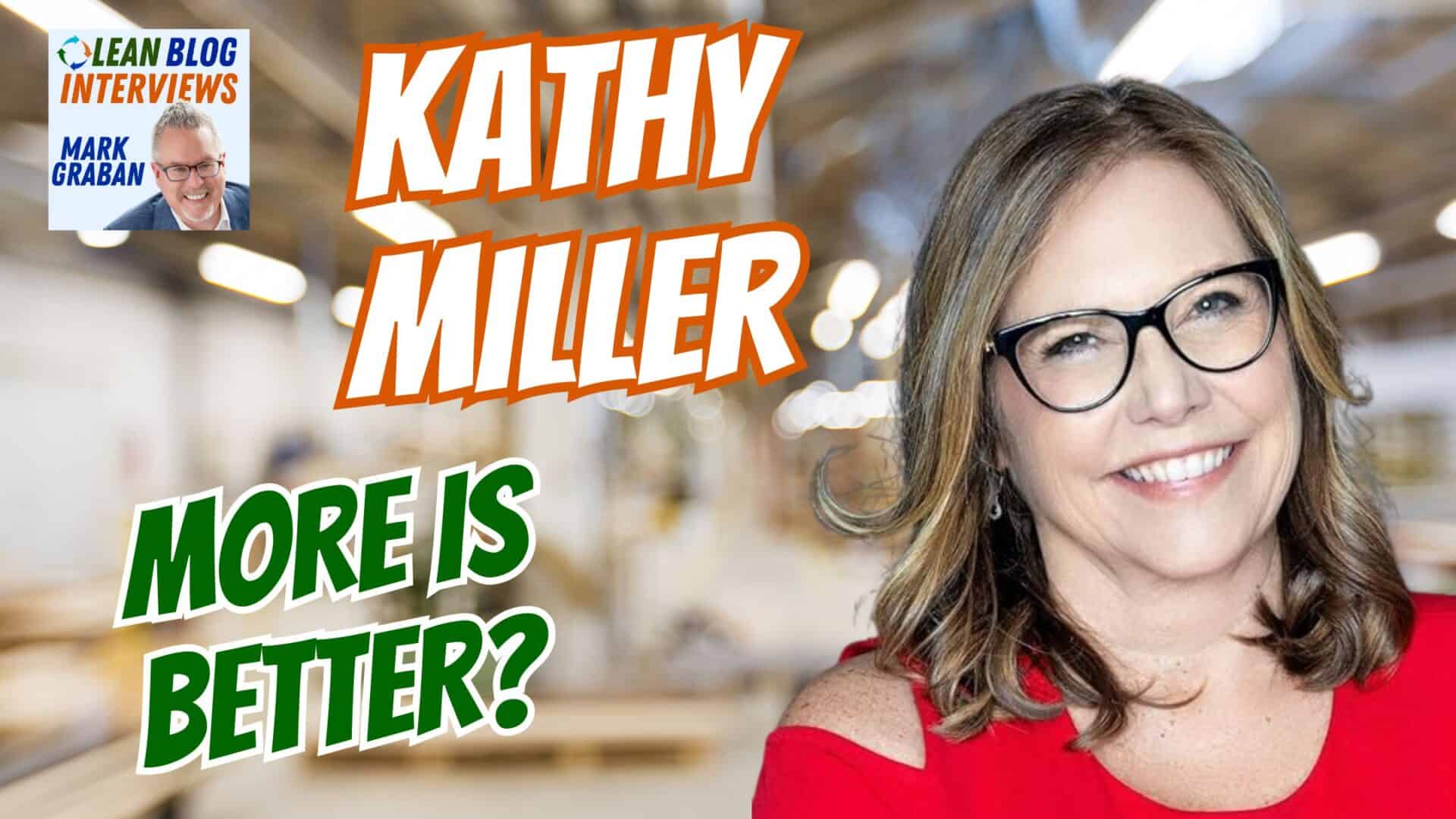
My guest for Episode #541 of the Lean Blog Interviews Podcast is Kathy Miller, a senior operations executive, leadership coach, and transformation advisor with extensive experience in automotive, aerospace, and manufacturing.
Kathy has held global VP and director roles, led operations with a scope exceeding $3 billion, and assumed enterprise responsibility for Lean, quality, and strategy deployment. She is a Shingo Prize recipient, a 2021 inductee into the Women in Manufacturing Hall of Fame, and returns to the podcast after her earlier appearance discussing Steel Toes and Stilettos.
In this episode, we discuss Kathy's new book, MORE Is Better: Leading Operations with Meaning, Optimism, and Relationships for Excellence, and why these themes matter for leaders responsible for results. Drawing on both decades of operational leadership and her master's degree in Applied Positive Psychology from the University of Pennsylvania, Kathy connects research-backed leadership practices to Lean principles such as respect for people, psychological safety, and system thinking.
We explore how meaning, realistic optimism, and strong working relationships drive engagement, retention, safety, and performance–without drifting into “soft” or unrealistic leadership platitudes.
Key Questions Explored
- What does positive psychology really mean, and how is it different from “toxic positivity”?
- How can leaders create meaning in highly segmented, operational work?
- What does realistic optimism look like in environments with daily problems and constraints?
- How do leaders build strong relationships at scale without forcing artificial “engagement”?
- How can compassion and accountability coexist in Lean leadership?
- What everyday behaviors most influence psychological safety on the front lines?
- How can leaders respond better when people bring bad news or problems?
Core Leadership Ideas Discussed
- Positive psychology focuses on moving people and organizations from surviving to thriving, not ignoring problems.
- Meaning comes from connection to the work, to others, and to a larger purpose, not just from the product itself.
- Leaders play a critical role in helping people see how their work contributes beyond their immediate task.
- Optimism is about how leaders frame setbacks, not pretending problems do not exist.
- “Realistic optimism” balances aspirational goals with operational reality.
- High-quality relationships are built through small, everyday interactions, not grand gestures.
- Psychological safety is most often undermined by overreaction, especially under pressure.
- Leaders' emotional regulation sets the tone for the entire system.
- Compassion means understanding the system people work in while still holding clear expectations.
Key Leadership Lessons from the Conversation
- Why “MORE” stands for Meaning, Optimism, Relationships leading to Excellence
- How Lean principles and positive psychology reinforce each other
- The difference between fixing people and fixing systems
- Why leaders who are depleted often create fear without realizing it
- How small moments of respect compound into trust and engagement
- Why soft skills are not soft; they directly affect safety, quality, retention, and performance
Kathy's R3A framework for navigating leadership in male-dominated environments:
- Relationships
- Realities
- Results
- Authenticity
This podcast is part of the #LeanCommunicators network.

Full Video of the Episode:
Introduction to Kathy Miller and MORE Is Better
Mark Graban: Welcome to Lean Blog Interviews. I'm your host, Mark Graban, and our guest today is Kathy Miller. She is a senior operations executive, keynote speaker, certified leadership coach, and business transformation advisor with deep experience across the automotive, aerospace, and broader manufacturing sectors. During her career, she held global VP and director roles, led operations exceeding $3 billion in scope, and had corporate responsibility for lean enterprise quality strategy deployment and industrial design.
She is a Shingo Prize recipient from her time in manufacturing and a 2021 inductee into the Women in Manufacturing Hall of Fame. She also joined us back in episode 438, discussing the book Steel Toes and Stilettos that was co-authored with Shannon Karels. It's great to have her back today. I also want to mention that she has a recent master's degree in Applied Positive Psychology from the University of Pennsylvania. That is going to be part of the conversation today. Kathy, welcome back to the podcast. How are you today?
Kathy Miller: I'm great, Mark. Thanks for having me back.
Mark Graban: It's great to have you back. We are going to be talking about a brand new book, a solo project titled MORE Is Better. The word MORE is in all caps, which might sound counterintuitive, but we are going to dig into that today. The full title is MORE Is Better: Leading Operations with Meaning, Optimism, and Relationships for Excellence. I would love to dive right into the new book. As an author, I always want to know the story behind the book and what motivated you to do this one.
Kathy Miller: First of all, I love to write, and you probably share that passion as well. We are at such an important point in our manufacturing journey. There is a lot of emphasis on reshoring and significant technological disruptions coming our way. We are also hearing a lot about burnout in our organizations – manufacturing is not different from others. I thought it would be a great time to really dig into what the organizational researchers are saying and translate that into real talk and usable tools for those who lead people on corporate concrete. I wanted to give them proven, easy things they can do tomorrow to help with culture and shore up retention and motivation.
Mark Graban: You mentioned researchers. Is the book a combination of your experiences, passions, and the recent master's degree that you completed?
Kathy Miller: It really is. I led many organizations throughout my multiple decades in and around manufacturing and big companies. I was both a direct line leader as well as a “lead by influence” leader with lean transformations and cultural transformations of operations, and my teams had very good track records. What I found when I went back to school for my Master's in Applied Positive Psychology was that the leadership style and the tools I embraced were very consistent with what research says works to motivate organizations and get results. So yes, it's a combination of all those years of experience trying to help people learn lessons – not the hard way, but through the ways I learned them – and the science that backs it up.
Understanding Positive Psychology in Manufacturing
Mark Graban: What is positive psychology? Is there an implication that what might be called psychology is negative?
Kathy Miller: I'd say there is traditional and positive. Traditional psychology is where we are helping people who are really struggling and have some issues they need help with to get them to neutral. The idea of positive psychology came out a few decades ago with Dr. Marty Seligman when he was leading the American Psychological Association. He and a number of his colleagues had this conjecture that if we can use research to take people from struggling to surviving, couldn't we use the same principles to take people from surviving to thriving?
A number of people joined that movement and started to study what helps individuals and organizations thrive, what the research says about that, and how we can do it. We really focus on helping people live their best lives. It doesn't mean that everybody is running around with smiley faces on all the time. That is a bit of a misnomer, but that is what positive psychology is all about.
Mark Graban: So it is not a mindset of what some might call toxic positivity or slapping a smiley face on things.
Kathy Miller: No, it's actually a lot about authenticity.
Mark Graban: That definition you gave of trying to level people up or raise the bar reminds me of two different types of gaps or problem statements for an organization. Are we closing a gap where we are underperforming to standard, or is it the type of gap where we are performing at target but need to raise the bar? There is an interesting parallel to what you often hear from Toyota folks or in lean circles about those two different problem statements.
Kathy Miller: It is about creating cultures where we can achieve excellence, so I think it applies to both. The principles universally apply.
The Power of Meaning in Operations
Mark Graban: I would like to dig a little bit into these MORE components – Meaning, Optimism, and Relationships – and how that leads to Excellence. Could you give us an overview, starting with meaning?
Kathy Miller: Meaning, the M in my MORE acronym, is all about helping the people in our operations feel a connection: connection to the work, connection to each other, and connection to something larger than themselves. It gives them the opportunity to contribute at the level of their competence using their unique skills and abilities.
Mark Graban: Within a team or a company, how much is that an individual sense of meaning versus a shared sense of meaning?
Kathy Miller: It includes both. People want to spend time in their life doing something that matters. You don't want to go to work every day and feel like what you are doing could be done by anyone and doesn't contribute to anything larger than yourself. You have those individual components, but then you have the collective component of knowing we couldn't achieve these things if we didn't work together as an aligned organization, understanding how we are making the world a better place through what we are contributing.
Mark Graban: How would a leader try to explore that with people on their team? How would you ask this? “What is meaningful to you in your job?”
Kathy Miller: You could have that conversation, but I probably wouldn't start there because it requires trust and vulnerability on your part. You could have that conversation through less invasive questions like, “What do you like about your job? What is your favorite part? What makes you excited about coming here in the morning?”
You can encourage it by helping people understand how what they do contributes to a bigger picture. Manufacturing is tough because we have segmented it into very small pieces so the work is repeatable and we can create quality things productively. That caused a disconnection between how what I am doing at this workstation contributes to a final product.
Some products are easy to understand regarding how they make the world better – imagine producing the Jaws of Life to get people out of wrecked vehicles. I used to run rubber factories where people were producing thousands of rubber parts. It wasn't until I started to connect them with how they were used in the world that you felt a different energy in the factory. I started bringing in salespeople to tell stories about how these seals were making things better. There was one story about a seal we procured that went on a mission with Special Forces to get a targeted terrorist. Our seal was on the water pack used to spray his face and identify him. It's not a pleasant story, but people suddenly felt they were contributing to the security of the world, and it took on a different level of energy.
Mark Graban: That is a great example. It makes me reflect on different organizations. My last manufacturing job was at a big company making industrial process control sensors – helping a company measure the thickness of foil they are producing. It isn't the same connection as diagnostic equipment at Johnson and Johnson or biotech companies curing diseases. But even back at General Motors decades ago, making engines for Cadillacs, people had a personal sense of meaning because they grew up loving cars or were third-generation employees. Meaning can be very personal.
Kathy Miller: Absolutely. It doesn't have to be life-saving technology to make it meaningful. It can be meaningful because you are part of a community with shared values. It can also be, “I am sacrificing for my family. I am doing this work because it provides good pay and benefits to provide for the dreams of my spouse or children.” That is a very valid reason to find meaning, even if it is aluminum foil.
I was working with a coaching client recently who had someone return from a year's maternity leave to a changed world – reorganization, different colleagues, different product lines. She was struggling to reacclimate. Instead of a performance discussion, the leader said, “I noticed you don't seem to share the same level of enthusiasm. Talk to me about what changed, what was meaningful before, and what would be meaningful again.” The employee got emotional, and they found modifications allowing her to work on parts of the job she found meaningful. We all want to belong, matter, and make a difference with our unique gifts.
Mark Graban: It reminds me of the late Paul O'Neill, CEO of Alcoa. He wanted every employee to be able to answer yes to three questions daily. The second was: “Am I given the things I need, including education, training, tools, and encouragement, so I can make a contribution to this organization that gives meaning to my life?” He made the connection clear between contribution to the organization and meaning to life.
Kathy Miller: That was very astute of him. We spend a lot of our waking hours making a living. How awful would it be if those hours were devoid of meaning?
Optimism: Moving Beyond Toxic Positivity
Mark Graban: Let's talk more about Optimism, the O in MORE.
Kathy Miller: Optimism sometimes gets a bad rap because people think it is about toxic positivity or a sunny disposition. There is nothing wrong with a sunny disposition, but optimism is more about the stories we tell ourselves when things go wrong and how we frame the situation. Dr. Marty Seligman sheds a lot of light on this. If you can see a problem as temporary and not pervasive, you are going to be more of an optimist and able to work toward solutions.
In manufacturing and operations, a plethora of challenges come your way every day. You want to propagate the mindset among your team that there is nothing we can't solve together with the right resources. It is not just another Tuesday full of problems. It is our unique situation, and we can bring the best of what we have to get past it.
Mark Graban: There is an interesting phrase in your work: “Realistic Optimism.” That sounds like an important balance.
Kathy Miller: It is. You want to make sure you are grounded in the realities of your situation. A lot of these principles target the middle of the spectrum. You don't want to be a pessimist, but you also don't want to be an unrealistic optimist because you lose credibility. Realistic optimism is asking: “What is our current state, and how do we get to that future state with the resources we have?”
Mark Graban: Paul O'Neill was a strong believer in setting goals around zero – zero harm, zero defects, theoretical limits of performance. Some find that inspiring, others say it isn't realistic. What are your thoughts on realistic optimism and goals like zero harm?
Kathy Miller: I think we are crossing into goal-setting theory. We need to be optimistic that we can always make things better, and it is okay to have goals that approach perfection while understanding the reality of the situation. I grew up with the UAW and was taught early on that all accidents are preventable. I had to embrace that zero-harm mentality. I would have periods in my plants, maybe a year without a recordable incident, so I do believe a world like that can exist.
In the meantime, we must deal with the reality of wiping out risks. It is okay to believe everyone should come to work and leave with the same amount of digits. If you believe it is acceptable to have one fatality a year, how do you get up in the morning? It is a combination of beliefs, values, and keeping it real while moving in the right direction.
Building Relationships and High-Quality Connections
Mark Graban: Let's talk about Relationships. This surely goes deeper than the employee engagement question: “Do you have a best friend in the workplace?”
Kathy Miller: That is the most controversial employee engagement question in the world. Relationships start with the basic concept of “high-quality connections.” These are small moments in time where two people interact and both leave feeling seen, heard, and created positive energy. These have been studied by Dr. Jane Dutton at the University of Michigan and Dr. Barbara Fredrickson at UNC.
As a leader of a large organization, it is not practical to have a deep personal relationship with 8,000 people. But you can learn names, smile, look them in the eye, and respectfully remind them you care about them – for example, asking them to put on safety glasses. These micro-moments build positive reservoirs of energy you can draw on when things get bad.
Compassion is another concept. It doesn't mean you are soft or look the other way when people make bad decisions. It means understanding people are human and giving them the training and resources to be successful – compassion with accountability.
Regarding the “best friend at work” question: My best friend never worked with me, but I had people I could count on. I remember a time early in my career as a manufacturing superintendent. I got literally yelled at by my boss in a conference room. I was devastated because my mantra was to be a high-value, low-maintenance employee. About an hour later, a peer from a different department came to check on me. He said, “You've never been yelled at before at work, have you?” I said no. He told me, “It's a good thing. Now you are just like one of the rest of us. You aren't someone planted here on the way to better things. You are one of the team.” He acted like a best friend in that moment, and it was huge support.
Conversely, I worked in an organization where a boss would pick a target at every staff meeting. When it was my turn, I waited for peers to support me, but it never happened. That was very lonely.
Mark Graban: I'm having flashbacks to my time with General Motors right out of college. There was a lot of yelling. It reinforced that this wasn't something I wanted to emulate – the belittling, blaming, and insulting.
Kathy Miller: I give keynote speeches to women's groups, and when I talk about those early days, younger generations ask why I put up with it. That was just how it was. I tell them I had to survive it so I could get to a point where I could influence it and make it better. Running away wouldn't have changed anything, but I never fell into that behavior myself because it isn't psychologically safe or right.
Cultivating Psychological Safety and Culture
Mark Graban: As you step into a new situation, what are some cultural indicators you look for?
Kathy Miller: I look for organizations that are inclusive. I can tell if I am on a curated tour or if that is just how things are. Do people look me in the eye, smile, and want to tell me what they are doing? I look for places that celebrate success and keep people safe as a lived value. That is the most basic form of caring for your people. You can tell when people have a sense of pride, and you cannot have that if you aren't treated well.
Mark Graban: We share a view on the importance of psychological safety. What are some everyday leadership behaviors that build that?
Kathy Miller: Getting to know your people, building trust, and not overreacting when people bring things to you. I have observed that people tend not to control their emotions when they are in a state of depletion – time pressure, tired, not taking care of themselves. Leaders who don't propagate psychological safety are likely not doing great themselves and get hijacked by their emotions.
The most important thing is to take a pause if you feel like overreacting. Reframe the situation: “I am glad Bobby brought this to me because we might prevent an accident.” The behaviors you bring to work are emulated throughout the organization.
Mark Graban: That is thought-provoking. People overreact when they are depleted. It reminds me to be more understanding of systemic factors. These leaders operate in a system that could be depleting them.
Balancing Compassion with Accountability
Kathy Miller: You can be understanding and compassionate but still give accountability. If leaders report to you and you see this behavior, you have the conversation: “This is not acceptable. Why are you acting that way?” Look for signs of depletion and stress. Some people just don't know better because that is how they were raised. You have to teach them. Compassion doesn't mean tolerating it long-term. You still hold people accountable to your standards.
I worked in automotive making pressure sensors, and I could not understand why we couldn't label the boxes correctly. I thought, “We built this big technology. Why can't we put the right number on the box?” I didn't understand until I worked in shipping for a day. I realized, “Oh my goodness, it is amazing we ever put the right label on with the system we provide.” Having the perspective to understand before reacting goes a long way.
Mark Graban: That turns the question “How hard could it be?” from “What is wrong with you?” to “Why is the system making it difficult?”
Kathy Miller: Exactly. Helping them fix it was amazingly satisfying for me and them. They felt someone finally cared that they had 800 customers with different requirements on sticky notes. If we embrace these principles, we can make operations a place that is uplifting and improves performance. If you care about the bottom line, you should care about these “soft skills.”
Women in Manufacturing: The R3A Formula
Mark Graban: Positive psychology education – how has that changed the way you coach leaders?
Kathy Miller: It gave me the science behind how I intuitively led. I have studies about the benefits of optimism. I am the person who translates the science to what it looks like on concrete. MORE Is Better offers both the research and the stories. The stories give me street credibility, but I have been blessed to learn from some of the brightest minds in organizational research.
Mark Graban: A final question. You coach women navigating male-dominated industries. What helps women in that situation thrive?
Kathy Miller: I have a formula for that. Being an engineer, it is R3A: Relationships, Realities, and Results, plus Authenticity.
Relationships: Cultivating allies, mentors, and peers is huge.
Realities: Understanding stereotypes that still exist. For example, an emotional outburst by a female is perceived differently than by a male.
Results: This is the most important thing. Let results be your calling card.
Authenticity: It is okay to display female characteristics in a male-dominated world.
That was the formula for success for me.
Mark Graban: People can learn more about how to work with you through your website, which will be in the show notes. Congratulations on the release of MORE Is Better: Leading Operations with Meaning, Optimism, and Relationships for Excellence. Thanks for coming back on the podcast, Kathy.
Kathy Miller: Thanks for having me. I really enjoyed it.