

What Ford and the UAW Saw in Japan in 1981 — and Why Some Leaders Missed the Lesson
In 1981, Ford Motor Company and UAW leaders traveled to Japan to study Toyota, Nissan, and Mazda — and they came home with very different conclusions about what they had seen.
Another in this series drawn from the Don Ephlin Papers.
Back in 2016, I spent a day at the Walter P. Reuther Library in Detroit digging through boxes of notes, memos, and reflections from one of the UAW's most thoughtful leaders–and I was struck by how familiar the thinking felt.

In early 1981, a delegation of Ford Motor Company and UAW leaders traveled to Japan to study the country's automotive and related industries. The joint Ford-UAW report from that trip, preserved in the Don Ephlin Papers at the Walter P. Reuther Library, captures a pivotal–and often misunderstood–moment in American industrial history.
The group included Don Ephlin, then the UAW's Vice President for the Ford Department, and Ford executives like Peter Pestillo. Their goal was clear: learn how Japanese automakers–especially Toyota, Nissan, and Mazda–were achieving such high levels of quality and productivity. What they were seeing was the early form of what we now call the Toyota Production System — a management system built on respect for people and continuous problem-solving.
Yet when they returned home, what they saw–and what they chose to see–diverged sharply.
Some, like Pestillo, seemed unimpressed. They believed Japan's advantage wasn't managerial, but circumstantial. Japan, they argued, simply had the right product at the right time: small cars, which Americans had come to prefer after the oil shocks of the 1970s.
Ephlin saw something very different.
It makes me think of the W. Edwards Deming quote, as shared by Claire Crawford-Mason:
“Americans want to copy the Japanese, but they don't even know what to copy.”
The “Small Car” Excuse — and What It Failed to See
The idea that Japan's success came from product mix rather than management approach became a convenient story for many in Detroit. If the Japanese were just building different cars, then American leaders didn't have a leadership problem–they had a market problem.
That interpretation missed what mattered.
The Ford-UAW trip report didn't focus on compact car assembly. It described a fundamentally different system of work–one where employees were trusted, encouraged to think, and empowered to act on problems in real time. A 1981 trip summary noted that “cooperative employer-employee relations” were seen as central to Japan's advantage.
That phrase is worth pausing on. Cooperation wasn't treated as a soft value–it was a deliberate management choice, embedded in how work was designed and led.
Today, we would call this Lean management, psychological safety, and daily improvement. In 1981, they simply called it cooperation.
A system design decision.
It meant building workplaces where problem-solving was safe, not risky–where ideas from the front line were seen as assets, not interruptions.
Leaders who dismissed the trip as a study in compact cars missed that point entirely. They focused on product size–and overlooked the scale of the learning system behind it.
Related Post: Toyota article from 1997 – the “Soul” of TPS that's hard to copy
Ephlin Saw Systems, Not Circumstances
Don Ephlin didn't return from Japan talking about compact sedans, factory layouts, or production tricks. He talked about people and systems.
“We found out the Japanese didn't have better people. They had a better system–one that gave people a chance to do their best work.”
That observation cut through the comforting myths of the day. The difference wasn't discipline or national character–it was design. Japan had created workplaces where involvement was expected, feedback was welcomed, and problems were surfaced rather than hidden.
Ephlin's view aligned closely with W. Edwards Deming's philosophy. Deming had long argued that approximately 94% of performance problems come from the system, not the individual–a message Japanese leaders had taken seriously, and many American leaders still resisted.
The Japanese auto industry had listened. Most Americans still hadn't.
Why Some Leaders Couldn't–or Wouldn't–See What Was There to Learn
Looking back through the Ford-UAW materials, three patterns help explain why many U.S. executives left Japan unconvinced.
1. Looking for Tools, Not Systems
American managers tended to benchmark what they could see–machines, layouts, kanban cards–without understanding the thinking behind them. They saw the tools but missed the philosophy. And when nothing seemed “revolutionary,” it was easy to say, “We already do that.”
2. Explaining Away Success
Attributing Japanese quality to car size, exchange rates, or government policy made the problem external. It preserved a sense of superiority–and avoided uncomfortable questions about leadership, culture, and systems.
3. Cultural Blind Spots
Many American leaders–on both labor and management sides–were conditioned to see performance through the lens of control and compliance. The idea that trust and autonomy could produce better results challenged deeply held beliefs about authority.
In that way, the Ford-UAW trip became a kind of mirror. What people saw in Japan depended less on what was there–and more on what they were ready to see.
The Same Excuses, Decades Later
I've seen the same pattern play out in healthcare. When executive teams visit a hospital known for its Lean culture–say, one that has dramatically improved safety, flow, and engagement–the easy reaction is to explain away the differences.
- “We can't do that; our patients are sicker.”
- “That's a children's hospital–our work is more complex.”
- “They have more resources than we do.”
- “We're too big (or too small to do this.”
It's the modern version of saying, “Japan just makes small cars.”
The excuses sound rational, but they block learning.
The real question isn't whether your context is identical. It's whether your principles are transferable–respect, teamwork, and learning from mistakes always are. When we defend our uniqueness too strongly, we protect our problems along with it.
Even the 1981 Headlines Couldn't Agree
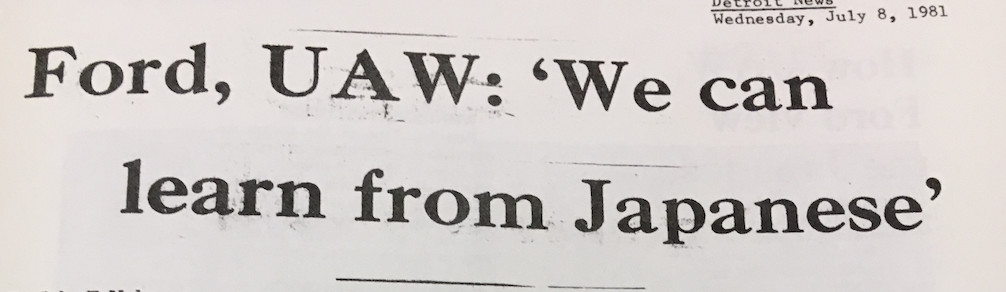
The media coverage in July 1981 perfectly captured the split in interpretation.
Various news stories carried conflicting messages — there was a lot to learn. Or people weren't impressed.
When the Ford-UAW delegation returned from Japan in 1981, the headlines told conflicting stories — and that in itself is telling.
Some articles described the trip as “eye-opening” and emphasized a genuine willingness to learn:
“Ford, UAW: ‘We can learn from Japanese'” — Detroit News, July 8, 1981
“Eye-opening tour of Japanese plants” — Akron Beacon Journal, July 9, 1981
Others downplayed the visit entirely:
“Japanese plants don't awe U.S. team” — Detroit Free Press, July 8, 1981
“U.S. Can Apply Few Japanese Practices: UAW, Ford” — American Metal Market, July 20, 1981
And some framed it as a kind of mystery to be solved:
“Japanese Riddle: Ford, UAW Seek Answer” — UPI, July 1981
These headlines didn't just reflect different editorial angles — they revealed a deeper divide in interpretation.
For some leaders, the trip affirmed what was possible. For others, it challenged too much. It was easier to suggest that “not much could be applied” than to reckon with the systemic implications of what they saw.
Whether the lessons were taken seriously had less to do with the content of the visit, and more to do with the mindset brought home.



Read The Articles:
What Was Actually There to Learn
The 1981 report surfaced lessons that were hiding in plain sight:
- Treating cooperative employer-employee relations as a strategic advantage
- Making a long-term commitment to capability development and quality
- Building structured systems to surface ideas and solve problems
These weren't cultural curiosities. They were intentional system designs. As Ephlin later showed through his work with NUMMI and Saturn, these principles could be translated to American factories–when labor and management chose collaboration over competition.
Those experiments would later prove that these “Japanese” practices worked just as well in American factories when the system changed.
The Real Missed Opportunity
The real conundrum of 1981 wasn't that Japan had nothing to teach. It's that some visitors weren't willing–or ready–to learn. They went to see factories, not philosophies. They benchmarked equipment instead of management thinking.
They came home talking about car sizes instead of system design.
Ephlin saw the gap–and named it. Improvement begins with humility.
You can't learn from someone you don't respect.
And that lesson still holds.
In any industry, it's easy to dismiss another organization's success as circumstantial. It's harder to look in the mirror and ask: Does our system make it safe for people to speak up, solve problems, and improve?
Why This Still Matters in 2026
Four decades later, the same dynamics still show up–in healthcare, manufacturing, tech, and beyond.
- We still see leaders searching for quick fixes instead of rethinking systems.
- We still see organizations chasing visible tools while ignoring invisible culture.
- We still hear versions of the same excuse: “That won't work here.”
But when people are trusted, when ideas are welcomed, and when mistakes lead to learning–not punishment–organizations thrive.
Whether you're building cars or caring for patients, the core challenge remains:
- Will we create systems that empower people to do their best work?
- Or will we keep blaming individuals for problems rooted in design?
Ephlin's insight isn't just a historical footnote.
This 1981 Ford-UAW Japan study trip is one of the earliest American encounters with what would later be known as Lean and the Toyota Way.
And it's a mirror for how we lead–and how we learn–today.
Reflection Question
The difference between learning and defending is often just ego.
When you visit another organization, what are you hoping to see–confirmation that you're already right, or insight that might prove you wrong?
The first flatters the ego. The second creates discomfort–and fuels improvement.
Author's Note
Based on the 1981 Ford-UAW Study Trip to Japan, documented in the Don Ephlin Papers at the Walter P. Reuther Library, Wayne State University. Additional commentary drawn from LeanBlog.org, especially “Lessons Ford and the UAW Learned from Japan in 1981 Still Apply (Even in Healthcare).” All direct quotations from Ephlin are taken from archival documents or contemporaneous Ford-UAW Quality of Work Life materials.





Thank you Mark for another insightful portrayal of the philosophy behind TPS & again driving home the points that more than the TOOLS, it is the philosophy that matters.