

Why Unchanging Metrics Can Be a Warning Sign
How “perfect” data can hide system problems–and what leaders should do instead
Today's post is some material I wrote for my book, Measures of Success, but cut for length. I've modified the material a bit to hopefully be fine as a standalone post.
When Metrics Look Normal–but Something Is Wrong
Today, many organizations rely on dashboards, automated data collection, and “real-time” metrics. Ironically, that makes it even easier to miss problems hiding in plain sight–especially when the numbers look neat, consistent, and reassuring.
A Healthcare Story About Suspiciously Perfect Data
There's a somewhat humorous, if not scary, story from a book (This is Going to Hurt) written by a former “junior doctor” in the British National Health Service (NHS) — the equivalent of a “resident” in the American medical education system.
One day, he noticed that “every patient on the ward has a pulse of 60 recorded in their observation chart.” That seemed like an unusually small amount of variation in that ward's system.
What a Process Behavior Chart Would Reveal
Let's say there was a “Process Behavior Chart” (PBC) for a single patient's pulse, taken hourly during their stay. The doctor might have seen an X Chart that looked like this:
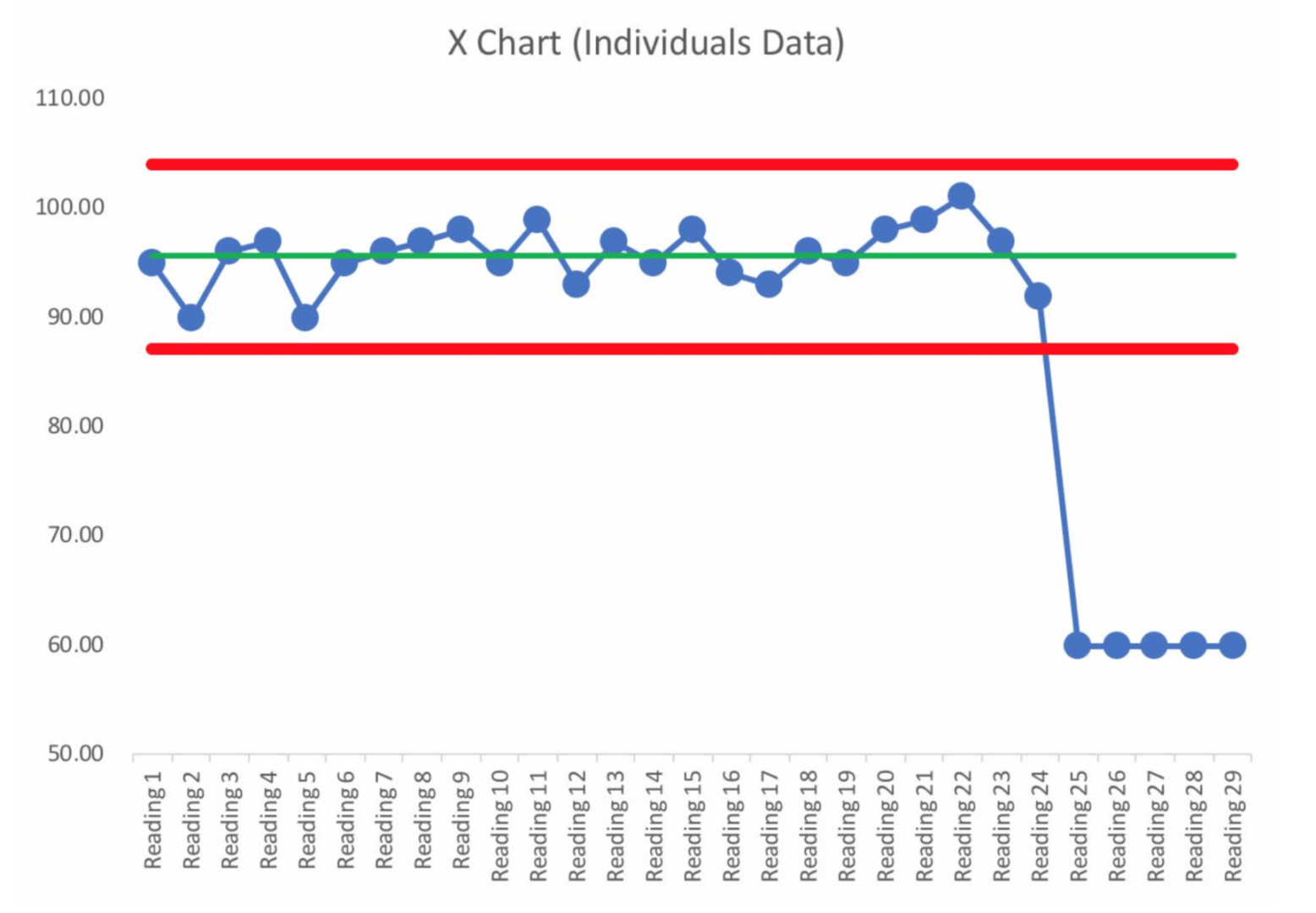
The red lines are the calculated “Lower and Upper Natural Process Limits” that tell us the range of routine variation in what had been a “predictable system” up until the pulse readings of 60. If the system hadn't changed, we would have expected any future pulse rates to fall between about 86 and 104.
How to Recognize a Meaningful Signal in the Data
We could use our three rules for evaluating a PBC to look for signals of a change:
- Rule 1: Any data point outside of the limits.
- Rule 2: Eight consecutive points on the same side of the central line.
- Rule 3: Three out of four consecutive data points that are closer to the same limit than they are to the central line.
The patient's first 24 hours in the hospital could establish an average pulse, along with the Lower and Upper Limits. The first data point of 60 is, of course, aRule 1 signal. Along with a pulse reading of zero, this single data of 60 would indeed be worth reacting to and investigating (if my pulse were zero, I'd want countermeasures taken to revive me instead of waiting for “root cause analysis” to be completed).
Going to the Gemba Instead of Jumping to Conclusions
Even without a PBC, Dr. Kay thought it was worth investigating. Asking why an individual's pulse suddenly dropped might raise questions about medications or the patient's condition. But, seeing that every patient had a pulse of 60 pointed to a different, more systemic cause.
Instead of asking why multiple times, Dr. Kay went to observe a healthcare assistant who had started a shift and was recording the 60 pulse numbers. As Dr. Kay wrote, he “surreptitiously inspect[ed] the healthcare assistant's measurement technique. He feels the patient's pulse, looks at his watch and meticulously counts the number of seconds per minute.”
That's undoubtedly a special cause! That's not how you take a pulse, of course. Teaching the healthcare assistant the proper method for taking a pulse would likely address the situation, restoring the system and the pulse metric to their normal state.
But, blaming or labeling someone as a “bad healthcare assistant” might not get to the root cause of the problem. Firing that “bad healthcare assistant” might only mean that you eventually get another “bad healthcare assistant” in their place.
Why Blaming the Individual Misses the Real Problem
Why was the pulse number wrong?
- The healthcare assistant was counting the number of seconds (60) in a minute on their watch.
Why was the healthcare assistant counting the pulse that way?
- They were never trained on the proper way to take a pulse.
Now, that might not be the only answer to the second why. We could also answer it by saying, for example, “The healthcare assistant was not being supervised” or “the system hired an unqualified person.” There might be multiple answers to each “why?” so we might end up with something that looks like a tree diagram instead of a linear flow.
For each answer or cause, we might ask whether there is evidence to support the statement or if it's a guess. In problem-solving, verifiable facts are more helpful than assumptions. The only way to really validate that we've identified a cause is to develop and test a countermeasure we think will address it, and then see whether we've affected our results by preventing future signals or shifting our performance over time.
From Hypothesis to Learning: Testing Countermeasures
One short-term countermeasure here might be some immediate training for that particular healthcare assistant. We might also find out if any other assistants are doing the same thing. In the long term, we might improve hiring and training processes to prevent this and other problems.
As with Process Behavior Charts, the point is not to be technically correct in a root cause analysis — the point is to solve the problem and improve our performance in a sustainable way.
At some point, we might suspect we have identified the root cause of a signal. When we are talking about or brainstorming possible root causes, that's initially only a hypothesis. We don't yet know that we have found the root cause if we're just talking.
Why Root Causes Are Hypotheses, Not Answers
I've been taught by former Toyota leaders that you have to test your hypothesis about the root cause. If you implement a countermeasure meant to address the root cause, you need to check whether performance improves. If we react to a negative Rule 1 signal from a single point outside our Natural Process Limit, we'd check whether our countermeasure puts the metric back within its prior range. If not, we probably haven't found the root cause (or we didn't find an effective countermeasure) so we adjust and “spin the PDSA cycle” again, as they say in many Japanese organizations.
When Learning Has Ethical Limits
If your countermeasure puts the process back into its normal, predictable range, you can turn off the countermeasure to see if the poor performance returns. It might not be ethical to do so in some situations if we are trying to solve a patient safety problem.
What Leaders Should Learn From This “Pulse Check”
When metrics suddenly look “too good” or unusually consistent, that's not reassurance–it's a prompt to pause and look closer. The goal isn't to react faster to numbers, but to understand the system that produced them. In this story, the problem wasn't a bad metric or a careless individual; it was a gap in the system that only became visible through observation, curiosity, and learning.
For leaders, the real takeaway is this: improvement doesn't start with blaming people or perfecting analysis. It starts by asking better questions, going to see the work, and treating causes–and countermeasures–as hypotheses to be tested. When we respond to data with humility instead of certainty, metrics stop being a scorecard and become what they should be all along: a tool for learning, improvement, and respect for people.
To learn more about my book Measures of Success and how these analysis methods can help your organization, check out my book's website.