

Gemba Walks for Leaders: Practical Do’s and Don’ts That Build Trust
Gemba walks are not about inspecting, fixing, or showing expertise — they're about learning. In this post, we share tips from Mischelle McMillin of Franciscan St. Francis Health–practical do's and don'ts that help leaders go to the gemba in a way that builds trust, supports Kaizen, and strengthens a culture of daily improvement.

Last spring, Mischelle McMillin spoke at our Kaizen Live! event at Franciscan St. Francis Health.
She is their Director of Business Transformation, reporting to Joe Swartz within the Franciscan system. Mischelle spoke during the event about Gemba Walks and how they relate to Kaizen and Daily Improvement.
Why Gemba Walks Matter for Lean Leaders
Here is video of this portion of her talk (2016 event attendees have access to the full hour-long talk and Q&A):
Preparing Leaders for the Gemba Experience
During her talk, Mischelle outlined some Gemba “Dos and Don'ts” that she uses to help her organization's leaders during their Gemba experiences.
Mischelle talked about how she and her team pulled together a group of leaders throughout the organization to meet in empty patient rooms each day.
“We stand there for 30 minutes, and we learn to see. We start this journey of creating a culture of going to the Gemba and learning to see,” Mischelle explained.
A few weeks later, with a bit of leading by example by Mischelle's team, further Gemba visits were planned in areas like environmental services, for activities like cleaning patient rooms.
“Some of our front line leaders are really comfortable; some of our other leaders may not be as comfortable so we did give them some Gemba dos and don'ts,” Mischelle said. “So we had lots of dialogue before folks started going out there shadowing and observing.”
These dos and don'ts were developed both for the benefit of the leaders, and the employees who are asked to perform their regular work with a person, who is most likely a stranger, at their hip asking them questions.
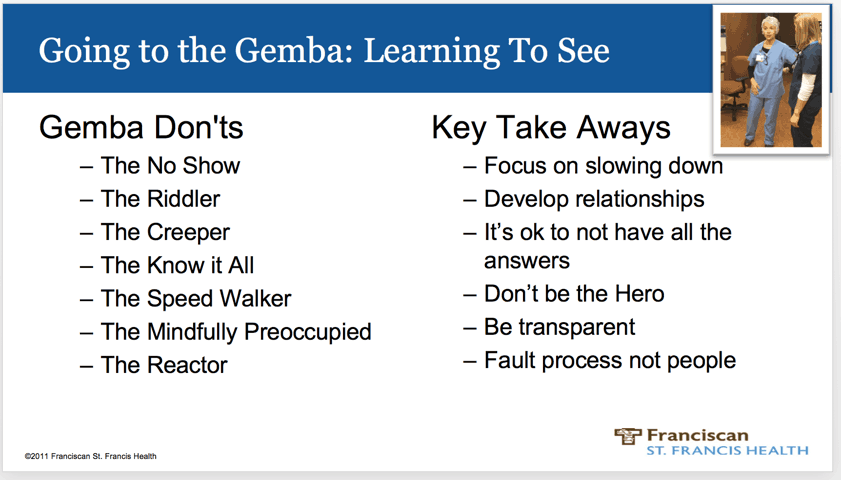
The slide she used spelled them out:
Common Gemba Walk Mistakes Leaders Should Avoid
Before sending leaders out to observe work, Mischelle emphasized the importance of being explicit about what not to do at the gemba. These aren't minor etiquette issues or personality quirks — they're behaviors that can quickly undermine trust, distract people from their work, and shut down honest dialogue.
To make the expectations concrete (and memorable), she gave these behaviors names. Her message was simple: don't be these people.
The No Show
If you say you're going to be there, you must be there. Canceling or not showing up sends a strong signal about priorities — and it's not a good one.
The Riddler
Rapid-fire questioning can feel more like an interrogation than curiosity. Be respectful of people who are trying to get their work done.
The Creeper
Quietly trailing someone for long periods is uncomfortable for everyone involved — including the leader doing the observing.
The Know-It-All
The gemba is not the place to show staff how to do their jobs. Teaching replaces learning, and it shuts down insight.
The Speed Walker
Rushing in and out defeats the purpose. Gemba requires slowing down, not speeding things up.
The Mindfully Preoccupied
Being physically present isn't enough. Phones, emails, and mental to-do lists need to be parked while you're there.
The Reactor
Leaders must be conscious of how they respond in the moment. Address immediate safety issues, but avoid overreacting in ways that create fear or mixed messages.
“So our leaders began going out, and we just gave them the opportunity to do so, encouraged them, told them how to get scrubs if they didn't have scrubs, and then we began dialoguing about their experiences,” Mischelle explained, “Part of this was really about team and culture and how we were developing that, so as they got through their Gemba experiences, and we kept encouraging them to go back out.”
One morning, the group went to breakfast and Mischelle and her team dug into what the leaders were learning and what their key takeaways were.
What Leaders Learned by Slowing Down
The leaders identified the following takeaways:
- Focus on slowing down
- Develop relationships
- It's ok not to have all the answers
- Don't be the hero
- Be transparent
- Fault process, not people
A lot of these takeaways were part of the reaction to finding some problems and performance variations on the floor. As leaders with a lot to get done, we tend to want to fly in and be the hero, solve the problem, and move on quickly. The leaders soon came to realize that they needed to focus on slowing down and giving room to staff to let them become the problem solvers.
Gemba Is About Relationships, Not Fixing Everything
When Mischelle and her team sent the leaders out, they didn't ask them to solve problems, but instead asked them to make connections. Connecting with staff, finding out who their kids are, if they have pets, etc., are so important to the culture of Kaizen, and a true benefit of Gemba.
What do you think of her list? What “dos and don'ts” do you teach or practice at your organization?
Gemba Walks, Psychological Safety, and Learning from Mistakes
As we move into 2026, this lesson feels even more important. Gemba walks don't work because leaders notice more problems — they work because leaders cultivate psychological safety. When leaders show up curious instead of judgmental, present instead of rushed, and humble instead of heroic, people are far more willing to speak up about what's really happening.
This connects directly to a core theme of The Mistakes That Make Us: learning only happens when people feel safe to surface problems, admit uncertainty, and experiment without fear of blame. The “don'ts” Mischelle describes aren't just etiquette tips — they're safeguards against unintentionally shutting people down. Overreacting, interrogating, or fixing things on the spot sends a clear (if unintended) message: don't bring me problems.
When leaders use gemba walks to build relationships, ask thoughtful questions, and focus on understanding rather than correcting, mistakes become learning opportunities instead of liabilities. That's when Kaizen stops being a program and becomes a habit — and when improvement becomes something people participate in willingly, not cautiously.