

What Happens When Leaders Don’t Listen? A Lean Look at Respect and Culture
There's a lot of silly stuff that people post that appears on the LinkedIn main page when I log in, between narcissistic selfies and urban legends like the one about Bill Gates and his daughter that's making the rounds.
But occasionally there's a real gem… this time, it's a quote from Shellie McKinney, an HR generalist at Kohler Co.
I re-shared her photo on LinkedIn as it appeared here:
“Leaders who refuse to listen will eventually be surrounded by people who have nothing significant to say.”
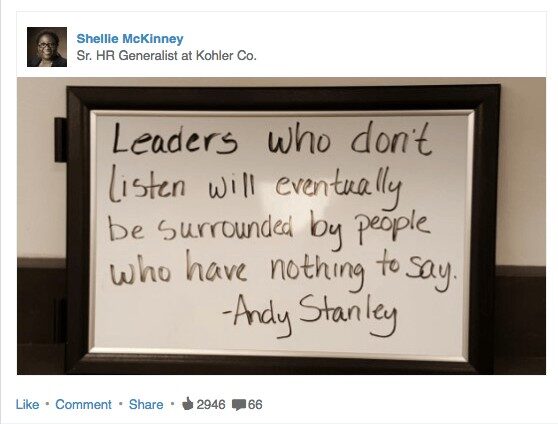
The quote is from Andy Stanley, “a pastor, communicator, author, and the founder of North Point Ministries in Alpharetta, Georgia.”
It looks better and more sharable on a whiteboard, eh?
It looks like one of Andy's main projects is a leadership podcast… I'll have to check it out.
This quote is highly relevant to the practice of Lean and Kaizen (or continuous improvement). Leaders need to learn how to truly listen to their employees, including their needs and their ideas.
Without listening (to customers, employees, patients, suppliers, etc.), it's not really Lean is it? Listening is a core aspect of what Toyota would call “Respect for People.“
There's far more to respect than just listening… but it's a good start.
I've heard leaders complain that “my employees won't speak up.” Instead of labeling them as bad or uncaring employees, these same leaders should maybe look in the mirror and ask how those people ended up that way.
Is it a “fear factor” or a “futility factor” getting in the way of people speaking up?
It makes me think of the old comment by the late Peter Scholtes, paraphrasing:
“If you're firing dead wood, ask yourself if you didn't at one point hire live trees.”
Listening isn't just a soft skill–it's a leadership responsibility. When leaders stop listening, they don't just miss ideas; they create silence. And in that silence, improvement dies, trust erodes, and problems fester. Respect for people starts with listening–genuinely, consistently, and with the intent to learn. If you want a culture of continuous improvement, it begins by creating space where people feel heard–and where what they say actually matters.






Good reminder of the need for self awareness as leaders. It’s amazing how often the problems we face are the result of our own actions (or inaction).
And I highly recommend Andy Stanley’s work.
Great quote! It reminds me of Deming’s point about, “Driving Out Fear.” People can be afraid to speak up if they feel that they will be ignored, or worse berated, by their leadership. I highly recommend Andy Stanely’s work as well. I listen to his leadership podcast every month.
Great quote. Listening is one of the most difficult ‘crafts’ for a leader to learn.
Importantly, it is also one of the vital components in a successful Lean organisation. The ideas and suggestions often come from those that do the job day to day. Leaders rarely have all the answers. Listening and working as a team builds respect, trust and success.
Great article
Amazing quote! One of the most important qualities in a leader should be “listener” because in order to make a company or group work, a leader needs to not only listen to their employees buy also the customer. If you do not listen to the customer there will be no one there to buy your product, work for you or be there in general in the end. Overall, this is a very important quote and will be prevalent in anything you do in life, especially in LEAN.
[…] Without listening (to customers, employees, patients, suppliers, etc.), it’s not really Lean is it? Listening is a core aspect of what Toyota would call “Respect for People?”….read on… […]