
Quality Circles Are Alive and Thriving in Japan: Lessons in A3 Thinking and Kaizen
TL;DR: Quality Circles are still thriving in Japanese hospitals and companies–rooted in the philosophy of developing people through structured problem solving. What some in the West now call “A3 Thinking” or “PDSA” is alive and well in Japan as a cultural practice of Kaizen. Here's what we can learn from it.
One question I was asked to ask during my Japan trip was whether “Quality Circles” are still active in Japanese companies. I think the term was brought to the U.S. in the 1980s and 1990s, but generally wasn't widely adopted for a number of reasons – probably due to management mindsets and organizational culture, not a lack of willingness on the part of American workers. At GM in 1995, people talked about failed attempts at forming QCs (and management mainly blamed the workers, sadly).
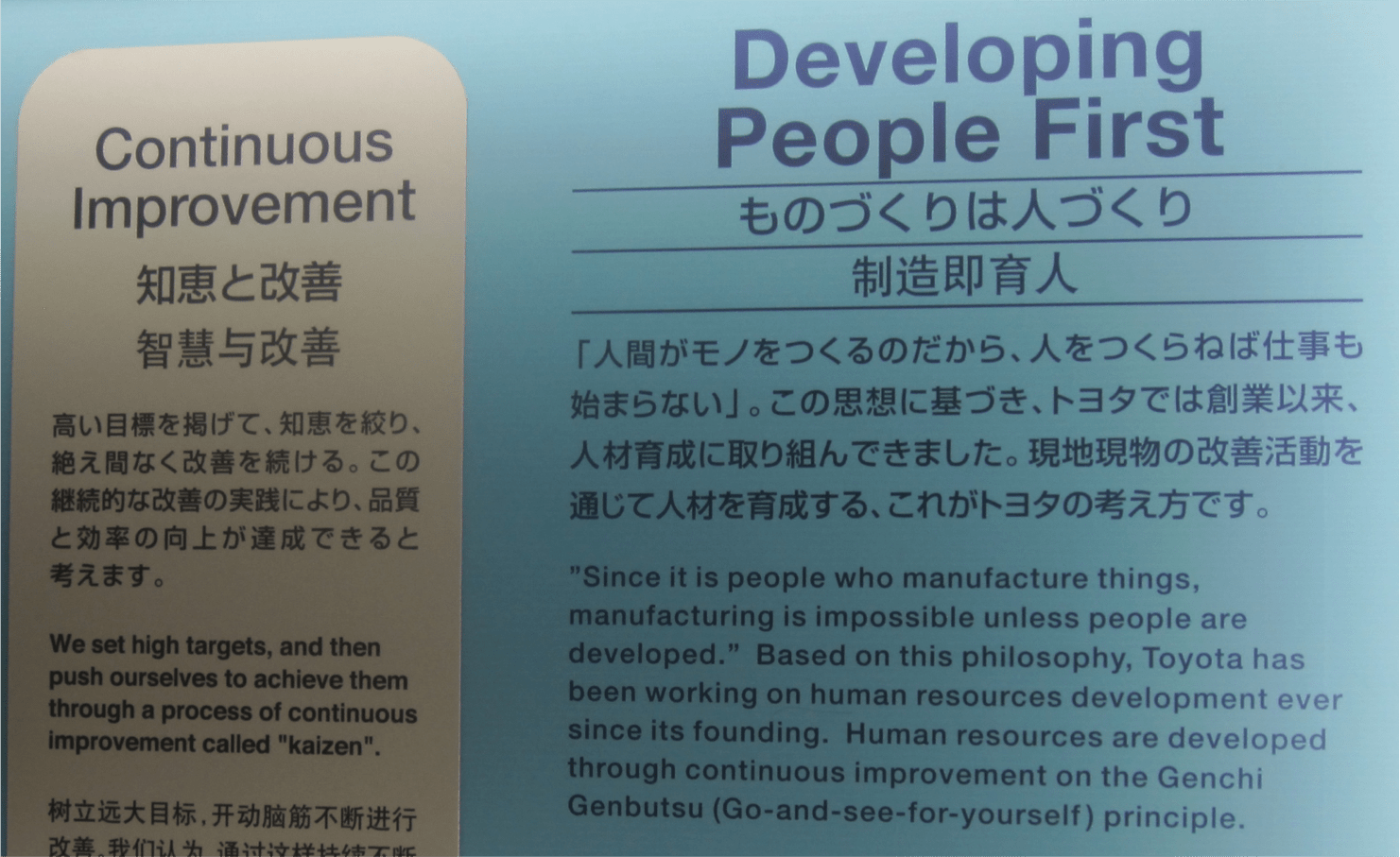
Toyota did not mention Quality Circles, but it did emphasize Kaizen as a core part of the Toyota Production System.
The two companies we visited on Tuesday, and the hospital we saw on Wednesday, all had very active Quality Circle programs that were driving improvement in many ways.
Each organization has a sequence or structure for the QC process, either 8 or 10 steps.
- Brainstorm problems
- Select a theme (from the brainstormed problems) and explain why you selected it
- Analyze the current state (and narrow the problem)
- Set goals
- Schedule the QC activities (over a six-month period)
- Root cause analysis
- Implement changes
- Check the effects
- Standardize and stabilize
- Identify the next QC project
The QC is a group of roughly six to eight people from a department. Different QC members will take responsibility for different steps in the process, with each person owning at least one step
At a high level, the QC process is PDSA – Plan, Do, Study, Adjust. The Deming Cycle (they still talk about Deming here).
While the QC teams presented their “QC Story” as a multi-slide PowerPoint deck, the thought process is very similar to what we might call “A3 Problem Solving” in the U.S. or other countries. The thought process and the steps are very similar, but an A3 is documented on a single sheet of paper.
The first company we visited on Tuesday, a complex, low-volume, high-mix manufacturer, explained their goals for the QC activities… just as Toyota would say:
- First priority/goal of QC is training people to learn problem-solving
- Second priority is the financial benefits
We heard the exact same philosophy at the hospital yesterday.
The theme of the manufacturer's QC activities is “QMM: Quality, Mission, Morale.” That's what they would like employees to focus on. They have 30 circles active at any given time (with about 350 employees). “All employees are in a circle.” Each circle has a manager who helps them, and a QC advisor who helps them when they meet formally with the advisor for a 30-minute monthly meeting. The QC work continues between those meetings, of course. The QC advisor is not in that role full-time.
Later on Tuesday, we visited a food services company that runs cafeterias all across Japan. They presented one QC story that was focused on a nursing home in Osaka. The QC stories are a “bottom-up activity” that includes even part-time workers, working to improve the presentation and taste of blended “mixer food” for the elderly who can't eat solid food.
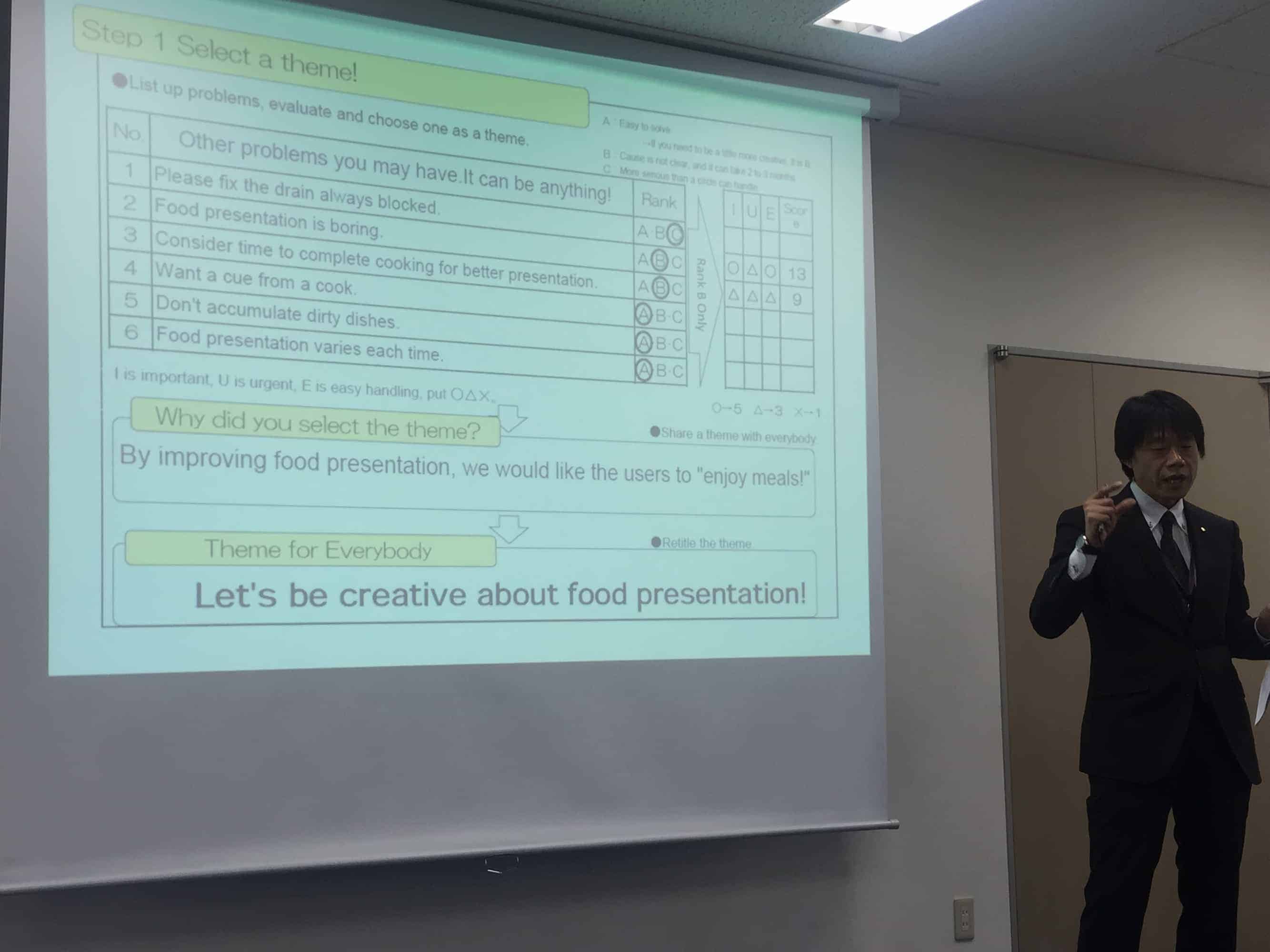
Step #9 in their 10-step method is to document the lessons learned. The managing director said, “Lessons learned are the most important item.” Again, that's a familiar theme – the focus on learning.
The QC activity there is “voluntary and autonomous” and is “not directed by the boss.”
With QC activities (and smaller Kaizen improvements), “Improvement has become the culture of the workplace… Kaizen is endless,” as the managing director said.”
The hospital we visited on Wednesday presented three different QC stories:
- Improving home care plans of care
- Improving “rice jelly” food
- Reducing the overtime required to manage and administer medications
I love the fun and colorful graphics they use in their team names, themes, and presentations:
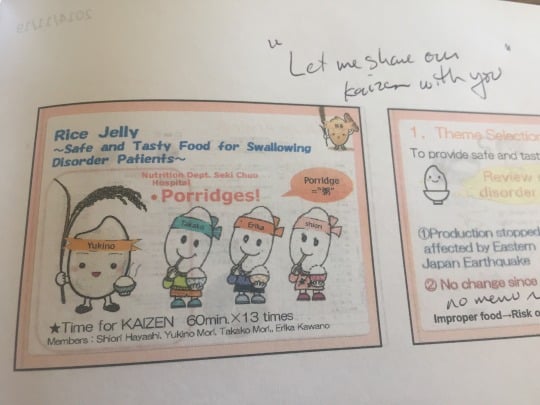


The hospital started the QC approach through TQM in 2004. The first Japanese hospital to do this was in 1985. The hospital's CEO explained that he visited the United States, including the IHI, and learned about “Lean” as both a term and a method. The hospital also has employees practicing smaller daily Kaizen improvements, which I'll write about soon.
The hospital has no full-time Quality staff or department, nor does it have full-time QC or Kaizen promotion staff. Quality is an activity for everybody to participate in.
We're off to see two more hospitals on Thursday and Friday. Whether we call it TQM or Lean, Quality Circles, A3s, or PDSA, what matters is focusing on the customer and engaging everybody in continuous improvement.
News Coverage
Our tour attracted some local media coverage:
ChatGPT translation (August 2025):
Foreign Tour at Kani Central Hospital
Learning about Kaizen on the Frontline
At Kani Central Hospital in Heisei-dōri, Kani City, a group of 23 people from seven countries, including the United States, Germany, and China, visited on the 19th to observe how the hospital practices “Kaizen” (continuous improvement).
The visitors toured the hospital pharmacy, learning about creative ideas for organizing drug storage and other improvements. They actively took notes and photos, showing a strong interest in the hospital's initiatives.
The tour was organized by Kaizen Institute Consulting Group, a Swiss-based organization that promotes Kaizen activities worldwide. Participants, many of them medical professionals, said they wanted to take practical improvement ideas back to their own workplaces.
For example, Dr. Christian Gruner, from Germany, commented:
“I want to bring these ideas home and apply them in practice.”
The visitors were impressed not only by the hospital's efficiency improvements but also by the staff's commitment to ongoing Kaizen efforts.
After the tour, the group also visited Fukuoka Prefecture to see how Kaizen is being practiced in different hospitals across Japan.
Whether we call it Quality Circles, A3 thinking, or PDSA cycles, the core idea is the same: engage people closest to the work in solving meaningful problems. What I witnessed in Japan was not just a method–it was a deeply embedded mindset of respect, learning, and shared responsibility for improvement. It's a reminder that sustainable change isn't driven by mandates or metrics, but by developing people first–and trusting them to improve the work every day. That's the essence of Kaizen.





Quality Circles are also still alive in some companies in the US as well. As a matter of fact, as I am typing this I am working with a circle group team on improving a process at our company. Also, last week I had three teams at the Honda circle group conference. Quality Circle are a great way to develop associates to be problem solvers and it is so exciting to watch them develop and grow into the best that they can be. It is just great!!!
Great, glad to hear that Dale!
Yes, quality circles are great as long as what they do aligned with the corporate objectives… otherwise carrying out projects here and there will not add much value to the process excellence and bottom-line.
None of the companies or hospitals we visited in Japan seemed very concerned about QC activities being “aligned to corporate objectives.” They are delivering results, but they focus first on developing people and teaching problem solving through these activities. Learning first, results second.
What you’re describing, Uditha, is a very Western view and maybe that’s why many of our organizations struggle with Lean and Kaizen.
[…] improvement is important to me, of course. The Japanese hospitals we’ve visited have a strong tradition of practicing Total Quality Management. Some are now embracing Kaizen as “daily continuous improvement” in addition to their […]
[…] They are all practicing an evolution of Total Quality Management (many for 15 or 20 years). See my earlier post about quality circles still being alive and well in Japan. TQM often creates a great foundation for what we’d recognize as Lean practices or Lean […]
[…] Some organizations there have been dabbling with Lean methods. One talked about their years of experience with Total Quality Management and “Quality Circle” projects (as I had heard about in Japan). […]
[…] in Chongqing, that the hospital is doing “quality circle” improvement projects (as I saw in Japan), with everybody (or most everybody) being involved in […]
In my previous company, we nom it SGA (Small Group activities) have a Team leader, facilator and a coach (Leader), using RCA for routine pbs and Kobetsu Kaizen or 12 steps focused improvement tool for the chronic one, the objective is financial benefits, unfortunately the culture and engagement is not supporting these daily and continuous activities, Japanese have this kaizen culture in their DNA and blood,