


The Jerk: A Problem-Solving Lesson in Checking Assumptions
A scene from Steve Martin's The Jerk offers a funny example of a serious problem-solving mistake: treating an explanation as a fact before checking it. Navin sees leaking oil cans, decides what must be causing the leaks, and chooses actions that follow from that mistaken assumption.
In 2010, I parodied the style of GEICO commercial that they were running at the time with a “did you know that Steve Martin's character from The Jerk was bad at 5S?”
That brought to mind the scene in the movie where Navin R. Johnson (Martin's character) was working at a gas station and somebody was shooting at him, missing and hitting cans of oil (warning: a few PG-13 words):
This is all tongue-in-cheek, but let's analyze his problem solving.
Start with what you can observe
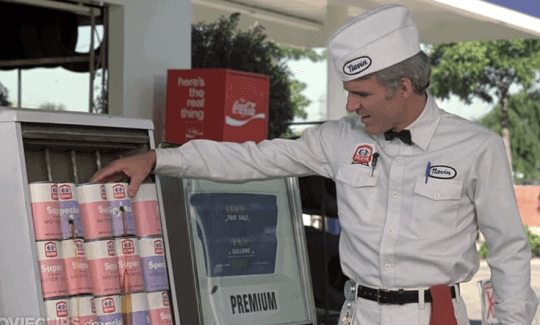
First, Navin discovers a problem. “Something's wrong with these cans.” He gets credit for not jumping to a root cause.
He might have been thinking about the way I was taught by Pascal Dennis to define a “problem:”
- What Should Be Happening? Cans hold the oil inside
- What's Actually Happening? There are holes in two cans, suddenly
- What's the Gap? Two holes
- What's the Impact? Oil is spilling out
Separate the evidence from the explanation
Navin can't hear the man who's shooting at him and two more cans spring leaks:
Navin yells to the owner of the station, “These cans are defective… they're springing leaks!”
He's made a faulty assumption that the cause of the holes is “defective cans.” He's getting off track in terms of finding a countermeasure.
The owner, played by the legendary Jackie Mason, sees the shooter up on the hill.
He corrects Navin and says “we don't have defective cans… we've got a defective person out there!”

More cans get hit.
So, Navin has understood a cause of the cans springing leaks. Asking why…
- Why is oil spilling out? Because there are holes
- Why are there holes? Because a man is shooting them
- Why is he shooting them? “He hates these cans!”
Navin has made a bad assumption here. The shooter hates Navin (for representing a completely average person, it seems).
Navin proposes a countermeasure that might not work… he yells, “Stay away from these cans!”
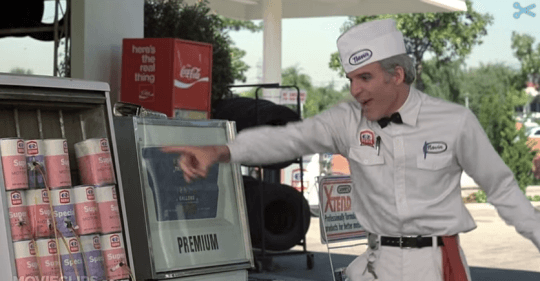
Navin runs away from the oil cans… to test his countermeasure in practice (we never know if a change is really an improvement until we test it out).
He runs to a Coke machine and realizes “there's cans in there too!”
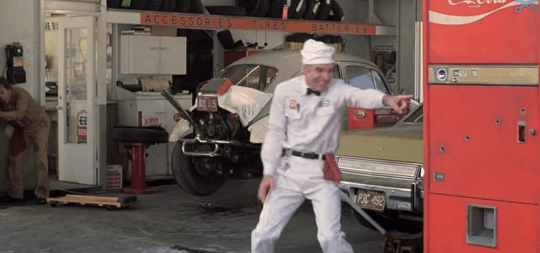
So he modifies his countermeasure a bit (a small PDSA cycle?) by running away from the Coke machine.
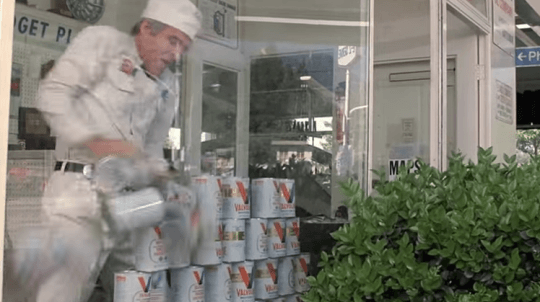
He runs inside the building… more oil cans!
Navin takes action again… by clearing away the cans (making it, unfortunately, easier to shoot him?)
Contain the immediate danger before studying the cause
Maybe this illustrates how we might panic when trying to problem solve in a stressful situation. Sometimes, we have to contain the situation, putting the proverbial fire out, before we figure out the root cause and longer-term countermeasures.
The station owner coaches Navin by yelling, “He doesn't want to put holes in the cans, he wants to put holes in you.”
Maybe it's ideal for a coach to lead by asking questions. But, again, sometimes when you're just trying to contain a problem, you might have to be more directive as a manager.
Armed with his better understanding, Navin tries a new countermeasure… driving off in a car. But, there's a defect in the process, as the car doesn't have its tires installed and he's driving on the wheels.

Navin manages to drive off and escapes to a carnival.
Unlike most ineffective warning signs, the shooter is actually deterred by a sign that says “Carnival Personnel Only.”

What to carry into everyday problem solving
The useful lesson is that asking why does not make an answer correct. Navin's explanation fits some of what he sees, but it misses the crucial fact. In a workplace, write down what you observed separately from what you think caused it. Ask what evidence would confirm or contradict the explanation before choosing a countermeasure.
This is one of the common problem-solving mistakes: jumping from a symptom to a solution. A colleague or coach can help by asking what is known and what still needs checking. When there is immediate danger, containment comes first; the detailed investigation can follow once people are safe.
People also need to be able to challenge an explanation without being embarrassed for doing so. That connects to psychological safety. An honest correction can save a team from spending time on the wrong problem. And as the distinction between mistakes and errors reminds us, naming the failure is only a starting point for understanding it.
Explore learning from mistakes
Read a free preview of The Mistakes That Make Us to see how the book approaches learning, accountability, and improvement before deciding whether it is right for you.