

‘You Deserve What You Tolerate’ — Where the Quote Comes From, and What Leaders Get Wrong About It
TL;DR: The phrase “you get what you expect and you deserve what you tolerate” appears to trace back to a 1970s Reader's Digest article, brought into Lean and healthcare circles through Charlie Protzman's seminars at Johnson & Johnson. I learned it there too. The quote captures something real: leaders define culture through what they allow to continue. But it's also dangerous if read as a blame device aimed at frontline staff. This post explains the source, the real meaning, and the misreading most leaders fall into.
Along my Lean journey, I learned an expression about the role of leaders, and I shared this in my first book, Lean Hospitals:
“You get what you expect and deserve what you tolerate.”
What Does “You Deserve What You Tolerate” Mean?
The phrase “you deserve what you tolerate” means that leaders are responsible for the results their organizations produce. If leaders allow broken processes, poor behaviors, or ignored standards to continue, they shouldn't be surprised by poor outcomes.
In short:
What you tolerate becomes your culture.
Last year, this phrase somehow “went viral” via Twitter when Tariq Trotter, aka @BlackThought, (co-founder of hip-hop “neo-soul” band The Roots) tweeted the phrase with attribution to me (which isn't quite correct because I didn't create the quote, I learned it from somebody):
And here is an image of it, in case it ever disappears for some reason:
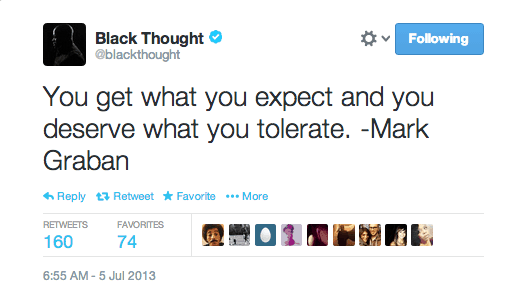
I would still love to know how that phrase got into his brain and his Twitter feed. Does he have a relative who is working in a hospital and got exposed to my book? I learned the phrase during my time at J&J from one of our Lean coaches and I don't know the exact origin.
Who Said “You Deserve What You Tolerate”?
The exact origin of the phrase has been hard to pin down precisely, but the trail is fairly clear. Charlie Protzman, the Lean consultant and author, has confirmed that he introduced the phrase into J&J through his Lean seminars in the 1970s, sourcing it himself from a Reader's Digest article of that era. (Charlie left a comment to that effect on this post in 2017.) Karen Martin has separately noted similar wording from Dr. Phil's public-speaking material, which would be a parallel popularization rather than the source. The 1970s Reader's Digest version is the earliest credible thread I've seen.
I learned the phrase at J&J myself, from one of our Lean coaches — almost certainly downstream from Charlie's seminars. What matters more than attribution, however, is the principle behind it: leaders shape culture through what they allow to continue.
Here is how I shared it in my book, in a section on “standardized work”:
“There is a phrase that we use that attempts to capture the responsibility of leaders in overseeing standardized work: “You get what you expect and you deserve what you tolerate.” As leaders, if you expect that employees will follow the standardized work, you have to take time to go and see, to verify that the standardized work is actually being followed. If you tolerate people not following the standardized work, you deserve the outcomes that result from the standardized work not being followed.”
Lean Hospitals, 3rd Edition (Graban)
“You get what you expect” — leaders often sit back and whine that their employees aren't following bundles, protocols, or procedures. Leaders need to expect that they will be followed. This means that leaders have to work together with employees to figure out HOW to make that happen. If supplies aren't available, help fix that. If there's not enough time to do things the right way, help fix that.
Toyota certainly expects that no car or truck comes off the assembly line with a door missing. So, they make sure their systems make that happen. None of this is about “beating up on employees” in the sense of “I expect it, so you'd better do it!” It's about working together and making it possible for the right things to happen.
Imagine a hospital where leaders expect that infections, bed sores, and patient falls are going to happen. What's the reaction when one of these things occurs? The leaders might shrug their shoulders and maybe say “well, we're better than the average hospital.”
Now imagine a hospital where leaders expect that preventable harm does NOT happen. If an infection occurs, the leaders work with staff to investigate why that happened (looking at the process, not blaming the people). They work to implement countermeasures that will prevent future infections – because we believe it's possible to eliminate them.
“You deserve what you tolerate.” — the thought here is that leaders need to proactively manage their processes to get the results they are expecting (and desiring). Far too often, I see news reports where something bad happens in a hospital (like the Quaid twins getting the wrong medication), and a C-level executive says, “Procedures were not followed, and there's no excuse for that.”
I'm sure the day that error occurred was NOT the first day when procedures were not being followed. The COO can blame workers… but it's really the COO who is to blame. If the COO and other leaders were unaware that procedures are routinely not followed in hospitals… or if the COO knew and TOLERATED this condition, than the COO and the hospital deserved the embarrassment and shame. The Quaid twins, of course, deserved none of this.
If you're a hospital leader who walks by water on the floor in a hallway (and ignores it), then you deserve to have somebody slip and fall. If you walk past checksheets on the wall that indicate hourly rounding is not happening (and ignore it), then you deserve to have patients fall or get bedsores.
Again, the patients deserve none of this.
What Leaders Get Wrong About This Quote
The phrase “you deserve what you tolerate” is one of the most misused in leadership. I've seen it weaponized in three predictable ways.
First, leaders use it to blame middle managers. “We deserve these results because you tolerated this — fix your people.” This inverts the original meaning. The quote was always pointed at the most senior person in the room, not the most convenient.
Second, leaders use it as license for harshness. They walk past water on the floor for years, then one day decide to “stop tolerating” by writing someone up. The principle is about systemic responsibility, not selective punishment.
Third, leaders read “tolerate” as “ignore” and miss the deeper meaning. What you tolerate isn't only what you walk past. It's also what your systems make easy, what your incentives reward, and what your daily behavior signals as acceptable. A leader who says “I expect compliance with hand hygiene” while running unrealistic patient loads tolerates non-compliance through the design of the work — even if she'd punish it in a one-on-one conversation.
The honest version of the quote runs something like: I deserve what I have designed, staffed, funded, and rewarded. Most of the work of leadership is in that sentence, not in the more punchy original.
Stop Tolerating What You Say You Want to Eliminate
The quote “you get what you tolerate” isn't about punishment. It's about responsibility.
Leaders shape culture every single day — not through speeches or mission statements, but through what they walk past, what they ignore, and what they allow to repeat.
If broken processes are tolerated, they become standard practice.
If shortcuts are ignored, they become the norm.
If harm is excused as “just the way it is,” improvement stops.
High expectations alone don't create excellence. Systems do. Follow-up does. Visibility does. Support does.
When leaders:
- Go and see
- Verify that standards are followed
- Fix barriers instead of blaming people
- Refuse to normalize preventable harm
…they send a powerful signal: this matters.
Culture isn't what you announce.
Culture is what you consistently accept.
In healthcare — and in any industry — the question isn't just:
“What do we expect?”
It's:
“What are we allowing to continue?”
Because in the end, you truly do get what you expect — and you deserve what you tolerate.
Frequently Asked Questions
Who originally said “you deserve what you tolerate”?
The phrase appears to trace to a 1970s Reader's Digest article, brought into Lean management circles by consultant Charlie Protzman through his seminars at Johnson & Johnson. Karen Martin has noted similar wording from Dr. Phil's later public-speaking material, which appears to be a parallel popularization rather than the original source. I learned the phrase at J&J in the late 1990s, downstream from Protzman's work.
What does “you deserve what you tolerate” actually mean?
The phrase is about senior leadership responsibility, not blame for frontline staff. It means that the outcomes an organization produces — good or bad — are shaped over time by what leaders walk past, fund, staff, and reward. If leaders tolerate broken processes, ignored standards, or unsafe shortcuts, those outcomes are the consequence of leadership choices, not individual failures.
Is “you deserve what you tolerate” a Lean principle?
It's not formal Lean doctrine, but it's widely used in Lean management as a shorthand for leader standard work, gemba walks, and the responsibility leaders have for sustaining standardized work. The principle aligns closely with the “Respect for People” pillar of the Toyota Production System: leaders create the conditions for people to succeed.
How can leaders apply this principle without blaming employees?
The principle is dangerous if read as license to discipline staff. The more honest reading is: I deserve what I have designed, staffed, funded, and rewarded. Application means examining whether the system makes the right behavior possible, easy, and reinforced — not punishing people for the system's failures. Leaders who walk past water on the floor, then “stop tolerating” by writing someone up the day a patient slips, are misusing the quote.
What's the difference between expectations and tolerance in leadership?
Expectations are what you say you want. Tolerance is what you actually accept day after day. The gap between the two is where most leadership credibility is lost. High expectations without follow-through, system design, and visible support read as performative — and the team learns quickly that the real standard is whatever's tolerated, not whatever's announced.







Via Karen Martin:
I can’t believe this post has only gotten one comment. It has been driving my approach to policies, procedures, and problem solving as an assistant nurse manager for the past month. I’ve been quoting it, printing it and handing it out to all the staff. I had read it in your book, but seeing it broken down again on the blog reinvigorated it. Thanks Mark!
Thanks, Andy. Can you think of an example of something a hospital “tolerates” that it should not?
Hospitals (and providers) tolerate 12 hour shifts for nurses and 80 hour weeks for residents. You can’t expect to improve safety if you tolerate and maintain a system that mentally and physically exhausts providers.
Sad, but true. Excellent example, Andy. The healthcare often expects the humans working in these organizations to be superhuman – never get fatigued, never forget things, never mess up. It’s not possible.
Hence, the need to improve the system (reasonable working hours, etc.) and improve processes (to incorporate error proofing, etc.).
[…] You Get What You Expect and You Deserve What You Tolerate by Mark Graban. “If you tolerate bad processes, you deserve bad results. That’s true in any organization.” […]
[…] I came across a slightly different expression from Mark Graban that captured the essence of what I wanted to […]
Its been a guiding principle for my management style since 2000 when I learned from someone…not sure who I heard it from, but it is old.
Mark,
FYI – I introduced that phrase into J&J during my 5 day Lean Seminars and Consulting at Ohio Health and Florida Hospitals. It came from a Reader’s Digest article back in the 1970s. Not sure of that source though. It is in most of my books.
Charlie Protzman