

Toyota’s 1992 View: Standardized Work and Kaizen Are Two Sides of the Same Coin
Most Lean programs treat standardized work and kaizen as opposites. Standardized work is the rigid part. Kaizen is the creative part. One constrains, the other improves. Pick whichever side you prefer and argue with the other camp at the next conference.
The 1992 Toyota booklet doesn't see them as opposites. It sees them as parts of the same activity cycle, carried out by the same people and connected through the same standards. Standardized work establishes the current method. Kaizen revises it. The standard connects the two.
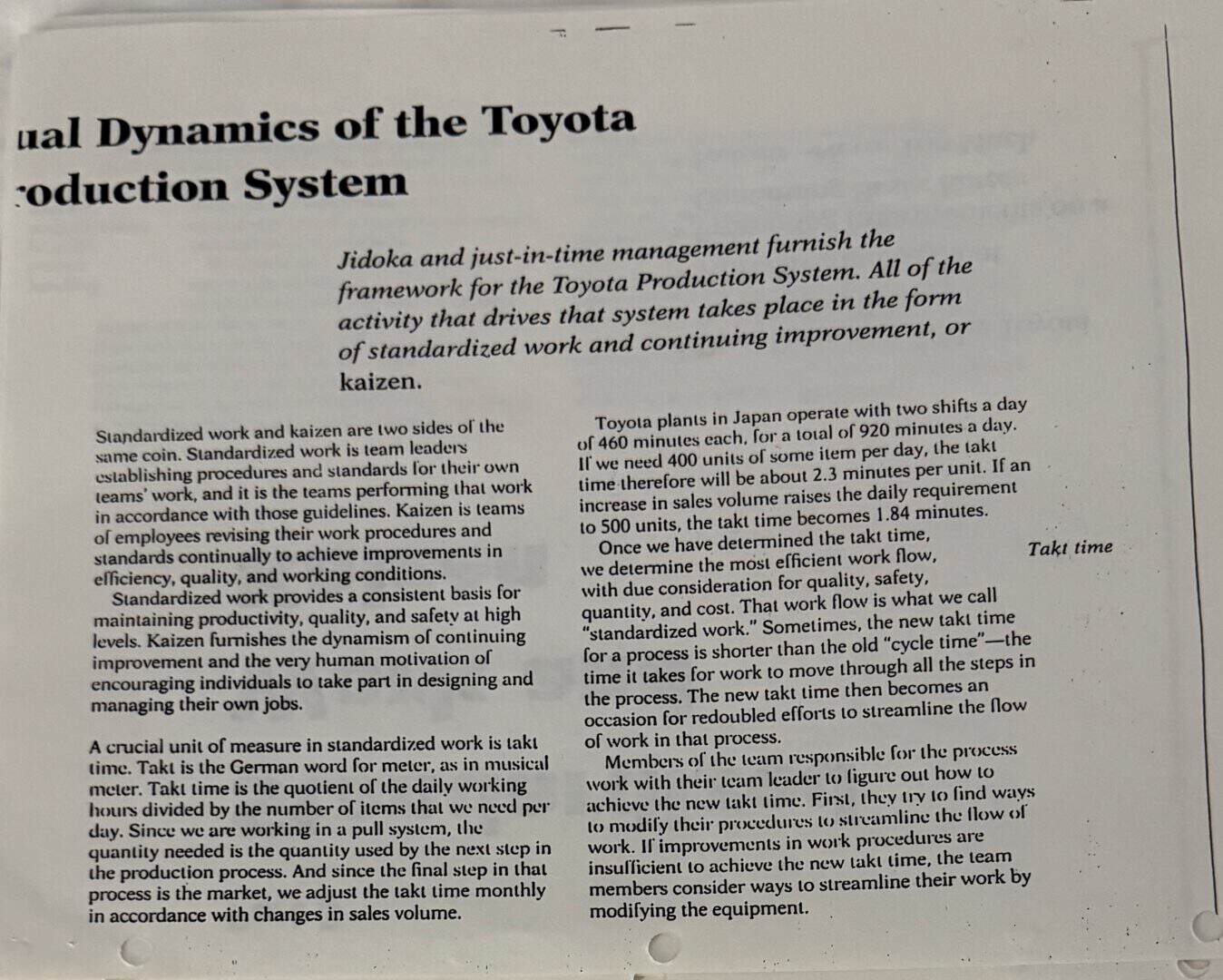
The section is called “Dual Dynamics of the Toyota Production System.”
Worth reading slowly:
“Standardized work and kaizen are two sides of the same coin. Standardized work is team leaders establishing procedures and standards for their own teams' work, and it is the teams performing that work in accordance with those guidelines. Kaizen is teams of employees revising their work procedures and standards continually to achieve improvements in efficiency, quality, and working conditions.”
Same teams. Same work procedures. Same standards. Standardized work establishes and follows the current method. Kaizen revises that method to improve efficiency, quality, or working conditions. The standard connects the two.
This is the sixth and final post in my series on Toyota's April 1992 publication, The Toyota Production System. It's a fitting place to end because standardized work connects many of the booklet's other themes.
Related post: Fujio Cho on Standardized Work: The Foundation for Improvement, Not Control
The misreading
A common misreading goes like this: standardized work means following a rigid procedure. Workers do what the document says. Deviation is bad. Compliance is good. Kaizen, when it happens at all, becomes a separate activity–a scheduled workshop, often led by an outside facilitator.
In that frame, standardized work and kaizen sit in tension. The standard is what you have to follow. The kaizen is what you do to escape the standard.
The 1992 booklet doesn't recognize that frame. The standard isn't simply imposed on the team by someone far removed from the work. The team leader and employees establish it, use it, and revise it together. The standard describes their current method, and the people doing the work are responsible for both following it and improving it.
The booklet is explicit on this point: “An especially important aspect of standardized work at Toyota is that the employees who implement its guidelines are the same people who establish those guidelines.”
That sentence contains the central argument. When the people who establish the standard are separated from the people who perform the work, the improvement loop Toyota describes breaks down.
Why the standard matters for kaizen
There's an implicit claim in the “two sides of the same coin” framing that's worth surfacing. The standard isn't the enemy of improvement. It's the precondition for it.
Without a current standard, the team lacks a stable baseline for judging whether a change improved the process. If three shifts perform the same work three different ways, any observed result is harder to connect to a specific method.
The booklet describes the loop directly:
“Members of the team responsible for the process work with their team leader to figure out how to achieve the new takt time. First, they try to find ways to modify their procedures to streamline the flow of work. If improvements in work procedures are insufficient to achieve the new takt time, the team members consider ways to streamline their work by modifying the equipment.”
Notice what's happening. Demand changes, producing a new takt time that the team must meet. Their first move isn't to schedule a workshop. It's to revise their own work procedures. That revision is kaizen, even though the passage presents it simply as the team's normal response to changing conditions.
In Toyota's framing, kaizen isn't an event. It's how the team keeps the standard from becoming obsolete.
The platform, not the constraint
The standard isn't merely a constraint on the team. It provides the platform for training, problem-solving, experimentation, and improvement.
Without a current standard, a team cannot reliably train people, coordinate work across shifts, troubleshoot problems, or evaluate changes. Even an imperfect standard provides a baseline the team can test and revise. It turns variation into a conscious choice rather than an accident.
Many American organizations have imported the standardized-work document without importing the improvement loop. The standard arrived from somewhere else–corporate, an industrial engineer, or a consultant–and the team was told to follow it.
The people doing the work had no meaningful role in establishing it and no authority to revise it. So the standard sat there, technically in force but practically ignored, while people continued doing the work the way they actually knew how to do it.
That isn't standardized work in the Toyota sense. That's a document on a clipboard.
What the booklet shows
The “Dual Dynamics” section shows four standardized-work worksheets: the Production Capacity Sheet, the Standardized Work Combination Table, the Standardized Work Chart, and the Operation Standards Sheet. Together, they document capacity, work sequence, takt time, standard in-process stock, and detailed operating steps.
These are detailed documents. The booklet shows photographs of actual examples, handwritten and typed, with diagrams.
Yet the booklet's most important point about these documents isn't their precision. It's who creates and maintains them.
“The team leader at each worksite is in charge of standardized work for his or her team. He or she assigns work in accordance with the monthly production schedule and with the team's capacity. The standardized work changes in reflection of the monthly changes in production, and employees must be able to respond flexibly.”
The standardized work changes as monthly production requirements change. The team leader and employees establish it, follow it, and revise it as conditions change. The document matters, but the document alone is not standardized work. It is a snapshot of the team's current best method.
What this means for the series
The series began with the Foreword's claim that maximizing quality and productivity depends on tapping employees' judgment and creativity. That claim connects nearly everything else in the booklet.
The line-stop cord depends on employees having the authority to stop production. The 97% kaizen implementation rate depends on their ability to change the work. The leadership shadow reflects whether leaders create the conditions for that authority to be exercised. One-piece flow helps employees see and act on problems while the causes are still close. And the standardized work-kaizen loop depends on the people doing the work participating in establishing and revising the method.
These aren't isolated practices. They depend on the same underlying conditions.
The booklet doesn't state that argument explicitly. It describes each element on its own terms. But read end to end, the connection is hard to miss: employees need the authority to act, the responsibility to improve, and a current standard that anchors both.
The forty-page booklet makes that argument mostly by showing rather than telling.
What the booklet still gets right
I started this series wondering whether a 1992 Toyota booklet still had something useful to say in 2026. After six posts, my answer is yes–but its greatest value is no longer the mechanics.
The booklet describes kanban, andon, leveling, and standardized-work worksheets. Those mechanisms are now documented elsewhere in far greater depth. The booklet is no longer the best implementation guide.
What the booklet still offers is an integrated view of the system. It doesn't separate technical practices from leadership behavior, employee authority, and daily improvement. Standardized work and kaizen are presented not as competing programs, but as connected responsibilities within the same management system.
The Lean field has spent decades pulling those elements apart, naming them separately, and writing books about each one. Much of that work has been useful. But the booklet's integrated framing is worth recovering: the people who perform the work must also have a meaningful role in establishing and improving how it is done.
If you're a leader trying to build something like what Toyota built, the first question isn't which tool to introduce. It's whether the people doing the work have a meaningful role in establishing the standard, the authority to improve it, and the support to do both.
What standard did your team revise this month, and who decided it needed revising?