

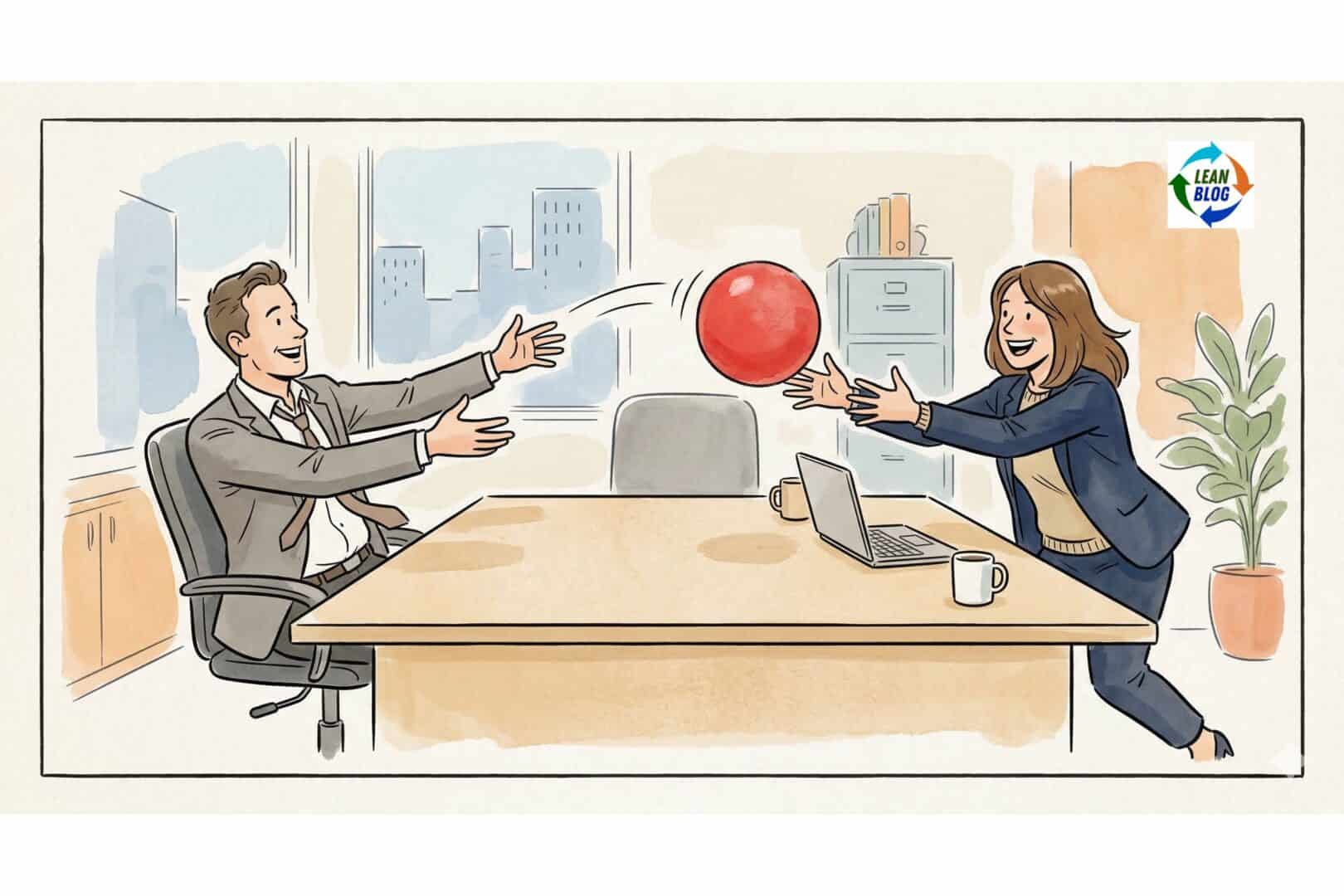
In strategy deployment — also known as hoshin kanri — there's a practice called “catch ball.” The metaphor is pretty straightforward. Goals and priorities flow down from senior leadership. Ideas and feedback flow up from frontline staff and managers. Both sides adjust based on what they hear. It's collaborative. It's iterative. It's how alignment actually happens.
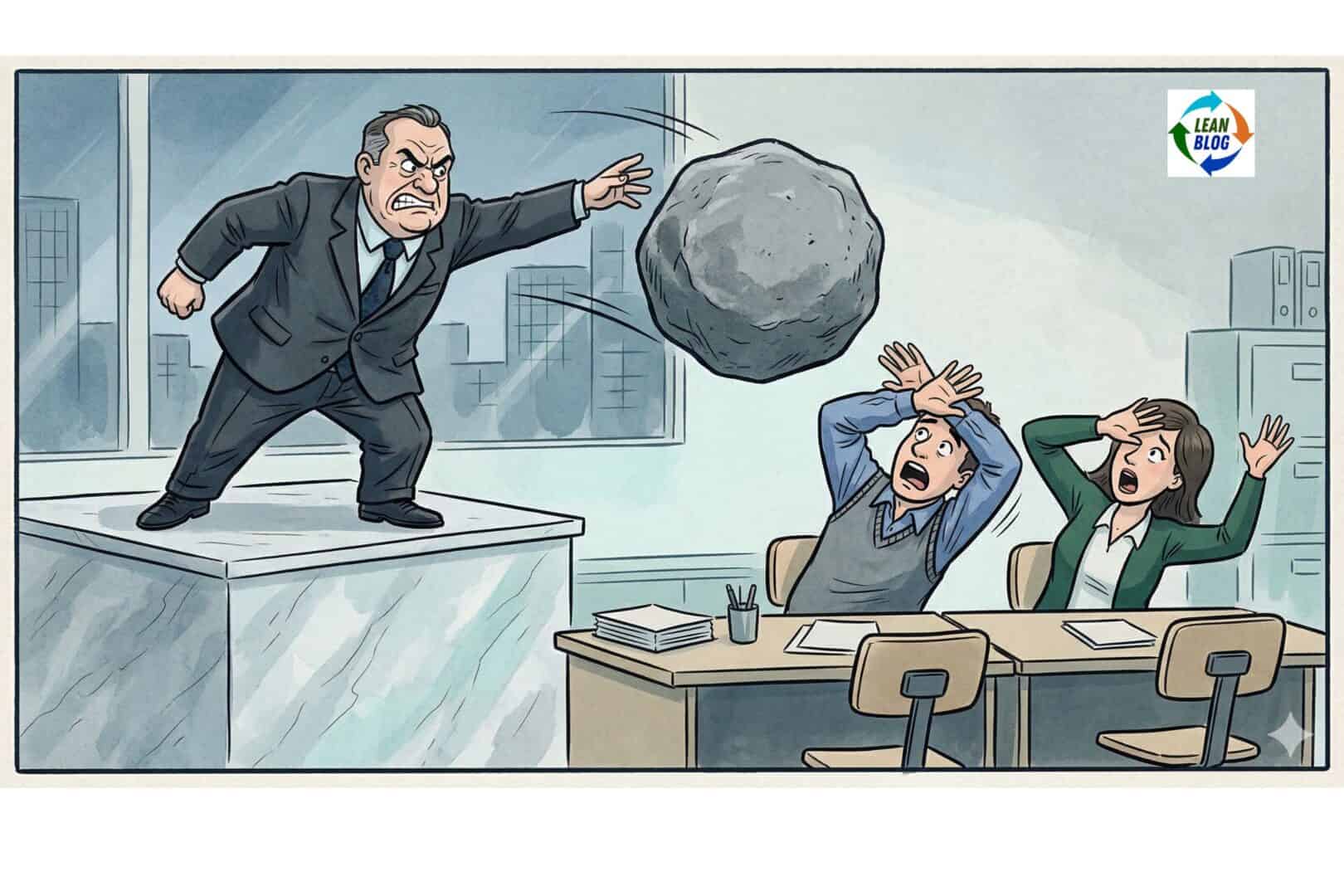
But what a lot of organizations practice is something closer to “chuck rock.”
That's as bad grammatically, in English, as “catch ball” is.
The important problem is the behaviors.
Leadership announces the goals. The goals cascade down. Nobody asks whether the goals make sense at every level. Nobody adjusts anything based on what the people doing the work actually know. It's top-down mandate dressed up in strategic planning language.
The difference between catch ball and chuck rock is the difference between a conversation and a command.
Why Chuck Rock Feels Efficient (But Isn't)
There's a reason so many organizations default to top-down-only goal deployment. It feels decisive. It looks like leadership. And it avoids the messy, time-consuming process of actually listening to people at other levels of the organization.
But the real inefficiency isn't the time spent in conversation. It's the year spent executing against metrics that don't match the work. It's the quarter lost chasing 400 “top priorities” that cancel each other out. It's the frontline manager who nods in the planning meeting, walks back to her unit, and quietly tracks what actually matters on a sticky note because the official metric is useless.
That's the hidden cost of skipping the conversation — not wasted meeting time, but wasted execution time. And most organizations never account for it because they never see the goals that should have been adjusted but weren't.
As W. Edwards Deming used to ask:
“By what method?”
Setting a target and walking away is not a strategy. It's a wish.
As I wrote in Lean Hospitals, strategy deployment distinguishes itself from older “management by objectives” or “goal deployment” methods specifically because it isn't only top-down. The catch ball process ensures that goals are adjusted based on feedback from managers, and improvement ideas from employees receive input from their leaders. That collaboration is what makes it work.
When you skip that step — when you chuck the rock instead of tossing the ball — you get the three outcomes Brian Joiner warned about in Fourth Generation Management. People who are pressured to hit a target without proper support and an effective improvement methodology will tend to distort the numbers, distort the system, or — the one we actually want — improve the system. The first two are almost always easier.
The L&D Story: Why “Aligned” Doesn't Mean “Identical”
One of my favorite examples from Lean Hospitals illustrates exactly why catch ball matters. At one hospital, the initial top-down metric for patient safety was the number of falls per unit. This was supposed to cascade to every department. But the labor and delivery manager pushed back. Her patients are young and generally don't fall. A zero-falls target would have been effortless to hit — and completely meaningless.
L&D substituted a patient safety metric that actually reflected the risks their patients faced. That's catch ball. The goal — patient safety — came from the top. The specific measure was shaped by the people who understood the work.
If that had been a chuck-rock situation, L&D would have spent a year tracking a metric that told them nothing, while the real risks went unmeasured. And the dashboard would have looked great — all green, zero falls, mission accomplished. The most dangerous kind of success.
What Catch Ball is Actually Like
In a Lean organization, goals, objectives, and strategy tend to flow top-down. Ideas and solutions should generally flow from the bottom up, with the assumption that frontline employees are closest to the process and the customer — and are, therefore, the experts.
That's not a free-for-all. It's structured. As John Shook has taught, strategy deployment is neither completely top down nor completely bottom up. Strategies and goals flow generally in a top-down direction, while ideas generally flow upward from frontline staff. In both directions, there's a catch ball process of collaboration.
At Baylor Scott & White Health, daily huddles were taking place at every level of the organization. Through tiered huddles, information about immediate risks or challenges could flow up to the executive team within a few hours — and important updates can flow back down to frontline staff and middle managers by the next day. That kind of rhythm is what makes catch ball a daily practice, not a once-a-year planning exercise.
At ThedaCare, the senior leadership visual room displayed strategic initiatives, but it also included a process for formally “deselecting” initiatives that aren't priorities for the current year. That “yes, but not now” list stayed visible so ideas aren't forgotten — just deferred.
One health system started their strategy deployment journey by having the senior team identify “top priority” projects. The initial list totaled over 400. Through some long and heated discussions, they narrowed it to the 20 that were truly “must do, can't fail.”
That kind of focus is the other side of catch ball. It's not just about getting input. It's about making choices together.
The Cost of Skipping the Conversation
Here's what tends to happen in organizations that rely on chuck rock instead of catch ball: the goals look clean on paper, but they don't translate into meaningful action at the front lines. Managers nod along in the annual planning meeting and then quietly ignore metrics that don't match their reality. Staff shrug at targets they had no role in shaping. And leadership wonders why execution is so poor.
Catch ball reduces that risk. Not because it makes planning easier — it doesn't — but because it pressure-tests goals against reality before execution begins. A leader who has played catch ball with three levels of the organization knows where the resistance will come from, which metrics need local translation, and which initiatives will compete for the same resources. That leader doesn't get blindsided in Q3. The leader who chucked the rock finds out the hard way.
Chuck rock creates exactly that kind of adversarial dynamic. Catch ball creates something different — the kind of alignment where people at every level can explain how their work connects to the organization's direction, and where they have the support and the agency to actually improve.
So Which One Are You Playing?

Most leaders would say they practice catch ball. Very few would admit to chucking rocks. But the test isn't what happens in the planning room. It's what happens two levels down.
Can a frontline supervisor in your organization explain how their local metrics connect to the strategic priorities? Did they have any input into those metrics? Or were the metrics handed to them in a spreadsheet they had no role in building? The ball is supposed to go back and forth. If it only goes one direction — and it's heavy enough to leave a dent — you might not be playing the game you think you're playing.