

Psychological Safety at Toyota: How It Accelerates Digital Transformation and Strengthens TPS
tl;dr: Toyota treats psychological safety as a core requirement for learning, innovation, and digital transformation–not a “soft” extra. A new Japanese book and firsthand insights show how safety enables stronger TPS, faster learning, and better flow.
Psychological Safety as a Competitive Advantage at Toyota
Psychological Safety has become one of the most important topics in leadership and organizational improvement–and it's playing a far bigger role at Toyota than many people realize. During my recent workshop tour of Australia and New Zealand, I had the chance to reconnect with former Toyota Australia leader Barry McCarthy. Our conversation, along with a newly published Japanese book he recommended, offered fresh insight into how Psychological Safety directly supports Toyota's digital transformation (DX) and strengthens the Toyota Production System. It's written by Shintaro Fujihara, a longtime Toyota engineer, and published by JUSE.
I've long believed that Psychological Safety is a foundational–but often overlooked–element of Lean and TPS. Leaders like Mike Hoseus say the same, and this new book provides some of the clearest evidence yet. It highlights how Toyota intentionally nurtures Psychological Safety as a prerequisite for learning, innovation, and better workflow–not as something “soft,” but as something essential for performance.
In this post, I'll share what I learned from Barry, what the new book reveals, and why Psychological Safety is becoming a central pillar in Toyota's approach to digital transformation and organizational development. I didn't expect to learn about flying koalas, though!
For a broader look at this topic, see the complete guide: Psychological Safety in Lean Organizations.
Insights from a Former Toyota Leader
I did expect to learn something when I had the opportunity to meet up for lunch with a friend, former Toyota Australia leader Barry McCarthy. Barry's also the chair of this year's AME International Conference in St. Louis. I first met Barry back in 2018 when I went on a Japan Study trip with Barry and the Honsha Consulting team, and I learned a lot from him on that trip (check out my podcast with him about these topics).
Toyota and Psychological Safety: Insights from a New Japanese Book
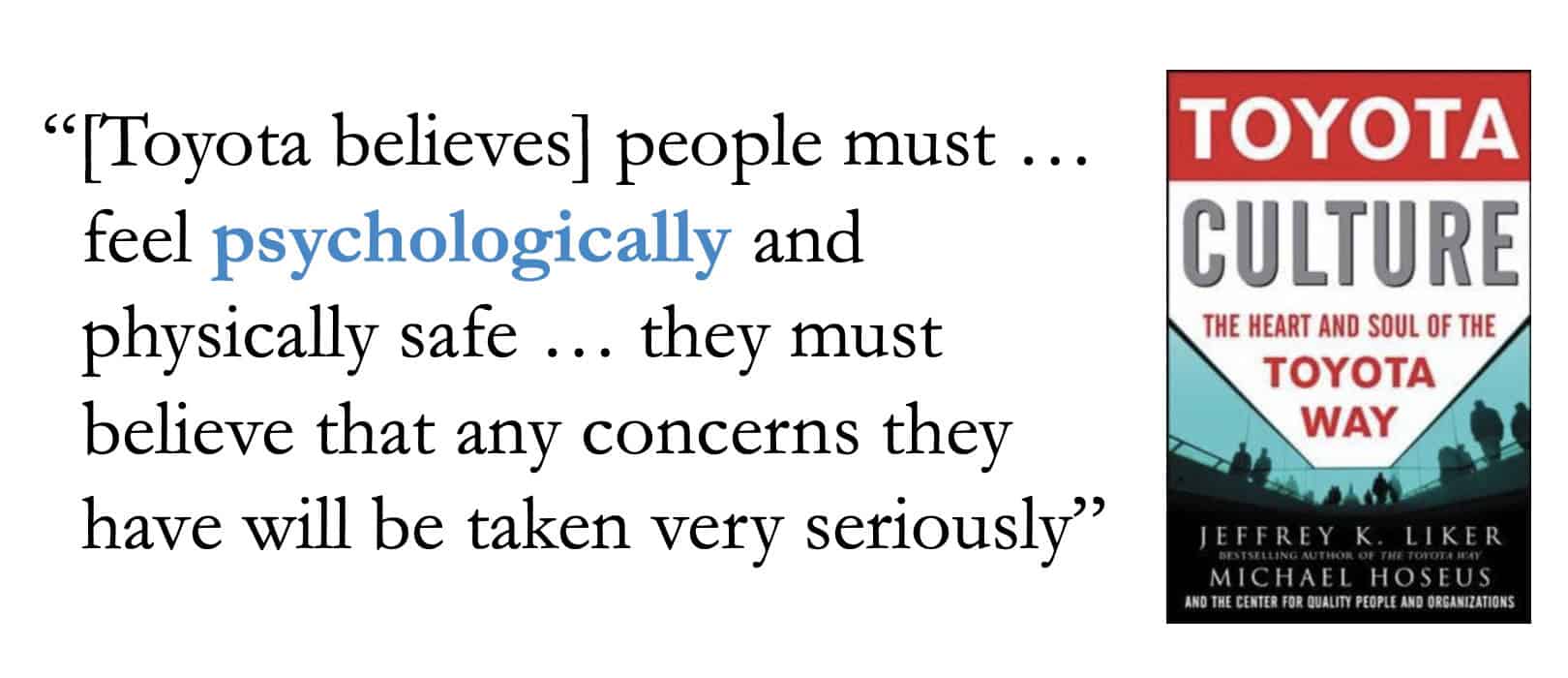
In recent years, I've come to believe that Psychological Safety is the oft-unheralded foundation of the Toyota Production System and Lean Management. Former Toyota Kentucky leader Mike Hoseus agrees, as we discussed in this Lean Blog Interviews episode — and as mentioned in the book Toyota Culture, that Mike co-authored with Jeff Liker.
I've learned a lot from Barry about Toyota as a “human development company,” as we discussed in his episode.
He agrees with me about the direct importance of Psychological Safety at Toyota — and that it's something they intentionally nurture.
One new piece of direct evidence of this is a book that was published, in Japanese, back in late 2023. The title can be translated to English as:
Barry shared his summary of the book (as translated by him via Google) and I ordered it from Amazon Japan based on his recommendation. When I got home, the book was waiting for me.
“DX” is jargon (an abbreviation) for “digital transformation,” something that's increasingly important to Toyota.
Back to the title — I suspect that “make workau flow better” might be a better translation since we don't normally try to “speed up work” directly through the Lean methodology. Lean is more about reducing and eliminating barriers to flow and not a matter of pressuring people to work faster.
The ChatGPT translation of the title says:
“Supporting Toyota-Style DX: Two Kata That Achieve Psychological Safety and Speed in Work”
“A way of speaking that resonates with young workers” and
“A way to move work forward”
I've been running pages through ChatGPT as a translation tool. It's incredibly fast. You take a photo of a page (or pages) and out comes the translation. I've been uploading photos in a batch size of “chapter” so ChatGPT can perhaps look at the full context of the chapter instead of only seeing page by page.
Hear Mark read this post — subscribe to Lean Blog Audio
Problem Statement
Before jumping into what Psychological Safety is, the book poses a problem statement:
“A diagnostic list for managers–if you mark 3 or more “yes,” you should seriously reconsider your current management style. Examples include:
- “I've never said ‘thank you' to a team member today.”
- “I find the word ‘challenge' cringeworthy.”
- “I haven't talked to anyone outside my own department.”
- “I tend to suppress my real opinions at work.”
I think a good question for leaders is: “Do you remember the last time an employee disagreed with you?” If the answer is “no,” then you have a problem.
What Psychological Safety Really Means at Toyota
(1) What is Psychological Safety?
“Being able to express honest opinions, candid doubts, and even disagree with others for the sake of organizational or team results–without fear.”
— Atsusuke Ishii, 2020, Japanese Management Skills Association
I think that's a great definition. The standard definitions of Psychological Safety, from Amy Edmondson and others, is that P.S. is about feeling safe to speak up about, basically, anything at work.
Why Psychological Safety Drives Performance–Not Comfort
Is Psychological Safety just a nice way to treat people? No. It's also about business success:
“Psychological safety is a leading indicator for organizational learning, growth, and long-term performance.”
The book also does a good job of explaining what P.S. is NOT:
A common misunderstanding is to associate psychological safety with a “soft” or “low-pressure” environment. But “psychological safety” doesn't mean “you don't have to work hard.” That would create a dead workplace.
Toyota's goal is a “learning organization,” not a soft one.
Respecting every individual means challenging them because you believe they can do better… not being soft or easy on them.
The book explains how P.S. is an imperative–that reducing fear leads to more innovation and that's why “…Toyota is investing so deeply in psychological safety.”
“Improving psychological safety became a precondition for advancing digital transformation.”
How Psychological Safety Enables Toyota's Digital Transformation
How did Toyota prove the connection?
“In employee satisfaction surveys, a surprising result emerged: when psychological safety increased, scores in well-being, communication, and innovation all rose.
The impact was especially visible in locations where teams created a safe space for honest feedback and mistake-sharing.”
From Insight to Action: Lessons for Leaders Beyond Toyota
Toyota's experience makes one thing unmistakably clear: psychological safety is not a cultural “nice to have” — it's an operational requirement. Without it, learning slows, problems stay hidden, and even the best digital tools fail to deliver their promise.
What this new research and firsthand experience reinforce is that Toyota doesn't treat psychological safety as a side initiative or an HR program. It's intentionally designed into leadership behavior, daily work, and how problems are discussed. That's what allows Toyota to strengthen the Toyota Production System and adapt it for a digital future.
Final Takeaway: Psychological Safety Must Be Designed
For leaders outside Toyota, the lesson isn't to copy tools or terminology — it's to ask harder questions about your own system:
- How safe is it to challenge assumptions?
- How quickly do problems surface?
- How often do people speak honestly about what's not working?
Those answers determine whether improvement is accidental — or built in.
If you'd like help assessing psychological safety, translating insights like these into practical leadership behaviors, or connecting Lean, TPS, and digital transformation in a way that actually works, I'd be glad to help — through consulting, workshops, or keynote speaking.
Psychological safety doesn't happen by chance. It's designed — or it's absent.
Let's talk about how to build a culture where people feel safe to speak up, solve problems, and learn their way forward.





[…] Source: How Psychological Safety Drives Digital Transformation and the Toyota Production System (or Lean) […]