

Gemba vs Genba: What Japanese Speakers Actually Say
TL;DR: Gemba and genba are the same Japanese word (現場), meaning “the actual place.” Japanese speakers, including native speakers and bilingual Lean professionals who've lived in Japan, all confirm: it's a romanization difference, not a meaning difference. The Lean world popularized “gemba.” Toyota and modern linguistic conventions favor “genba.” Both are correct. Stop arguing about it.
When Lean practitioners argue about whether it's “gemba” or “genba,” the answer usually comes from another Lean practitioner — repeating what they were taught. I went and asked native Japanese speakers and bilingual Lean professionals who've lived and worked in Japan. The answer is settled, and it's not what most people think.
What Does Gemba (Genba) Mean?
Gemba (現場) (also spelled genba) is a Japanese word meaning “the actual place.” In Lean management, it refers to going to the real place where work happens in order to observe processes, understand problems, and support improvement.
If you've ever wondered why Toyota spells it one way and Lean books spell it another, you're not alone.
A “gemba walk” refers to leaders going to the gemba — the actual place where work happens — to observe, learn, and support improvement.
Gemba vs. Genba: Why the Spelling Confusion Exists

People often ask whether “gemba” or “genba” is the correct term in Lean. You'll see both spellings used in books, training materials, and Toyota-related content–and the inconsistency leads to confusion, debate, and sometimes unnecessary argument. Are these different words? Do they have different meanings? Or is this simply a translation issue that's taken on a life of its own?
The short answer: they're the same Japanese word, with the same meaning, expressed through different romanization conventions. The longer answer–and the more useful one–helps explain why both spellings exist, how Lean literature popularized one version, why Toyota tends to use the other, and why focusing too much on spelling misses the real point of gemba/genba in the first place.
I was taught that the English version of the Japanese word that means, basically, “the real place” or “the shopfloor” is spelled “gemba.” But not everybody agrees.
People searching for “gemba meaning” or “genba meaning” are usually trying to understand whether the words are different — they're not.
Why “Gemba” Became the Dominant Spelling in Lean
And we see that spelling used quite often, including:
- Gemba Academy
- Masaaki Imai's book Gemba Kaizen
- Jim Womack's book Gemba Walks
- Michael Bremer's book How to Do a Gemba Walk
So “gemba” doesn't seem wrong.
Some companies and sources use “GEMBA,” but there's no reason for it to be in all caps. That might be the only incorrect option.
But, in recent years, I've seen more references to the same word being spelled “genba” with an “n.”
Many say that “genba” is the technically correct spelling these days. But it used to be translated as “gemba.”
Confusing, right?
Japanese Romanization: How One Word Becomes Two Spellings
I've heard that the variation in English / Western spelling is a matter of the difficulties in translating from Japanese kanji characters (現場) to the Roman / Latin alphabet — and that the sound of the letter in Japanese might sound like an “m” or an “n.” Some say the “n” and “ba” together sound like an “m,” which confuses people.
In Japanese, the syllable “n” naturally changes depending on the consonant that follows it. Before a “b” sound, it is pronounced with the lips closed, so it can sound like an “m.” That's why the same word may be romanized as either “genba” (the literal transliteration) or “gemba” (the way many English speakers hear it).
Here's a small detail with outsized importance: Toyota's global website uses “genba” exclusively. A search for “gemba” on Toyota's official global site returns zero results and suggests “did you mean genba?” Toyota — the company that originated the practice — has settled on the literal Japanese romanization. The Lean consulting world has not followed.
There are some books that use the “n” spelling in the title:
- Stories From The Genba: Conversations With Japan-Insider Country Managers
- Super Genba: Ten Things Japanese Companies Must Do to Gain Global Competitiveness
The spelling “Genba” just looks incorrect to me when used in a Lean context, even though I know it's not a typo. There's more to it than that.
I normally don't spend too much thinking about this — and I'm certainly not spending time online arguing about which is correct. So why am I blogging about this?
Hear Mark read this post — subscribe to Lean Blog Audio
What Japanese Speakers and Bilingual Lean Practitioners Say
One listener even suggested ‘genba' was a police term for crime scenes while ‘gemba' was the shop floor — a creative theory, but Japanese speakers were unanimous in saying it's the same word
To check this firsthand, I asked friends with varying levels of Japanese fluency — including native speakers and bilingual Lean practitioners who've lived and worked in Japan. The replies were remarkably consistent.
Jon Miller:
Jon grew up in Japan and wrote about this as a comment on this blog post:
Yes. “Gemba” is the same as “genba,” and it does mean “actual place” and, in common use, “factory floor” or “workplace.”
He also replied to an email about this, saying:
“Both spellings same word same meaning. 現場, actual place. Cops say “let's go to the…” when they mean crime scene, accident scene, etc. Filming on location, reporting from a warzone, construction site, shop floor, all the same gemba / genba.”
Dan Markovitz:
Dan lived and worked in Japan after college. He replied to my email:
“In my experience and classroom instruction, it's just a matter of transcribing Japanese sounds into Roman letters. In Japanese, the word is spelled with the phonetic symbol corresponding to “n,” so technically, you could spell it “genba” and be correct. However, I suspect that it just sounds better with an “m,” and hence we use the word “gemba.””
Katie Anderson:
Katie, author of Learning to Lead, Leading to Learn, lived in Japan and studied Japanese for a few years recently. Her reply to my email:
“It is the way the Japanese language is translated to Roman characters.
So genba is actually correct.
But somewhere along the line, English speakers heard it as gemba and that is what was popularized.
But there is no “gemba” that can be written in Japanese :) “
Hide Oba:
Hide is a TPS consultant, the son of the late Hajime Oba. Check out my podcast episode with Hide.
Here is his reply to me, as a native Japanese speaker:
“I also don't care about the spelling, but I posted about this topic.
I only found the difference in translation style, no difference in meaning.
We don't have different pronunciations of this word, genba.”
Here is the blog post he wrote and shared with me about Genba.
Gemba vs. Genba: Side-by-Side Comparison
| Spelling | Origin | Used By | Meaning |
| Gemba | Older Western usage; sound-based | Imai, Womack, traditional Lean literature | Same word: “actual place” |
| Genba | Modern romanization of 現場 | Toyota, linguistic standards | Same word: “actual place” |
So which should you use?
If you're writing for a Lean audience, use “gemba.” It's the convention they expect, and it's what Imai, Womack, and the major Lean institutions use.
If you're writing for or working with Toyota, use “genba.” That's their corporate standard.
If you're writing for a Japanese-fluent or linguistics-attentive audience, use “genba.” It's the technically accurate romanization.
If you're not sure, use whichever your team or organization already uses, and don't switch mid-document. Consistency matters more than choice.
Other Voices / Articles:
By Art Smalley: Is it Genba or Gemba?
He says “genba” is technically correct and adds:
“Personally I use the “Genba” spelling version simply because I learned it that way in Japan in language classes long before I ever worked for Toyota Motor Corporation in Aichi Prefecture or became a lean consultant. Old habits (especially when they are technically correct) are hard to break. And this one I really don't think particularly matters all that much in the end. British English and American English often for example have words which are spelled or pronounced slightly differently and yet we manage to communicate.“
A Toyota UK Website: Genba – Toyota Production System guide
The funny thing here is that the article was originally written using the word “genba.”
But a former Toyota UK employee posted a snippy comment:
“The word is GEMBA. Please correct this as it undermines the perceived Toyota knowledge base. I've already raised this once without response (something completely unacceptable when I was a TMUK Quality Engineer!)”
So a Toyota blogger responded:
“Either Genba or Gemba is acceptable as the word does not translate directly into English.”
Toyota's Global Website:
This was sent to me by a LinkedIn connection:
“I had the same conversation with colleagues and found an interesting correction in Toyotas web site.
If you search for the word Gemba in Toyota's global site you get 0 results and it asks if you meant Genba. Looking for Genba brings up all of Toyota's articles.
There is no real difference, but I found it interesting.”
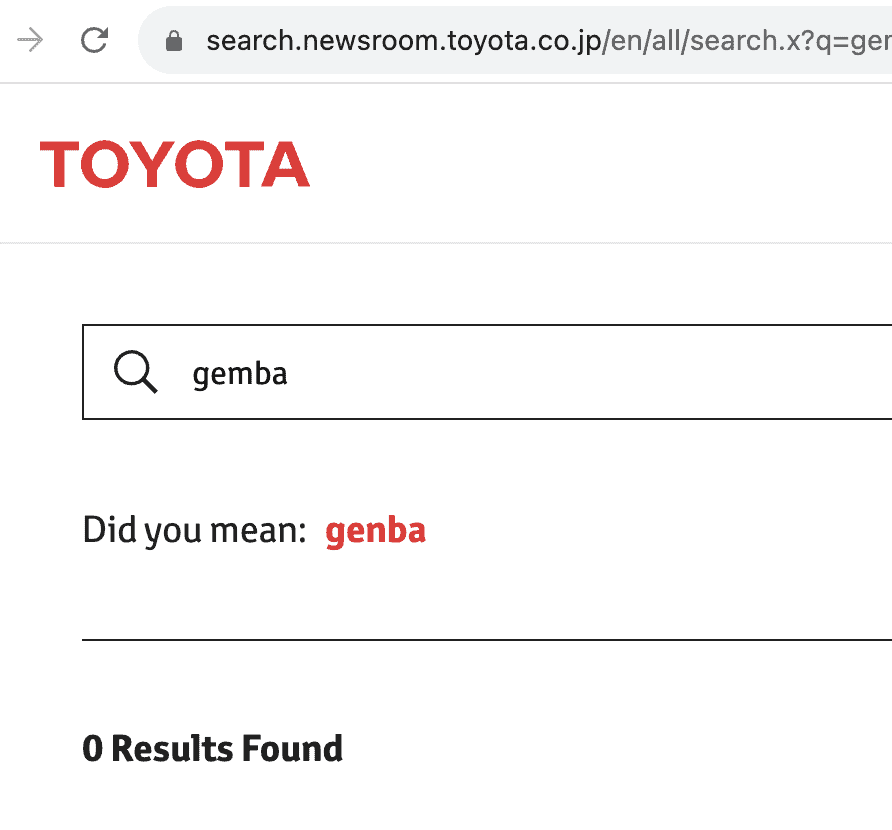
At this point, it's fair to ask which spelling you should use. Modern romanization standards favor “genba,” while decades of Lean literature popularized “gemba.” Both are correct. What matters is choosing one and using it consistently, not which version you choose.
Just don't put it in ALL CAPS.
When I asked ChatGPT for sanity-checking, the bot's summary matched the human experts: same Japanese word (現場), romanization difference, no meaning difference. The Lean world chose “gemba” because that's how early English-language Lean texts spelled it. Toyota and linguists use “genba.”
What Matters More Than Spelling: Going to the Real Place
Whether you spell it Gemba or Genba, what truly matters is that you go there.
Leaders can get stuck debating terms, but improvement comes from habits. Whether the word uses an “m” or an “n,” the work is the same: seeing reality, understanding causes, and supporting people as they solve problems. The spelling is trivia; the behavior is the system.
The heart of Lean isn't in the transliteration–it's in the behavior: showing up at the actual place, observing with respect, asking good questions, and engaging people in improvement.
Spelling may vary, but purpose shouldn't.
If you're leading Lean efforts, don't spend energy debating spelling. The work matters more than the word. Build a culture where leaders routinely go to the real place, see the real work, and support people in solving real problems. That's what sustains improvement.
A Practical Question for Lean Leaders:
I'd like to hear from you:
- Have Gemba/Genba walks helped you see something you would have missed otherwise?
- Has the spelling ever caused confusion–or resistance–in your organization?
- Which spelling do you use, and why?
Your experiences can help others navigate the same questions.
Frequently Asked Questions About Gemba and Genba
What does gemba mean?
Gemba means “the actual place.” In Lean management, it refers to going to the real place where work is done so leaders can observe processes, understand problems firsthand, and support improvement.
What does genba mean?
Genba is the same Japanese word (現場). The spelling difference comes from romanization conventions. The meaning is identical: “the actual place.”
Which is correct: gemba or genba?
Both are correct. They're different romanizations of the same Japanese word (現場). “Genba” is the technically accurate transliteration and is what Toyota uses on its global website. “Gemba” became the dominant spelling in Lean literature because early Western authors heard the word and spelled it phonetically. The Lean community standardized around the phonetic spelling; Toyota and linguistically-precise sources use the literal one.
Do you say “go to gemba” or “go to the gemba”?
Both forms are common in practice and neither is wrong. “Go to gemba” treats the word as a place name (like “go to work”). “Go to the gemba” treats it as a noun (like “go to the shop floor”). The phrase you use is less important than the behavior — actually showing up at the real place to see the real work.
Is gemba/genba a Toyota term or a Lean term?
Both. The Japanese word 現場 predates the Toyota Production System and is used throughout Japanese society — by police, journalists, construction workers, factory workers, and engineers — to mean “the actual place” wherever something is happening. Toyota's use in TPS popularized it as a Lean concept, but the word itself is part of everyday Japanese.
Why does Toyota use “genba” instead of “gemba”?
Modern romanization standards favor “genba,” which is closer to the literal Japanese spelling. However, early Lean books popularized “gemba,” and that spelling became common in Western Lean literature.






beep bop bork GEMBA and LEAN should always be in all caps
just kidding.
LOL is that your ChatGPT voice or the Swedish Chef?
This is fascinating Mark, and it brings up an aspect of “Gemba” that I’m also curious about. Is it, “Go to Gemba” or “Go to the Gemba”? In the definitions above, it’s referred to as “the real place” and “real place”. So both can be true. Even though I generally avoid jargon in my continuous improvement work, I like the word “gemba” and English doesn’t offer up anything as intriguing. But when I do introduce it, I use “actual place” as the definition, because the phrase “Go to Gemba” feels like a tougher sell, and a bit awkward, for people learning to solve process problems. What do you think?
I guess I’ll fall on the “it doesn’t really matter” camp on that one. Neither one, “going to gemba” or “going to the gemba” sounds particularly awful or better to me.
I do agree we have to be careful with jargon… but gemba is a very flexible word.
We could say “shopfloor” in a factory but that’s not the only place where work is done in a manufacturing company.
This was sent to me by a LinkedIn connection:
“I had the same conversation with colleagues and found an interesting correction in Toyotas web site.
If you search for the word Gemba in Toyotas global site you get 0 results and it asks if you meant Genba. Looking for Genba brings up all of Toyotas articles.
There is no real difference, but I found it interesting.”
The search results:
https://search.newsroom.toyota.co.jp/en/all/search.x?q=genba&pagemax=20
I’ll add that to the post.
It’s funny that the Wikipedia entry address / URL uses “gemba” but then says that the word is “genba” (also romanized as “gemba.”).
https://en.wikipedia.org/wiki/Gemba
I’m prefer used ‘Gemba’ as to remember Masaaki Imai who is a 1st person promote with his book “Gemba Kaizen”. This was shared by one of Shingijutsu sensei (retired from TMC)
TPS purpose is to « Make job easier and develop human capital ».
So let’s make it simple and accessible to all members : Gemba=Genba !!
Thoughts from Reiko Kano, who I have met and worked with in Japan during some study trips: