
What Do We Mean by Vulnerable Acts in the Context of Psychological Safety?
TL;DR: Vulnerable acts at work include everyday behaviors like asking questions, admitting mistakes, and challenging ideas–and leaders build psychological safety by modeling and rewarding them.
Timothy R. Clark, who started his career in manufacturing leadership, is the author of The 4 Stages of Psychological Safety.
He has a short definition of psychological safety:
“A culture of rewarded vulnerability”
To unpack that definition, Clark defines culture as the sum of our human interactions.
What is “vulnerability”?
“exposure to the risk of harm or loss”
To create the conditions for psychological safety, leaders need to do two things: model and reward acts of vulnerability.
You Can Improve Psychological Safety by:
- Modeling vulnerable acts
- Rewarding vulnerable acts
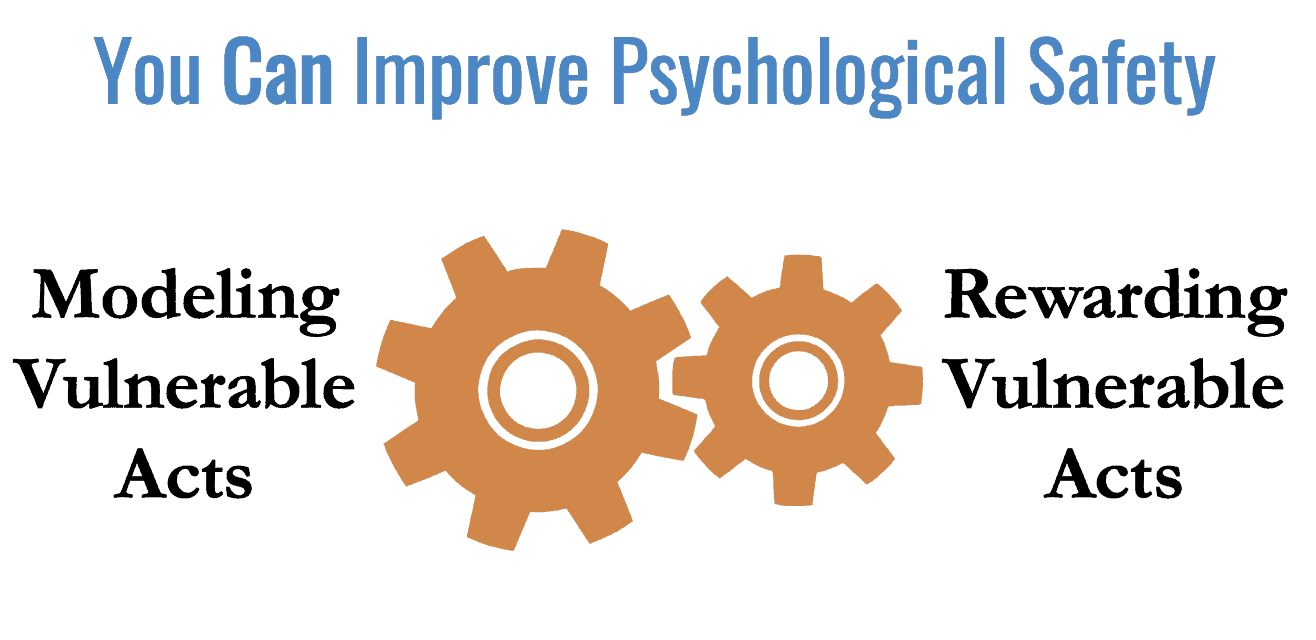
Rewarding vulnerable behaviors could include thanking an employee for speaking up, for asking questions, for challenging things. Taking a suggestion and turning it into action is rewarding the act of speaking up.
Punishment, on the other hand, could be overt — getting yelled at, punished, shunned, fired — or it could be subtle (just being ignored).
In a culture of psychological safety, we feel safe to:
- be ourselves
- learn, including asking questions and making mistakes
- contribute to our fullest capabilities
- challenge the status quo
As I work with leaders and teams on psychological safety, one trap or barrier can be our assumptions of what a “vulnerable act” might be.
For a broader look at this topic, see the complete guide: Psychological Safety in Lean Organizations.
“Let Me Be Vulnerable for a Minute”
When somebody prefaces a statement with something like, “Allow me to be vulnerable” or “I'm going to be vulnerable…” what do we expect to follow?
I think in everyday usage, we might expect to hear:
- Something personal
- Something potentially embarrassing
Those are indeed both vulnerable acts. But the definition goes far beyond that in the workplace.
Remember that vulnerability means exposure to loss or harm.
Sharing something personal or embarrassing could risk hurting your reputation or being ridiculed or shunned. That would be loss or harm. Studies show, as Dan Pink points out, that being vulnerable or admitting regrets or mistakes actually builds trust with people. Building trust creates the conditions for psychological safety. Sharing a mistake or something about yourself is an example of “modeling vulnerable acts.”
But as Clark points out, basically any human interaction is, on some level, a vulnerable act.
When we think about things we do or say, it's not an evaluation in terms of “yes/no” as in “vulnerable or not.” There are degrees of vulnerability, and it's very situational.
What Counts as a Vulnerable Act at Work?
The following list of vulnerable acts is by no means all-encompassing. Some of these acts will be more vulnerable in certain workplaces or teams — more risk of loss or harm. Some of these acts might feel more vulnerable to YOU than they would be to ME.
But my feeling of vulnerability will vary depending on the team I'm working with. I'm generally not afraid to point out opportunities for improvement. In some settings, that's not vulnerable at all – but in other settings, there might be the risk of being punished in some way (instead of being rewarded).
- asking a question
- sharing an idea
- acknowledging we don't know something
- saying “I made a mistake”
- sharing an experience
- just showing up
- sharing something about yourself
- doing anything for the first time
- asking for help
- introducing yourself
- calling out a potential error
- disagreeing with somebody
Labeling an act as “vulnerable” doesn't mean the action is bad. It doesn't mean the person shouldn't have spoken up to challenge something.
When leaders punish vulnerable acts… people will stop speaking up, they'll stop taking risks. They'll self-censor to protect themselves. That's why leaders need to REWARD vulnerable acts, including making mistakes. I explore that in my upcoming book, The Mistakes That Make Us, by the way.
LeaderFactor, Tim Clark's company that trained and certified me, as an excellent exercise called “The Ladder of Vulnerability.”
“The most practical way to increase psychological safety is to model acts of vulnerability yourself and reward the vulnerable acts of others. The Ladder of Vulnerability™ will give you examples of vulnerable acts in each of The 4 Stages.”
When doing this exercise, it's helpful to think through which acts feel most vulnerable to you in that setting and which acts feel least vulnerable. Sharing your ladder with your teammates can help you each understand each other better — building acceptance, inclusion, and respect.
As an example, when I did this exercise while working part-time with the KaiNexus team, here's how vulnerability showed up for me in that specific context:
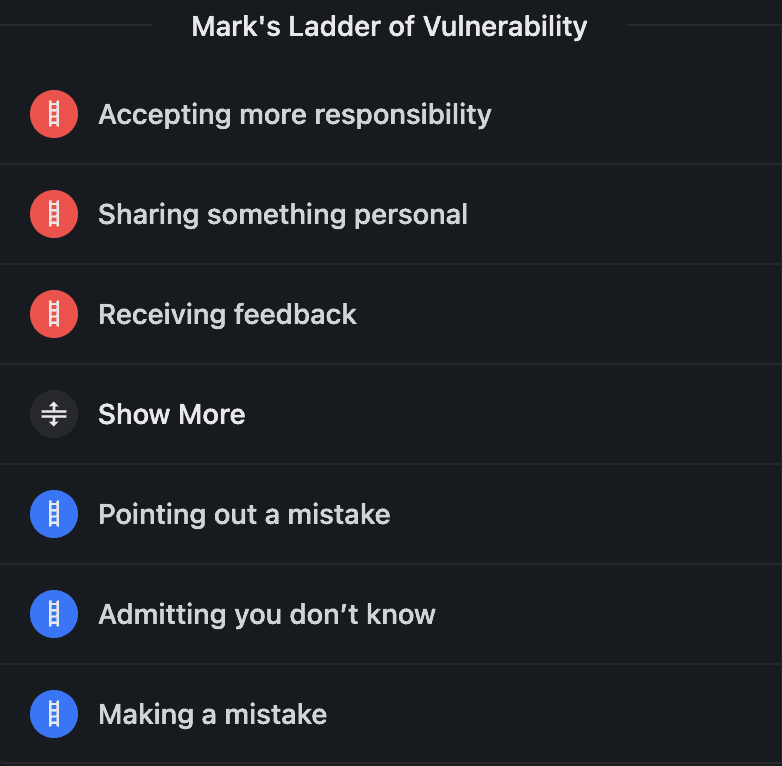
But it's all relative. To me, KaiNexus isn't a very risky or dangerous environment for me. I'm not really too concerned about receiving feedback. Even on a list of acts that aren't very vulnerable, there have to be three that are “most vulnerable” to me.
These lists would look different, for me, if I were thinking about other teams or other workplaces.
What Do You Experience? What Do You Think? How Do You Feel?
What do you think of these concepts? What vulnerable acts do you see in your meetings or other interactions with people? How many vulnerable acts are part of your daily life?
Writing a blog post and sharing it — that's a vulnerable act. You, as the reader, might hate it (and you might not have gotten this far). This post might hurt my reputation if it didn't make sense.
But, I'm open to feedback — please feel free to leave a comment. I hope you feel like doing so isn't too vulnerable for you. What's the risk of loss or harm?
Read more about psychological safety
What Leaders Teach Through Their Response to Vulnerability
Psychological safety doesn't depend on grand gestures or deeply personal disclosures. It's built–or broken–through everyday interactions.
Asking a question. Admitting uncertainty. Pointing out a potential problem. Challenging an idea. Saying, “I made a mistake.” These are all vulnerable acts because they carry some risk of loss or harm, depending on the context and the people involved.
Leaders shape psychological safety not by declaring it important, but by how they respond in these moments. When vulnerable acts are ignored, minimized, or punished, people quickly learn to stay quiet and protect themselves. When those same acts are acknowledged, appreciated, and acted upon, people learn that it's safe to speak up.
That's why improving psychological safety isn't about encouraging people to “be more vulnerable.” It's about leaders consistently modeling vulnerability themselves–and rewarding it in others.
Every interaction teaches. The question is: what are people learning from yours?