

Hand Sanitizer Dispensers: When Simple Design Beats Fancy Technology
TL;DR: Hand sanitizer dispensers may seem trivial, but their design affects reliability, cost, and infection prevention. This post uses a Lean lens to show why simpler, manual solutions can outperform more complex electronic ones–especially in healthcare settings where failure isn't an option.
When “No Sanitizer Available” Is a Process Failure
I think I'm obsessed with hand sanitizer dispensers — especially in hospitals and other public places.
I've written before about my concept for a “two-bin hand sanitizer dispenser” that (when combined with better replenishment processes) would prevent empty dispensers from being found on the wall in hospitals.
It's a solvable problem, for sure — if we'd put our minds to it.
Look at how we've solved (or tried to solve) the problem of “running out of toilet paper”:
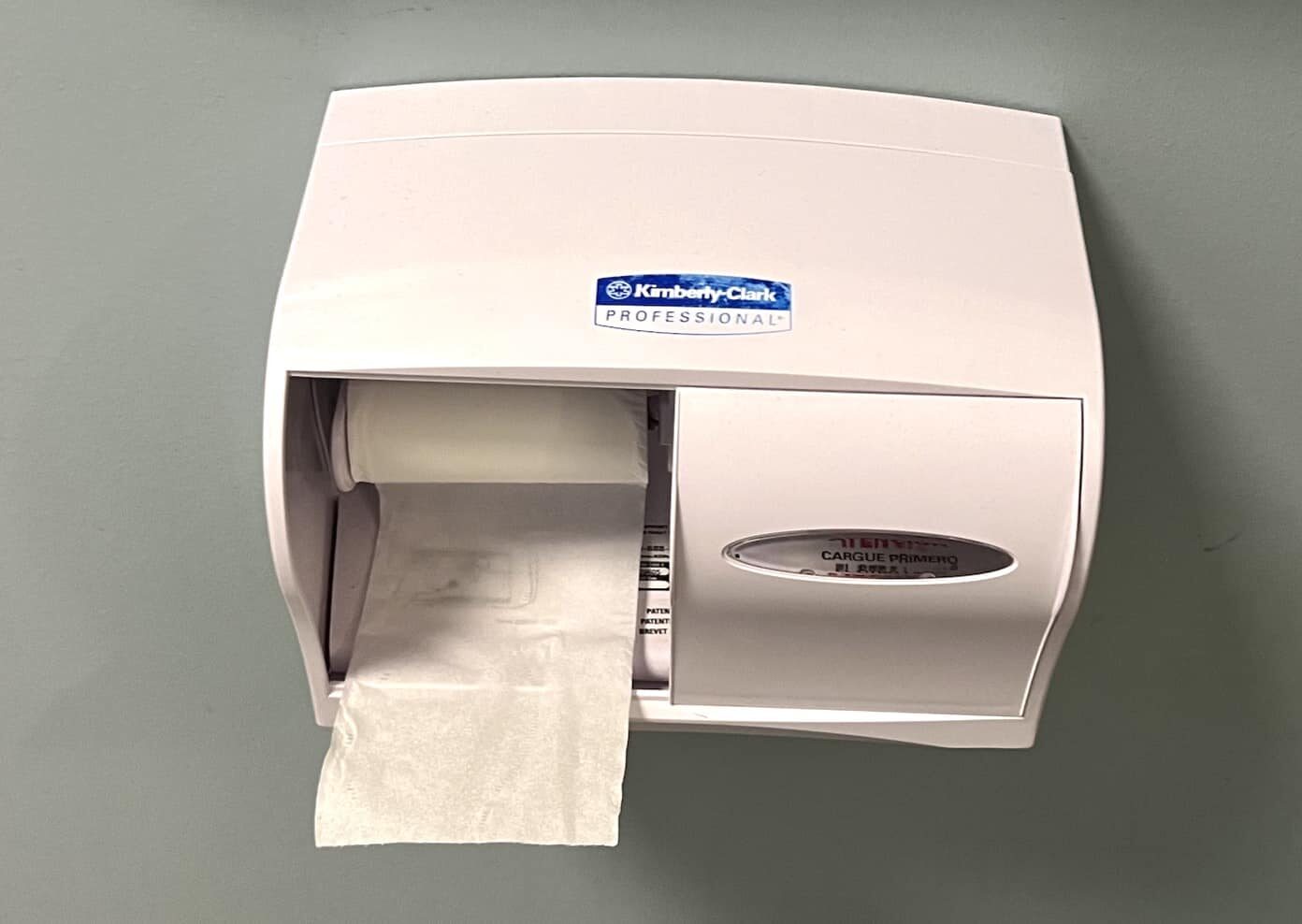
You can see where my two-bin hand sanitizer idea comes from.
From a Lean perspective, hand sanitizer dispenser design is less about novelty and more about reliability, ease of use, and keeping infection-prevention systems working every time.
How Added Complexity Creates New Failure Modes
There's the problem of empty dispensers. There are also related problems that lead to the same functional problem of “no hand sanitizer where it's needed”:
- Battery-powered dispensers that have dead batteries
- Proprietary hand sanitizer refills that lock you in to using only one type of bag / container
I'm generalizing, but in the U.S., we LOVE solutions that are fancy and high-tech. Here's a photo of two dispensers (from two different makers) that were side by side in a facility I saw recently:
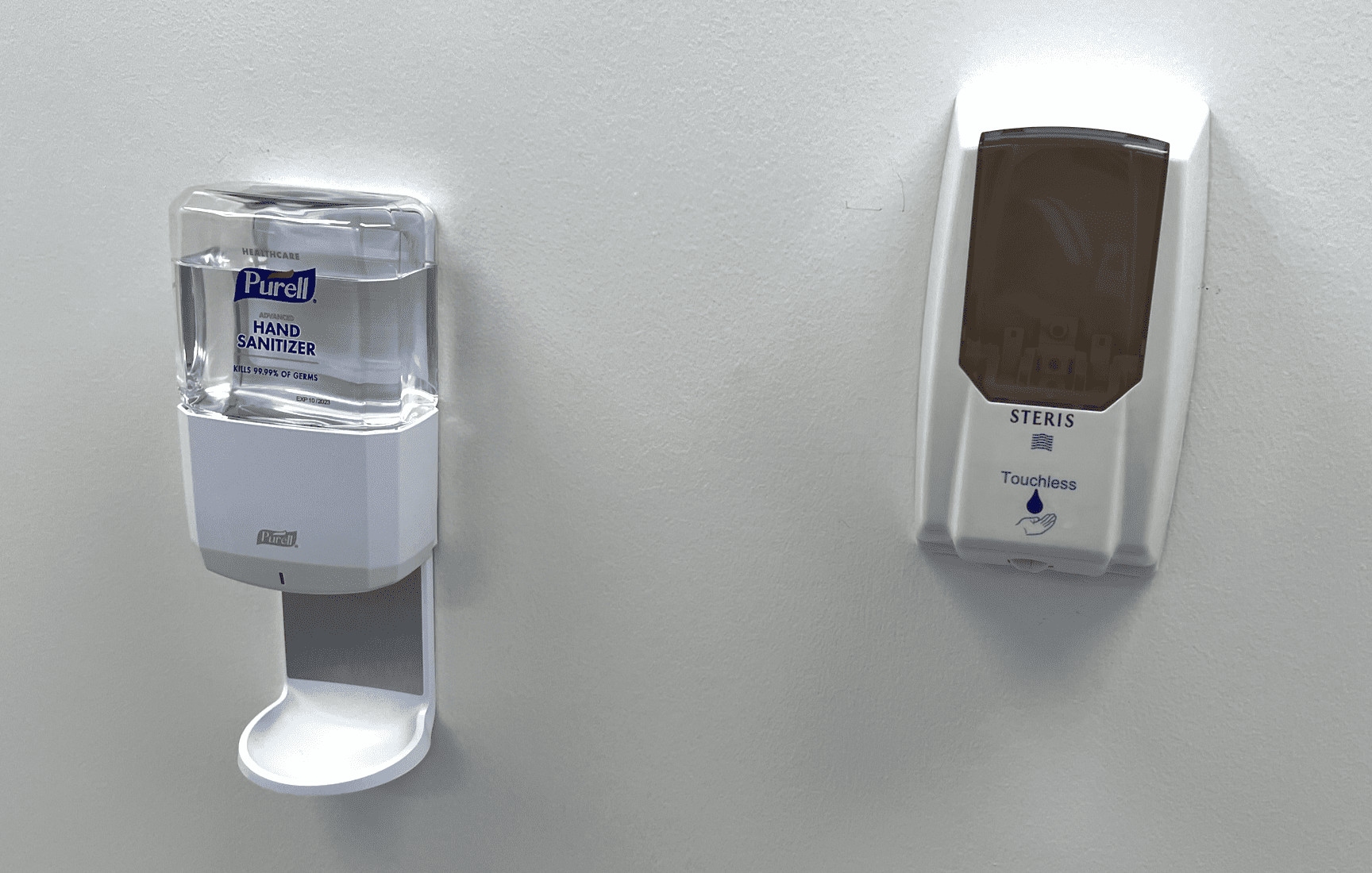
With “single-bin dispensers” like this, you have to either replace the container before it's empty (leading to some wasted product) or you wait until it's already empty (which drives the waste of not having sanitizer when and where it's needed, which can lead to higher infection rates).
These days, most hand sanitizers seem to be driven by sensors and battery power to squirt out a certain amount of product. I don't have precise data on this, but it seems like the “press to pump” dispensers have fallen out of favor compared to the “automatic” ones.
Maybe there's a concern expressed about touching a dispenser handle / button / pump that others have touched. But, if we're immediately using hand sanitizer, doesn't that solve the problem?
What problem is the battery-powered dispenser intended to solve?
It “solves” one problem (that might not even be a problem) but it creates a new problem because the dispenser is useless with a dead battery (and I've run into this). There's no apparent “manual pump backup plan” option.
Designing for Reliability Instead of Novelty
Last November, I had a chance to take a vacation with family to France — a trip that had been delayed a year by the Covid pandemic and a trip that found us learning that the Omicron variant was a thing about two days before coming home.
In France, I saw many hand sanitizer dispensers that were driven by manual foot pumps. Brilliant! Or I should say, “brillant” or “brillante” or “magnifique”!
Here is one from a hotel lobby:
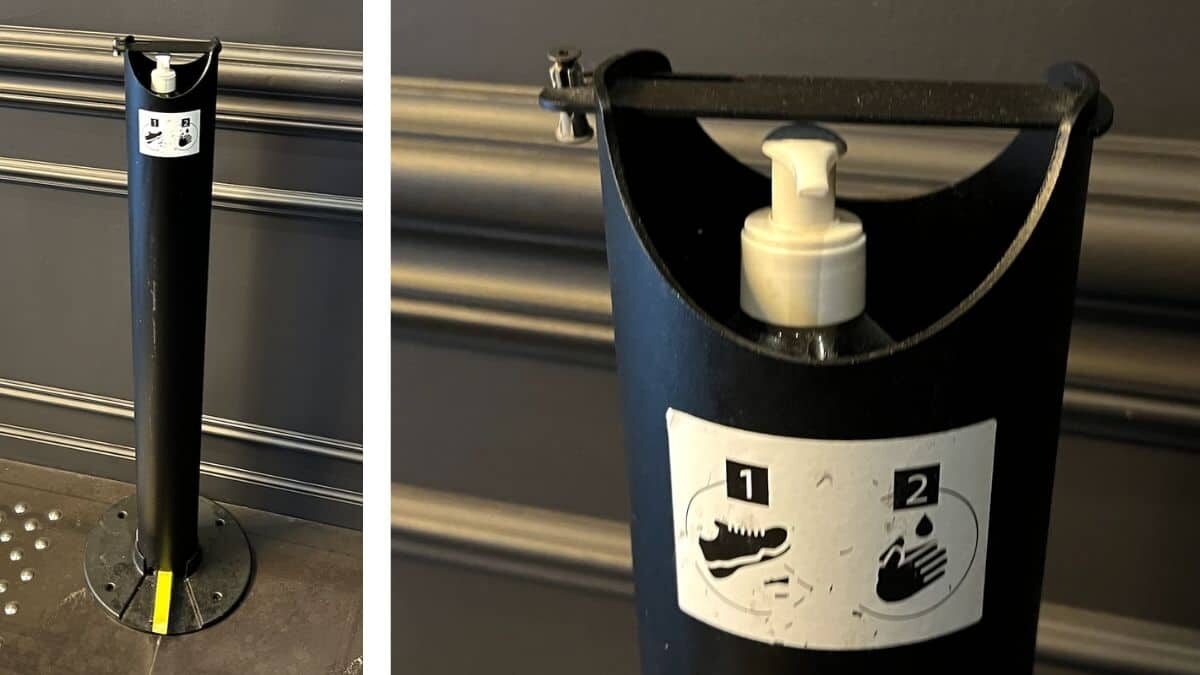
It's not as “fancy” but, to me, it seems more “elegant.” It's easy to use. You won't have to worry about your hand touching the button or pump handle. It seems like you could replace it with many different non-proprietary dispenser bottles, as long as they worked with a manual pump action.
Now, these would be challenging for a person who is in a wheelchair, for example, but how many of the automated dispensers might be too high on the wall for somebody to easily reach? Does a floor standing pump get in the way or run the risk of getting tipped over in a way that the wall-mounted dispenser avoids?
For comparison, here is a floor standing dispenser (here in the U.S.) that's battery powered / automatic, below:

What About Price and Cost to Operate?
Are these foot pump dispensers less expensive? Do they last longer? I'd guess the answer is “yes” to both, but I'm not sure.
Wait, let's search Amazon. You can buy anything there.
You can buy a two-pack of foot-powered dispensers for just $49.
The list price for a Purell automated wall-mounted dispenser is… $50. You can buy one on Amazon now for just $22.54. But, it says The “refills sold separately.” Is the dispenser artificially cheap because they have a “razors and blades” business model?
You can buy two 1200 mL containers of Purell for $32. that's about $26.67 per liter.
The foot pump one is a “Universal Bottle Fit” so can we get cheaper non-proprietary bottles? You can use any size from 250 mL to 1 liter.
You can buy a one-liter bottle of Purell for $20 and that's without shopping around.
If you're using a lot of hand sanitizer, the foot pump dispenser pays for itself pretty quickly.
What do you think? Should we be using the clever, less-complicated foot pump solution? Is that what a traditional “Lean sensei” would tell us to do? Does that matter? Am I overthinking something that's just not that important?
Reliability Still Matters More Than Novelty
Four years after the height of the pandemic, I still routinely encounter empty or non-functioning hand sanitizer dispensers–often in restaurants and other everyday settings. The urgency may be gone, but the underlying design and process problems clearly aren't. When dispensers are empty, dead, or proprietary to the point of being hard to maintain, the result is the same: a basic safety measure quietly fails.
This isn't really about hand sanitizer. It's about reliability. Systems that depend on batteries, sensors, special refills, or perfect replenishment discipline will eventually let people down. Simpler designs–with fewer failure points and easier upkeep–tend to work more consistently, especially in environments where staff turnover is high and maintenance is nobody's full-time job.
From a Lean perspective, this is a reminder that improvement isn't about adding sophistication for its own sake. It's about designing systems that work in the real world, day after day, even when conditions aren't ideal. Whether in healthcare, restaurants, or public spaces, leaders should be asking the same question: What's the simplest design that will reliably do the job?
Empty dispensers are a small problem–but they're also a visible signal of how easily we tolerate fragile systems. And if we accept unreliability in small things, it's worth asking where else we might be doing the same.