
Part 2: More from the Original 1984 NUMMI Team Member Handbook — Unions, Teams, Leaders

Here's Part 2 of a post about the original NUMMI Team Member Handbook from 1984 (see Part 1 here).
This, and other documents I'll be blogging about, are part of Don Ephlin's UAW office papers, archived at the Walter P. Reuther Library at Wayne State University in Detroit. Thanks to them for their assistance.
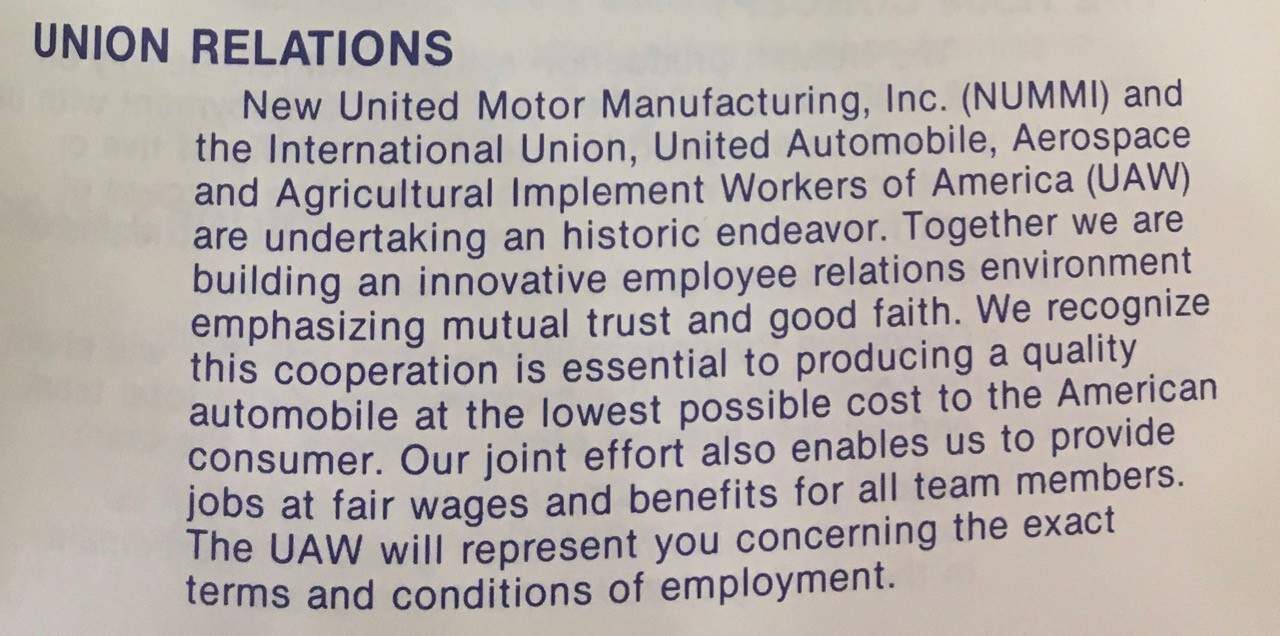
As we further explore the NUMMI handbook, the section on Union Relations also talks about teamwork and quality. Remember that the NUMMI plant was reopened by Toyota and GM as a UAW plant, as it had been before, hiring from the same UAW workforce. Note that Toyota hired all new managers and taught them the Toyota Way.
“Mutual trust” was indeed “innovative” compared to the GM environment (and the GM plant I started my career at in 1995 didn't have mutual trust). Cooperation… joint efforts… that lead to quality, which leads to success, which leads to continued employment and wage increases.
Toyota probably didn't complain about the union as a barrier or excuse like GM did. Toyota had concerns about working with the UAW (as we'll see in future posts about other documents from the Ephlin Files).
The Team Concept
What did Toyota and NUMMI mean by the “team concept?” When I was at GM in 1995, the union agreement language talked about the “team concept” and the foremen were renamed “Team Coordinators,” but the new language didn't create a team environment until we got a new plant manager (who was one of the original NUMMI guys sent there from GM).
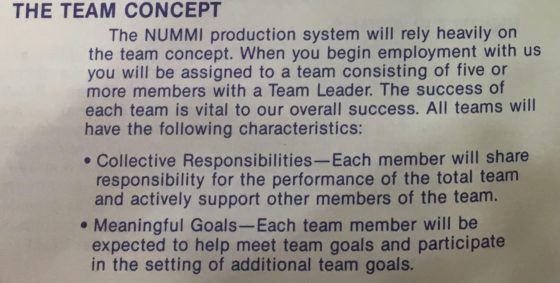
A Team Leader is the first level of supervision in a Toyota system, an hourly employee who can do the jobs on the line as a fill-in, to do training, to help with problem-solving, etc.
At GM, in 1995, we had an hourly employee in a role called “Assistant Team Coordinator,” but they were used as a fill-in team member for vacations, illnesses, and breaks. I don't remember the ATC being allowed to function like management.
More from the handbook:

Teams… note the emphasis on quality being listed before production goals and plans.
When I was at GM in 1995, the top priority was making your production numbers (quantity). I saw that same challenge at Dell Computer in 1999 and 2000.
Again, we see the emphasis on safety and Kaizen (or continuous improvement). I guess those two weren't listed last because they are the least important things. Toyota wouldn't want Team Members and Team Leaders prioritizing production numbers over safety.
Job Classifications
Another part of the Team Concept was NUMMI only having what look like four job categories for Team Members. When GM ran the plant, there were over 100 classifications (per this article: “Would the Toyota system work in U.S.? NUMMI was a test run“).
The four job classifications were:
- Production Team Members
- Skilled Trades
- Powerhouse/Facility Control
- General Maintenance
- Tool and Die Making
Toyota emphasized cross-training, which provided additional flexibility:
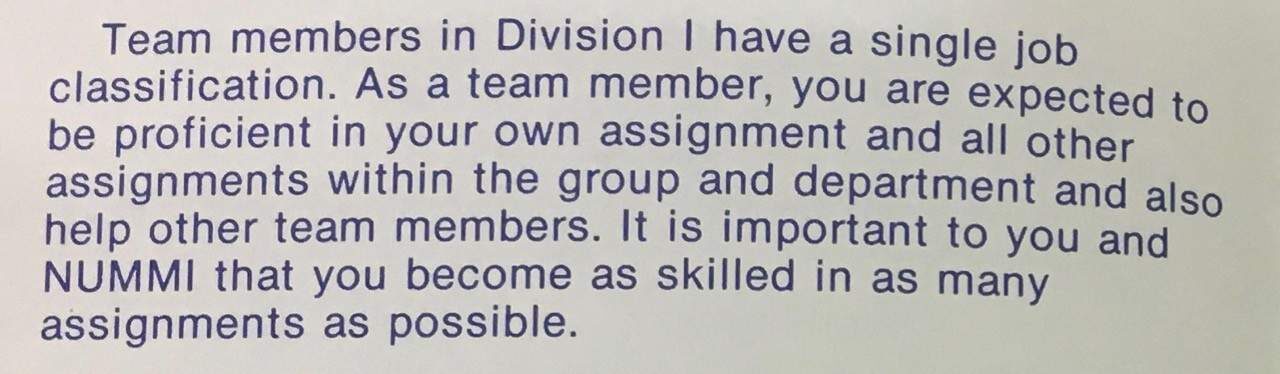
Cross-training — ensuring employees are properly skilled and able to perform different jobs — is key in a Lean system. You don't just throw a heart surgeon into brain surgery in the name of flexibility and efficiency. Safety and quality come first, which means not assigning someone to a job unless they're properly trained–an investment in that employee.
Awards & Incentives
Even though W. Edwards Deming always emphasized intrinsic motivation and the dysfunction that can come with awards. Deming was very influential and important to Toyota, but they still offered awards (or said they could):
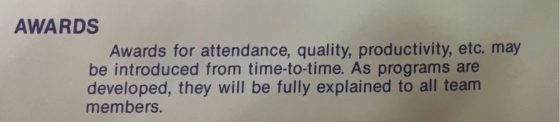
I know the Toyota plant in San Antonio offers incentives for perfect attendance. I've heard that the Georgetown, Kentucky plan has done drawings for free Camrys and the price of entry for a team member is perfect attendance for the year (see an article from 2004).
“[In 2004] 4,273 team members achieved perfect attendance, which accounts for more than 60-percent of TMMK's workforce.”
But, does that create an unhelpful incentive for somebody to come to work when they're sick, spreading germs to others?
Team Leaders
What makes for an effective supervisor or Team Leader? Do organizations put enough thought into this, or do they just promote people who were good individual contributors?
Here's what the NUMMI handbook says about selecting Team Leaders (again, from the hourly ranks):
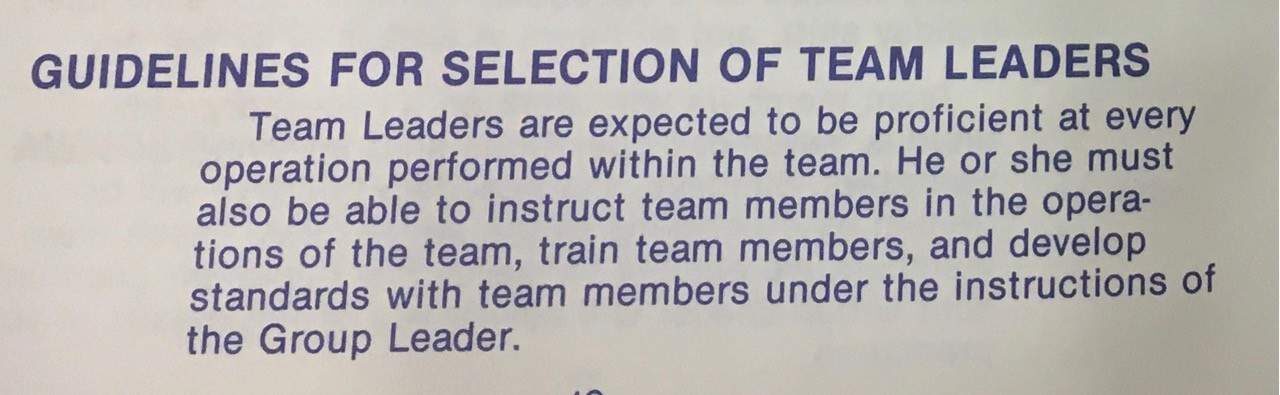
Today, do hospitals choose Charge Nurses and front-line managers based on their ability to both do the jobs AND train and instruct people?
Are they given enough training (or any training) about how to train others effectively?
This is one area where the “Training Within Industry” method can be very helpful, especially in healthcare.
NUMMI also emphasized the ability to help others with Kaizen, or continuous improvement.
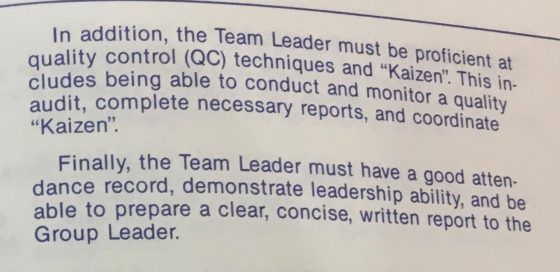
How do you see these principles being applied in your organization? Or how could they be applied?
Bringing the NUMMI Handbook Together: From Philosophy to Practice
When I step back and look at both parts of this handbook together, what stands out most isn't any single policy, structure, or role–it's the coherence of the management system.
In Part 1, we saw how NUMMI set the tone from day one: respect for team members, dignity, mutual trust, and a philosophy that put quality and people ahead of short-term production pressure.
In Part 2, we see how that philosophy was translated into very concrete practices–how unions and management were expected to work together, how teams were structured, how leaders were selected, and how responsibility for quality, safety, and improvement was deliberately placed close to the work.
None of this feels accidental. Toyota didn't just say “we value teamwork” or “we believe in respect for people.” They defined expectations, roles, and behaviors that made those ideas real in daily work–especially in an environment that had previously been defined by mistrust and adversarial relationships.
What's also striking is how little emphasis there is on tools. There's far more attention paid to leadership, learning, cross-training, communication, and continuous improvement than to any specific Lean technique. That's a reminder that what made NUMMI different wasn't a checklist of practices–it was a fundamentally different way of thinking about people and management.
For leaders today–whether in manufacturing, healthcare, or knowledge work–the question isn't “Can we copy NUMMI?” It's whether we're willing to be as intentional about our own systems. Do our stated values show up in how we select leaders? In how we work with unions or professional staff? In how we define teamwork, accountability, and improvement?
NUMMI shows that culture isn't created by slogans or handbooks alone–but it can be supported by them, when they're aligned with leadership behavior and daily practice. That's a lesson that still feels very relevant today.





Nice post!
It is noteworthy that when Toyota people (old timers) talk about cost reduction, they mean EVERYTHING that could reduce costs. The obvious ones are less labor input, less inventory, lower prices on purchased materials. The less-obvious ones are balanced cycle times, short lead-time, and cross training. The important contributors to cost reduction that managers miss are “mutual trust and good faith,” teamwork, coaching, and cooperative relationships between union, labor, and management.
I’ve always been impressed at how well thought-out TPS is, as it has evolved over time due to changing circumstances, and, in particular, when it comes to human relations. The images shown above have a friendly tone, rather than a threatening tone. That also helps reduce costs.
Thanks for commenting again, Bob… more to come in this series… from the NUMMI handbook and other related documents from the UAW, Ford, and other sources.
Toyota originally wanted to partner with Ford, but ended up working with GM for a number of reasons.
It’s a shame how rare “mutual trust” in across different types of organizations.