
The Danaher Business System Page Talks About Speed. Where Did Safety and Quality Go?
Danaher has been one of the most cited Lean success stories in the United States for decades. The story usually starts at Jacobs Manufacturing (Jake Brake) in Connecticut in 1987, with Art Byrne, George Koenigsaecker, and the Shingijutsu consultants who had worked with Taiichi Ohno. What started there became the Danaher Business System, or DBS. A lot of people in the Lean community, me included, have pointed to DBS as an example of Lean done seriously and sustained over a long time.
So I was curious to read how Danaher describes DBS today.
What the current page says
The current Danaher Business System page describes DBS as Danaher's system of continuous improvement and the culture that makes it work. That's a good start.
From there, the emphasis is on innovation, reducing time to market, and shrinking lead times. The featured example is a Leica Biosystems digital pathology slide scanner, the Aperio GT450. The results listed are 33 patents, 1.5X revenue, and a market share gain of more than 10 percent.
Those are real business results. But I read the page a couple of times, and then the linked Our Approach page, looking for the words “safety” and “quality.” Neither page uses either word. The Approach page is mostly about the “DBS Innovation Engine,” acquisitions, and partnerships.
Hmmm.
How DBS used to be described
This isn't how I remember DBS being explained. It's not how the Toyota Production System, or TPS, is described.
For years, the way Danaher talked about DBS put quality near the front. In the 2010 annual report, then-CEO Larry Culp wrote that DBS tools help operating executives strive for “world-class quality, delivery, and cost benchmarks,” as quoted by the Kaizen Institute. Kevin Meyer wrote years ago about how often he heard quality, delivery, cost, and innovation repeated by people at every level of Danaher. And a 2015 investor presentation filed with the SEC listed quality and on-time delivery among the DBS core value drivers.
Quality wasn't a footnote. It was usually the first word in the list.
Somewhere along the way, at least on the public website, safety and quality dropped out of the description.
SQDC, in that order
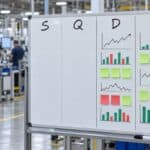
A lot of Lean organizations put SQDC on their daily management boards: safety, quality, delivery, and cost. The order isn't random. In my experience, it tells people what comes first when those things conflict. Safety is at the front. Cost is at the end.
Larry Culp still talks this way. After his years leading Danaher, he became CEO of GE, now GE Aerospace. When Aviation Week asked him in 2023 about GE's Lean work, he said their mantra was “safety, quality, delivery – before cost.” I wrote about that at the time, including how GE investor meetings open with a safety briefing, the same way GE starts every meeting.
So the former Danaher CEO puts safety at the front of the list. The current DBS page doesn't put it anywhere.
What a web page does and doesn't tell us
I want to be careful here. A corporate web page is not a management system. It's written for investors, potential employees, and customers, and probably edited by a marketing team. I'd guess Danaher's operating companies still track safety and quality closely.
It's also fair to say that speed and flow aren't opposed to quality. Toyota describes the Toyota Production System as resting on two pillars. One is just-in-time, which means making only what's needed, when it's needed, in the amount needed, in a continuous flow. The other is jidoka. As Toyota explains it, that means stopping right away when there's an abnormality, so defective products don't get passed along. A machine stops itself, or someone on the line pulls the andon cord and the line stops if need be. That's how quality gets built into the process instead of being inspected in at the end.
The two pillars depend on each other. Flow tends to expose problems that big batches of inventory would hide. But that only helps if people are expected to stop and fix those problems. Flow without jidoka just moves defects downstream faster.
Toyota's page ties the two together. The point is to deliver to customers quickly, at low cost, and with high quality. Danaher's page describes the first pillar well: lead times, time to market, speed. I couldn't find the second one.
Maybe it's implied. But the page doesn't say it.
Why the words matter
In my experience, the words leaders repeat are the words people inside the organization hear as the priority. I've seen this in healthcare many times. When executives describe Lean mostly in terms of throughput, length of stay, and cost, frontline staff hear “work faster” and “do more with less.” Then leaders are surprised when people are skeptical of Lean. The tools might be the same, but the message is different.
Danaher today is mostly a life sciences and diagnostics company. Its businesses make equipment and tests that labs and hospitals use to diagnose patients. That makes the omission more surprising to me, not less. Getting a diagnostic product to market faster is good for patients. Getting it to market faster with a quality problem is not.
I don't know if the page reflects a real shift in priorities or just a shift in how DBS gets marketed. It could be either. But if I were a new associate at a Danaher company reading that page in my first week, I'd come away thinking DBS is mostly about going faster.
I'm not sure that's what the people who built it would want me to take away. If you asked people inside Danaher today what DBS is for, would quality still be the first word they'd say?