

TL;DR for Leaders: A $5 fix to keep coffee filters clean became the first formal Kaizen at Franciscan Health–and helped spark a culture where tens of thousands of employee-led improvements followed. This story shows how small, everyday ideas, when taken seriously by leaders, build trust, engagement, and a sustainable system of continuous improvement.
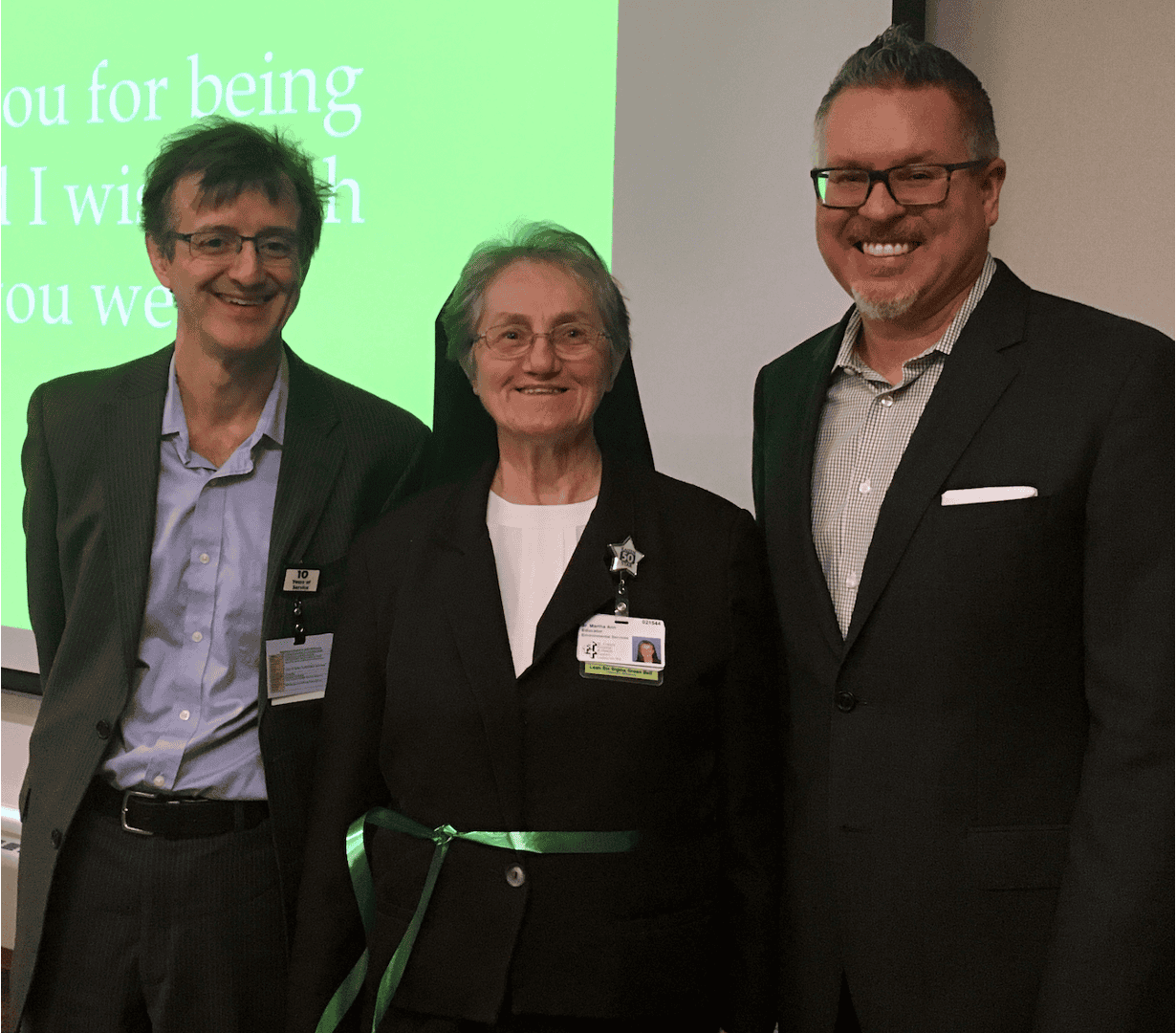
When people ask what it looks like to connect daily improvement to mission, I often think of Franciscan St. Francis Health in Indiana–and specifically of Sister Martha Ann. Here she is, below, in a photo with me and my Healthcare Kaizen co-author, Joe Swartz (who also works at the health system).
I first met her roughly a decade ago during a visit to the health system to learn more about their work with Kaizen and continuous improvement. At the time, she was leading the Environmental Services (EVS) department. What stood out immediately was not just her warmth and humility, but her depth of commitment to improvement–and her willingness to model it herself.
A Leader Who Modeled Kaizen From the Start
Sister Martha Ann had earned her Lean Six Sigma Green Belt and wore a small green ribbon on her habit as a quiet symbol of that commitment (seen in the photo above). It wasn't about certification for its own sake. It was about serving patients better, developing her team, and building a culture where improvement was everyone's job–starting with her.
How a $5 Improvement Sent a Powerful Signal
The very first Kaizen formally submitted at Franciscan came from Sister Martha Ann's team. It wasn't a complicated operational fix or a major safety hazard–it was about coffee filters.
They were sitting out in the open in the EVS breakroom, collecting dust and debris. It wasn't a crisis, but it was a daily annoyance–one of those little things that nobody had taken the time to solve.
One of her team members, Debbie, suggested a simple solution: place the filters in a small plastic container to keep them clean and protected. The idea was easy to implement, cost almost nothing (about $5), and made the space better for everyone.
It wasn't just about coffee. It was about sending a signal: you can speak up, and your ideas will be heard. Even something small is worth improving if it affects the people doing the work.
Why Small Improvements Build Trust Faster Than Big Initiatives
Here's how it was documented:

What Happens When Leaders Take Small Ideas Seriously
Franciscan St. Francis didn't stop at coffee filters. Over the next several years, the organization built one of the most successful and sustained Kaizen systems I've seen in healthcare. The results were measurable and meaningful:
- Total Kaizens implemented (2007-2015): 26,634
- Total estimated cost savings: $16,030,379
- Peak participation: 41% of employees submitted a Kaizen in 2011
- Highest volume of Kaizens in a single year: 4,225 (also in 2011)
- Annual savings peaked at $3.5 million in 2010
Even as volumes ebbed and flowed, participation remained remarkably strong, with more than a third of employees actively contributing ideas in most years from 2009 onward.

Sister Martha Ann's EVS department was at the forefront of that movement. Under her leadership, they became the first non-governmental hospital EVS department in the U.S. to earn CIMS certification–a high bar for excellence in environmental cleaning and operations. That national recognition was important, but even more impressive was the day-to-day pride her team took in solving problems and improving care environments.
Kaizen as a Daily Expression of Mission and Values
Bob Brody, the hospital's CEO at the time, once said:
“I hope you will discover, as we have, the incredible creativity that can be derived by engaging and supporting each and every employee in improvements that they themselves lead.”
That principle was evident in the way Sister Martha Ann and others led their departments–not through top-down mandates, but through curiosity, compassion, and consistent coaching. In our conversations, she always came back to people: how to support them, how to help them succeed, and how to live the mission through action, not just words.
Improvement at Franciscan wasn't a bolt-on project or a management trend. It was woven into the culture. Kaizen became a way of showing respect for people–not just patients, but colleagues too.
This Pattern Scales Far Beyond One Organization
Franciscan's story isn't unique — but it is instructive.
I've seen the same pattern play out in other healthcare systems that treat Kaizen as daily work, not a program. At UMass Memorial Health, leaders focused on encouraging steady idea flow, coaching teams, and acting on small improvements without waiting for “perfect” ideas.
What started as thousands of frontline ideas per year has now grown to more than 200,000 implemented improvements — not through mandates or incentives, but through consistent leadership behaviors and psychological safety.
The lesson mirrors Sister Martha Ann's coffee filter Kaizen: when people see that small ideas matter, they keep contributing — and the results compound.
Read more: A Continuing Culture of Continuous Improvement at UMass Memorial Health
Why This Story Still Matters in 2026
A decade later, I still reflect on what I learned from my visit and from Sister Martha Ann. Her example reminds me that the most powerful improvements often start small. They don't require executive sponsorship or major investments–just leaders who are willing to listen, to learn, and to act with intention.
Her story is proof that continuous improvement is not separate from the mission–it is the mission, when done well.
Whether your organization is just getting started with Kaizen or looking to reinvigorate a stalled effort, there's a lesson here: Start where you are. Invite everyone in. Celebrate the first small win. And never underestimate what a motivated, respected team can achieve–especially when they have a leader like Sister Martha Ann who believes in them.






What I love about that filter example is that it was a simple quite start. Something that not only had a financial benefit but a personal taste & safety benefit to everyone in the coffee room (clean & dry)
Basically sold the concept into everyone. An excellent marketing of the concept of Kaizen.
Thanks for sharing this. I recall meeting Sister Martha Ann during a “Kaizen Live” event you and Joe hosted in late 2019. Sister Martha Ann indeed exhibits pride in every day improvement as we saw throughout Franciscan Health.
The story above reminds me of another small Kaizen in the Pediatric unit involving coffee as well. The frustration of taking a sip of old, burned coffee was addressed with 3 stacked cups. As I recall one identified the hour the coffee was made, the second cup would be turned to the time it was made. I will have to dig into my archives for the picture to recall the purpose of the third cup. This was just going to make a small improvement for a weary parent or team member who went to get a coffee to replenish the energy for whatever they were dealing with that day or night.
Throughout that Pediatric unit, they had “stars” (Kaizen cutouts) where they displayed their Kaizen ideas. From the simple coffee examples through a Code Bag, to reduce time when they have to respond to another unit (such as emerg) and time is precious.
Thanks again for sharing and taking me through memory lane.