

Forget the Template: Why Lean Success Depends on Scientific Thinking and Action
Lean succeeds when people focus on scientific thinking and action, not perfect templates. A3s, hoshin kanri, and other tools only work when they support real learning, experimentation, and reflection–mindset and behavior matter far more than format.
During my recent Japan Study Trip with Katie Anderson, I saw something that reminded me why Lean works so well when it's practiced deeply, and why it often falls flat when we treat it as a set of tools. Across every company we visited–from manufacturing to healthcare–leaders kept repeating a simple point:
“The template isn't the most important thing.”
And the more I listened, the clearer it became: what matters isn't the boxes on the page but the thinking and the actions behind them.
A key takeaway from Katie's Trip resonated deeply with me: thinking and action are far more important than templates. This insight, shared by Isao Yoshino, a retired Toyota executive, and other leaders we met at various companies, has significant implications for how we approach improvement practices.
This theme is particularly relevant to methodologies like A3 problem-solving and hoshin kanri (strategy deployment). It's all too easy to get caught up in the details of the template–whether it's the layout, the boxes, or the software–while losing sight of the true purpose.
Read my blog posts from all of my Japan tours
Two Examples, One Truth
Here are two contrasting examples of templates:
- A DMAIC-based A3 from an American hospital (on the left)
- A “10-box” style template from a Japanese manufacturing company (right)
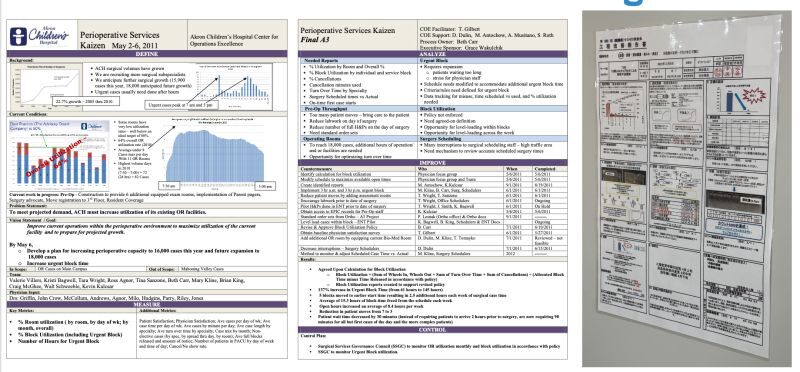
Does the size of the paper matter? Whether it's hand-drawn or digital? Portrait or landscape? These are secondary concerns. What really matters is whether the template serves as a tool for scientific thinking, structured problem-solving, and iterative improvement.
The point isn't which template you use. Both can work, and both can fail. What matters is how they help people think, experiment, understand causes, and improve the work.
To illustrate the variety, here's how one Japanese manufacturer structures its thinking on paper:
The Japanese template has these boxes in the “Process improvement report,” starting with the “theme”:
- Reason
- Current State
- Goal
- Plan
- Factor (“cause”)
- Investigation
- Measures
- Effect
- Standardization
- Reflection and Future
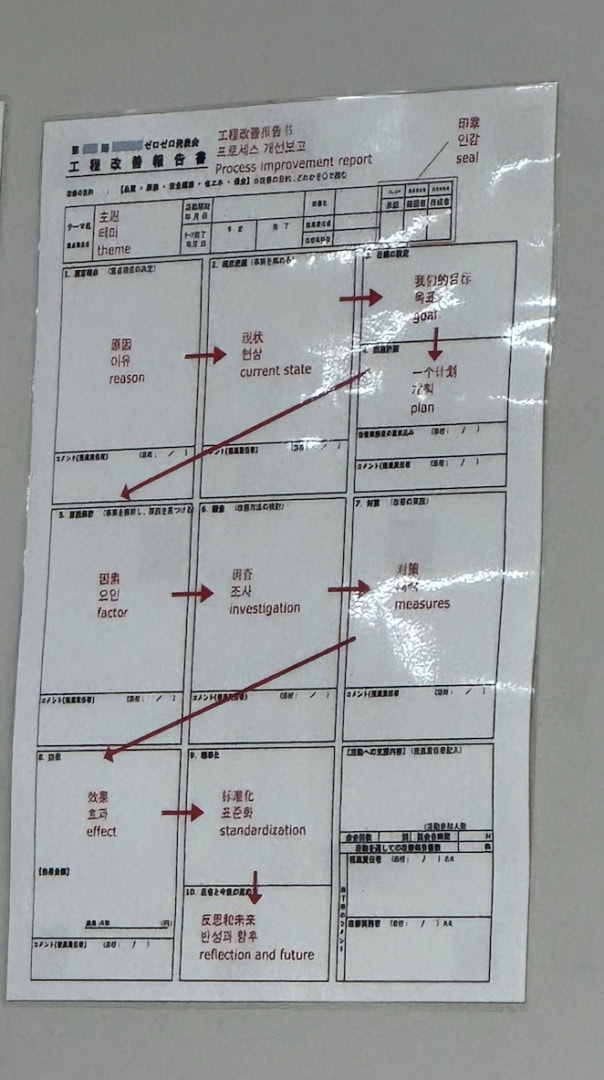
This structure is thoughtful and clear–but it's only useful if it reflects real learning. The template doesn't create improvement; the conversations and PDSA cycles do.
Mindset Over Mechanics
I'd always rather see a messy, hand-drawn A3–on a whiteboard or a sheet of paper–that shows real PDSA (Plan-Do-Study-Adjust) cycles than a perfectly formatted document that's been filled out because “we're supposed to.” A3 problem-solving was never meant to be a formality. It's meant to be dynamic, iterative, and grounded in active learning.
When Lean tools turn into “tick-box” exercises, we lose the essence of Lean. Tools don't create improvement; thinking does. Templates don't solve problems; people do. The real impact comes from the mindset, behaviors, and systematic problem-solving that sit beneath the surface–not from the boxes or the formatting.
What's Your Experience?
How do you help people focus on the thinking and the actions–not the template–in your organization? What practices keep the work grounded in scientific learning rather than paperwork? Let's keep the conversation centered on what truly matters: building the habits of inquiry, experimentation, and reflection that lead to meaningful results.






The quality of the thought and problem-solving that goes into employing lean technologies determines how effective they are. As an alternative to actual iterative learning, businesses wind up concentrating on perfecting the format. The distinction between the 10-box Japanese template and the DMAIC-based A3 demonstrates that mentality matters more than structure. Active, hands-on problem-solving is more my style than mentally jotting down every solution. Instead of merely checking a box, A3 thinking needs to spur actual practice development. However, it is safeguarded at the core of Lean towards genuine change that endures by concentrating on the behaviors and procedures that underlie the tools.