Why Process Behavior Charts Are the Best Way to Understand This KPI (and Its Real Trend)

282
0

tl;dr: Run charts and bar charts can hint at patterns, but they often mislead. A Process Behavior Chart reveals whether a KPI truly changed–or if it's just fluctuating as systems do. When leaders see variation clearly, they can react less, understand more, and improve where it actually matters.

I'm all for visualizing data and performance measures in the form of a chart. Charts are far better visuals than “bowlers” or “bowling charts,” as I've written about and spoken on before:

For time-series data, like metrics and KPIs, I strongly prefer “line charts” or “run charts” to “column charts” (sometimes referred to as “bar charts”).

I'm also not a fan of overlaying this year's performance on top of last year's. If we're going to look at 24 months of data, it's more effective to see that as a single time series.

Here's an example of the type of chart I've seen a lot — with last year's data in columns and this year's data as a line:
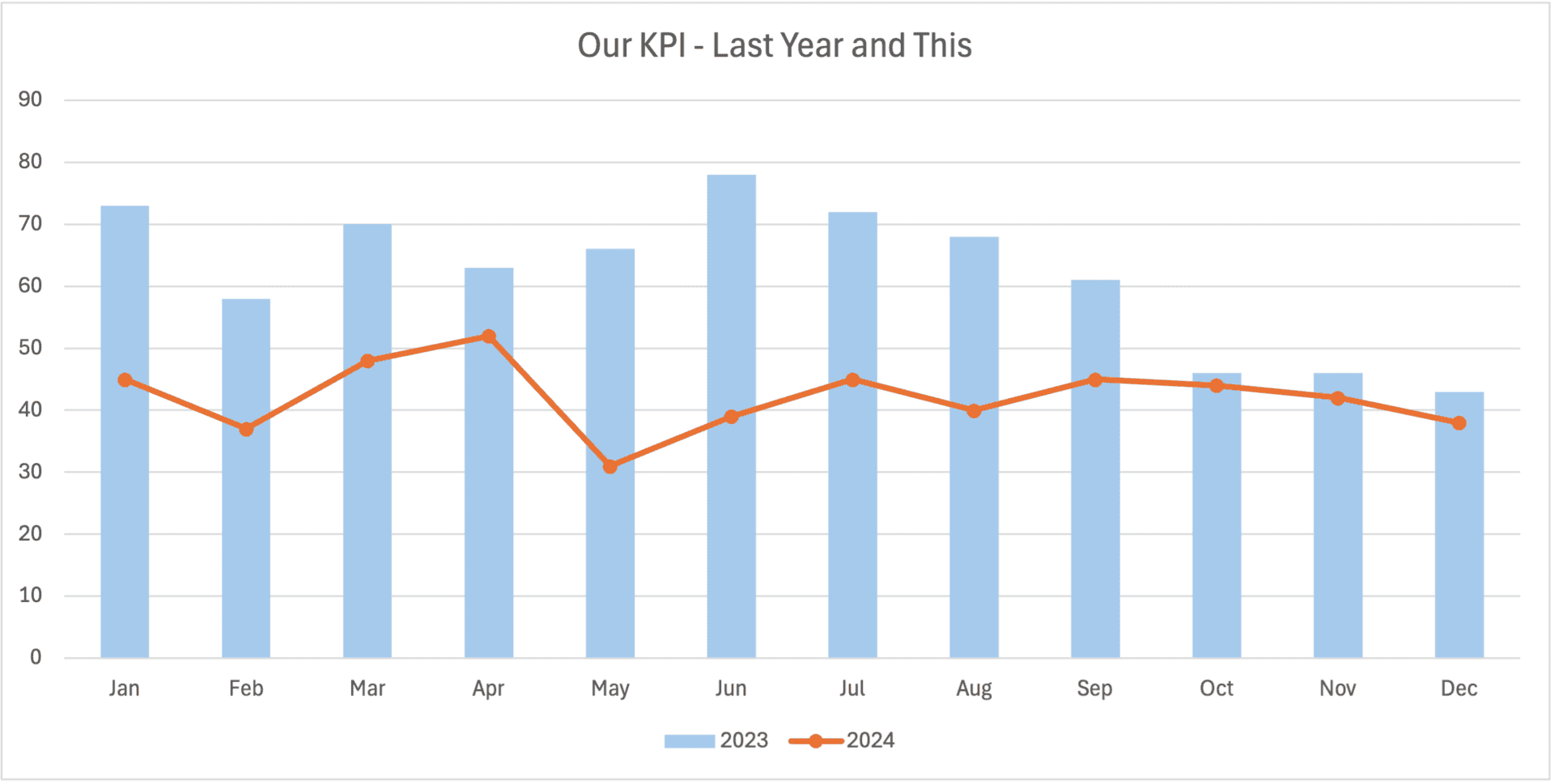
A combination column-and-line chart comparing a KPI across 2023 and 2024. The 2023 values are shown as blue bars fluctuating mostly between 55 and 75. The 2024 values are shown as an orange line with data points between roughly 35 and 50. Every 2024 data point is lower than the corresponding 2023 month, but the chart does not show whether any true trend or system change occurred.

To be fair to this visualization, one thing that jumps out is that every 2024 data point is LOWER than the corresponding 2023 month.

But what's the statistically valid trend? When did performance improve? What would we expect for future performance?

A “process behavior chart” (another name for “control chart”) would be the best visualization. But let's start with a run chart for comparison:

The run chart displays monthly KPI data from January 2023 through December 2024. Values hover between 60 and 78 for most of 2023, then fall sharply in October 2023 to approximately 46. From that point forward, the KPI fluctuates between roughly 37 and 52 for all of 2024, suggesting a sustained lower performance level.

The run chart makes is much clearer that something happened in October 2023 that caused performance to shift downward. It looks like a one-time event, where the metric had been fluctuating around an average of about 65. And now it's been fluctuating around an average of about 43.

Now let's look at the Process Behavior Chart view, where the initial average, along with the lower and upper limits, were calculated using the first nine months of data:

A two-year Process Behavior Chart displays monthly KPI data from January 2023 through December 2024 as a continuous line. For the first nine months of 2023, the KPI varies between roughly 58 and 78, fluctuating around an orange baseline average line drawn just below 70. A green upper limit line appears near 90, and a light blue lower limit line appears in the mid-40s.

In October 2023, the KPI drops sharply to the mid-40s, falling below the lower limit and indicating a statistical signal. From that point forward, throughout all of 2024, the KPI remains at a lower level, fluctuating between the upper 30s and low 50s. The baseline and limits shown apply only to the initial period, making it clear that the data after October represent a different system performance level. The chart visually demonstrates a significant one-time shift rather than a gradual decline.

The October data point is just below the calculated lower limit… evidence of a “signal” — that tells us that something changed with the process. I call that a “Rule 1” signal — and then we see more of those.

We also see, then, a “Rule 2” signal, with eight (or more) consecutive data points that are below the baseline average. This is a meaningful and sustained shift in performance.

Hopefully, we know WHY that happened.

A Process Behavior Chart tells us that the system changed — but we need to understand our system enough to figure out what changed. Was there an intentional system change or improvement project? Or was performance changed by some outside factor?

We can then calculate a new average and limits using the last 15 data points, which looks like this in my spreadsheet:

A Process Behavior Chart shows monthly KPI data from January 2023 through December 2024 as a continuous line. During the first eight months of 2023, the KPI fluctuates between the high 50s and upper 70s. A baseline average line for this initial period appears just below 70, with an upper natural process limit near 90 and a lower limit in the mid-40s.

In September 2023, the KPI begins to drop, and in October 2023 the value falls below the lower limit, indicating a clear statistical signal. After this signal, a second set of limits is calculated to reflect the new system performance. The new average line, starting in October 2023, is drawn around the low 40s. The new upper limit appears close to 60 and the new lower limit appears just below 30.

From October 2023 through all of 2024, the KPI remains at this lower performance level. It fluctuates between the upper 30s and low 50s, consistently staying within the new limits and showing no additional signals of further change. The chart clearly illustrates a one-time downward shift between September and October 2023, followed by a stable but lower system performance throughout the following year.

We might be happy that this number has shifted down from an average of 68.5 to a new average of 42.7. But there's no evidence of continued decline. A linear trend line would be mathematically correct but practically misleading:
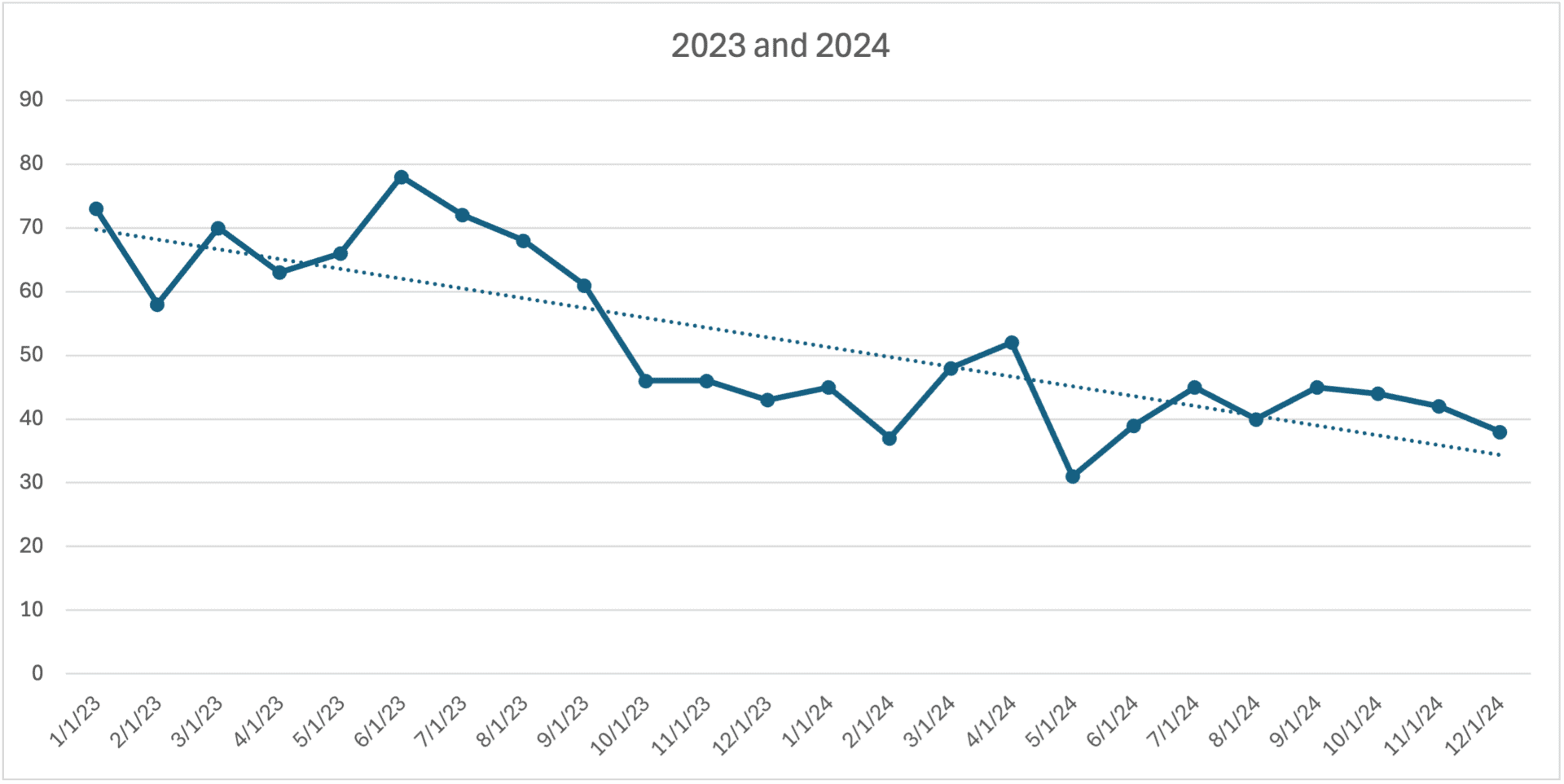
A two-year run chart shows monthly KPI data from January 2023 through December 2024 as a single continuous line. Throughout 2023, the KPI fluctuates between the upper 50s and upper 70s, with occasional dips but no obvious trend within that year. In early fall 2023, the values begin to drop, and by October they fall into the mid-40s. From that point forward, across all of 2024, the KPI remains at this lower level, varying between the upper 30s and low 50s.

A dotted linear trendline is drawn across the entire two-year dataset. The trendline slopes downward from left to right, implying a gradual, steady decline from early 2023 through late 2024. However, the actual data show a different pattern: a relatively stable system in 2023 followed by a sudden, one-time shift to a lower level beginning in October 2023. The chart visually demonstrates how a linear trendline can oversimplify and misrepresent the true behavior of the system.

The linear trendline implies (incorrectly) that performance will continue to improve, hitting zero given enough time. But I think the one-time shift downward is probably a more accurate description of what happened.

Here is the same Process Behavior Chart as generated by the free XMRit.com tool that shows the shifted average and limits. You can click this link to play around with the chart.
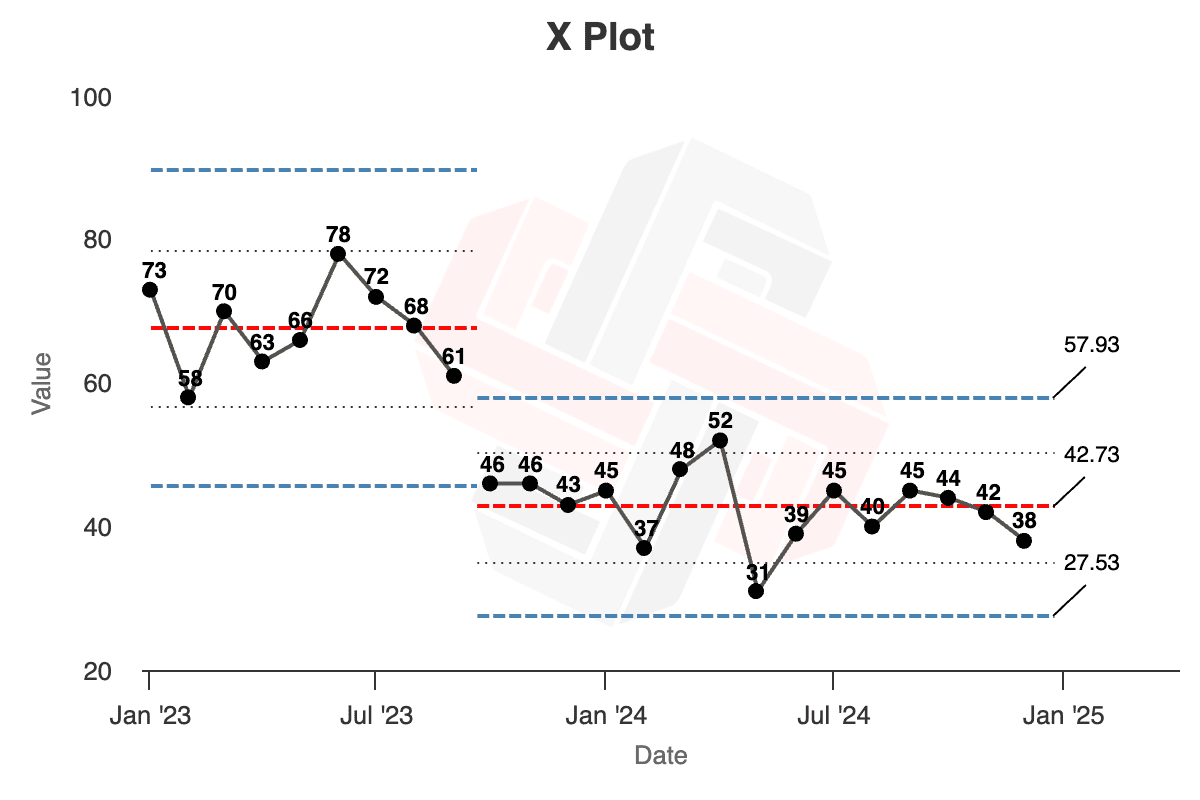
A Process Behavior Chart labeled X Plot displays monthly KPI values from January 2023 through early 2025. Each data point is shown as a black dot connected by a thin gray line, with the numerical value printed above or beside each point.

The first segment of data, covering January through September 2023, ranges from 58 to 78. A red dashed average line for this initial period appears at approximately 67.8. Dotted horizontal lines mark the natural process limits, with the upper limit near 90 and the lower limit near 58.

Beginning in October 2023, the KPI drops sharply to 46 and then continues at lower values through 2024. A second red dashed average line for this new period is drawn around 42.7. A new set of natural process limits appears for this period as well, with the upper limit near 57.9 and the lower limit near 27.5, shown in blue dashed lines.

Across 2024, the KPI fluctuates between 31 and 52 but stays within these new limits, indicating that the system has shifted to a new, lower level of performance. The chart clearly displays two distinct periods: a higher, stable system in early 2023 and a lower, stable system after the October 2023 shift. The plotted values, limits, and averages make the level shift visually evident and help differentiate real signals of change from routine variation.

We can use the PBC to predict future performance. It's going to keep fluctuating around the average of 42.7, with data points between the limits of 27.5 and 57.9… UNLESS the system changes again.

How do we know the system has changed? By seeing a statistical signal following these three rules:

  1. Any data point outside the limits
  2. 8 or more consecutive data points on the same side of the average
  3. 3 of 3 or (3 of 4) consecutive data points that are closer to the limit than they are to the average

To learn more, check out my book Measures of Success: React Less, Lead Better, Improve More (get a free sample chapter). I can also come do a workshop and provide coaching for your team…

Process Behavior Charts don't just make a KPI easier to read–they help us understand how our system is actually performing. When we see variation clearly, we stop chasing every up-and-down movement and start focusing on meaningful changes. That shift creates calmer leadership, better decisions, and more effective improvement work.

If you want to visualize a KPI honestly, predictably, and in a way that supports real continuous improvement, nothing beats a PBC.

What do you think about these different approaches to visualizing metrics? What does your organization use? How do you see the potential benefits of Process Behavior Charts?


Please scroll down (or click) to post a comment. Connect with me on LinkedIn.
If you’re working to build a culture where people feel safe to speak up, solve problems, and improve every day, I’d be glad to help. Let’s talk about how to strengthen Psychological Safety and Continuous Improvement in your organization.

Get New Posts Sent To You

Select list(s):
Previous articleRyan McCormack’s Operational Excellence Mixtape: December 13, 2024
Next articleWhat Were the 10 Most Read LeanBlog.org Posts of the Second Half of 2024?
Mark Graban
Mark Graban is an internationally-recognized consultant, author, and professional speaker, and podcaster with experience in healthcare, manufacturing, and startups. Mark's latest book is The Mistakes That Make Us: Cultivating a Culture of Learning and Innovation, a recipient of the Shingo Publication Award. He is also the author of Measures of Success: React Less, Lead Better, Improve More, Lean Hospitals and Healthcare Kaizen, and the anthology Practicing Lean, previous Shingo recipients. Mark is also a Senior Advisor to the technology company KaiNexus.

LEAVE A REPLY

Please enter your comment!
Please enter your name here