
tl;dr: GE Aerospace is redefining its culture under CEO Larry Culp through a Lean operating system called “Flight Deck,” built on safety, SQDC, and respect for people. Their Safety Management System, independent oversight, and commitment to continuous learning reflect a mature Lean transformation.
You might still associate the “old GE” with Six Sigma, but under the leadership of CEO Larry Culp, the last five years have been all about Lean. You can get a strong sense of that in the recording of their 2024 GE Aerospace Investor Day event (registration required).
First off, the old conglomerate General Electric has been almost completely dismantled. GE Healthcare was spun off last year, and the GE Vernova business will be spun off on April 2nd. That leaves the GE ticker symbol as “GE Aerospace.” General Electric is no more (almost).
Kicking Off with Safety
As GE does with these events (such as the GE Lean Mindset event last year) and internal meetings, they always start with safety.
Steve Winoker, Chief Investment Relations Officer & VP, started (after a quick hello and legal/regulatory language about forward-looking statements) with a safety briefing for attendees (the investor/analyst community).
“At GE Aerospace, safety is our top priority. You often hear us talk about Safety, Quality, Delivery, Cost–in that order…”
So, he pointed to where the two exits were in the event of a fire or an emergency before handing off to CEO Larry Culp.

CEO Larry Culp's Remarks
After a very brief mention of the upcoming spin, Larry continued, “on the safety theme” right away — a reminder of their purpose, which includes “bring them home safely” (those flying on planes or helicopters, including their employees). It seems “lift people up” would have a double meeting for customers and employees, as well.
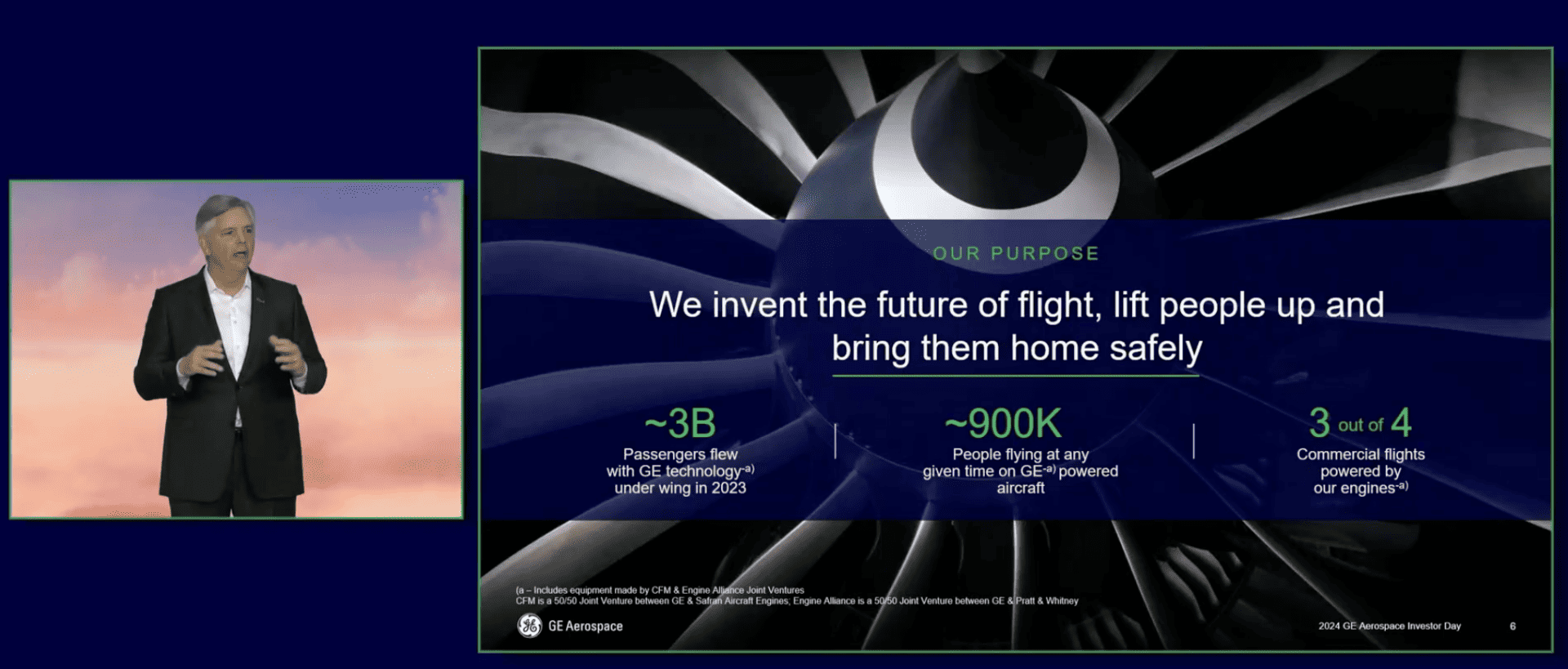
Larry talked about their responsibility for the roughly 900,000 people on GE-powered aircraft at any given time. Wow. And that's about three billion passengers a year. “That is an incredible responsibility” that all GE leaders and employees carry, “which is why we take safety so seriously.”
Larry emphasized, “Our Lean mantra of SQDC that has really been at the heart of the Lean transformation of GE, let alone GE Aerospace.”
“Safety and Quality before Delivery and Cost. Easy to say. Hard to do.”
He added:
“It really comes back to respect for people, one of the most important tenets of any Lean transformation.”
Larry then threw to a video with one of their engineering leaders, Jonathan Blank, talking about product safety.
Engineering Leader Jonathan Blank on Product Safety
“We do not compromise on safety,” he says early in the video. “It is our purpose. Our employees, every day, understand this purpose… understand this is our number one priority. We continue to invest in our people, our processes, our systems, and our technology.”
Jonathan talked about their Safety Management System (SMS), which was introduced voluntarily in 2013, and was certified by the FAA (in 2017).
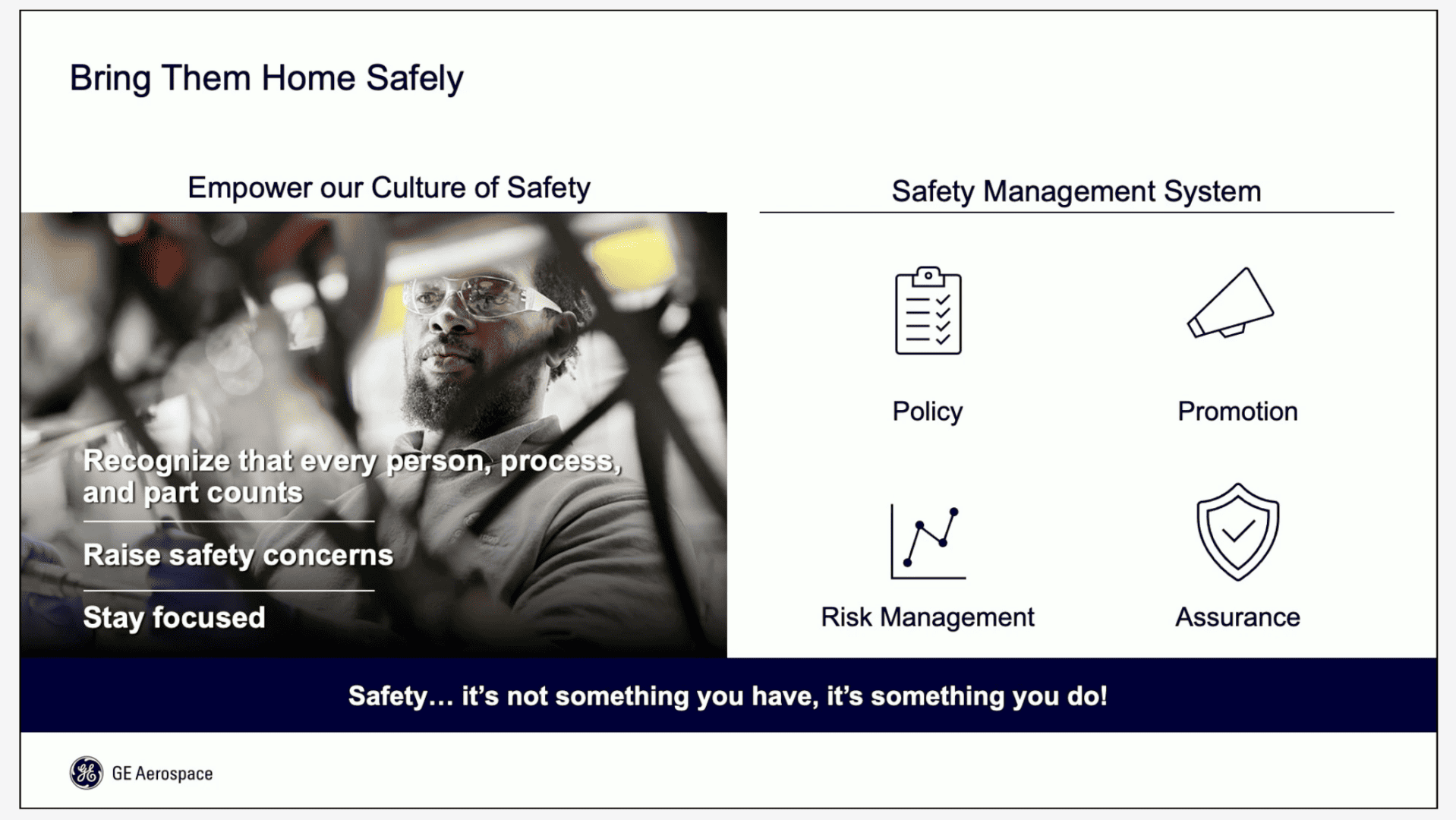
Every person counts… the encouragement to “raise safety concerns” must be backed by action. This framework “creates a culture of open reporting, where every employee is expected to raise a concern that they see or find anywhere.”
Here's the action: the commitment that “we will address it with a cross-functional team.”
GE Aerospace “created an independent office for flight safety and for engineering–not connected to the product line profit and loss center. We continue to learn and continue to grow in our understanding, because safety is a continuous improvement journey… It's a reflection of our learning culture and our Lean mindset.”
“We learn from every event that occurs.”
That's great to hear, and that's what every organization (in aviation, healthcare, or elsewhere) should aspire to.
As CEO, Larry came back to emphasize that “the Flight Safety Office comes up through our Chief Engineers, as opposed to the P&Ls. We like that separation of duties… and a mandate to keep safety front and center.” The safety policy begins with “senior management commitment to improve safety,” and promotion includes “create a positive safety culture in a workplace.”
The combination of their SMS, their Quality Management System, and their “Lean Operating System” is the “best way we know to operationalize flight safety at GE Aerospace,” says Larry.
What is “Flight Deck”?
How will GE Aerospace implement its strategy? Larry says it's “Flight Deck,” the relatively new name for their “proprietary Lean operating model.”
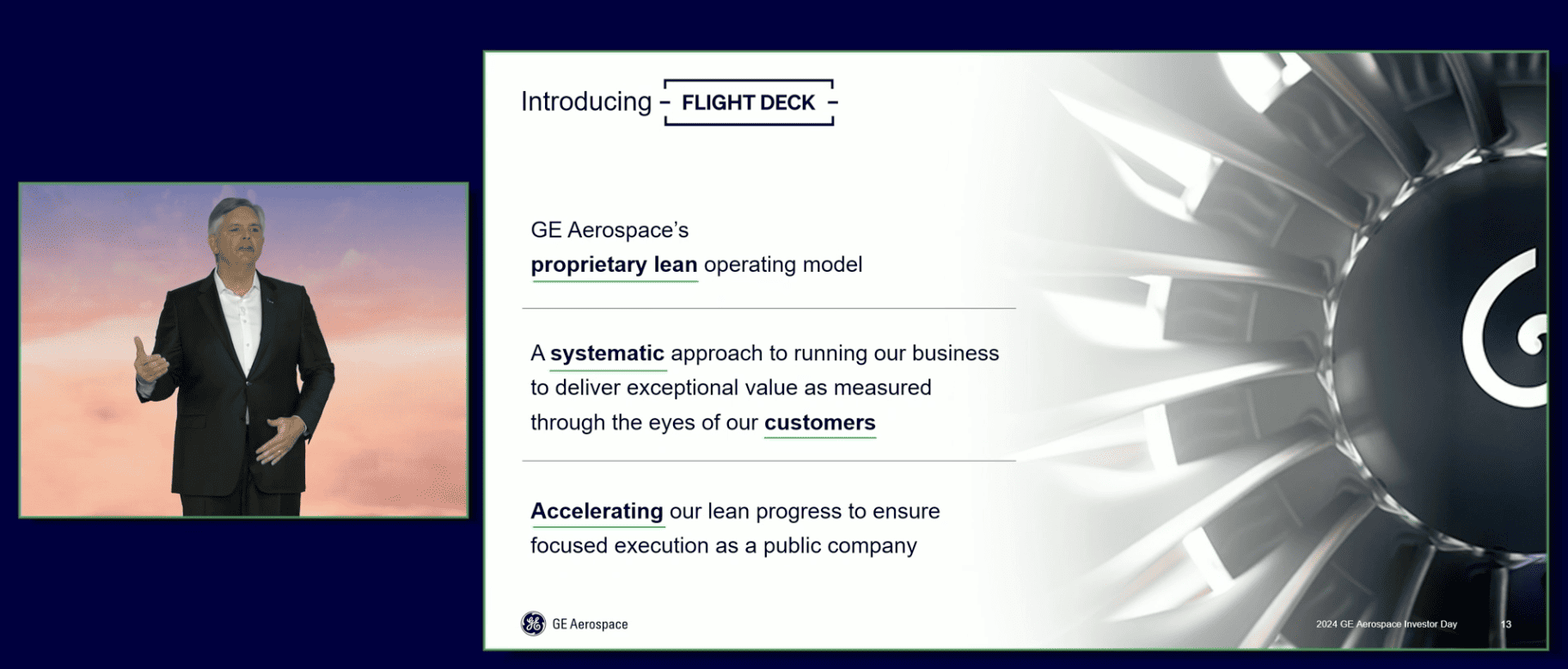
As it says on the slide, it's “a systematic approach to running our business to deliver exceptional value as measured through the eyes of our customers.” Larry said:
“It's the framing of the next step of our Lean transformation… this is the way we're going to run the business. We're going to run the business with the customers' expectations front and center… to accelerate the Lean transformation that has been building momentum.”
Here's a video of that part of Investor Day:
Larry said, “Don't take it from me,” and threw to a video with some employees from around the world talking about Flight Deck.
It's rooted in “our leadership behaviors of humility, transparency, and focus.”
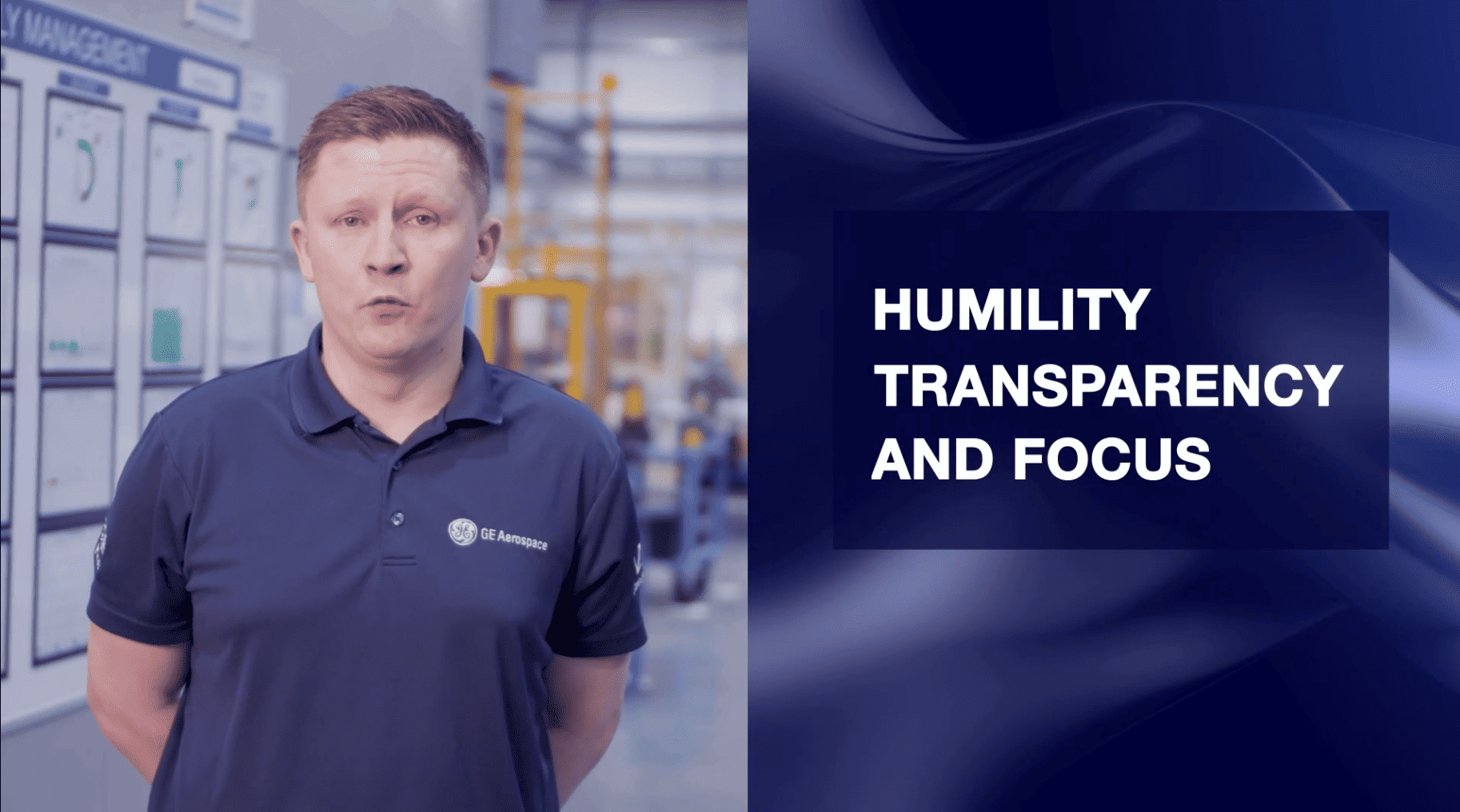
Of course, humility is a word that Toyota uses quite often. Flight Deck is their “bridge from strategy to results… operating as one team and with one strategy… Flight Deck is how we work, how we lead, how we soar.”
Back to Larry, he says that Lean
“…is not a means unto itself… it's a means to an end.”
Larry added, “Think about the way we run the business, first and foremost operationally, from an SQDC perspective, the financials obviously matter, but all the while we want to make sure we are also playing the long game. And that's where Hoshin Kanri comes in, that's the piece of the operating model that allows us to identify, through our strat[egy] planning process, the breakthroughs that we need to strengthen our competitive advantage and then operationalize them… to not only TALK strategy, but to DELIVER it.”
10 Flight Deck Fundamentals
Larry said he “could talk about this all day” (and I believe him!), but he wrapped up by sharing ten “Flight Deck Fundamentals.” You can see them below:
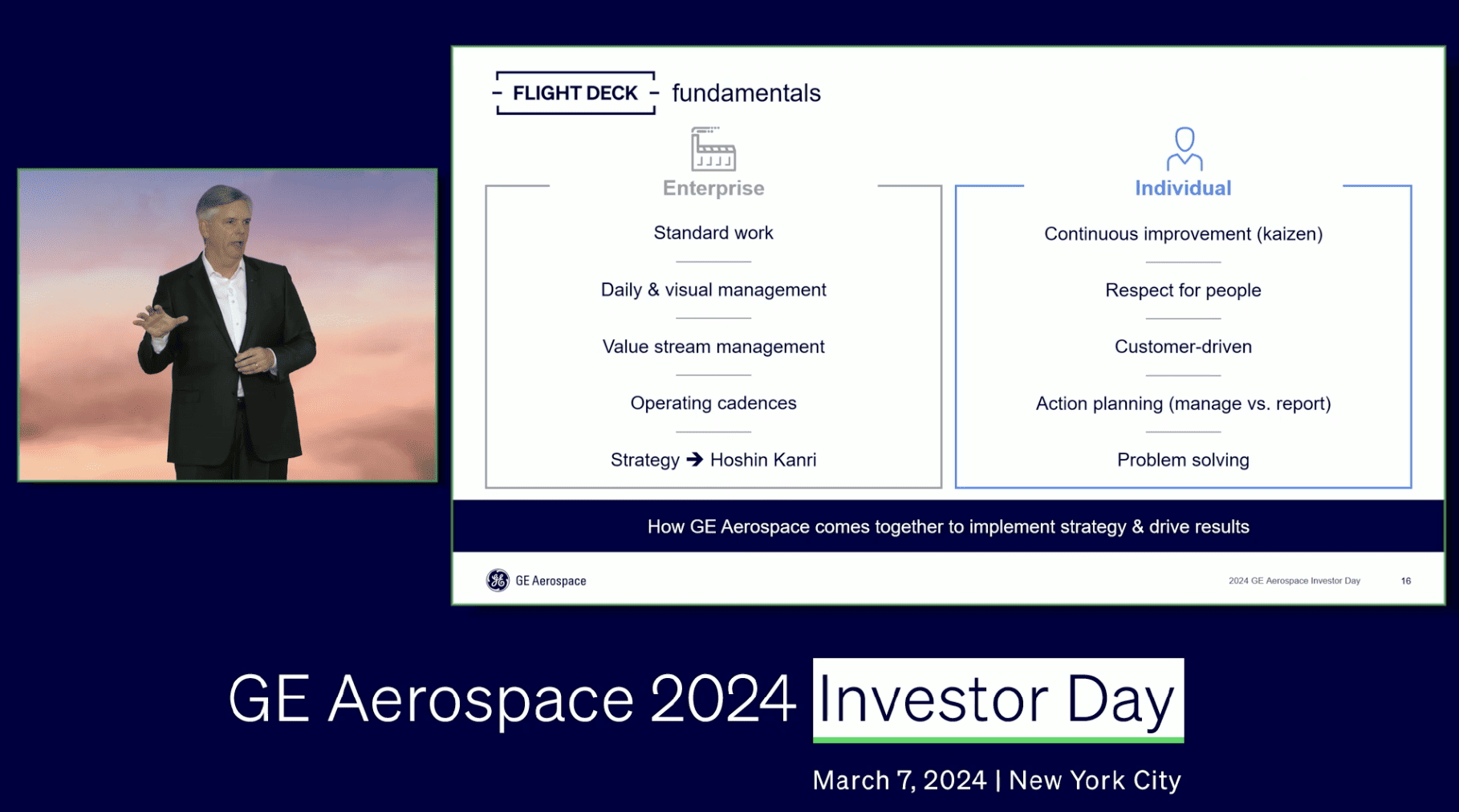
Enterprise-Level Fundamentals
These shape how GE Aerospace runs the business:
1. Standard Work
In contrast to “quarter-end heroics,” standard work creates consistency and repeatability. The goal isn't scrambling at the end of the quarter — it's building systems that perform every day.
2. Daily & Visual Management
This allows leaders to manage in real time — not after the fact. Problems are made visible early, when they're still manageable.
3. Value Stream Management
Instead of optimizing silos, GE looks at the flow of work across the value stream. As Culp put it, this lets them focus on “the work we do, not the functions that might be the way we're organized.”
4. Operating Cadences
Weekly and monthly operating reviews align everyone around the “critical few.” These rhythms reinforce discipline and shared focus.
5. Strategy to Hoshin Kanri
Hoshin is how breakthrough priorities are identified and operationalized. Flight Deck “sits in the middle,” connecting strategy to operational and financial delivery — not just talking about strategy, but delivering it.
Individual-Level Expectations
Flight Deck isn't just structural. It's behavioral.
These are the expectations for every GE leader:
6. Continuous Improvement (Kaizen)
“We want everyone to have a continuous improvement mindset. We never rest.”
Improvement is not episodic. It's daily.
7. Respect for People
“It starts with listening — maybe a little more than speaking.”
Respect shows up in behavior, not slogans.
8. Customer-Driven Thinking
Seeing the business “through the eyes of our customers — not the way we see ourselves or would like to be seen.”
9. Action Planning (Manage vs. Report)
A shift from reporting activity to managing execution. As Culp emphasized, there's a difference.
10. Disciplined Problem-Solving
“We want to be good, disciplined, scientific problem solvers — not casual finger pointers.”
That's Lean thinking in one sentence.
Notice how none of these are flashy tools. They're systems and behaviors. Flight Deck isn't a slogan — it's a disciplined operating model designed to turn strategy into sustained results.
Lean Leadership Is a System, Not a Slogan
Larry Culp's remarks weren't just about aviation or engineering. They were about leadership — and about system design.
Flight Deck makes something very clear: safety, respect for people, and disciplined problem-solving don't happen because leaders say the right words. They happen because leaders build operating systems that make those behaviors the norm.
Lean isn't a side initiative at GE Aerospace. It's how strategy gets executed. It's how tradeoffs are made. It's how performance improves — quarter to quarter and year to year.
The deeper lesson isn't about jet engines.
It's this:
If you want long-term performance, you have to operationalize your philosophy.
You can't delegate it to a Lean team.
You can't relegate it to a project.
You have to lead it.
Flight Deck is a reminder that sustained results don't come from slogans.
They come from leaders who design systems where safety comes first, problems are surfaced early, and improvement never rests.
The question for any CEO — in aerospace, healthcare, or anywhere else — isn't whether Lean works.
It's whether they're willing to run the business this way, starting from the top.
FAQ
What is GE Flight Deck?
GE Flight Deck is GE Aerospace's proprietary Lean operating system, focused on safety, SQDC, Hoshin Kanri, and daily management.
Is GE Flight Deck the same as Six Sigma?
No. It represents a shift from Six Sigma toward a broader Lean management system emphasizing culture and leadership behaviors.