


Employee Silence: Is Fear the Only Reason People Don’t Speak Up?
When leaders ask about employee silence, meaning why people don’t speak up about problems, safety concerns, or improvement ideas, they usually blame fear. Research suggests futility may be an even bigger factor.
At the first KaiNexus user conference in 2015, Professor Ethan Burris gave a talk backed by extensive research. That talk was my first real exposure to the idea of futility as a reason people stay quiet. Prof. Burris has been a friend of KaiNexus, and we’re big fans of his work on “employee voice” — and the reasons why (or why not) employees speak up (or don’t). Burris is an associate professor of management at the McCombs School of Business at the University of Texas at Austin.
If you ask, “Why don’t employees speak up?” regarding issues such as problems, process improvement opportunities, ideas, and safety concerns, the first answer that comes to mind is usually fear. They are afraid to speak up because they fear punishment, blame, or repercussions.
That’s one reason why I thought GM was wrong to lecture employees to “Speak Up For Safety” when management either didn’t listen to people or punished them.
Beyond fear is the second reason employees don’t speak up when they otherwise might want to… it relates to the “management didn’t listen” part of the last sentence.
The other factor:
Futility
This HBR piece, co-authored by Burris, covers it well:
Do Your Employees Think Speaking Up Is Pointless?
They often do think it’s pointless! When trying to spur Kaizen and continuous improvement, employees are often very skeptical about why it’s going to be different this time. Why is management finally going to listen? When will we actually get help implementing solutions?
Is it going to be worth my time?? The effort? Am I wasting my breath?

From the HBR piece:
In the 2009 Cornell National Social Survey, for example, more respondents reported withholding information about problems or ideas for improvement due to a sense of futility (26%) than a fear of personal consequences (20%). In another study, we found that futility was 1.8 times more common than fear as a reason for withholding ideas from direct supervisors in a large multinational corporation.
It’s interesting to me that futility is a bigger barrier than fear. Does that surprise you?
Dr. Deming said we need to “drive out fear” from organizations. Can we also drive out that feeling of futility? I think we can… I know we can (I have seen it happen) with the adoption of a robust Kaizen methodology.
Also, check out another HBR piece, again co-authored by Burris:
Debunking Four Myths About Employee Silence
What are you or your organization doing to help employees speak up? Are you removing the fear or reducing the feeling of futility? Or both?
Fear Isn’t the Only Barrier–Leadership Response Is the Real Test
Fear is real, and Deming was right to insist that leaders must drive it out. But this research reminds us that fear isn’t always the biggest reason people stay silent. Often, the deeper problem is futility–the learned belief that speaking up won’t lead to action, help, or improvement.
That belief doesn’t come from a single incident. It’s shaped over time by patterns of leadership behavior: ideas ignored, problems deferred, feedback requested but never acknowledged. From a Lean perspective, this is a system problem, not an employee attitude problem.
If leaders truly want people to speak up, the question isn’t just “How do we make it safe?” It’s also “What happens after someone speaks up?” Are ideas acted upon? Are people thanked for raising problems? Are small improvements supported, even when they challenge the status quo?
When organizations adopt a meaningful Kaizen approach to continuous improvement–one that emphasizes follow-through, coaching, and visible support–both fear and futility begin to fade. People learn, through experience, that speaking up leads to learning, not punishment… and to progress, not indifference.
That’s how cultures change. Not through slogans or encouragement alone, but through consistent leadership actions that show people their voice matters.
Related: Why Employees Don’t Speak Up: Fear and Futility and Fear and Futility: Why People Don’t Speak Up.
FREE CHECKLIST FOR LEADERS
Why They Stopped Telling You
When people go quiet, most leaders assume fear. Often the bigger reason is futility: people raised problems before and nothing happened. This free two-page checklist helps you find out which one you have, and what to do about each.
About five minutes to read, with a one-minute self-check you can answer today. The download link appears as soon as you enter your email.
The Silence Tax: read a free sample or pre-order
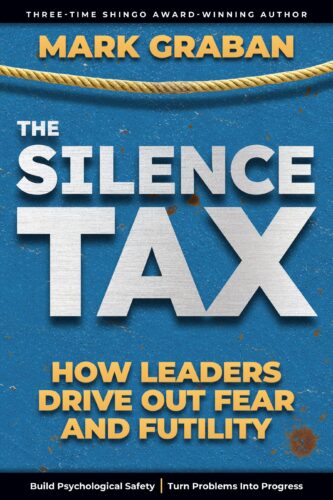
My new book, The Silence Tax: How Leaders Drive Out Fear and Futility, is about why people stay quiet at work and what leaders can do about both causes. It comes out February 9, 2027. The Kindle edition is available for pre-order now.
"An essential guide for leaders who want to turn employee voice into organizational learning and improvement."
Amy C. Edmondson, Harvard Business School; author of The Fearless Organization
Pre-order on KindleGet the free sampleEarly edition on Leanpub







I am in the agreement that about futility being one of the main reasons that employees do not often share ideas. We have had several suggestion program attempts over the years and it always ends up the same way. Too many suggestions, no good way of deciding on which ones to move forward with, and too little resources and time to take them all on. Sometimes too many options are worse than no options at all. Once we get overwhelmed, then it slowly falls to the wayside, along with our credibility.
Thanks for the comment, Nick. It’s a shame when that happens.
I’m currently staying in a hotel that’s just a real mess. It’s outdated, in poor condition… just seems generally mismanaged and there are many things that have gone wrong with the room and an attempt to eat at the restaurant.
A manager asked me if I had any concerns and it, frankly, didn’t even seem like it was worth the effort to tell him anything in detail. It felt futile.
Leader: The people just don’t care.
Me: Yes, but it is a “heartfelt apathy!”
—————–
Typically we interpret apathy as not caring to begin with.
The attitude of not speaking up and caring due to a history of futility? I refer to that as a “heartfelt apathy”. The workers come to that state from their own experience in trying to raise issues and being ignored by their leaders.
Yeah, I think people “stop caring” (or put on the appearance of that) after being in a bad culture, which includes being ignored by their leaders.
I think of the late Peter Scholtes, who talked about so-called “dead wood” in the organization. He asked the provocative question of whether or not the organization had once hired “live trees.”
[…] At KaiNexus, we’ve been fortunate to have a good relationship with Professor Ethan Burris, from the University of Texas McCombs School of Business. He has done a lot of research and publishing around employee engagement and idea systems, as I’ve mentioned here on the blog before: “Is Fear the Only Reason Employees Don’t Speak Up?” […]
Employee fear is something that most companies fail to address. Some even ignore the fact that it exists. This article rightly pints out the problems that develop when employees are in fear at the workplace. If employees are in fear of speaking up management gets only the good news. In a company that only encourages positive input much gets lost by failing to encourage employees t speak freely without the possibility of negative consequences. Nice article. Management needs to recognize the great value of employee input and encourage, rather than discourage it.
Here is video of his presentation:
Yes. I see this everywhere I go. “It doesn’t matter what we suggest nothing will change.” Management counters that they want to hear ideas but hold the right to veto the idea because employees don’t have the big picture. Often employees point out problems and management sees it as whining and tells them to stop bringing up certain issues (having too much work to do is a common concern that is quickly smacked down). Employees then just decide not to say anything. Management then gets upset that employees stop coming forward with ideas. Its a terrible vicious circle that is tough to break.
[…] employees feel that speaking up is “futile,” it's understandable why they would give […]