Toyota Copied Ford’s Suggestion System–and Got Far Better Results
I've been reading The Birth of Lean, a collection of talks and interviews with the people who helped build the Toyota Production System. One passage stood out because it explains something I had never seen described this clearly:
Toyota copied its employee suggestion system directly from Ford.
That might be surprising to those who think everything associated with Lean originated inside Toyota. It didn't. Toyota learned from many sources, including Ford.
The history also has a certain irony. Today, Ford and other automakers continue trying to learn from Toyota. Ford's current CEO, Jim Farley, spent 17 years at Toyota before joining Ford in 2007. His roles included leading Lexus and helping launch Scion. Farley has more recently described using the Toyota practice of going to the gemba to understand Ford's engineering and manufacturing problems firsthand.
But in this case, the direction of the learning was reversed.
Toyota copied Ford.
And then Toyota outperformed Ford.
Toyota Brought Home Ford's Suggestion Plan
Masao Nemoto, a former Toyota executive, told the story during a 1997 talk included in The Birth of Lean.
Eiji Toyoda had traveled to the United States to study Ford's operations. That much I knew. They visited a Piggly Wiggly grocery store, and what they saw inspired the kanban system for materials management.
Toyoda apparently had very little spending money, so when he returned to Japan with a souvenir, people were curious about what he had brought back.
It was not a model car or a Ford-branded pen.
It was a thick booklet titled Suggestion Plan.
Nemoto recalled:
“We translated it into Japanese and changed all the places that said ‘Ford' to ‘Toyota.' That became our employee suggestion system.”
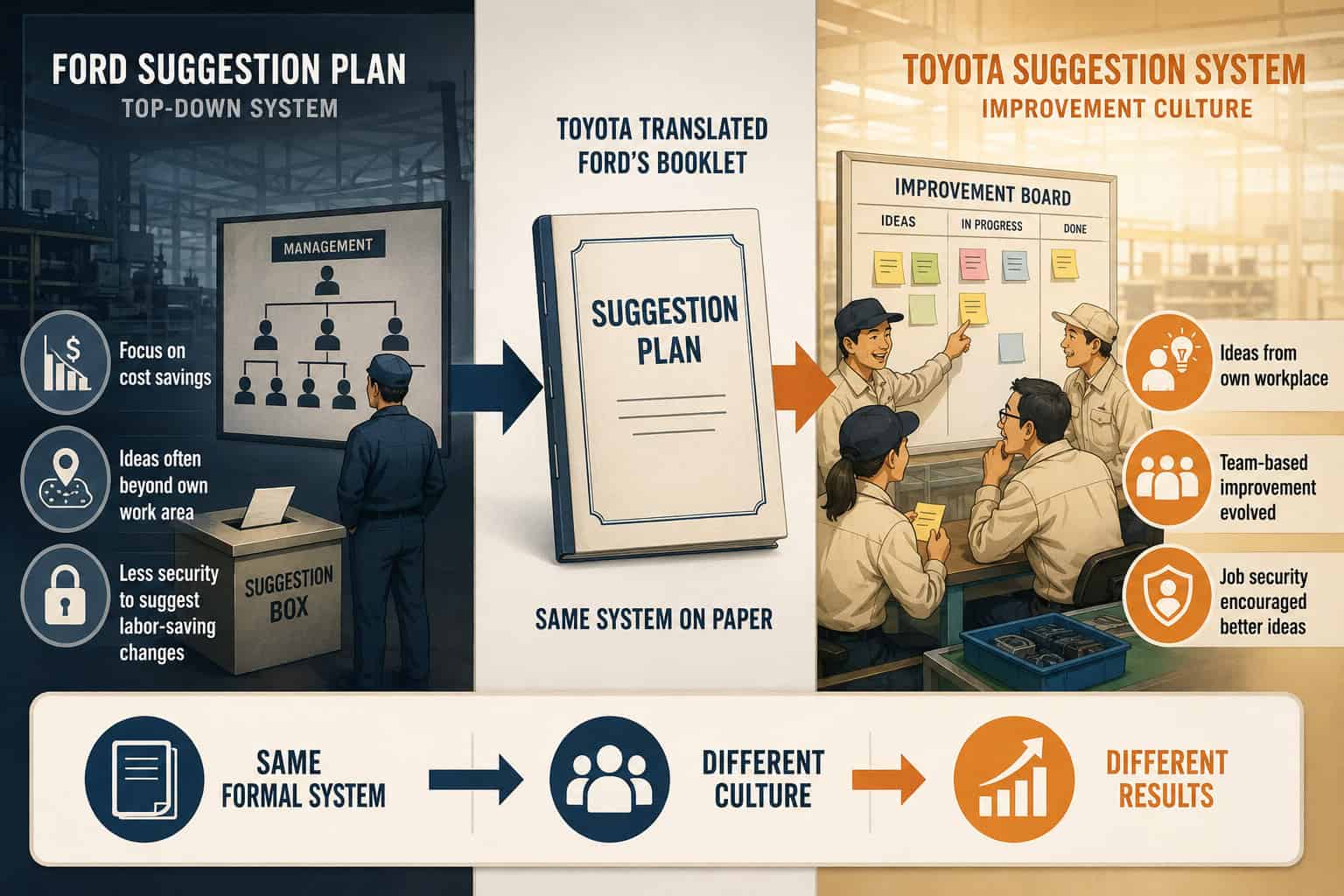
This was not a vague case of Toyota being “inspired by” something it saw at Ford. According to Nemoto, Toyota translated Ford's booklet, replaced Ford's name with Toyota's, and put the system into practice.
Ford's plan rewarded employees for ideas that produced measurable savings or profit. Nemoto said Ford gave the employee half of the resulting financial benefit.
Toyota adopted the same system.
The results were not remotely the same.
By the way, Joe Swartz and I warned about this in Healthcare Kaizen. When an improvement system focuses too heavily on documented cost savings, it can become a cost-savings suggestion program rather than a system for improving daily work. Ideas involving safety, quality, patient experience, or reduced frustration may be extremely valuable even when nobody can credibly calculate their financial impact. The emphasis on savings can also steer people toward ideas with a large, visible payoff instead of the many small improvements they are best positioned to make in their own work.
The Same Formal System Produced Different Behavior
According to Nemoto, Ford received many suggestions concerning operations outside the submitter's own workplace.
The incentive may help explain that pattern. When employees can receive a substantial share of the savings, they have a reason to search broadly for opportunities with an identifiable (and large) financial payoff. They are not necessarily concentrating on the work they know best or the problems they are responsible for solving.
Toyota saw a very different pattern.
Nemoto said nearly all of Toyota's suggestions came from employees seeking to improve their own workplaces. These employees were not roaming the company looking for a lucrative idea. They were improving the work directly in front of them.
An example I've seen in my travels was a Toyota tour guide improving the physical setup of her work.
Toyota workers, back then, submitted some suggestions that Nemoto believed would have been unthinkable in the United States.
Employees proposed ways to reduce the staffing required in their own work areas.
That is extraordinary.
In most organizations, improving productivity puts people's jobs at risk. That's a common reason for people to fear Lean (“Less Employees Are Needed”). Employees quickly learn that eliminating waste might also mean eliminating positions–including their own.
Under those conditions, refusing to suggest certain improvements is not resistance to change. It is rational self-preservation.
Nemoto said Toyota employees felt secure enough in their jobs to propose ways of doing the work with fewer people. There's a long history of Toyota NOT laying people off when times are tight, especially in recent decades (and that includes Toyota North America). Read posts about that.
Toyota copied from Ford, but improved upon the method. The adopted it AND adapted it.
The difference was not the suggestion form.
It was the management system and the mindsets surrounding it.
Job Security Changes What People Will Suggest
This story is related to psychological safety, although the mechanism is more concrete than the fear of embarrassment, criticism, or punishment that we often discuss.
It is employment security.
An employee might feel perfectly comfortable disagreeing with a supervisor (without fear of punishment) and still avoid proposing an improvement that could cost them their livelihood.
Job security changes the economic calculation.
When employees believe productivity improvements will lead to layoffs, management cannot reasonably expect them to identify every possible labor-saving idea. Leaders might ask people to eliminate waste, but employees hear a different request:
Please help us determine how many of you we no longer need.
Toyota employees apparently believed that reducing the staffing needed in one area would not mean putting themselves or their coworkers out of work. People could be reassigned as the company grew, as attrition created openings, or as other work needed additional help. I've heard hospitals say things like, “Your job might change, but your paycheck (or career) is protected.”
That allowed employees to improve their work without fearing that the improvement would make their own futures worse.
Psychological safety and job security are not identical. But both affect the same underlying question:
What do people believe will happen to them after they speak up?
You can copy a management practice word for word. You can reproduce the forms, financial incentives, procedures, and terminology. But if employees expect different consequences, they will make different decisions.
The visible system may be the same.
The behavior will not be.
Toyota Did Not Merely Administer Ford's System Better
It would be easy to conclude that Toyota simply executed Ford's suggestion program more effectively.
But another passage in The Birth of Lean suggests something more important. Toyota's suggestion system continued evolving as the company's broader management system changed. They improved their improvement system. No surprise.
In a separate interview, Eiji Toyoda explained that the suggestion system initially emphasized individual ideas. Later, as Toyota introduced total quality control, employees began participating in more group activities.
Suggestions increasingly came from teams.
Toyoda said:
“We didn't go out of our way to promote team suggestions. That's just how things happened.”
He added that the suggestions gradually became more substantive once people began working on them together. Toyota's familiar slogan, “Good Thinking, Good Products,” emerged from the suggestion system.
The change was not apparently the result of a corporate initiative to increase the percentage of team-based submissions. Toyota did not announce a new target, add a team-suggestion category to the dashboard, or launch a communications campaign.
The suggestion system followed the work system.
As problem-solving became more collaborative, suggestions became more collaborative. And, according to Toyoda, they became more substantive.
Toyota had started by copying Ford's documentation. But the practice became embedded in a very different organizational environment–one shaped by job security, team-based problem-solving, quality improvement, and direct responsibility for improving one's own work.
At that point, it was no longer meaningfully the same system.
The Suggestion Box Was Never the Point
Many organizations have launched employee suggestion programs that aren't copying Toyota.
The mechanics they use, from the traditional suggestion box approach, usually seem reasonable. Create a form. Invite ideas. Send them to a review committee. Reward the best ones. Track the number submitted and the estimated savings.
Sometimes the program generates a brief wave of activity. Then employees stop submitting ideas because approvals take too long, nobody follows up, or the ideas vanish into a committee.
Or the problem-solving is poor because they're inviting people to jump to solutions.
Eventually, the organization receives a trickle of suggestions about parking, cafeteria food, or the vending machine. Someone in HR quietly stops publicizing the program, and the suggestion box becomes office furniture. Or it gathers cobwebs.
The lesson from Toyota is not that every organization needs a better suggestion box.
The box was never the point. Or the software. It's about mindsets.
Toyota copied Ford's box. It copied the written plan and its basic incentive structure. What Toyota could not copy from a booklet–and what Ford could not produce merely by having the same booklet–was the surrounding environment.
That environment shaped which ideas employees noticed, which ones they were willing to share, and which ones they rationally kept to themselves.
Measure What People Are Willing to Suggest
Organizations often evaluate suggestion systems using activity and financial measures:
- How many ideas were submitted?
- How many were approved? (the answer in a suggestion system is usually about 2%)
- How many were implemented?
- How much money did they save?
Those measures can be useful. Toyota certainly tracked suggestions and recognized employees for participating.
But volume alone tells us little about the health of an improvement culture. An organization can generate thousands of superficial ideas while employees remain unwilling to raise its most consequential problems.
A more revealing test is the substance of the ideas people are willing to submit.
- Are employees improving the work they know best?
- Are they identifying unnecessary steps in their own processes?
- Are they willing to question staffing, workload, or the way responsibilities are divided?
- Would they propose an idea that reduced the labor required in their own area?
- And do they trust that making the work better will not make their own future worse?
Toyota copied Ford's suggestion system. The book.
Toyota's results were better not because its form was better, but because its employees had different reasons to use it–and fewer reasons to hold back.
That tells us far more about a management system than the number of suggestions in the box.