


Psychological safety is widely described as a prerequisite for continuous improvement — but what does it actually look like inside organizations that are actively trying to improve?
Ahead of the 2023 KaiNexicon conference, we surveyed KaiNexus customers about psychological safety in their workplaces. The goal wasn't to produce a scientific study, but to surface honest perceptions from organizations that are already committed to Lean and continuous improvement.
The results are revealing. Even in improvement-oriented organizations, psychological safety varies widely depending on leadership behavior, context, and the type of “risk” involved — from asking questions to admitting mistakes.
How We Framed the Survey (and Its Limits)
I'm sharing those responses and thoughts here in this post. This is not a scientific survey, where selection bias may arise from those who choose to vote and respond. Our KaiNexus customers are pretty self-selecting in terms of their organizations having a commitment to continuous improvement. It's not representative of the broader corporate culture as a whole.
What the Survey Revealed About Psychological Safety
On a scale of 1 to 10, you can see the average responses and the distribution curves for the following:
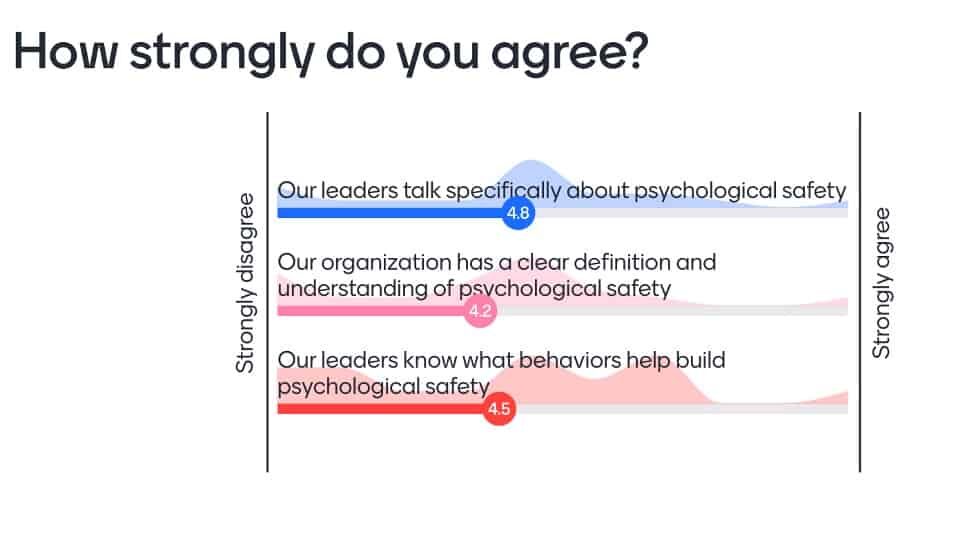
Leadership Understanding of Psychological Safety
Our leaders talk specifically about psychological safety? There's an average score of 4.8 (out of 10) and it's a pretty tight distribution around 5.
Our organization has a clear definition and understanding of psychological safety? That was a 4.2 out of 10 with a lot of 5's and more 1's that bring down the average.
Our leaders know what behaviors help build psychological safety? A 4.5 out of 10, but that distribution had many more 1's and 2's and some higher scores. So there's more variation there.
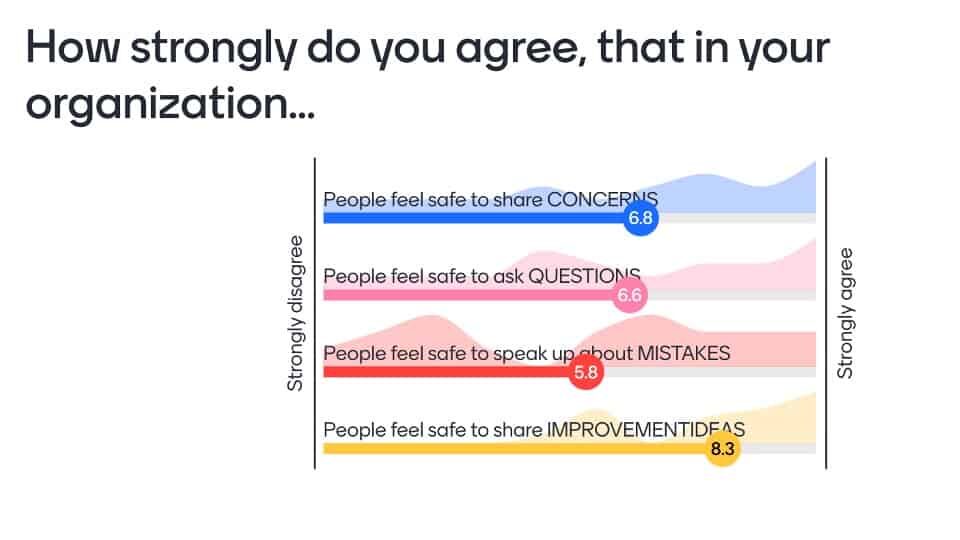
Psychological Safety Varies by Situation
When we feel enough psychological safety to speak up, our level of safety might vary a bit depending on the situation. In other words, some of these “vulnerable acts” are more vulnerable than others.
Feeling safe to share concerns? 6.8 average with a lot of 8's and 10's
Feeling safe to ask questions? 6.6 with a slightly more spread-out distribution.
Feeling safe to speak up about mistakes? That's not surprisingly, to me, the lowest average score, at 5.8. There's also a more bimodal distribution, with some people in organizations where speaking up about mistakes is very risky, and thankfully, others feel safer doing so.
Feeling safe to share improvement ideas? That's the highest, at 8.3, which we'd hope to see, if not expect, in organizations that value continuous improvement more than the average workplace.
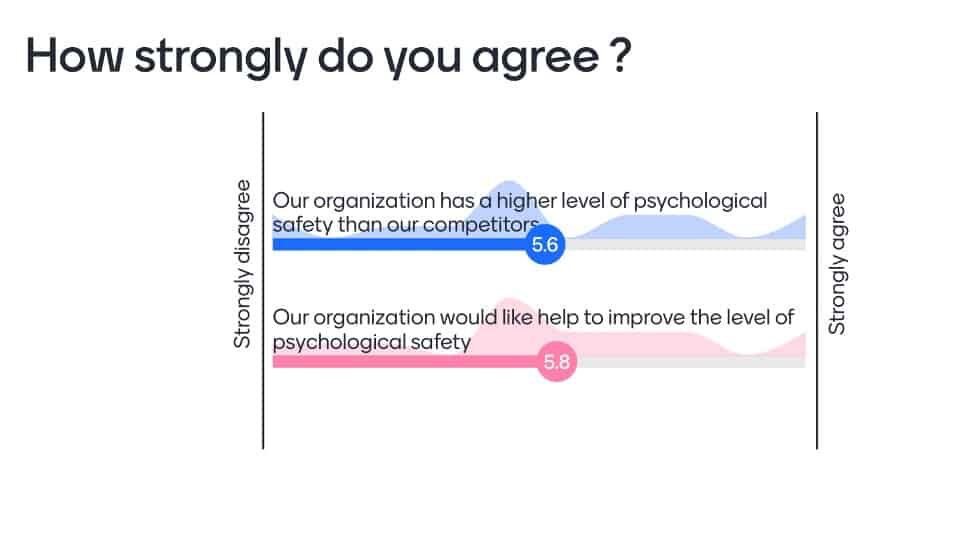
How Respondents View Their Organization Compared to Others
It's admittedly difficult to compare your workplace to others, especially if you've only worked in one organization.
The responses to “Our organization has a higher level of psychological safety than our competitors” and “Our organization would like help to improve the level of psychological safety” are both pretty centered around roughly 5.
What Leaders Say Gets in the Way of Psychological Safety
The remaining questions prompted respondents for free-form answers. I'll present them as submitted so you can read the comments and the variation. Feel free to leave a comment on this post.
What's a primary barrier to higher levels of psychological safety in your organization?
| We are still shifting culture out of the “business results” focus. |
| Business organizations can often be very political at the leadership level so fear results in expressing mistakes. Change is minimal when expressed. |
| Getting employees to feel comfortable speaking their concerns |
| Leadership is not involved with cutting-edge thinking. |
| The organization needs a larger understanding of roles and services provided. Too much of our work occurs in silos which leads to turf protection. |
| Awareness and learning to let go from old behaviors |
| Everyone's in survival mode; senior leaders do not recognize yet how their own behaviors may need to change; traditional culture of non-transparency at highest levels |
| Organization size likely results in variation in a given employee's experience with psychological safety. Overarching culture of psychological safety likely helps set a minimum experience, though. |
| Psychological Safety as a formal concept is not discussed and may not be widely understood. |
| Awareness |
| Pressure to deliver every second of the day, followed by a focus on the output not what it took to get it or per say the quality of it. |
| Mostly understanding what it is, and then taking the time for self reflection to understand if you are providing that as a leader. |
| Identifying who “owns” it to make it happen |
| Leadership treating all front line employees as being valuable human capital worthy of explaining their purpose in the organization. |
What resources do you use to educate people about psychological safety?
| Internal education and HR resources |
| None at this time. |
| Webinars and educational requirements. |
| We don't have a deliberate plan. My team has included some basic expectations in the LSW standard and we are building a simple check in the employee survey we are designing to measure Lean Maturity. |
| Orientation, class time, bi-annual administration of Culture of Safety survey, RCA's, discussion in some meetings |
| C.I. training for leaders and front line that reinforce ideal behaviors. General leadership training sessions primarily for new leaders. |
| Limited training and online materials. Mainly relies on competent managers to talk about it, encouraging safe spaces and coaching others/demonstrating leading behaviours |
| We have none |
| NEO, annual education, |
| Communication meetings, motivational advertisement on tv monitors, CI program, Safety tool box talks |
What actions do your leaders take in attempts to build higher levels of psychological safety?
| Promoting positive open communication. |
| Telling direct reports it is ok to “not know” and that mistakes are learning opportunities and only bad when willingly repeated. |
| Not aware. |
| Immediate RCAs with feedback and being present to empathize with staff. |
| There is an honest interest to “embrace the red” and buy-in to stop making the issues about the people instead of the process |
| New COO centering topics of safety and transparency in their messaging; varying levels of encouragement to speak up and use KN |
| Expectations, forums, and mechanics to call out opportunities to improve or remedy mistakes. Recognition and reward systems for those who do. Target goals for improvement results achieved. |
| Team charters within projects and teams. Verbal setting of standards. Actively demonstrate the behaviours and create the environment directly. |
| No intentionality on leaderships part |
| This is mainly done through employee communication meetings and Gemba walks. |
How would you articulate the benefits of psychological safety?
| Creating positive space to express mistakes/changes needed help create improved processes for the organization. |
| Feeling secure in that you are allowed to grow and make mistakes and improve yourself over time. |
| Empowered workforce and work environment. |
| The more that staff are able to report and identify potential issues, the better product we can provide and the more satisfied our staff will be. |
| Without it, we will never get honest feedback. Without feedback we can't improve. |
| A precondition for a culture of continuous improvement; humans feel valued at work; |
| Enables employees to focus and improve on the value they can deliver to the organization and the value the organization can deliver to its customers; which returns fulfillment back to that employee. |
| Employee wellbeing leading to increased motivation leading to increased productivity and improvement mindset. Additional benefit of increased retention of staff. |
| The freedom to share concerns and ideas without condemnation of any sort. |
| Improved outcomes/safety and speed and effectiveness at responding to issues. |
| An employee that experiences psychological safety is one that will feel free to engage in improvement and innovation. |
Any Other Comments?
The other comment was spot on!
“My opinion is that psychological safety, or other examples of a positive culture, aren't achieved through training but through repeated experiences that reinforce the belief that the safety exists.”
What These Results Suggest for Lean Leaders
That statement is more of a fact than an opinion. You cannot train your way to psychological safety. Leaders cannot just tell people that they should feel safe. Don't rely on what Timothy R. Clark calls “rhetorical assurances.” They don't work.
When a person believes (or feels or perceives) that they have a high-degree of psychological safety, it's the result of their interactions with leaders and colleagues. What leaders SAY is important but their ACTIONS are more important.
What does work is action… when leaders “model vulnerable acts” (leading by example) and then “reward vulnerable acts” (rewarding people who follow their lead on things like admitting mistakes). Are leaders doing this consistently over time, even when under a lot of pressure?

What This Survey Means for Lean Leaders
These survey results reinforce a pattern that shows up repeatedly across Lean organizations: psychological safety is widely valued, but unevenly understood and inconsistently practiced.
Most respondents work in environments that encourage improvement ideas, yet far fewer feel fully safe speaking up about mistakes or challenging leadership behavior. That gap matters. Continuous improvement depends not just on idea flow, but on honest signals when something is not working.
The findings also highlight a common leadership blind spot. Many organizations believe they support psychological safety, while employees experience it situationally–or not at all. This disconnect is rarely about intent. It is about everyday leadership behavior under pressure.
Psychological safety is not created through training, slogans, or one-time initiatives. It emerges through repeated experiences where leaders respond to bad news with curiosity, treat mistakes as system signals, and reward people for speaking up–even when it is uncomfortable.
For Lean leaders, the implication is clear: if problems are not being surfaced, improvement has already stalled. The question is not whether people “should” speak up, but what leaders are doing–consistently–to make it safe, expected, and worthwhile to do so.
Psychological safety is not a side topic in continuous improvement. It is the condition that determines whether improvement is real–or performative.