

Shohei Ohtani and the Harada Method: How It Works
TL;DR: As a high school sophomore, Shohei Ohtani filled out a 64-box goal chart built on Takashi Harada's method for personal development. Norman Bodek brought that method to English-speaking audiences. It is a serious approach to individual goal setting, and it still runs into the problem Deming spent his career on: best efforts inside a bad system do not produce good results.
Shohei Ohtani was a sophomore at Hanamaki Higashi High School in Iwate Prefecture when he wrote down a goal: become the top baseball prospect in Japan by the time he graduated.
He did not write it on a sticky note. He put it in the center of a grid, surrounded by eight supporting goals, each of which was surrounded by eight specific actions. Sixty four boxes in total. People call it the 64-chart, the Harada chart, or sometimes the mandala chart.
Ohtani was a student of Mr. Sasaki, who studied under Takashi Harada, a former middle school teacher in Japan who developed the method. Harada later told the Wall Street Journal that the approach was “a big pillar” in Ohtani's development, and the Angels confirmed at the time that he still used it.
How the Harada Method works
The structure is the part people search for, so here it is plainly.
You start with one long-term goal, stated specifically enough that you would know whether you had reached it. Around it you place eight areas you would need to develop, covering both the skill and the person. Around each of those you place eight concrete actions. That produces sixty-four things you have actually committed to doing, rather than one aspiration you have committed to wanting.
Here is Ohtani's actual chart from high school (translated and reformatted as a PDF):
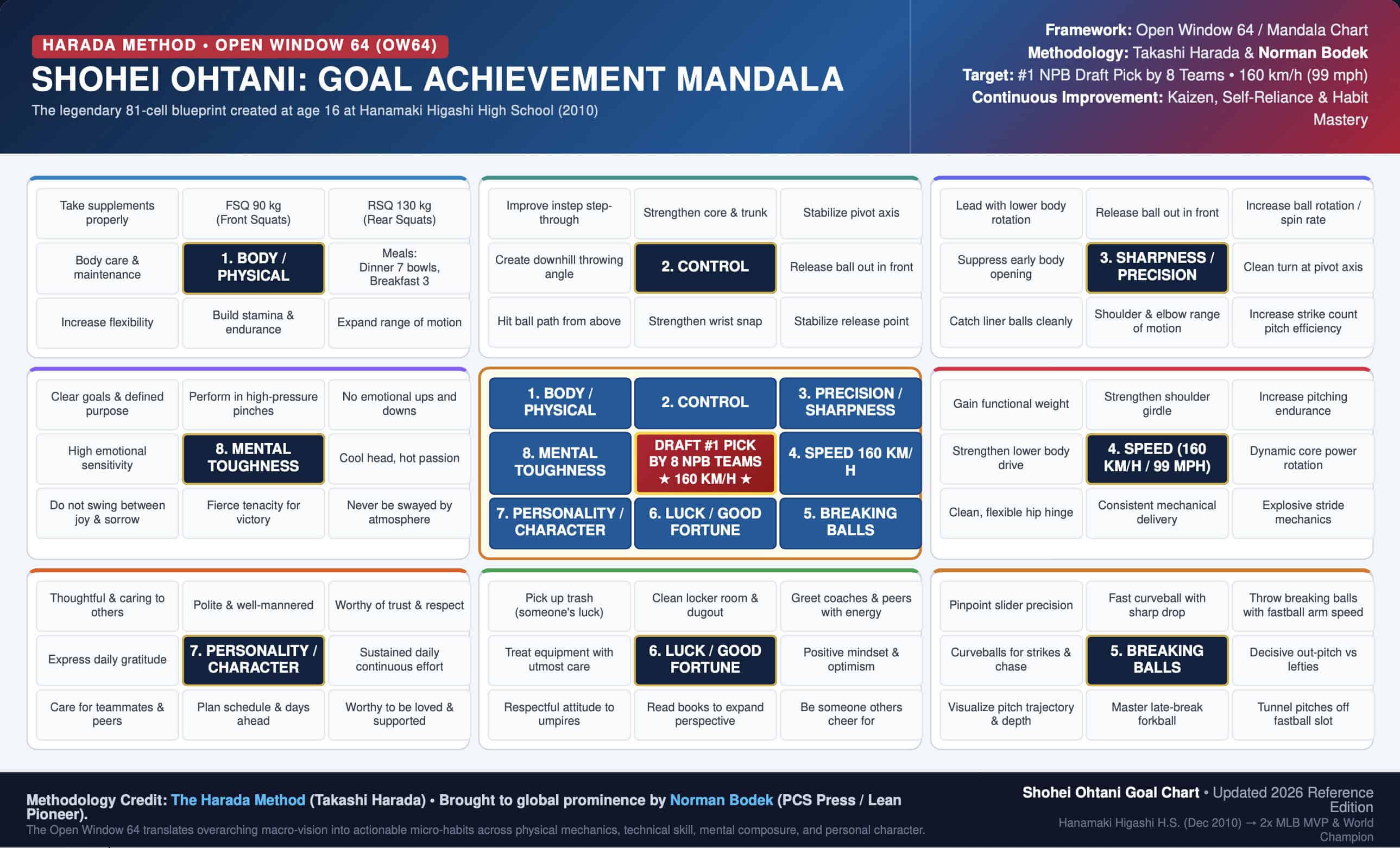
Norman Bodek originally published this through PCS Press. That site is gone, so I am hosting a copy here to keep it available. The chart was originally in Japanese.
Underneath the chart sits a piece people skip, and it may be the more important half. Before setting the goal, you write out your motivations in four categories:
- What is good for you materially
- What is good for you immaterially
- What is good for other people materially
- What is good for society in an intangible way
Norman Bodek argued that the more you write in those four categories, the stronger your motivation becomes, because you end up knowing precisely what you want.
That framing stuck with me because it resembles something else I have been studying: Motivational Interviewing, and the distinction between change talk and sustain talk. In that approach, you do not tell someone why they should change. You create conditions where they articulate their own reasons. The Harada goal categories do something similar on paper. There is also a clear line to PDCA and PDSA, since the chart is a plan you are meant to run, check, and adjust rather than frame.
How I heard about it
Norman Bodek co-authored the book The Harada Method: The Spirit of Self-Reliance with Takashi Harada, and he told me about Ohtani years before most American baseball fans had heard the name. Norman was a guest on my podcast in 2013 to talk about the method: Norman Bodek on the Harada Method and the Spirit of Self-Reliance.
I suggested at one point that he contact sports writers, since the Ohtani connection was a better hook than anything a management publisher could arrange. The Wall Street Journal wrote about it in 2018 and quoted him. A Chief Executive interview around the same time covered his broader argument about workforce development.
Norman died in 2020. I wrote about what he meant to me in Mourning and Remembering My Time With Kaizen Mentor, Norman Bodek, and revisited his influence again in 20 Years of Lean Podcasting, Thanks to Norman Bodek.
What people who have actually used it say
I have never formally used the Harada Method. Norman offered to coach me through it and I never took him up on it. So rather than tell you how well it works, here is what people who did try it have said on this blog.
Andrew Wagner took Bodek's webinar, read the book, and built an annual 64-chart. He found the process useful and also overwhelming. His diagnosis was that he lacked a single sharp objective to organize everything around, so he ended up with a large, unfocused list of things he would like to do. He made incremental progress, nothing dramatic. What would have helped most, he said, was a coach.
Arnout Orelio, a certified Harada Method trainer, made the case that the method works when you run all of it rather than picking pieces. His advice on goals was to make them both big and specific, work backward from five years to one year, and start with a three to six month project while you are still learning the mechanics. He was direct that there is no shortcut.
Those accounts point the same direction. The chart is not the hard part. The coaching and the discipline are.
Where Deming might push back
Here is my hesitation, and it is not really about the Harada Method.
Bodek believed, into his eighties, that the next real gain in manufacturing would come from bringing out the best in every worker. I do not disagree with the sentiment. I do think it is incomplete.
Deming's point was that people work inside a system, and that the system sets the ceiling. “Best efforts will not ensure quality,” he wrote, and he meant it as a warning to leaders who kept exhorting individuals rather than fixing the conditions those individuals worked in. You can hand every employee a 64-chart and change very little if the process they work in is unstable, the goals conflict, or speaking up about a problem is unwelcome.
There is a related problem Norman raised in our podcast conversation: an individual's personal goals may not line up with the organization's goals. He framed the method as a way to find the overlap, so that what a person wants for their own growth also serves the organization. That is the right question. It is also harder than filling in boxes.
This is where the method connects to Respect for People as Toyota describes it, which is about developing people rather than simply being nice to them, while still holding leaders responsible for the system those people work in.
Ohtani is not really evidence either way. He is one person with extraordinary ability who also happened to use a structured planning method. We cannot separate those. What the story does establish is that a teenager was taught to be specific about what he wanted and about the daily work required, which is more than most organizations teach anyone.
So I hold both. Develop individuals seriously. Also build a system where developed individuals can actually succeed. Leaders who only do the first one are running a motivational program. Leaders who only do the second are wasting people.
Frequently asked questions
What is the Harada Method?
A structured approach to personal development created by Takashi Harada, built around a long term goal, eight supporting goals, and eight concrete actions under each. It also includes written motivations, daily routines, and coaching.
What is the Harada 64-chart?
The grid at the center of the method. One main goal, eight supporting goals, and sixty four specific actions. It is sometimes called a mandala chart or a goal matrix.
Did Shohei Ohtani really use it?
He completed a Harada-style chart in high school through his coach, Mr. Sasaki, who had studied under Harada. Harada has said publicly that Ohtani continued using the approach after turning professional.
Do you need a coach?
Practitioners who have written here say yes, or close to it. The people who found it useful had either a trainer or an accountability structure. The one who tried it alone described the result as unfocused.
Is the Harada Method compatible with Lean thinking?
Partly. It supports Respect for People and personal development, and it maps onto PDCA. It does not address system design, which is where Deming would say most performance is actually determined.
Where can I see Shohei Ohtani's actual Harada Method chart?
The chart he completed as a high school sophomore is available here as a PDF. It shows the full 64-box structure with his central goal of becoming Japan's top draft prospect.


Hi Mark:
Great post about Norman Bodek’s book and how it is being successfully applied. I started at AME roughly 4 years ago and one of the first things I did as a new employee was attend Norman’s “Harada Method” AME workshop in downtown Chicago. I found Norman to be an amazing, humorous, humble workshop leader and thoroughly enjoyed that session, the stories he told and getting my copy of his Harada Method book autographed by him.