

Do Not Remove: What a Kaizen Binder Taught Me in Japan
On a factory table in Japan, in December 2019, there was a binder. White cover, the word KAIZEN in big orange letters, a photo of cherry blossoms underneath. Inside the front cover, someone had printed a word cloud — IMPROVEMENT, DEMING, PDCA, TOYOTA — and a hand-drawn PDCA with a finger pointing at it. Someone had put real care into the cover. This was not a binder shoved in a cabinet to satisfy an auditor once a year.
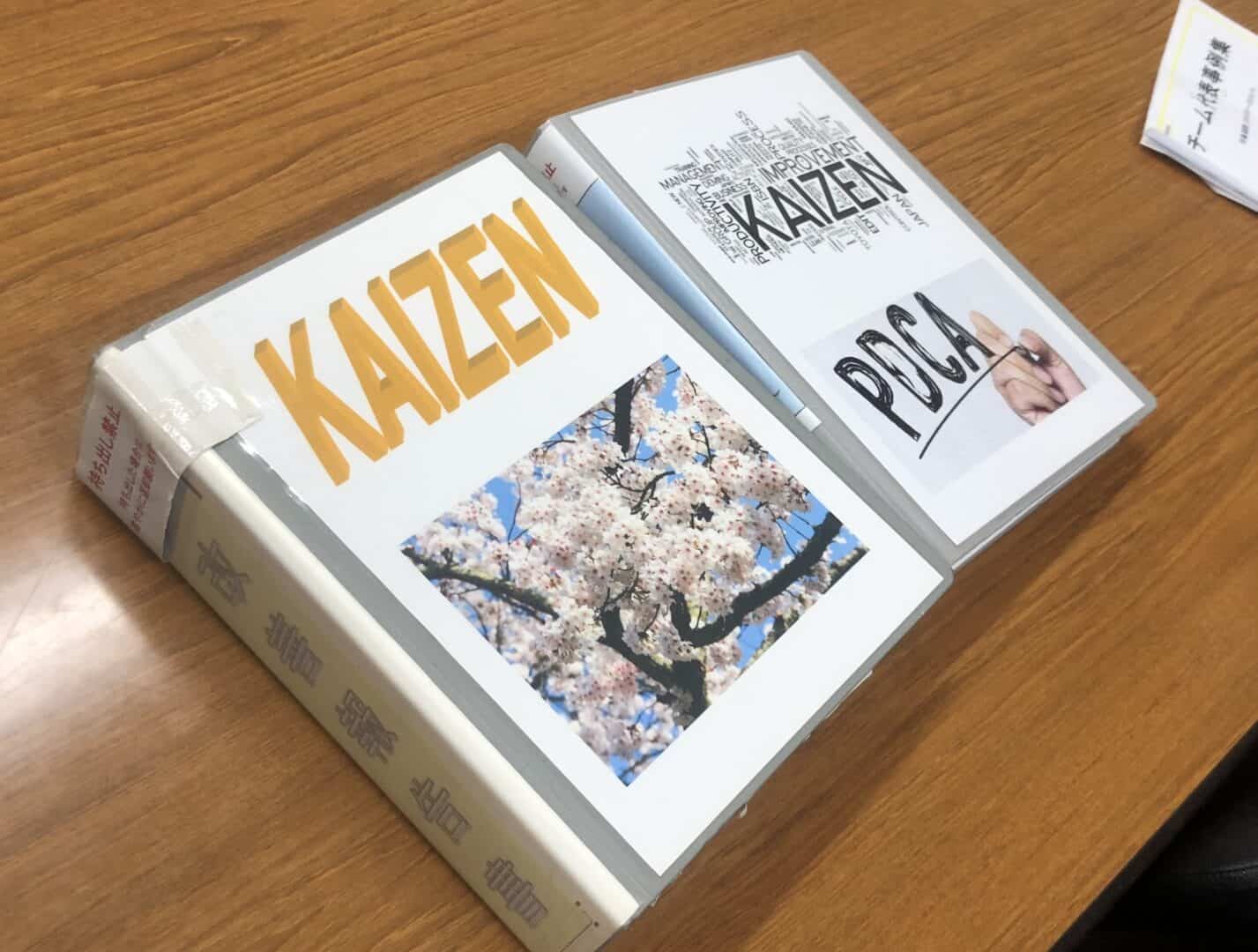
The detail I keep coming back to is the strip of tape on the spine. It read, in Japanese, “Do not remove.” Thanks to Claude AI for the translation of these documents. When I took photos of them in 2019, I guess I anticipated that I would be able to read them some day.
You don't label a binder “do not remove” unless it leaves the shelf often enough that you've started to worry about it walking off. The label is a small piece of evidence. People were pulling this thing down — to train, to copy ideas, to show a visitor like me and our Japan Study Trip group. A reference document only needs a rule against borrowing it when it's actually getting borrowed.
So I started reading what was inside. And the contents turned out to be more interesting than the cover.


Four reports, and a quiet progression
Every report used the same form or template. A standard kaizen report sheet, tied to the company's ISO system, with a before photo, an after photo, a 4M category checkbox, a cost line, and a hanko stamp from the person who did the work and the leader who signed off. By chance, the four reports I photographed show something like a progression.
The first one might look trivial, but that's OK. An etching work-record form was only being filled out on one side, because the old ring binder made the back of the page awkward to reach. So they swapped it for a top-clip clipboard. Now you flip the sheet and use both sides. Cost: zero yen. Time invested: five minutes. And someone wrote it up on a formal, ISO-linked, stamped report.
A five-minute, no-cost fix for the back of a clipboard earned a place in the binder. That is either absurd or it's the whole point. I've come around to thinking it's the whole point. That's common “kaizen” practice — small improvements are valuable too!
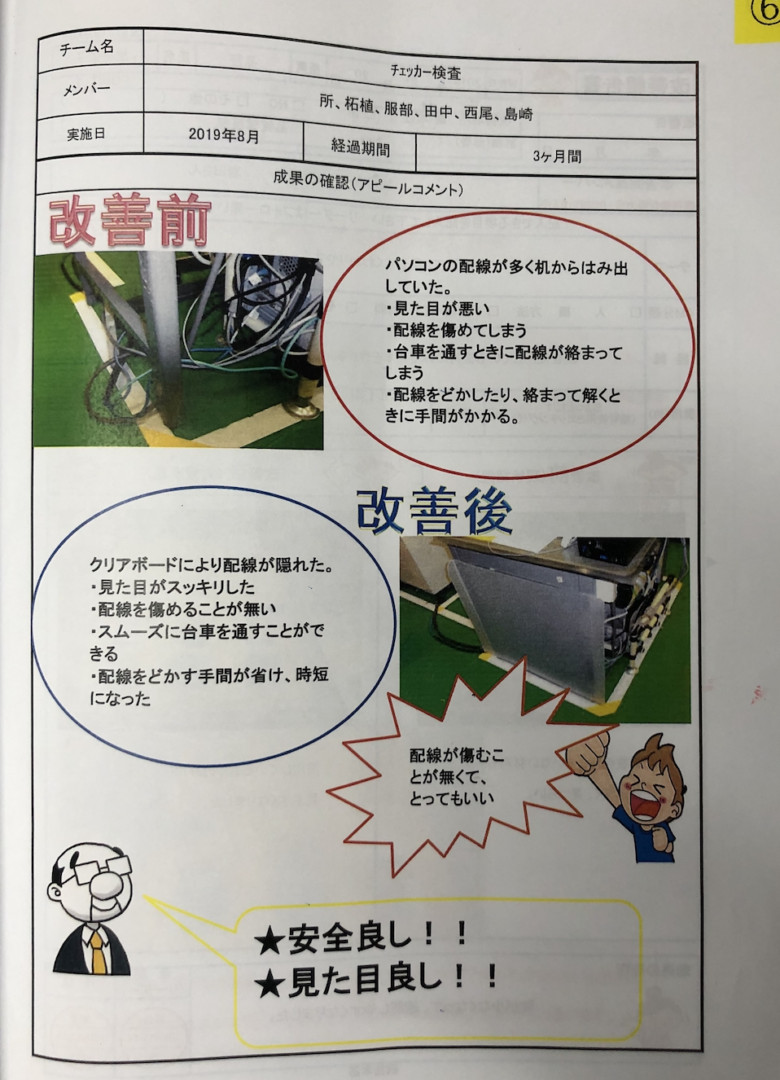
The second one is beautifully simple. A cluster of PC cables had spilled onto the floor by a desk leg, where a cart would snag them every time someone pushed through. The fix was a clear board placed over the area to hide and contain the wiring. Before and after photos, a cartoon character throwing a thumbs-up, two stars at the bottom:
“Safety, good. Looks, good.”
It was built to be read on a board in about ten seconds, and to make the next person think “I could do that.”
The third report starts to show some mistake-proofing reasoning. An X-ray drill setup required dialing a voltage to a target value — 24.0 kV, then 30.0 kV — while watching a digital readout and creeping up on the number by hand. Hunt and peck. So they drew a mark at the target position on each dial. Now you line the dial up to the mark and you're close. What I like is the justification the operator wrote underneath: two adjustments per cycle, about 30 pieces a day, so a few seconds saved each time adds up. Whether or not anyone taught it in those terms, the operator was using the logic: a small amount of waste, repeated often, becomes worth improving.
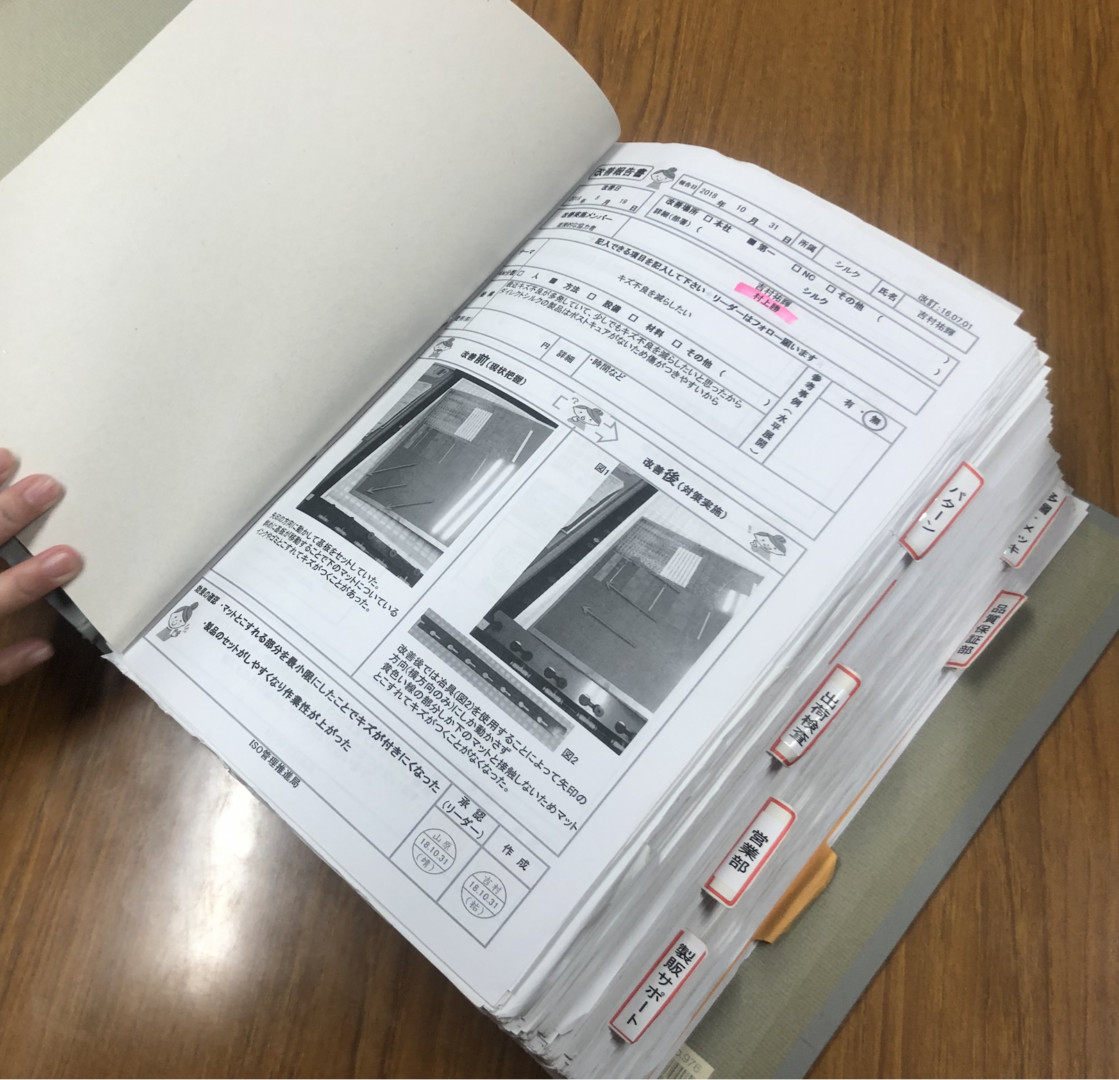
The fourth one is the one an engineer would be proud of. A silk product kept getting scratched because the board dragged across an inked mat as it was set into place. The countermeasure was a fixture that constrains the motion to a single direction and shrinks the contact area, so the part stops rubbing the mat. The drag goes away, and so does the scratch. That's also “poka-yoke thinking.” They didn't rely on “be more careful,” which is the countermeasure that never works. They changed the mechanism so the scratch can't happen.
Read those four in order and you can see a progression. Build the habit of writing things down, even the small things. Tidy up and make it safer. Reason about frequency and cumulative time. Engineer the defect out of existence. The clipboard fix and the fixture are very different in sophistication, but they live in the same binder, on the same form, with the same stamp. That equality matters.
What the form itself is teaching
The form has a 4M category box — Man (Person), Machine, Material, Method — so improvements can be sorted later. It has a yokoten field, “horizontal deployment,” asking whether this idea should be copied elsewhere. Most of the ones I saw had “no” circled, but the field is on every sheet, which means the organization is systematically asking the question. That's the difference between a suggestion box and a system. A suggestion box collects ideas. A system asks where else each idea belongs.
This sort of spread and sharing is easier through software platforms like KaiNexus, by the way.
And then there's a line printed across the top of the form that I found myself rereading. Translated, it says something close to:
“Please fill in the items you can. Leaders, please follow up.”
That tells the worker that an incomplete report is fine, lower the barrier, just write it down. And it tells the leader that their job here is to support and follow up, not to grade. Respect for People is usually something people put on a poster. Here, it was built into the document design. The form itself coaches the leader on how to behave. I've drawn a lot of forms in my career and I never thought to do that.
The part I have to be honest about
Here's where my Process Behavior Chart brain kicks in. Almost none of these reports carry a measured result. The scratch one says scratches were “frequent” before and gone after, but there's no defect rate, no before-and-after count. The dial one reasons toward a time savings without ever stating the seconds. As a Process Behavior Chart person, I notice the absence. Scratch defects are exactly the kind of thing you can and should count.
So a thick binder proves engagement and discipline. It does not, by itself, prove business impact. Both things can be true at once, and I think they are here: a level of participation most companies would envy, and a measurement habit with room to grow. Maybe I'm importing a high expectation onto a culture that was busy solving a different problem, which is getting everyone to participate at all. That problem is the harder one, and they had clearly solved it.
What strikes me most isn't any single fix. It's the volume. Hundreds of these sheets, from Sales and Shipping and Quality Assurance, not only from the engineers, bound into volumes thick enough to need a readable spine. The clever fixture is nice. The fact that it sits in a fat, tabbed, stamped archive of its peers, the fact that people are told not to remove it because they keep reaching for it, is the actual asset. You can't fake that with a kickoff event or a poster campaign. It accumulates one stamped page at a time, over years.
I don't know whether your organization has a binder like that. You might have some sort of digital binder or folder or drive. I don't know what would be in it if it did. But I keep picturing that strip of tape. What would it take for an organization's record of small improvements to become so useful that people had to be reminded not to walk off with it?
Want first-hand experiences like this? Come to Japan with me!