From Firefighting to Flow — Darren Walsh on Lean Leadership Routines That Sustain Results
Why do so many Lean efforts stall after early wins? In this episode, Darren Walsh explains why firefighting feels productive but prevents real progress–and how leaders can build daily routines and standards that sustain improvement over time.
Scroll down for how to subscribe, transcript, and more

My guest for Episode #539 of the Lean Blog Interviews Podcast is Darren Walsh, author of Making Lean and Continuous Improvement Work: A Leader's Guide to Increasing Consistency and Getting Significantly More Done in Less Time.
Darren is the Director and Leadership Coach at Making Lean Work Ltd and holds a master's degree from the Lean Enterprise Research Centre at Cardiff University. He brings more than 25 years of experience helping leaders transform organizations in automotive, aerospace, medical devices, energy, and healthcare.
In this episode, Darren and Mark explore why so many Lean and continuous improvement programs fail to sustain–and how leaders can build the right systems and habits to make improvement last. Darren explains the three common pitfalls he's seen across industries: choosing the wrong improvement approach, relying on traditional “solution thinking,” and lacking consistent leadership routines.
Darren also introduces his DAMI model–Define, Achieve, Maintain, Improve–as a way for organizations to avoid “kaizening chaos” and instead create a stable foundation for improvement. He shares stories from across sectors, including healthcare examples where better standards and daily management led to faster care, higher throughput, and dramatically lower mortality rates.
Mark and Darren discuss the difference between problem-solving and firefighting, the danger of “shiny Lean” initiatives that don't address core issues, and the leadership routines that keep everyone aligned and focused on the right problems. The conversation offers a grounded reminder that Lean isn't about tools or jargon–it's about building consistency, clarity, and capability throughout the organization.
“You can't kaizen chaos. First, you have to define and stabilize the standard.”
“Most organizations say they want improvement–but they haven't built the routines to sustain it.”
“If every team in your business is working on the right problem, that's an incredibly powerful organization.”
“Firefighting feels heroic, but it hides the real causes and keeps us from solving them.”
Questions, Notes, and Highlights:
- What's your Lean origin story? How did you first get introduced to Lean and continuous improvement?
- You've worked across industries–from electronics to oil and gas. How do you overcome the “we're different” resistance when applying Lean in new settings?
- Why do some organizations still associate Lean with cost-cutting instead of learning and improvement?
- What led you to write Making Lean and Continuous Improvement Work? What problems were you seeing again and again?
- Can you explain the three common pitfalls you describe in the book?
- What is the DAMI model–Define, Achieve, Maintain, Improve–and how can leaders use it effectively?
- How can organizations build a strong foundation for improvement before jumping into tools like 5S or Kaizen?
- What are the essential leadership routines for sustaining Lean and consistency?
- Why do so many teams fall into firefighting mode, and how can leaders break that habit?
- How can visual management and daily management systems help teams focus on the right problems?
- How do you balance working on small employee-driven Kaizen improvements versus larger, strategic problems?
- You've said, “You can't Kaizen chaos.” What does that mean in practice?
- What lessons from the healthcare case study–cutting waiting times by 88%–stand out most to you?
- How can leaders ensure alignment and help every team work on the right things?
- What's next for your work and research? What will your next book focus on?
This podcast is part of the #LeanCommunicators network.


Full Video of the Episode:
Thanks for listening or watching!
This podcast is part of the Lean Communicators network — check it out!

Automated Transcript (Not Guaranteed to be Defect Free)
Introduction
Mark Graban: Hi, welcome to Lean Blog Interviews. I'm your host, Mark Graban.
Our guest today is Darren Walsh, the author of the book Making Lean and Continuous Improvement Work: A Leader's Guide to Increasing Consistency and Getting Significantly More Done in Less Time.
So before I tell you more about Darren, welcome to the podcast. How are you?
Darren Walsh: I'm good, thanks, Mark. Yeah, great. Thanks.
Mark Graban: I'm excited to talk to you about your experiences and the book.
We'll see if we can get significantly more conversation done in the time that we have available. I think we'll have a high-quality discussion, not just a productive one. But let me tell you a little bit more, again, about Darren Walsh.
He has a master's degree from the Lean Enterprise Research Center, a highly acclaimed and well-known center in Cardiff, Wales. He is a director and a leadership coach at Making Lean Work Limited, a leading management consultancy. He specializes in helping business leaders unlock the transformative power of continuous improvement. So we'll talk about that today.
And he has over 25 years of experience in many industries, including automotive, aerospace, medical devices, energy, and financial services.
A Lean Origin Story: From IT to Shingo
Mark Graban: So, I like to ask people, Darren, before we talk about the important topics of the book… to get to know you a little bit better. What's your lean origin story? Does automotive come first in the bio because that's where you got introduced to lean, like a lot of people, or tell us your story?
Darren Walsh: Yeah, it really was. I started in IT, believe it or not. I was an apprentice in IT, working at a manufacturing company. There was no full-time job there for me. And I got offered a role in production engineering. First, I said yes, but I wasn't sure what production engineering was. And that was in an electronics business.
It wasn't long after getting into the role. My quality manager had an influence on me. He shared with me… it was a Welsh government or a Department of Trading and Industry business book at the time, which featured the gurus, the quality gurus: Deming, Juran. Taylor. And I just got right into that.
And yeah, right at the back was this… pretty looking feller, Shingo. And I just devoured that. That was just fantastic. And before long, I was reading the works of Shingo, mm-hmm, at home.
I went from that electronics company to another electronics organization, but this time as an industrial engineer. So really just fine-tuned into improvement activity. Got mentored there by Dr. Kato, Richard Kato, a Japanese consultant brought in from Sony.
I worked with him for about 12 months. He spoke very little English, so he used to point and draw and, yeah. I had a real, real, great upbringing there.
Went from there, spent a number of years there trying to squeeze out one, 2% in high-volume industry to an organization, Sega. More project organization.
Mark Graban: The video game company.
Darren Walsh: Yeah. I was on the “sexy side,” so I was on the same company, but I was on the sexy side. So the driving games, the motorbikes, the beat 'em ups. Yeah. And I was, I would work on new product development, leaning out… how are the people going to build the product?
Lean it out. Yeah. Put the systems in, teach the managers how to improve.
And while I was there, that was one of my challenges. I used to go back… I would be working on a new project and I'd go back to one of the business units, and I used to scratch my head. Why is the cleanliness, the 5S, degrading? Why is the performance degrading? Why aren't the meetings working as they should be?
So that's when I… I found out about Lean and I got myself enrolled at the Masters in Cardiff. Went from Sega to Boston Scientific, three and a half thousand people in one plant, drove lean across the plant there. And then went on to Parker Hannifin, so 11 sites in Europe. Then after that, Zodiac Aerospace, division lean role there again. And then a GM role in oil and gas. Okay. So it really, yeah, it was really, Parker was more automotive. Right. Mixture. Yeah.
Adapting Lean and Its Language
Mark Graban: So, as we talk about so often here on the podcast, it goes to show that the ideas and the concepts and the methods or the philosophy… are highly transferrable.
I'm curious about your experiences of coming into a new setting where, let's say after automotive, coming into oil and gas… was there defensiveness about saying, “Well, what we do is different.”? “We're not producing discrete products. This is different.” Yeah. How do you get past that challenge?
Darren Walsh: I think that question came up and that comment came up every time that I went into a new business environment where I had a proper job, and since then, working as a management consultant.
Yeah. So it's mainly just focusing on the biggest problems. And. Talking about some of the thinking behind the tools and the techniques and… just getting them to start buying in, buying into the logic, before defending the solutions.
I'd also add there that, when I went into oil and gas, I did the experiment that I didn't even use the lean terms. So I went in and yeah, after a couple of months, one of the managers said to me, “When are you going to start teaching us lean?” “When are you going to start teaching us continuous improvement techniques?”
You're doing it. You've got your visual boards, you've got your routines, you've got problem-solving. So really, sometimes… human nature is we want the shiny stuff, we want the buzzwords, but lean… I think is just basic routines.
Mark Graban: Yeah. And it's funny, it's a double-edged sword where people might say, “Well, we don't want a lot of jargon.” But then, like you said, “Well, where's this branded, shiny-sounding thing?”
Do you find a term like “continuous improvement” was more accepted than a word like “lean” or Japanese words like “kaizen”?
Darren Walsh: I think at the moment, there's so many people and so many different views of what Lean is… that really, over the years, Lean has probably got a bad name. So in some, definitely some organizations, some sectors, there's a pushback on lean.
Why ‘Lean' Can Be a Hard Sell
Darren Walsh: Even some managers, they think lean is a cost-cutting exercise. Mm-hmm. So that's how it comes across to the workforce. Whereas, for me, it's just a way of thinking. It's just a way of thinking. Right. And working.
So sometimes, yeah, continuous improvement I think can land better with people.
Mark Graban: Yeah, and you're right. Lean done badly or cost-cutting done in the name of lean in a community can create a bad perception.
I went into one health system and we started talking about lean and improvement, and one of the medical staff, I think was a nurse, came over and talked to me and said that her husband had been laid off from a major computer company with a three-letter name. And she said, “Well, that was because of Lean.”
And so I'm glad she at least came up and said something. Because it opened the door to at least have the conversation about, “Well, that's unfortunate.” That's not what Lean is supposed to be. And when I was working for J&J, our consulting group partnered with health systems to have a “no layoffs due to lean” commitment.
But at least she opened the door to that conversation, even if she didn't believe it right away.
Darren Walsh: Yeah. And that's some of the pushbacks which I've had. I've had that from employees. When you really get into it with employees, they see the benefits of not having to rush, not having to do rework… and not having to do things the hard way and having stress all day long and having managers on their back.
Why Improvements Don't Sustain
Darren Walsh: Sometimes from leaders and managers themselves, you also get pushback on “This lean stuff doesn't sustain itself.” “We did a project a couple of years back. We saved ourselves 200,000 or whatever.” “But it didn't sustain.”
Well, that's not lean, and… that's not the fault of lean or continuous improvement. That's the fault of you. You didn't have a management system or routines in to sustain the gains and keep driving it.
Mark Graban: It's fair to say nothing magically sustains itself. Right? Exactly.
I mean, if a new technology or a new approach is beneficial or helpful for people, they'll continue doing it. If it's making their work easier, safer, better.
Darren Walsh: Yeah. Yeah, definitely. And that's for me, that's a large part of lean. A lot of people will jump to the improvement steps in Kaizen and then find out that either they haven't delivered the results or they can't sustain it.
But ultimately it comes back to, “Well, you've got to have a foundation for improvement. You've got to have disciplines.” You can't have management saying to the team, “Right. You guys in production, you go and do some lean or continuous improvement, and we'll carry on with our meetings.” …They've got to be involved, they've got to play the game as well.
Mark Graban: Yeah. Over time, what you've learned, or what are you doing now to create a better foundation? I hear you. You've said a couple of times, don't just jump right into improvement. Don't jump into just using tools. What's a better way in your experience to set that foundation?
Setting the Foundation: The Three Pitfalls
Darren Walsh: Good question. I think that really comes back to these three common pitfalls that I kept seeing. This sort of, mm-hmm, drove me to write the book. Yeah, I kept seeing wherever I went… I kept seeing that teams were not working on the right things. Improvement activity was not really delivering. And just day-to-day teams were not delivering consistency.
So the three pitfalls is basically:
- The teams apply the wrong improvement approach.
- They suffer from, and they don't recognize that traditional management solution thinking is at bay. It's alive and well in the organization.
- And number three is the leadership routines.
DAMI: Define, Achieve, Maintain, Improve
Darren Walsh: So this improvement approach… many organizations say they want to get on the improvement bandwagon or they want to do operational excellence… They'll start applying Kaizen or they talk about PDCA, but for me, they don't understand. They haven't selected the right improvement approach for their business if they want to sustain it in the long term.
Then you've got to think about DAMI. And the four steps of DAMI and Kaizen, which is: Define the standard, Achieve the standard, Maintain the standard, then Improve the standard. And if you want to then add automation to streamline it further.
But most organizations, they skip the first steps. Then they start trying to improve when they haven't got robust standards in the first place. And they haven't got a system to maintain it, like a daily management system or lean management system.
Even if you've got brilliant visual management… brilliant problem solving… if you've got this traditional management solution thinking in the organization, what you'll find is the visual management is allowing problems to breed and grow… So the teams are not solving the real and underlying problems, right? Problems will escape closer downstream to the customer.
Even a global coffee chain that has written books on lean… they still run out of butter and jam and tea bags, and the dishwashers are breaking down every single day. And you see the same thing happening in aerospace, in financial services, in medical devices… not having teams consistently perform.
So that traditional management solution thinking for me is the key to address that and also having effective leadership routines to make sure that teams across the business are actually working on the right things. Imagine an organization where every team is working on the right thing. That's some powerful organization.
Focusing on the Right Problems
Mark Graban: Yeah. Well, as you were saying… solving the right problems. So, if we go back to some of the luminaries you were citing earlier, I often think back to something Taiichi Ohno wrote… “Start from need.”
And then later in the chapter, Ohno elaborated… “We should start with our most pressing needs.” And in my experience, that's a better approach than people that might dogmatically say, “Oh, well, you should always start with 5S.” Well, 5S might address a lot of needs, but in certain settings, that might not be the most pressing need.
Darren Walsh: Yeah, no, I completely agree with you that you've got to start with the main problem. Start with the need.
There's a lot of conversations with organizations… “What problem are you working on?” It used to be that problems were seen as a negative thing. So now organizations are starting to see that problems are just a gap. An opportunity to improve.
But some leadership teams, they still take six weeks to define their problem… To even work on the problem statement in the background, 6, 7, 8 weeks. It's just madness. That's one of my frustrations again, is that after hundreds and hundreds of years, we're still very poor at solving problems or even defining problems…
Mark Graban: There might be a balance to be found between the idea of, “Well, don't rush to solutions,”… but let's also not get stuck in analysis paralysis. I wonder, do you think that when you see that happening, is that people being hesitant to test a countermeasure that might not work? Are they afraid of being punished for trying?
A lot of organizations talk about “bias for action,” but at the same time, they might punish people for taking, quote-unquote, “the wrong action.”
Darren Walsh: Yeah. You do see that in some organizations, but you also see this in organization where the leader really wants it. And sometimes I think it's also, they overthink it. And again, sometimes it comes back to they are trying to fill in a… problem-solving box… they start going wider and wider and wider, and they hit the wall.
So some of
it for me is… sometimes it's not about asking them coaching questions. Because… you can't coach them if they haven't got a really good understanding of what they're doing. So sometimes it's going to the… thinking behind the tools, doing a little bit of awareness and teaching.
And then once they've got that, letting them try that again. And usually they've got a far better effort then, and then you just coach them… and then get into testing countermeasures.
…you want to tackle the more significant problem that the business has got. But sometimes leadership teams… or frontline supervision and their teams, sometimes they're not in agreement on what that is.
So obviously you've got to pick something. You start with perhaps the most pressing need from a customer's perspective… But ultimately, that's where the daily management, or the… I call it the lean management system… come in, which really should be helping the teams understand their own performance, exposing problems and working on the right problem.
Mark Graban: And how do you find the balance between working on the most pressing needs… defined as a gap in performance… and the classic kaizen advice… that says, “Well, let people work on lots and lots of small improvements that matter to them.” How do you find the balance?
Darren Walsh: Oh, that's a good question. I think there is a lot to be said of having people work on what they feel is important to them. But ultimately. You should also have facts and data. And if your visual management… is showing you with facts and data that actually there's a bigger, there's a pressing need, you should really try and coach your teams to work on that first…
'cause quite often… the improvement activity can be masked by the day-to-day problems…
I think this is more of a fractal approach… leaders shouldn't be thinking, “Right. Okay. Improvement activity… That is for our frontline teams…” I think it's a business-wide thing. It should embrace the management at every level. And really, when you think of it as a fractal approach, every team, even the leadership team, has got a problem to solve.
…I remember I was working in a food business… and the leadership team there was stressed. They were trying to get results. They worked hard. And I walked around the plant and nearly all the metrics were green. So the frontline teams… were all in a pretty good place. But that senior leadership team, they were under a lot of pressure.
And, largely it was because the… organizational problem wasn't rolling through, it wasn't the alignment. So it should go, for me, it should really go both ways. It should go from the work and it should go from the business.
The Four Core Business Processes
Mark Graban: Yeah. And so maybe that ties into one thing I was going to ask you about as you write about… the idea that every business has four core or primary processes… that manufacturing or operations might not be the most pressing issue for a business. Right? Tell us about those four primary processes.
Darren Walsh: Yeah, so the four primary processes that I believe every organization's got…
- First of all, the customer's got a problem, you've got a solution. You've got to somehow pitch that solution to them. That's the sales process.
- Then you've got to develop that solution. So that's your new product development and introduction process.
- Then you've got to create… you've got an order, or you've got a patient, you've got to deliver that care… That's the operations.
- And sometimes the product or service is offline and we need to get it back online. So that's your aftermarket process?
Mark Graban: Yeah. Or it could be consumables and supplies related to the product.
Darren Walsh: Exactly. And, a case and example is that… Years ago I worked for Sega… on the “sexy side” of the organization… the big arcade equipment.
But on the other side of the business, the consumable, Genesis… They had something like 70% market share. But their new product development process was just too long. So Nintendo, Microsoft, and Sony all came out with their offerings, and their lead time for new product development was much shorter.
So they were developing better products with better features and better graphics, faster. And then Sega's market share went from 70 to 3% in a matter of 12 months.
Mark Graban: Because I played… Genesis was pretty popular and then that next generation, yeah, nobody remembers the Sega Saturn… Xbox, Nintendo came on the market. …Sega… is not a player in that market.
Darren Walsh: Yeah. And Sega scrambled… Dreamcast. They developed Dreamcast, which was a good product, but by then it was too late. They'd lost that. So they ended up reorganizing the business. And Sega does not make product anymore. They make software only.
And you can look at that with BlackBerry and Nokia… it goes on and on. So it's not just about operations and manufacturing… You've got to be developing better products quicker.
Mark Graban: And back in the auto industry… the Japanese automakers were not just better in operations, but their product development cycles were faster than Ford and General Motors and Chrysler. And that's where the lean product development movement… were focused on that piece of it… building a defect-free rotary telephone was not going to be good enough anymore.
Darren Walsh: Yep. Yeah.
Mark Graban: And so there's that executive level… of what's the most important problem to be solved for the business?
Darren Walsh: Yeah. And I think successful businesses that last decades, generations, they focus on each of these primary processes. Toyota, their aftermarket care is brilliant. New product development. Yeah. They're focusing on every single one of these primary processes.
But when you get into organizations, sometimes… they'll mix 'em up with the secondary and tertiary processes, HR, continuous improvement, quality… And then they don't deliver what the customer really needs.
Defining Standards for Leadership
Mark Graban: Yeah. So I'd like to talk more, the acronym that you brought up earlier. Uh, DAMI, correct? …And defining the standard like that… can be a huge need. …I wanted to… talk more about leadership routines, daily management systems. It seems like there's a big opportunity around defining standards of, “Well, how do we lead, how do we manage?”
Darren Walsh: Yeah, good point. Yeah, completely agree with you. I think that, yeah, PDCA is brilliant. It is the essence of problem solving, but ultimately… there's a macro cycle, which is the DAMI: define, achieve, maintain, and improve.
And unless leaders understand that, they can end up driving improvement, and the improvement actions may not stick… when actually the process is not repeatable or it's not even capable and the standards are not there.
What I do, I don't push that there's a rollout of standards. I try and build it into the problem solving. So one of the key parts of problem-solving… you should also think about the standards. What are the standards here?
And for leaders, I believe that there's a couple of key routines… and we can define the standards based around those.
Yeah, checking and embedding standards. If you don't check and embed standards, then problems will just come back. Variation will come back. So someone in the organization and leaders need to play their part. …checking and embedding standards is a key, key part of the process.
Training people to achieve the standard. Quite often we will just say, “Come in,” especially new managers. We just say, “Yeah, come in and just bed up with someone, follow them for a few weeks.” And it's often, there are not standards in place for management.
So a different way of training. …there's the on-the-job training and coaching. So who's your coach? And then… how are we going to deepen the standards and maintain that level of understanding?
So checking and embedding standards is key. The big one for me is checking alignment. Making sure that each team understands their performance, knows the problems impacting that performance. Either they're working on it or they're getting help in the business, and that perhaps leads onto another management standard, help chain.
And that is all about maintaining standards.
…each team delivering its best performance regularly, surely should be something that is on everybody's agenda. …that's what we really mean when we talk about problems and gaps, is it's a gap to your best level of performance.
And so that management routine to check alignment… you can go along to maybe a daily standup meeting… and after the team has spoken, thank them for their effort… And then ask them, “Would they mind if you check alignment?”
And then just run through a very simple process to check alignment, to make sure that teams understand that performance are working on those problems. And if they can't fix those problems, they're getting help when needed.
I think that's half the battle then. Then when we drive variation out… we can start applying Kaizen and we'll have more time for it as well.
Moving from Firefighting to Prevention
Mark Graban: Well, and that's where I think this idea of defining a standard is so critical. Having some stability in place and, I think it might be fair to say it's really hard to kaizen chaos.
Darren Walsh: Yeah. You can try and you'll be busy, but quite often you won't get the results. …And what you'll probably find is that you won't get much buy-in from your immediate managers. ‘Cause they will see that you're trying to work on something, but their problem is somewhere else.
Mark Graban: Right. The… appeal of trying to kaizen the chaos might remind people of the firefighting mode that they've maybe already been in. …I was wondering if you can kind of dig into… why firefighting can be so attractive and… how to try to shift away from that, of being the hero gets rewarded in an organization, where stability and prevention sometimes don't get that same kind of attention and reward.
Darren Walsh: Yeah. I think… it just comes back to human nature. We all like shiny new things. And sometimes… we'll jump to these solutions. So as part of this traditional management solution thinking, quite often we jump into solutions rather than trying to really understand what we are doing.
When you're under pressure… everybody just wants to try and help the business. They feel that the business is under pressure and quite often they just want to help. But often that help is, they're doing the wrong things. And quite often it's masking the underlying problem.
Toyota… has got a system called “Stop, Call, Wait.” And it's just brilliant that if somebody is doing the work and following a best-known standard, if they've got an issue and stop, help will come. So, stop. Call for help and wait until that help comes and addresses that problem.
Mark Graban: They're usually not waiting that long. It, yeah. It's a well-designed system.
Darren Walsh: Yeah, exactly. And the system is actually designed, the help must come, but in most organizations, the help does not come. So people have often got a choice. So it's often a habit that's created over time that they don't have a system to call for help.
If they call for help, somebody comes along and it's like, “Well, what do you want now?”
Mark Graban: The attitude. The attitude might be, right. Yeah. Something might arrive that doesn't look like help.
Darren Walsh: Yeah. So quite often then, they don't raise these issues… The people who actually get promoted, they get promoted for working hard or being technically good. Quite often they don't get promoted for building a team. And pulling the team together to work on the right thing.
Standards First, Then Kaizen
Darren Walsh: And you say, “you can't kaizen chaos.” I completely agree with you. I think kaizen's overrated. The majority of times, if you want results, it's not improvement activities. It's not streamlining the process. It's getting back to, “Well, have you got a capable standard that delivers what the customer wants, and are we maintaining that standard?”
And quite quickly you can actually get rid of the noise that is causing all of this chaos. When you've got chaos, your management system's fractured. It's not working. Teams throughout the business are not fixing the right problems, otherwise they won't keep blowing up.
Mark Graban: Or they're not fixing the problem. They're getting past it. They're surviving the problem, and then the problem comes back another time.
Darren Walsh: Yeah, yeah, yeah. And… quite often people think, “Right, yeah, I've fixed that problem.” But they haven't. They've fixed it in that one instance… So the underlying problem is still there.
Mark Graban: Yeah. Well, it comes back to people's definition of problem solving… some people say, “Oh, we don't need that. We're already great at problem-solving.” But they're solving the same problem over and over again.
Darren Walsh: Exactly. And I think this is the value really of visual management. ‘Cause if you see the same problem popping up and you see the performance is not stabilizing or not improving, then you can look at what actions we've taken and then start realizing, “Yeah, there must be something else at play.”
And quite often organizations and teams are again… skipping the stages of problem-solving. So they'll be very vague. They'll go from problem to action. But they won't know that that's the right problem to solve because they've got no data behind it. And they haven't broken down the underlying causes…
Mark Graban: Yeah. Well, putting the fire out. As opposed to preventing the next fire… This firefighting phrase comes up and… I've got an old friend… who has been a firefighter… And one of the things we talked through is a very small percentage of a firefighter's time is spent actually fighting fires. They spend a lot of time doing education and inspections and they do more actually to prevent fires.
Darren Walsh: Yeah, yeah. Than to fight them. If you think about it, it is linked to the standard. It's coming back to, what standards the organization should have. It's education and awareness… And then the audits, then inspections maintain the standard.
Transformation in Action: A Healthcare Case Study
Mark Graban: And again, that's where lean and experiences from people like you, Darren, are very transferable across industries. And, as we wrap up here, we'll talk about the book again. The title is Making Lean and Continuous Improvement Work.
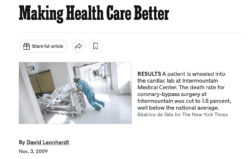
There are healthcare case studies that caught my eye… this example here of reducing the waiting time, referral-to-treatment time for certain cardiac procedures, reducing that by 88%… maybe to your point earlier, that was not just incremental kaizen, that was more of a reinvention or transformation of the work, right?
Darren Walsh: Yep. And that really was a mixture of solving the day-to-day problems, but it was also linked to the actual standard. The pathway was not capable anymore. So we had to design the pathway. But instead of… trying to chase the waste… we designed the pathway based on the value-added elements, and then just tested it. And just made it work.
And that was an example that, in a notoriously hard environment to change, we transformed it, and the national average was 24 weeks. And now that service is six weeks and they've sustained it, and they put far more procedures through.
But… every organization needs a system or a routine to make sure they're working on the right things or improving the right things.
…ultimately there's three things that leaders need to have. The right mindset. They need to be able to adopt an improvement mindset, a discovery mindset. They need to spend time on the right things, otherwise they won't create these new improvement habits. And then they need to start performing some of these leadership routines.
Just a couple of weeks ago I was sharing that… case study with another healthcare practitioner and they said, “Yes, but what about… you can't just change things like that.” “What about the next part of the process? Wouldn't you cause a bottleneck?”
Said you might, and you might have to go and fix that, but at the end of the day. Patients or customers were waiting 52 weeks. Their health was degrading. And now they're waiting six weeks and they're getting treated… And that's freeing up beds and saving time for other procedures.
Mark Graban: Yeah, there's mindsets again, right? …the other powerful outcome of that work… It's reducing waiting times. It's increasing the number of cases per day that goes hand in hand.
And faster care has a dramatic impact. I think the numbers in the book were a reduction in mortality rates from 24% to 6%. That's quite literally lifesaving work. …I don't know what's more important than that. So I'm glad you were able to share examples like that in the book as well.
Conclusion
Mark Graban: …I encourage people to check that out, again, by Darren Walsh, Making Lean and Continuous Improvement Work. …Anything that you'd like to add, kind of as a final thought or something to leave us on?
Darren Walsh: Yeah. The whole book was aimed at this problem that organizations and teams are not solving problems and not improving… And this was all about trying to break down this mammoth problem of how do we make lean and continuous improvement work, and focus on the day-to-day and the routines, problem-solving, leadership routines.
And really, yeah, I tried to fill it with… transformative case studies. 50% improvement in oil and gas, medical device, automotive, healthcare. These are not your 1, 2, 3, 4%. These are, 50% or more. And I think that's the real power of lean and continuous improvement when it's done right and we're able to sustain it.
…it's definitely helped me as well going through that process. Refine my thinking. I'm already onto the second book.
Mark Graban: Uh oh. Great. …What's that one going to be?
Darren Walsh: I think it's just going to delve into these three common pitfalls again, and just look at some other sectors and delve into those…
And, I've been offering some discounted assessments. So if any organization wants to have an improvement assessment, reach out and then, yeah, that will help me also with the research and I'll give feedback to the team there.
Mark Graban: All right. Well, there'll be information linked to Darren's website and LinkedIn and different ways that you can contact him in the show notes. So Darren, congrats on the book being out there and helping people make this all work. Really appreciate you joining us on the podcast today.
Darren Walsh: Thank you, Mark. Appreciate it.
Mark Graban: Yeah.