

How a Simple Kaizen Idea at NUMMI Saved Hours of Work
NUMMI Tour Tale #1: Why Fix the Escalator?
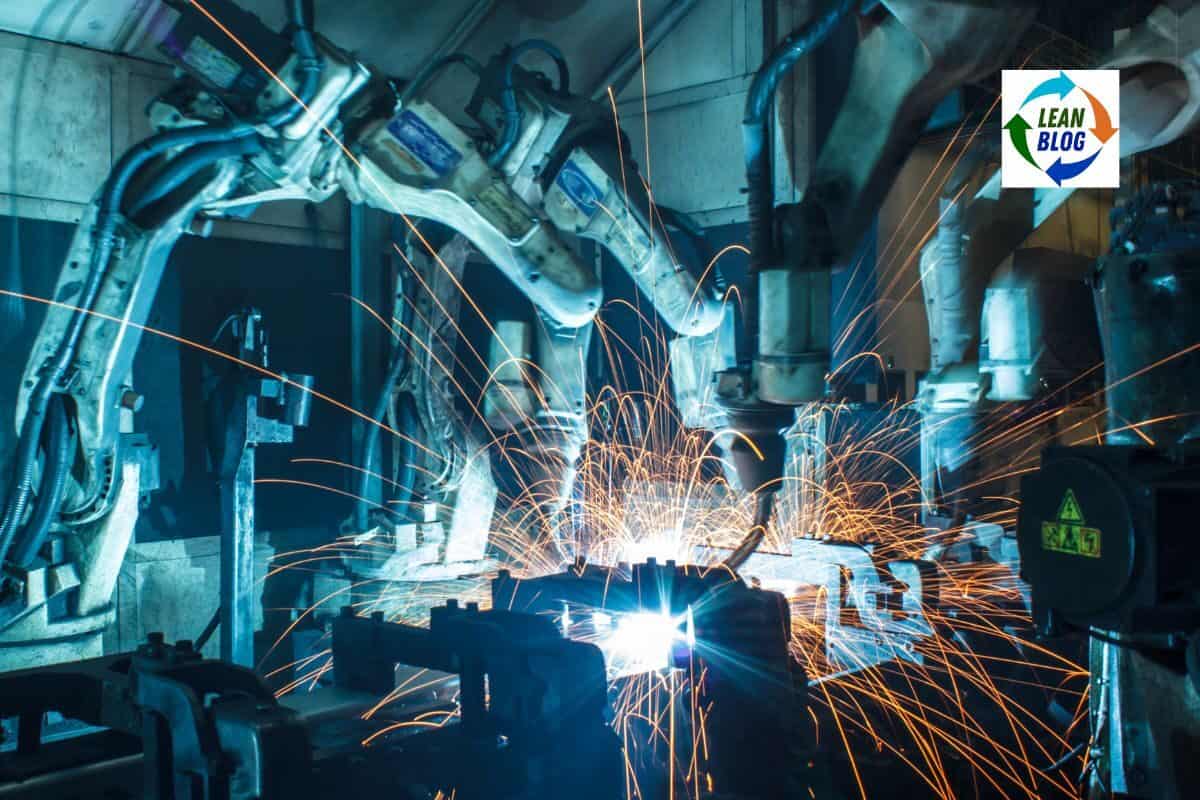
The NUMMI tour guide told an interesting kaizen story as we went past the body weld area. Car bodies are held and transported on metal carrier racks that recirculate through the welding process. The bodies move on to painting, and the racks cycle back all day long. The racks get greasy and dirty during the process.
(Note: It's not grease; see comment at the end of the post).
Workers cleaned them by hand with wire brushes. This took four hours to do, once a week, shutting the line down, I assume.
An operator had the idea of covering the rack bases with plain old aluminum foil. After a week, they remove the dirty foil and replace it, which takes only one hour instead of four. The team member received a cash bonus for the suggestion.
I think that was a clever idea, one that saves the company money, even with the cost of aluminum foil factored in.
But could one push further to the root cause here? Why are they having to clean those racks? Is there anything that can be done to prevent the racks from getting dirty or slow that down? I'm not a welding expert, so I can't say, but it's interesting to think about.






I’ve seen a similar set-up like this at the Audi plant in Ingolstadt, Germany. They were using aluminum wrap to prevent the racks from being covered in some sort of glue (?) in the body shop area, if I remember correctly.
Audi practices TPM, of course.
But, again, could one push farther to the root cause there?
Actually, it is most likely that what they were brushing off was not grease, but welding spatter. During the welding process, all those sparks you see flying through the air are actually small burning spheres of metal. Those spheres were likely sticking to the frame. They cannot be eliminated from the process. If it was just gresae, they could use a pressure washer to remove.
Without adding more cost, I wonder if they can use some sort of flux. May be they could integrate the flux onto the foil. May be high temperature Teflon/Pyrex coated foil on the spot-welders. They would have to experiment.
I think the spot-welder arms themselves are copper (conducts the needed amps the best for a spot-weld). Not sure if the metal structure of the arms could be changed.
Any chemist out there? As with any weld, there is a chemical reaction going on. What could reduce free flying particles? Is there away to get the particles not to fly or bond back to the source?
Troy Lee
The welding spatter can be eliminated if proper welding equipment is used and the parts fit properly. Electric servo guns are the answer on several levels. My guess is the material on the racks is not spatter from weld guns however. It is most likely over spray from paint applications or glue applications.
Some of the racks are immersed in solutions of primer paint, or other compounds.
[…] Go To NUMMI Tour Tale #2: The Power of Reynolds Wrap […]