

TL;DR: Dr. John Toussaint says healthcare culture won't change until leaders do–moving from “white coat leadership” (all-knowing, autocratic, blaming) to Lean leadership as facilitator, teacher, and student who learns improvement by doing it.
Mark's note (2026): I originally shared this short video clip in 2013, featuring remarks by Dr. John Toussaint from 2009. I'm republishing and expanding on it here in 2026 because the message still hasn't aged out–and, in many healthcare organizations, it still hasn't fully landed.
I'm sharing a short video clip from 2009 featuring Dr. John Toussaint, then CEO of the ThedaCare health system, discussing the need to shift away from what he calls “White Coat Leadership” toward Lean leadership.
John has been remarkably consistent on this point for nearly two decades. And yet, in 2026, many healthcare organizations are still struggling with the same leadership behaviors he was warning us about back then.
A Short Clip From 2009 — and a Leadership Lesson That Still Applies
John's core point is simple: if you want staff and physicians to change habits, leaders have to change theirs first. Not in a memo. Not in a slogan. In daily behavior.
When I watch this again in 2026, I'm reminded how often “culture change” is framed as something other people need to do–frontline staff, middle managers, “the system.” Toussaint brings it back to the executive mirror.
Are your leaders aware of this? Are they practicing it?
Toussaint's Core Leadership Message
John contrasts “white coat leadership” with Lean leadership:
- White coat leadership: all knowing, in charge, autocratic,impatient, blaming
- Lean leadership: facilitator, “teacher, and even student
He also makes a point that still stings (in a useful way): leaders can't delegate learning. If the CEO hasn't participated in improvement work, it's hard to expect anyone else to take it seriously.
He tells a story I've heard in different forms many times–leaders claiming “we're implementing Lean,” and then giving the blank stare when asked if they've ever been to a rapid improvement event.
Why This Still Matters in 2026
A lot has changed since then. Healthcare has lived through enormous pressure, staffing challenges, burnout, and ongoing complexity. But Toussaint's message is still relevant because the temptation is still the same:
When stress rises, leaders often retreat to old habits–command-and-control, blaming, impatience, “the buck stops here.”
Lean leadership is the countermeasure. It's not soft. It's not optional. It's the hard work of creating conditions where people can surface problems, learn, and improve without fear.
So here are a few reflection questions I'd add in 2026… These aren't gotcha questions. They're reflection prompts I often use with leadership teams–and with myself.
- When things go wrong, do leaders respond with curiosity… or blame?
- Do leaders spend time where the work happens (and learn), or mostly ask for reports?
- Are leaders developing people and improving systems–or just pushing for compliance and results?
- If you asked your CEO (or CMO) what they've learned by participating in improvement work, what would they say?
John's framing is a useful gut-check: if we want different habits from the organization, leadership has to model those habits first.
Toussaint's message hasn't changed. The question is whether our leadership habits have.
Additionally, what John was describing–long before the term became fashionable–is what we now often call psychological safety. If leaders react with blame, impatience, or distance, people learn quickly that speaking up isn't safe. Lean leadership isn't about being “nice.” It's about creating conditions where problems surface early, learning happens daily, and improvement doesn't depend on heroics — Moving “beyond heroes,” even.
This simple slide captures the leadership shift Toussaint has been calling for–and the habits many healthcare organizations still struggle to unlearn.
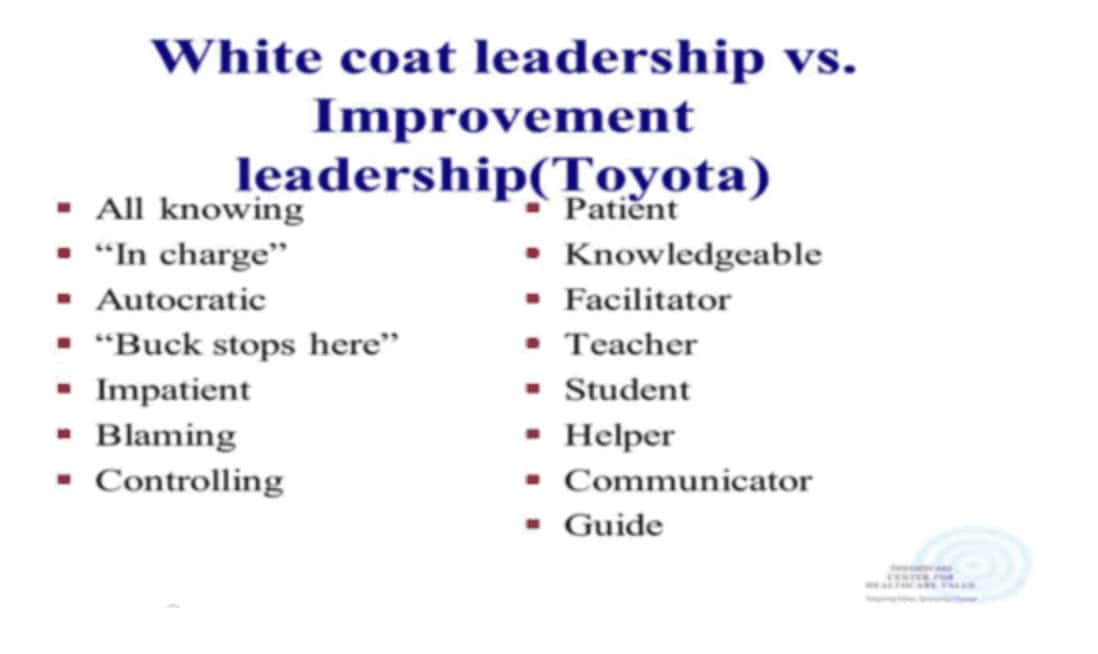
Which column do your leaders default to under pressure?”
White Coat Leadership vs Lean Leadership — Dr. John Toussaint
Below is an excerpt from Toussaint's remarks. Even years later, it captures a leadership contrast that many organizations still struggle to navigate.
“White Coat Leadership”: The Old Paradigm
“From a leadership perspective, if you want your staff and physicians to change their habits, that means you have to change your habits. Okay? If you don't change your habits, they won't change their habits. So what are those things that we need to change? So, look at the right-hand side. I've, in some cases, put a white coat on with audiences.
'cause I'm a physician, so I put a white coat on and then I ask people to tell me what that white coat elicits, uh, in their mind about leadership. And so I've written down some of the things people tell me about leadership. When the white coat is on, that I'm all knowing that I'm in charge, that I'm autocratic, that the buck stops here, that I'm impatient, I'm blaming, okay?
Lean Leadership as Facilitator, Teacher, and Student
So that's our paradigm. And frankly, that's not just doctors. That's administrators, too. Healthcare administrators act the same way as doctors, but that doesn't work. It doesn't work. In this new world. In this new world of lean management, we have to become facilitator, teacher, student. Oh, by the way, if you don't know what you don't know, you can't teach.
Why Leaders Can't Delegate Learning
So you gotta go learn this stuff because you can't just expect people to. You know, figure it out. You've gotta learn it yourself, which means you gotta be on rapid improvement events and value streams and all those sorts of things. I always get a kick out of talking to CEOs when they say, well, you know, we're implementing Lean.
And I ask them, “Have you ever been to a rapid improvement event?” And they kind of gimme a blank stare. They don't even know what a rapid improvement event is. You know, so if the CEO doesn't know that. Okay, how, how, how can we expect anybody else to get serious about this stuff? So this is the difference in the two leadership styles.”
End of quote.
Leadership Habits Shape Culture–Every Day
What John Toussaint was pointing to in 2009–and what still matters in 2026–isn't a philosophy problem or a knowledge gap. It's a habits problem.
Culture doesn't change because leaders announce a new initiative or adopt new language. Culture changes when leaders consistently show up differently: how they react to problems, how they ask questions, where they spend their time, and how they respond when things don't go as planned.
“White coat leadership” isn't something most leaders consciously choose. It often shows up under pressure–when time is short, stakes feel high, and old instincts kick in. That's exactly why Toussaint's contrast remains so useful. It gives leaders a simple way to notice their own behavior in the moment and ask, Which model am I reinforcing right now?
Lean leadership isn't about having all the answers. It's about creating conditions where learning is possible–where people feel safe to surface problems, test ideas, and improve the system together. That work can't be delegated. It has to be modeled.
Toussaint's message hasn't changed. The open question, still, is whether we're willing to practice the leadership habits that make the culture we say we want actually possible.
If you’re working to build a culture where people feel safe to speak up, solve problems, and improve every day, I’d be glad to help. Let’s talk about how to strengthen Psychological Safety and Continuous Improvement in your organization.





Thanks for the post Mark. That was a great session on lean leadership. We are bringing a group, including senior leaders, from East Tennessee Children’s Hospital this year. I can’t wait to see what they bring back from the summit.
A leader without followers is just somebody going for a walk. So if a “leader” wants “followers” to implement these principles, then the leader must implement them first. This is why we begin our work with a Partner organization by teaching the leadership the principles, and coaching them as they practice the techniques. We refer to it as “Top down, bottom up.” Leaders do, then empower/expect others to do, and hold them accountable for same.
Good stuff Mark! Now go get you a heart-shaped steak for Valentine’s Day :-D
Mmmmm…. heart shaped ribeye: