


tl;dr: Toyota's culture treats problems as opportunities for learning–not failures to hide. Lessons from Toyota leaders show how kaizen, psychological safety, and trust enable frontline problem-solving, sustainable improvement, and long-term success.
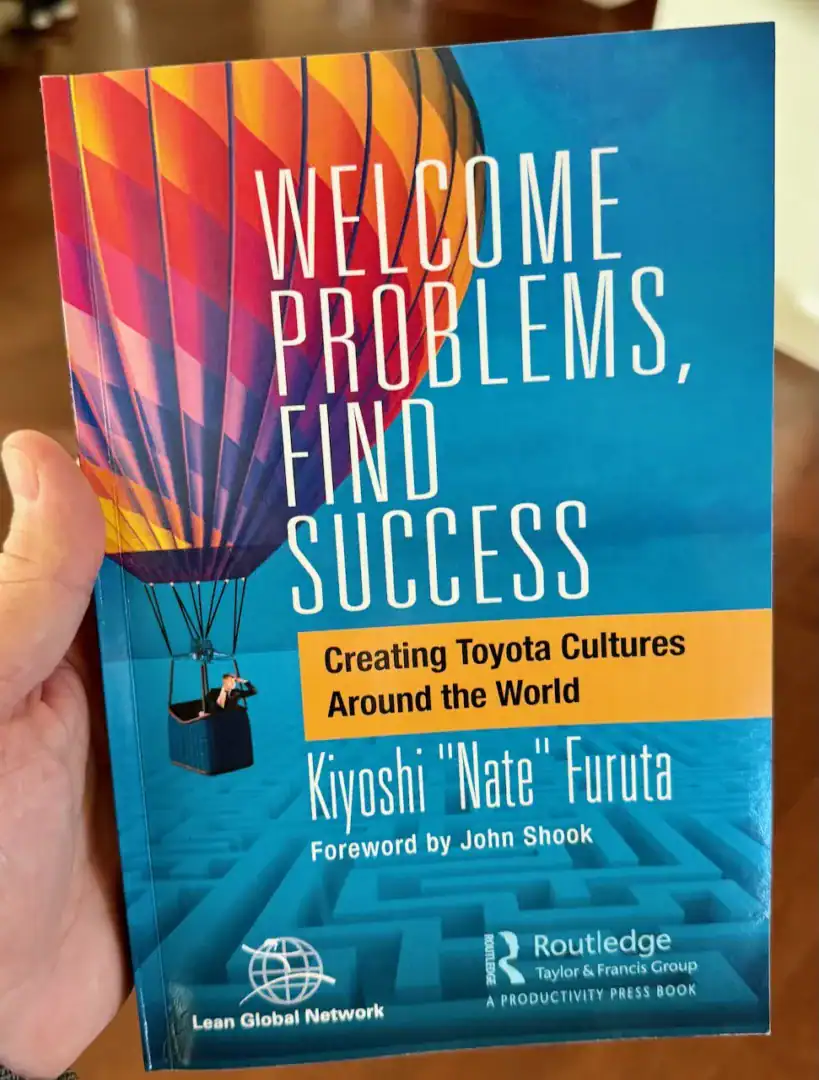
I have been really enjoying this book, released in 2021, by Kiyoshi “Nate” Furuta, a retired Toyota executive: Welcome Problems, Find Success: Creating Toyota Cultures Around the World. I bought it a year ago and wish I had started reading it sooner!
Who Is Nate Furuta — and Why His Toyota Perspective Matters
Furuta is the retired former chair and CEO of Toyota Boshoku America, Inc. — an automotive parts supplier to companies including Toyota and General Motors. As it says on the company's website:
“…we take pride in being a company driven by quality and kaizen (continuous improvement).”
The company was founded by Sakichi Toyoda in 1918. You can also read about their “TB Way.”
Furuta was the first Toyota employee at the NUMMI joint venture between Toyota and GM. He was also the first Toyota employee at the Toyota plant in Georgetown, Kentucky. He has a very unique perspective on “creating Toyota cultures around the world,” as the book's subtitle says.
There are two things in particular that jump out at me enough to share in this post.
Taiichi Ohno's Lesson: Hiding Problems Is Worse Than Having Them
First is a story about the legendary Taiichi Ohno and one of their factories in Japan. Ohno was given data that showed that a long-troubled crankshaft line had some “surprising improvement” after it “repeatedly had problems delivering on time.”
Even though that sounds like great news–what was there to investigate??– Ohno went to the “gemba” to go and see (“genchi genbutsu”). He was looking for facts, not just data. He wanted to know how that improvement had occurred, something that a “management by results” leader might not care to explore. Ohno wanted to know what could be shared elsewhere.
What did he find?
“Carefully examining the line, he realized that a manager had secretly built and hidden excess safety stock to cover up for the line's habitual delivery problems. Mr. Ohno was, of course, furious that inventory was being increased rather than the real problem solved, and decided to take dramatic action.
He ordered employees to bury the excess stock on the plant grounds. After he gave his order and left, the manager persuaded employees to again hide the excess.
It didn't take long for Mr. Ohno to find the excess stock once again, and this time he ordered it destroyed before his eyes.”
Ah, building up safety stock to buffer against production downtime instead of fixing the root causes of that downtime. That's what I lived through during my first year working at a GM engine plant in 1995 (they also made crankshafts and other engine components). Supervisors had old habits of wanting to “buffer” everywhere and anywhere, by pulling parts off of the line any time a machining station went down. This often created awkward, if not dangerous, conditions for production workers. That wasn't showing “respect for people,” in a Toyota way.
I chuckled when I read about Ohno ordering them to bury the parts. I could also understand why the manager and employees wouldn't want to do that. It's pretty hardcore that Ohno later ordered that inventory to be destroyed.
Hear Mark read this post — subscribe to Lean Blog Audio
When Buffering Replaces Problem-Solving: A Contrast from GM
During my time at GM, having the buffer stocks wasn't generally shameful. But it led to quality problems because sometimes an engine block that had been pulled off the line after “Operation 30” had to be stored somewhere off to the side. It should have been loaded back onto the line before “Operation 40,”… but sometimes people made a mistake and loaded the part onto the conveyor belt before “Operation 50,” which meant the part or parts had now skipped Operation 40… and that was a quality disaster.
The only shame about buffered parts was the holding of scrapped (defective) engine blocks on pallets. Eventually, the cost of that material would have be written off. But managers didn't want the defects to hit the books, so they played a game of hiding the inventory. I don't think anybody ever thought to bury the parts.
NUMMI's Breakthrough: Trust, Andon, and Psychological Safety
In the book, Furuta writes extensively about creating a problem-solving culture. However, while I was reading, Furuta didn't mention the need to help team members feel safe admitting problems, pointing them out, or sharing them.
It seems like “psychological safety” is something that is a bit taken for granted at this point in Toyota's history, although it was called out specifically by Jeff Liker and Mike Hoseus in their book, Toyota Culture, as I wrote about here:
As Furuta wrote, managers need to not view problems negatively. It's implied that employees won't get in trouble for pointing out a problem or sharing an improvement idea. Furuta writes a lot about “mutual trust and respect,” as covered by Toyota people in other books.
But this story from NUMMI–where they needed to change the old culture from when that building housed the GM Fremont plant–starts to piece it together:
“The new Fremont management trusted members enough to let them pull an andon cord, which quickly illuminated that a problem existed and, not without consequence, stopped the production line (a stopped line can result in thousands of dollars of losses per minute).
Management promised employees they would have the ability to stop the line if they encountered a problem, and management stuck to that promise. We told them that a member was responsible for pulling the andon cord to alert management of a problem, and the line would stop if the problem could not be fixed immediately.
Workers then started trusting their bosses enough to ask for help by pulling the andon cord when there were problems. A team leader, who was a union member, would attempt to fix the problem before the situation warranted the line to stop.”
There we have it:
- Management trusted the team members…
- Therefore, team members started trusting management
The team members learned that management wouldn't scream at them for potentially stopping the line (or part of the line).
Why Andon Requires Psychological Safety — Not Just Permission
Pulling the andon cord requires two things:
- Psychological Safety (I won't get in trouble for doing so)
- Problem-Solving (I would get discouraged if problems didn't get fixed)
Furuta writes about the need to address culture before teaching a lot of Lean tools. It seems to start with:
- Mutual trust and respect
- Psychological safety
- Problem-solving
- Then, advanced Lean tools
How many organizations focus on the fancy or exciting Lean tools without first building a culture of PDCA / PDSA problem-solving? And how many companies have spent a lot of time training people on problem-solving without first focusing on psychological safety, to help people feel safe enough to point out problems to begin with.
Read more about Andon cords at Toyota:
No Problem, No Kaizen: A Leadership Mindset That Endures
As Furuta says often in the book (and ends the book):
“No problem, no kaizen.”
Please check out the book. I'd love to perhaps run an online book club about it.
What struck me most in Nate Furuta's stories–and in the lived experience at Toyota and NUMMI–is how deliberately leaders chose not to hide problems. Instead, they worked to create conditions where problems could be surfaced early, discussed openly, and addressed together.
That doesn't happen because of tools alone. It happens because leaders consistently demonstrate trust, respect for people, and a belief that improvement is everyone's responsibility. Pulling an andon cord, admitting a mistake, or pointing out a broken process all require psychological safety. Without it, kaizen stalls, buffers grow, and learning stops.
Toyota's enduring lesson is simple but challenging:
If leaders punish problems–or quietly reward hiding them–they get fewer signals and worse outcomes. When leaders welcome problems, respond constructively, and support problem-solving, they build cultures that improve every day.
“No problem, no kaizen” isn't just a slogan. It's a reminder that progress depends on our willingness to see reality clearly–and to treat every problem as an opportunity to learn.
Please scroll down (or click) to post a comment. Connect with me on LinkedIn.
If you’re working to build a culture where people feel safe to speak up, solve problems, and improve every day, I’d be glad to help. Let’s talk about how to strengthen Psychological Safety and Continuous Improvement in your organization.