Search Results for andon

Managers Must Help The People They Supervise

Last week, a nurse manager downloaded the free first chapter of my book Lean Hospitals and wrote this message in the contact form:

"Interested to see how the disconnect between management and the staff supervised can be helped. Too many managers refuse to help those they supervise. A growing number have never done the work that they are in charge of getting done. Patients and residents feel it, not healthy. Poor PR. It does get back to the consumer. Difficult to fix at that point."

In my experience working with many hospitals, her comments resonate with me. Identifying problems like these doesn't mean Lean provides easy solutions for organizational transformation.
Ratings for “The Oscars” Were Lower in 2018? Should We Ask Why or Look for Longer-Term Trends?

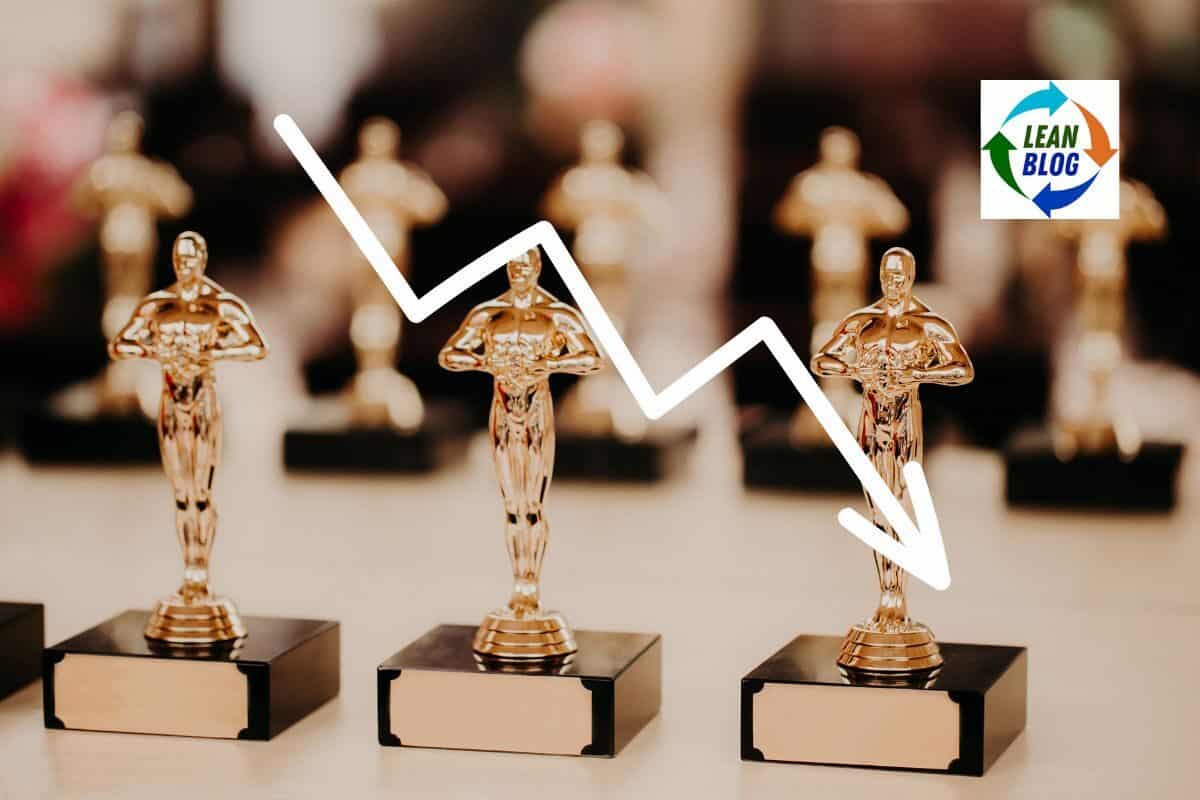
Downward trending line graphic over gold trophy figures representing decline in success or performance.

As I blogged about yesterday, things went well at the Oscars... or, at least, no errors were made in the announcements. But that thing that didn't go well was the TV ratings.

Two Data Points Are Not a Trend
The headlines I saw had a lot of two-data-point comparisons. Headlines sometimes gave the percentage decrease in viewers or how many million fewer viewers there were. Many talked about "record low" but if you're tracking a metric "record low" or "all-time high" doesn't mean there's a "special cause." That "record low" could still be noise in the system.

The WSJ Gets Japan Wrong: Why Lean Isn’t “The Japanese Model”

Not all Japanese companies are the same. "Lean isn't easy" if you're a Japanese company. Toyota has created something special, since "Toyota culture" is not exactly the same as "Japanese culture."

The WSJ says the "model is cracking."

Do scandals involving quality and ethical lapses involving companies including those and Nissan tarnish Lean and the Toyota Production System? No. That's as silly as thinking the Wells Fargo banking scandal tarnishes Silicon Valley (although the Valley does enough to tarnish itself).

Lean Can Be Very Fragile, Especially With Executive Changes

Lean can be very fragile. History shows that Lean can fall apart even in an organization that is years into a "Lean journey" with strong CEO involvement.

How is this possible? If often happens when a new CEO is brought in from the outside. In the case of the manufacturing company, Wiremold, it happened when they were acquired by a French company, Legrand.

As an aside, the team that coined the term "Lean" almost used the term "fragile," as I blogged about here.

Back in 2007, Bob Emiliani joined me for Episode #30 of the podcast. As we revisit the podcast and the new transcript I had made, what are the lessons for manufacturers or hospitals?

What's the risk that's created when new leadership takes over?

What We’re Looking Forward to Learning at the Toyota Plant Tour

Tomorrow, with the entire KaiNexus team, I'm going to visit the Toyota truck plant in San Antonio, the plant referred TMMTX. The 15 of us will be there in closed toed shoes and all other required clothing to learn about the Toyota Production System, Kaizen (continuous improvement), and Lean.

I've blogged about it on the KaiNexus blog. I asked the KaiNexus team to say a little bit about what they hope to learn in the visit and you can read their comments it here.

In this post, I share a 24-minute tour preview webinar that I put together, links to past tour blog posts, and more.

Throwback Thursday: A Look Back at Japan #Lean Healthcare Study Trips

For today's Throwback Thursday, I'd like to look back at some blog posts about the trips I took to Japan in 2012 and 2014 to study Lean healthcare and Kaizen with healthcare practitioners from around the world.

I'm again partnering with Kaizen Institute to plan and help lead a trip that will be held in the last week of February, as I wrote about here...

Should Lean Conferences Add a “Code of Conduct” for Speakers and Attendees?

In today's post, I pose a question: Should the major Lean conferences adopt or adapt a practice that's now common at tech events, including Agile and Lean Startup events: a "Code of Conduct" for participants and attendees. Is this a countermeasure to a problem that doesn't exist in the Lean community? Or, is it still good to proactively encourage people to speak up to conference organizers if they are subject to bad behavior during the event? In this post, I get feedback and thoughts from the Lean Enterprise Institute, AME, Catalysis, Lean Frontiers, and the Shingo Institute.

Fast Lean – What’s Not to Love?

Mark’s note: I somehow stumbled across this 2002 HBR article, Read a Plant–Fast, so I asked regular guest blogger Paul Critchley to write a post about it and his thoughts. Personally, I think it’s fair to refer to Lean transformations as…