

What These Nurses Had to Say About “Lean Hospitals”; Free Gift with Pre-Order
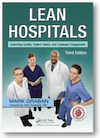
I recently learned that a company called Anderson Continuing Education offers continuing education (CE) credits for nurses related to my book Lean Hospitals. See their page for my book.
I am still trying to learn more, but they will sell the book or, if you already own the book, you can just buy a quiz (that can be mailed to you or delivered online). One nurse I knew was excited because “21.5 contact hours for 30 bucks is a steal!”
I haven't seen the quiz yet, so I can't fully endorse it, but I'll update this post after I see it.
Anderson says, on their page:
“You can't learn Lean from a book, but it's a good place to start.”
I fully agree with that. A book can create awareness and some knowledge, but Lean is really a “learn by doing” endeavor (hopefully under the tutelage of a good coach).
What struck me was some comments that Anderson posted from nurses who piloted their quiz after reading the book. Some excerpts:
“It is a topic I probably would not have chosen to pursue, but (I) actually found it to be quite informative and (it) helped me to see things from a different perspective.”
I'm not surprised to hear that. Nurses aren't generally exposed to operations management concepts (neither are MDs or pharmacists, etc.). It makes me wonder if the book would have had more appeal with a different title other than the straightforward “Lean Hospitals.” Or, it might not just be the title or the term “Lean,” but the topic itself, as they said.
“I LOVED the Lean philosophy that everyone is involved! Despite the “heavy” reading this course should be required for hospital and clinic nurses. I read the book cover-to-cover, re-read a LOT of it and did a LOT of highlighting.”
I'm glad that the nurse loved Lean. The nurses I've worked with have been excited to get engaged in improving patient care and creating a less frustrating workplace.
As I've shared before, these nurses at Franciscan St. Francis Health love Lean and continuous improvement (Kaizen):
When nurses are upset about Lean, that's a sign that something's going wrong.
What could go wrong? It could be that leaders don't understand Lean and they equate it with cost cutting. Or they're sending nurses home early in the name of Lean (which is NOT Lean). Or the leaders are only driving top down change. Real Lean is something that nurses love and participate it.
Back to the nurse comments from Anderson's site:
“I initially approached this study with some skepticism. Every quality improvement plan in the past has been focused on blame. I actually reread the text as I think many applications can easily translate to the critical care area. As long as the management does not fully embrace Lean, it will not occur without a culture of blame.”
I can understand the skepticism or cynicism about new programs or management concepts. Nurses have heard it all if they've been around long enough… TQM, Six Sigma, Studer, Disney, Baldrige, Lean…
When I work with hospital staff who get excited about Lean, they often ask, “How do we know our management will really stick with this? Will they get bored and move on to the next new fad?” They're concerned that they'll get mentally invested in Lean only to have it pulled out from under them.
On the topic of blame… hospitals have long had an unfortunate culture of “name, blame, and shame.” Lean is, of course, an alternative to that. I'm glad the nurse learned this from my book. You don't get anywhere with a culture of blame. This is a hard habit for many CEOs to shake.
The last comment:
“I highly recommend this text for nursing as well as management. The principles of Lean must flow from the top down to ensure full participation.”
I'd try to clarify that Lean isn't about ideas and solutions flowing from the top down. But, Lean does require the support and PARTICIPATION of senior leaders. As Deming said, quality starts in the boardroom. Deming also said not to blame individuals for problems caused by the system (and that most problems ARE caused by the system).
Executives need to lead by example… including by learning to not blame people. As John Shook always says, Lean is not old school top-down management… but it's not completely bottom up either. Leaders are responsible for culture and strategy… some of that can't be delegated.
Anyway, I hope my book and the Anderson CE credits are helpful to you. I've informed Anderson that the revised, third edition of Lean Hospitals will start shipping in early or mid-June.






[…] though is to read… and I’d hope more CEOs would read my book. It’s great that nurses read it and improvement specialists or “Lean geeks” read it… but I think we’d all […]