

Episode #190 features Karen Martin, co-author of Value Stream Mapping, on using VSM as a strategic leadership tool–avoiding “map wallpaper,” aligning incentives, and turning future state into execution.
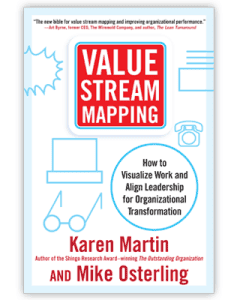
My guest for episode #190 is a returning guest (from episode #151), my friend Karen Martin, talking about her (co-authored by Mike Osterling) newly-released book, Value Stream Mapping: How to Visualize Work and Align Leadership for Organizational Transformation. You can order via Amazon and can learn more via Karen's website.
In the episode, we talk about topics including how this book fits with her others, some common struggles that people face when mapping value streams, why it's important for senior leaders to be involved with VSM work, how long mapping should take, the publishing value stream, and the use of VSM in different industries. I hope you enjoy the conversation!
For a link to this episode, refer people to www.leanblog.org/190.
My Endorsement of the Book
Here is the endorsement I gave for the book based on my reading of a pre-publication version of the book:
“Value Stream Mapping is a wise and practical guide that will help you lead transformation efforts in your organization. While some think of value stream mapping as a ‘lean tool,' Martin and Osterling rightly emphasize the strategic value of looking at the big picture and improving your entire value stream from suppliers to the customer and all points in between. The book is full of tips and lessons learned to help you avoid mistakes and maximize the results that you get from the time invested into proper value stream mapping.”
You can read the introduction (PDF) or the executive reading guide (PDF) online.
You can also view webinars Karen has done on this topic:
- Value Stream Mapping – Strategy Before Tactics
- Value Stream Mapping: How to Visualize Work & Align Leadership for Organizational Transformation
You can also sign up for a new webinar being done tomorrow, Jan 7 2014: Value Stream Analysis: Beyond the Mechanics – Part 1 (Planning)
For earlier episodes of my podcast, visit the main Podcast page, which includes information on how to subscribe via RSS or via Apple Podcasts.
Podcasts Sponsored by KaiNexus
If you have feedback on the podcast, or any questions for me or my guests, you can email me at leanpodcast@gmail.com or you can call and leave a voicemail by calling the “Lean Line” at (817) 776-LEAN (817-776-5326. Please give your location and your first name. Any comments (email or voicemail) might be used in follow ups to the podcast.
Interview with Karen Martin on Value Stream Mapping
Mark Graban: Hi, Karen. Thanks for returning and being back on the podcast again.
Karen Martin: Thank you for having me, Mark. It's great to be back.
Mark Graban: It's been about a year and a half since we talked about your last book, The Outstanding Organization. I know you've been busy working with people and continuing to share concepts from that book, but here you are with another book about value stream mapping. The title is Value Stream Mapping. If you could tell the story about the book, what motivated you to focus on this as opposed to other topics, and what inspired you to write the book?
Karen Martin: I did these books in a weird order. I wrote a hierarchy out yesterday of my books. When you think about it, The Outstanding Organization is a foundational book, and then Value Stream Mapping would be the next layer down. Then Kaizen Event Planner is the next layer down. Then Metrics-Based Process Mapping is parallel with the Kaizen Event Planner. I guess I'm doing things a little in reverse and a little screwy in the middle.
It came from Mike Rother and John Shook's book Learning to See which came out in 1999. Here we are almost 15 years later, and it's a seemingly weird topic to be publishing another book on. What motivated Mike and me to write it is that after all those years and talking with organizations and seeing them struggle with how to apply value stream mapping, especially in non-manufacturing environments, we saw the tool a little more broadly and deeply than many organizations and lean practitioners did. I think a lot of people were viewing it as this mechanical tool to design a future state and get waste out of a value stream. We see it as a much more transformational tool from a leadership mindset and behavior perspective and a cultural shifting perspective. We felt like the ship had not sailed completely and it was time to look at value stream mapping in different ways.
Common Value Stream Mapping Struggles
Mark Graban: I'm curious to explore what some of these struggles are because there's certainly been a lot of value stream mapping activity. Some of it is probably helpful. Some of it may be becoming a form of wallpaper that people proudly display but doesn't lead to a lot of organizational transformation. What are some of the struggles that you see out there that you're hoping to head off by sharing your experiences and lessons in your book?
Karen Martin: We have eight pages of the perils of value stream mapping, so there are many. Some of the more common ones are seeing people literally as wallpaper. So many times we see these beautifully designed value stream maps, but when we ask how they are doing in transforming to this future state that is so wonderfully designed, there's this blank stare. As always, execution is tough in an organization. It's even tough with my own clients, even when I'm there pushing for them to keep moving forward on executing that future state. There are so many distractions, and the lack of focus that exists very often at a leadership level keeps organizations from realizing that wonderful design and realizing their full potential that the value stream map promises.
That's a very common one, that value stream maps are done at far too low a level in the organization. I mean too low in terms of being in the weeds and being more of a process map, which they were never meant to be. And also having too low of a person and a team involved in mapping so that they're not able to make some of the strategic decisions that a future state would require.
Mark Graban: I've certainly seen that happen in hospitals where we've got a team of frontline staff and managers from different departments, and we're taking this cross-functional view of the value stream, which is good. But then we uncover these issues that require a much higher level of leadership to help resolve some of those issues or help avoid sub-optimization or poorly designed incentives or siloed incentives. Why is it important to have senior leaders involved or aware of the issues involved with value stream mapping? How would you pitch things to senior leaders about why they should pay attention or even be directly involved in value stream mapping?
Karen Martin: Current state and future state maps probably require slightly different teams if you did them from a purist perspective. It's not practical to do that, and it's not advisable. Here's why: For the current state, leaders at a director level or above aren't familiar with the details of how work happens and what the performance metrics are with that work. The tendency is to bias the team toward those lower-level people who know how the work is actually done and can report metrics. When you get to the future state design, that level of person isn't going to have the authority to say, “Let's merge these two departments together,” or “Let's remove this department from a process.” They just aren't at that level of power. If you keep them being in the design seat, then after the map is done, there's this whole sales process that has to go on and excessive lobbying to lobby this future state design to leaders that have the authority. There's so much that gets lost in translation in that lobbying process that it almost never works.
The way to bridge that gap is to either gather more data upfront before the mapping so that we have the data or to go to the gemba during mapping, which is highly advisable, and gather from the people who are doing the work now. In most non-manufacturing environments, the data is very difficult to get. The people when you go to the gemba aren't necessarily going to have the data that you're looking for. There's a fair amount of sleuthing that we do upfront to find out what's available. I call it “what's getable data” and “what's not,” and to figure out how we're going to get through the current state with this leadership level on a team. They have to understand this work and how it flows. From a macro level, it's wildly important for leaders to understand workflow and see the holistic nature of how departments are interconnected or not. This team needs to be primarily directors and above in a hierarchical type of environment.
Mark Graban: Do you find it challenging to get those senior leaders to participate? It's a common problem with Kaizen events, a topic you've also written a book about. What strategies have you found to be successful, or what advice would you have for others who are trying to get senior leaders to participate?
Karen Martin: It does require a fair amount of education upfront for them to understand why they would be involved with mapping, because that's what the other people do. You have to help them understand that this is indeed strategic. They wouldn't want people saying, “Hey, let's get rid of this department and merge these two together.” They wouldn't necessarily want that kind of strategic decision-making being done by people at manager level or below.
I say to them, “Look, you can come with me into a room for three days and we can hammer this out and you can have a solid plan to move forward on. Or you can keep living the pain that you've been having for how many years. It's your choice.” There are rare cases where we absolutely cannot get together for three consecutive days, which is what I advise. In that case, we just have to deal with a whole lot of rework because it takes a while to get your mind wrapped back around the issues and remember where you left off and all those things that separating it and having a gap between the different stages of mapping will introduce into the process. It's not easy. I have all kinds of pleading and begging and cajoling. And just straight talk to convince all the leaders that need to be on a team to dedicate that time to solving big organizational problems.
Scope of Value Stream Mapping
Mark Graban: You do most of your work these days in different service sectors, correct?
Karen Martin: I personally am involved in fewer manufacturing value streams than healthcare, financial services, government, military, distribution, oil and gas, and utilities. Interestingly, right now over 50% of my client base that I'm physically involved with and not my team is manufacturing, which is odd for the last five years. I'm working with them on the entire mother value stream from concept to grave. It's all the way from product concepts through development, design, manufacturing, shipping, and then revenue collection and possibly in the case of pulling a product off the market. They're big value streams.
Mark Graban: How much do you see people really looking at a true end-to-end value stream? Do you see people wanting to look at the really broad systemic issues or are they asking you to come in and look at a more narrow part of the overall extended value stream?
Karen Martin: It does depend on the fence posts and where it begins and where it ends as they go on in both directions. I usually get brought in for pretty big chunks of a value stream. If someone wanted to work just on the quoting process or just on discharge processes or just on a mortgage application, I might skip a value stream map and go to a process level map. I almost always try to convince the client that looking at it from a value stream perspective first, no matter what it is and no matter what problem they're trying to solve, they often will suboptimize because they haven't looked at it from a value stream perspective. I have done value stream segments. For example, I've used value stream mapping for just a purchasing process, but it was a big complex purchasing process. I had a hospital where I used value stream mapping quite effectively for just the discharge process. But there were eight handoffs in the discharge process. Looking at it from a flow perspective first before they dove into the weeds was highly effective.
Mark Graban: One thing I've recommended that I'm curious to hear your thoughts on is to often start with a high-level value stream view. People want to dive into the weeds. Let's not do a value stream map with 437 steps. Let's look at the departments or what some people will call the big chunks in the process. Once we've identified maybe where the biggest opportunities or the starbursts are on the map, then dive into more detail and what we might consider a process map.
Karen Martin: Absolutely. What happens if you don't do that is that you spend all this time at the micro level with 400 blocks, but some of that work may have been completely unnecessary and just be a time sucker that keeps you from making improvements. The Value Stream map does allow you to get above the work and look at it from a macro perspective so you can figure out where you need to do the deep dive. It's a much more effective use of people's time. You have a hard time convincing people to come in for three days. Why not use our time really wisely in making improvement?
Timeframe for Value Stream Mapping
Mark Graban: You talk about the three-day timeframe. What are your recommendations in terms of the amount of time that this should take? Why three days? Can you do it in a day? Would it take a week? What are your thoughts on setting expectations?
Karen Martin: If you are looking at a fairly healthy chunk of a value stream or a true end-to-end value stream, where you're going to have five to 15 and sometimes 20 blocks on the map, my experience has been that it takes a full day for everyone to truly understand the current state, especially if we're going to go to the gemba, which I highly recommend. And we're going to do a deep dive into the environmental issues that may be at play. If you want to do a deep dive into the current state without getting into the weeds, it still takes a full day for an entire team to get to the point where they see the truth about the current state through the same lens. That's the whole goal of the current state map: to get that deep understanding so that you're in a better position to design.
The current state often bleeds a little bit into the second day. The current state takes a while to get through. The future state often moves much more quickly because if you've done that deep dive and gotten the level of clarity that makes for a good current state mapping experience, then the future state design becomes much easier. It's much more easy to know what the appropriate countermeasures are because you've done that deep dive. The future state should be done more or less at the end of the second day.
The third day is putting together the transformation plan on how you are going to get from current to future, and what has to happen. It results in an Excel-based tool that has line items for every improvement that needs to be made. These are macro-level improvements. Each one of those line items has an owner, a target completion date, and a Gantt-ish chart to show start and ends and times for the improvement planned. It just takes a while to get it all the way through to an actual executable plan.
Mark Graban: Some people talk about a short-term or practical future state versus a longer-term ideal future state. Do you like to break it down that way and do multiple future states, or how do you approach that?
Karen Martin: I would love to. I rarely have the time in a client engagement to do those multiple states. I'm hard-pressed to get them to commit to three days, and it takes three days to get something that's executable. In the planning process, Mike Osterling and I are huge believers in team charters that are both communication tools, consensus-building tools, and planning tools for the event. That talks about timeframes. Sometimes an organization has a key deadline, like an acquisition or a new regulatory requirement that requires rethinking the value stream. Or a competitor is coming out with a new product and you get intel about that and you want to get racing to the market.
If there's not a hard date, then I ask the client to consider how aggressively they want to move and to consider the cultural implications. A lot of clients want to take on too much too fast, and they're subject to excessive distraction and implosion where they can't possibly absorb that amount of change that quickly. It takes some conversation with leadership to scale back the expectations on how fast their organization can move.
The first time I heard about a 90-day time period was when I went to an LEI workshop probably 10 years ago. They were suggesting that you look at about a 90-day improvement window, and then you remap and start another 90-day window. So you're doing these constant PDCA cycles. I recommend that, but most of my clients choose a six or nine-month period because they just don't have the discipline yet and the appetite to go back over a value stream again 90 days later. 90 days is lickety-split in corporate speak. What I would like them to do, and what I think makes sense theoretically, is not what is actually happening in my experience in the real world.
Value Streams in Need of Improvement
Mark Graban: You were on Twitter talking about a contest and a promotion you're doing, asking people what value stream needs the most fixing in the world. What value stream would you want to see fixed?
Karen Martin: Healthcare. Any aspect of patient care in healthcare. It is just such a mess. I had 15 years of exclusive healthcare experience working in all aspects of healthcare before I dove into this other world that I'm now in. It's just so sad because my heart and soul, my DNA, my cells are wrapped up in healthcare, but the problems are so big. It doesn't mean there's no hope. But it is just gonna take a lot more courage than I see right now to make the dent that we need to make as quickly as we need to make it.
Mark Graban: I like the way you put that. It takes courage for people to stand up, like Paul O'Neal who was trying to influence healthcare in Pittsburgh and has spoken nationally and has been involved in a lot of healthcare advocacy to stand up and say we should not be harming anybody and no employee should get hurt in the course of the day. I admire that ThedaCare and others are trying to push people in that direction, but there's still so much room for improvement. Value stream mapping is so powerful in healthcare because things have been so siloed. The specialization has increased so much to where the silos are narrower and deeper and sometimes less connected to the overall patient experience. There's such huge opportunity. What are some of the things that you see going on out there?
Karen Martin: It's powerful in any environment, but it is really powerful in healthcare because they have never looked at it truly from a patient's perspective from beginning to end. Value stream maps I've been involved in with in healthcare is the whole outpatient imaging experience, the discharge, the ED patient flow, and the whole revenue cycle. That was a very interesting one to look at. The amount of errors being made and the amount of rebuilding that's being done keeps people from doing other things and keeps hospitals being burdened with excessive labor. You don't need as many people to do work when you don't rework all the time.
Mark Graban: Or we can reduce delays for patients and take care of more patients when that's needed.
Karen Martin: Where I get my biggest high so far in doing value stream mapping in healthcare is the freed capacity of nurses to be able to get to the bedside and do what nurses went into their careers to do and what patients need. It's a win-win-win. When I was value stream mapping the discharge process, and we saw this enormous problem with medication reconciliation upon discharge. One of the things that we did in the future state was introduce them to pair programming, what software design often uses. It was a tough sell to convince this hospital that they would gain efficiency by putting two nurses on med rec, not one. It was wildly successful, and they're now talking about it to all of their sister hospitals and they're experimenting in many different settings with pairing.
There's just this freedom that nursing has to do the right thing and to feel good about their work and to not have the morale issues that nursing has. My heart goes out to nurses. They're in an untenable position in many organizations, and value stream mapping offers a great lens into what's really going on and how to solve it.
Mark Graban: I found sometimes people go through the cycle of beating themselves up when they see how broken the current state is. I found myself telling people, “Look, this is nobody's fault because nobody designed this. It just happened.” The future state is an opportunity to actually step back, and this is what people find empowering and exciting. “Oh, we can fix this.”
Karen Martin: I just had this revelation yesterday that part of what the transition phase between current state and future state is about is giving people hope. We don't talk about hope in business circles, but when people are beaten down and frustrated with the amount of chaos that they deal with day in and day out, hope is a great antidote to resistance. Hope is the way forward. I'm gonna do some thinking more about this, but I just really want to think about this whole concept of bringing hope to businesses. Of course, it has to be followed with execution, but I think hope is a good place to start.
Mark Graban: When people start seeing that possibility, it's great to see how people start to turn from despair to optimism, especially in healthcare where the work is so important.
Karen Martin: If I were brought in as a consultant, I would want to look at the publishing value stream. It is so ripe for improvement, as any author knows, and the publishing industry to date has been so not interested in looking at it. I've offered free value stream mapping services to both of my publishers, and neither one of them have taken me up on it. I will fly for free to New York and I will spend three days value stream mapping the process and showing them how ridiculous it is and how crazy it makes their lives. It's not just authors, it's the people that are living in this dysfunctional environment.
Mark Graban: You're not the only podcast guest. A very well-known lean author went to a major publisher and offered the help and they said no because they didn't see a problem. That's part of the challenge with any process improvement or lean improvement or value stream activity. First off, people have to agree that there's a problem to be able to go and want to work on anything.
Karen Martin: It's psych 101. You're not gonna get a drug addict to go through treatment until they reach rock bottom and realize they have a problem. A lot of leaders don't want to take that step. I think the people below the senior leadership level are well aware of the opportunity.
Strategic vs. Tactical Value Stream Mapping
Mark Graban: Value stream mapping is hopefully a way of creating that visibility and understanding. You've talked recently about value stream mapping really needs to be strategic, not tactical. Can you talk about that point?
Karen Martin: This gets back to the “don't go into the weeds if you don't need to” and “get above the work.” This is really about looking at gaps, disconnects, and redundancies at a macro level, and rethinking the order in which work occurs and rethinking the people who are best suited to do work in particular areas. Who should be doing that? Those kinds of discussions are strategic. No one at a lower level can make those decisions. It's getting above the work and creating the blueprint for where you want to go.
The analogy I always give is if you want to go on a vacation, you've got to make a decision if you want to go to Hawaii, Miami, or Boston before you figure out the route you're going to take. This is that same kind of activity: deciding where we want to go. Then we get into the how, the tactics of how we're going to get there. Those kind of tactical decisions happen after value stream mapping.
Mark Graban: Karen, it's time to wrap up. Can you do a quick rundown of your website and different places people can get in touch and follow up? You offer so much in terms of free webinars and you're blogging now and the content you make available.
Karen Martin: My main website is ksmartin.com. I also have karenmartin.com now. The webinars are on the learn tab of my website as well as on Vimeo, YouTube, and SlideShare.
Mark Graban: Karen, it was great talking to you again. Let's do another podcast before 18 months goes by.
Karen Martin: Let's do. It was really great. It's always fun to talk with you and you ask great questions. So let's do it sooner than later.
Mark Graban: Thanks for your work and thanks for being a guest here of the podcast today.
Karen Martin: Thank you so much, Mark. You're a great host. Thank you.
If you’re working to build a culture where people feel safe to speak up, solve problems, and improve every day, I’d be glad to help. Let’s talk about how to strengthen Psychological Safety and Continuous Improvement in your organization.