

In Customer Service, Apologizing Does NOT Get to the Root Cause
I walked into my hotel room after three nights of complaining about the internet and found a stuffed bear on the bed.
“Beary Sorry,” it said. Hampton Inn logo on the chest. Next to it, a handwritten apology note.
I'd been staying at this Hampton Inn in Illinois for a work trip, with multiple future weeks already booked. The “high-speed” wireless was anything but. I complained the first night. Nothing changed. The second night, I called the 800 number for tech support. Nothing changed. The third night, I told the front desk I'd have to find a different hotel if the internet wasn't fixed.
Their response was a bear.
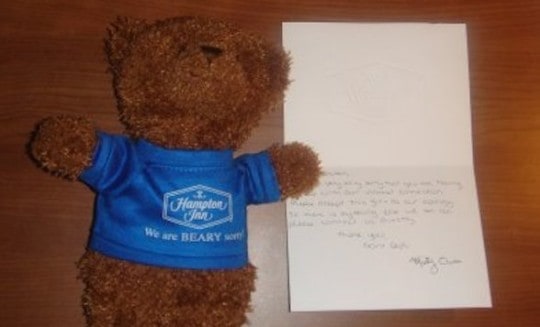
What struck me about that bear wasn't the gesture itself. It was that the bears existed at all. Someone had ordered them. Someone had them printed with the hotel logo. Someone had built a supply chain for apologies — which means the complaints were frequent enough to justify inventory.
They'd industrialized the apology instead of industrializing the fix.
The Follow-Up Was More of the Same
After I canceled my future reservation, I got a voicemail from someone at the hotel. Another apology. They said they were taking one night off my bill. (It later turned out they refunded the entire stay — $590.)
That's $590 in revenue they simply threw away. If they had talked to me live and asked what I actually wanted, a refund would have been the last thing out of my mouth. What I wanted was working internet. What they gave me was cash and a bear.
Every dollar spent on make-goods is a dollar that could have gone toward making the problem stop happening. But make-goods are visible and feel decisive. Fixing the underlying system is invisible and feels slow. So organizations default to the thing that feels like action, even when it changes nothing.
This Pattern Shows Up Everywhere
A good piece in the Wall Street Journal made a version of this argument — that the real job of service recovery isn't fixing the individual complaint, it's helping the organization learn from the failure so it doesn't repeat. Sorting out the immediate problem and offering compensation does nothing to address the underlying cause, which practically guarantees the same failure will happen again.
That sounds a lot like the difference between treating every complaint as a special cause when it's really a common cause — a predictable output of a system that hasn't changed.
And if employees aren't given any role in improving the process, they start to see complaining customers as the enemy. The WSJ piece cited a study of a European bank where employees didn't even classify missing account statements as complaints. As one put it:
“These things happen. There is nothing we can do about that.”
That's not a bad attitude. That's a rational response to a system that offers no mechanism for improvement.
The Ritz-Carlton Understood Something Different
Ritz-Carlton authorizes front desk staff to credit unhappy customers up to $2,000 without asking a supervisor. That sounds generous. It's actually expensive on purpose.
When one consulting client heard about the policy, they said it would cost too much. The consultants' response was sharp: the high cost of poor service is exactly what makes the system work. When each failure is expensive enough to feel, management has a reason to eliminate failures at the source.
That's not a customer service policy. That's a system design decision. The cost of the apology creates pressure to make the apology unnecessary.
Hampton Inn took the opposite approach. They made apologizing cheap — a $5 bear, a voicemail, a refund processed after the fact. When apologizing is cheap, there's no pressure to fix anything.
The Question Worth Asking
The goal of any complaints process should be to initiate improvements that drive future complaints toward zero. Not to make the current customer feel a little better on their way out the door.
How much of your organization's improvement energy is actually going toward apologies dressed up as solutions?







Well said Mark and ditto that.
I have a director over a large outpatient service line who is very active in addressing complaints as well as recognizing staff whenever a compliment comes in. I personally have had errors in their service and got some gratuitous apologies but know for a fact that nothing was done behind the scenes to make sure the same problem never happened again to another patient.
It seems the director believes that immediate response is sufficient to address the problem.
Hi Mark.
How true. But at least you received an apology. What about the Sprint 1,000 who received ‘Dear John’ letters from Sprint for being too expensive to service, even though it appears that the majority of costs were caused by Sprint’s woefully inadequate customer service in the first place.
Faced with a whole range of actions to resolve the costs issue, Sprint chose perhaps the least intelligent way out. And incurred no end of other costs as a result.
Sprint Fires its Unprofitable Customers
http://www.customerthink.com/blog/sprint_fires_its_unprofitable_customers
Graham Hill
Independent CRM Consultant
Interim CRM Manager
PS. Saw you were a judge at the Strategic Manufacturing Awards I attended in Duesseldorf last week. Interesting list of awardees.
This is part of a broader malign trend in American business (and American society as a whole)–WORDS are viewed as the primary reality, much more important than the things the words are about. Thus, it is more important to make the right verbal gestures of apology than to actually fix the problem.
This phenomenon can be observed in many call centers, where the precise words that the agent must use are carefully Taylorized, but no one seems to have actually thought through the problem-solving procedures in any depth.
Graham – that’s cool that you saw that. I still haven’t seen the full list of winners. What was interesting about the list of winners, to you?
Hi Mark,
Not to criticize your entry but I thought one of the most salient lines in the WSJ article was:
"Managers in charge of service recovery, meanwhile, can feel pressure to limit flows of critical customer comments, even though acting on the information will improve efficiency and profits."
because these behaviors promote an environment of “first order processing” encouraging an atmosphere of heroism from people on the front lines. The problems this creates was most clearly illustrated (to me) by Tucker, Edmondson and Spear in their article _Why Your Organization Isn’t Learning All It Should_ based on their study of problem resolution strategies employed by nurses. I don't know if links work here but that article is here:
http://hbswk.hbs.edu/item.jhtml?id=2397&t=strategy
My interpretation of the authors analysis, applied in a manufacturing environment is here:
http://www.fashion-incubator.com/archive/problems_in_problem_prevention/
I think you have to consider that Hampton Inn has already done the analysis on customer retention vs. investment in higher-speed internet. Someone may have performed the cost/benefit analysis that looked at the cost of losing a certain segment of customers (such as business travelers without Blackberries requiring highspeed internet access) vs. the cost to upgrade the technology in their hotels. Not that I agree with this, but it’s a possibility that shouldn’t be ruled out.
Jason — interesting point. It could be a possibility, but I’d also think it would be pretty dumb of them to make that choice, considering how important internet access is to many business travelers (a group that’s Hampton’s primary market).
I did get a follow up call from the hotel and they said they DID have someone who visited to check out and improve their internet connection…. so we’ll see.
As it turns out, Hampton not only refunded one night, but the ENTIRE STAY. That was $590 they just threw back. Surprising.
Great piece. I know it’s fairly old, but I came in through a link on another blog as it seemed relevant and interesting.
I like how simply you laid this out. Now if companies would act on it all that time and energy they’d “waste” to fix the problem would most likely clear up lots of time and energy from performing “make goods”.
Most of the time I feel the same way, don’t comp me something – fix the issue. I had a similar round of interesting events happen at a recent hotel. “Sorry” was all they offered. No fixes, no actual action.
I’ll definitely be looking for a different chain next trip.