Steve Spear on Evolving our Knowledge and Learning on Lean

Returning to the podcast for Episode #358 is Steve Spear, a senior lecturer at MIT and author of the book The High-Velocity Edge: How Market Leaders Leverage Operational Excellence to Beat the Competition. He's also the founder and co-creator of a software company and product called See to Solve.
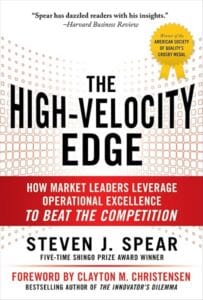
The High-Velocity Edge
by Steven J. Spear
Steve's book on how market leaders out-learn and out-improve their competition.
He's also the author of two outstanding Harvard Business Review articles: “Decoding the DNA of the Toyota Production System” and “Fixing Healthcare from the Inside, Today,” both of which we'll discuss today. One of the themes for this episode is the evolution of knowledge. What does that mean for a company and what does that mean for an esteemed researcher and professor like Steve?
Steve has a BS in economics from Princeton University, an MA in management and an MS in mechanical engineering from MIT, and a PhD from Harvard Business School. He was previously a guest in episodes #58, 87, and 262. I hope you enjoy the conversation as much as I did!
Streaming Player:
Videos of Steve Spear:

For a link to this episode, refer people to www.leanblog.org/358.
For earlier episodes of my podcast, visit the main Podcast page, which includes information on how to subscribe via RSS, through Android apps, or via Apple Podcasts. You can also subscribe and listen via Stitcher or Spotify.
Questions, Topics, Quotes, and Links:
- Steve's website
- LinkedIn profile
- Steve on Twitter
- MIT Sloan faculty profile
- Steve's articles:
- Steve's book:
- The High-Velocity Edge: How Market Leaders Leverage Operational Excellence to Beat the Competition
- The “Rules in Use explained some of it… missing big parts of the management system” (from his 1999 article)
- A3 problem solving as learning… a tool or a mindset?
- Knowing versus figuring it out
- Incrementalism – learning like “The Karate Kid”
- Evolution is not just growing, but also deciding what to discard
- Creating a community of scientists
- Dr. Rick Shannon (my podcast with him)
- The impact of the late Clayton Christensen on Steve and his work
- Previous podcasts with Steve:
Thanks for listening!
More with Steve Spear
- Gene Kim and Steve Spear on Why Organizational Wiring Matters More Than Tools or Talent (2023)
- Steve Spear on Lessons from Hajime Oba: How Toyota's Legendary Teacher Looked at Systems and Learning (2020)
- Episode 262, on Lean jargon and improvement science (2016)
- Episode 87, on high-velocity healthcare (2010)
- Episode 58, on why Toyota outraces the competition (2009)
No matter what our hopes, expectations, predictions, no matter what those are, reality gets the final veto.
Steve Spear

Follow the Lean Blog Interviews podcast
Since 2006, I've been talking with leaders, authors, and practitioners about how Lean thinking works in the real world, in healthcare, manufacturing, and beyond. Follow the show so you don't miss new episodes.
Jump to a section:
- Introductions
- “Decoding the DNA” and the Gap Between Toyota and Its Rivals
- Learning Dynamics: How Toyota Finds Out What Customers Need
- Tools That Start With “What Don't I Know?”
- Fixing Healthcare From the Inside, Today
- How Pratt & Whitney Learned How to Win
- Blame, Learning, and Reality's Final Veto
- From the Four Rules to the Four Capabilities
- How Our Understanding of Lean Evolves
- Learning the Toyota Production System the Karate Kid Way
- Clay Christensen, Kodak, and Getting Stuck in a Groove
- From Healthcare Lessons to The High Velocity Edge
- What It Really Means to Be “the Toyota of Your Vertical”
- Homework: Ask “What Did We Learn Today?”
- Where to Find Steve
Episode Transcript
Introductions
Mark Graban: Hi, this is Mark Graban. Welcome to episode 358 of the podcast. It is February 10th, 2020. Returning to the podcast as our guest today is Steve Spear. He is a senior lecturer at MIT. He's the author of the book The High Velocity Edge: How Market Leaders Leverage Operational Excellence to Beat the Competition. Steve is also the founder and co-creator of a software company and product called See to Solve, among the many other things that he does. Now he's the author of two outstanding Harvard Business Review articles. We're gonna take a look back at these articles, um, here today. The first was Decoding the DNA of the Toyota Production System from 1999, and then the second one published in 2005 is Fixing Healthcare from the Inside Today.
So one of the themes for the episode beyond the Lean and Toyota content itself is the evolution of knowledge. You know, I was curious to talk to Steve, um, about this and, and in, in his articles, but also what, what does that mean for a company, the idea of evolving our understanding of Lean? Uh, what does that mean for an esteemed researcher and professor like Steve? So he was previously a guest in episodes 58, 87, and 262. You can find those in the podcast feed. You can also go, um, to the page for this episode, leanblog.org/358. It'll have links to all of that, links to his articles, uh, his book. I encourage you to check that out, and I hope you enjoy the conversation as much as I did.
Well, Steve, hi. Thank you for joining us again on the podcast. How's it going?
Steve Spear: Uh, fantastic. Thanks for having me.
Mark Graban: Well, it's al- always great to, to talk to you and, and, and hear what, what you're thinking about and working on. It, it's been, um, a little over three years since we, we've had you on the podcast and, and so it's really, uh, nice to have you back. Um, I, I'm, I'm sure a lot of the listeners are familiar with you and, and your work, but, um, gonna turn the floor over to you, if you don't mind introducing yourself a little bit more of, um, you know, some of your background and, and, uh, and, and history.
“Decoding the DNA” and the Gap Between Toyota and Its Rivals
Steve Spear: Oh yeah, sure. So, um, you know, by way of background where people might know me, I wrote an article back in, I think '99, which gets, uh, cited and repeated back to me quite a bit called Decoding the DNA of the Toyota Production System. And that grew out of an effort to try and explain, um, two things, I suppose. One was, why was it that Toyota was able to get so much more value out of the work it was doing around designing and producing automobiles than anybody else? And, uh, the second sort of related question was, given that so much time had been invested in, in trying to, uh, copy Toyota through the use of, uh, lean tools like, uh, uh, Kanban, continuous flow standard work, and that sort of thing, why was it that Toyota was actually widening the lead on its, um, rivals and competitors?
And just to put a, a parenthetical on that, the, uh The gaps that motivated so much inquiry about Toyota back in the '80s, uh, and into the '90s, they still exist. When I last looked, uh, Toyota's profit per unit sold was something like, I don't know, $2,700. Um, number two in the world was Ford, and they were one third that. They were at about $900 per unit sold. Wow. Uh, General Motors, Chrysler at about $400, $600 per unit sold. They were at about a quarter. I mean, the gaps are just staggering. Uh, just one last example just to kind of whet people's appetite. Um, you take a look at, uh, hybridization, combination electric motor and internal combustion engine.
So, uh, General Motors came up with the Chevy Volt, uh, sold about 160,000 units of that car, and then finally threw up their hands and said, “Ah, we're moving on to batteries.” Hmm. Um, Toyota faced with exactly the same challenge to meet the needs of a market which were looking for, which was looking for, uh, less smog, more, uh, fuel efficiency. Uh, they came to market with the Prius, uh, 10 years in advance of, uh, the Volt. And, um, they didn't stop with the Prius. They took the hybrid system, put it through, I don't know, five, six, seven evolutions of improvement, but then retuned it, repurposed it onto two dozen different platforms.
And the sales on the, um… And again, Toyota's very careful. They don't say it sales a Prius. They talk about sales of hybrid. Uh, their sales of hybrid are, um, over 16 million. I mean, the difference in outcome between a Toyota hybrid and Chevy Volt is 100 to one. I mean, it's crazy, right?
Mark Graban: Yeah. Yeah. Cadilla- It's funny, GM tried to make a Cadillac version of the Volt, which some sort of called Cimarron 2.0, if you remember- Uh-huh. that history of we're gonna slap a fancier interior in a Chevy and call it Cadillac. That, that sold very low volumes and like you said, it seemed like GM just gave up.
Learning Dynamics: How Toyota Finds Out What Customers Need
Steve Spear: Yeah, and this is also a little bit of a parenthetical on the, um, self-introduction theme. One of the things that's, uh, really, um, a takeaway from Toyota, sort of the big, you know, sort of mega meta takeaway, was how here was a company that had, uh, come up as its, uh, modus operandi for, uh, creating and then sustaining competitive advantage. It was gonna do it on a, on the basis of its learning dynamics. And, and yeah, that's it. They, they said, “You know what? We all go into the same marketplace, and the person who's, uh, faster and better to understand the needs of that marketplace, they got a better starting point. And the person who's, uh, better, faster to figure out how to meet those needs,” the emphasis on the figuring out because you don't yet know how to, how to meet those needs, um, to them goes huge spoils.
And so you, you link this back to, um The, uh, the Cimarron with the, the Volt technology inside. Um, you know, Toyota's starting point, and I think General Motors may have missed it on, on… in that particular example, is the very first thing you have to do is lean deeply, deeply into the problem space, and in a very empathetic fashion, uh, discover, learn, experiment as to what the real need is you're trying to satisfy on before you offer a product or a service. Uh, in, in the case of Toyota, there's some really telling examples. So, um, when they decided that they, they wanted a presence in the, uh, full-sized truck market, they said, “Well, what do we know about full-sized trucks?” And the answer was, “Very little. We, we make mid-sized trucks.” And, uh, you know, make Tacomas, and they're all right, but they're not a full-sized truck.
Yeah. So, uh, the design engineer said, “Let's go find out what people actually expect from a full-sized truck.” And there are these really great stories within Toyota about their design team, uh, going to NASCAR races and offering people rides-… in different, um, full-sized pickups to, uh, say, “Hey, what do you like this?” Like, going to construction sites, you know, different weather, different environments to say, “Hey, what do you like? What do you dislike?” And then that was the, uh, information that informed the Tundra. Yeah. Uh, you see a similar sort of immersive approach towards… You know, and again, it all starts with, um, we don't know what the market really wants, so let's go find out.
So the, um, so- The, um, story within Toyota is that the, when they were trying to, uh, really up, step up their game on minivans, the chief engineer there drove minivans, um, in all of the 50 states to, again, try and figure out what delighted and disappointed people in minivans. And it was his 50,000 miles in 50 different states, which, uh, informed the first, uh, version of, uh, Toyota's, uh, minivan. So, um, you get that, and then it just sort of… The, the funny one is that when Toyota first tried to do luxury, they took, uh, a predecessor of the Avalon, and kind of like in your GM example, they blinged it up, you know, a lot of chrome and leather and that kind of thing.
The sales on it were crummy because, uh, the Toyota value proposition is affordable reliability, and this thing was less affordable, and it was like, all right. And, and if you're looking for a luxury car, you don't go to a Toyota dealer. So they said, “Ah, you know, we really don't know what we're doing here, so let's go find out what we don't know and come to a better understanding, at least of the target first.” So the story there is that, uh, the the design team got, you know, exiled to go live in Beverly Hills for like six months. And they shopped at Rodeo Drive. They ate at the Four Seasons, et cetera. And what they came to appreciate was that, um, luxury was only in part the product. It was, uh, a big part of why people paid the prices they did in those different c- you know, quote unquote, “luxury settings.” It wasn't the product so much, it was the service.
It was that when you walked in, things were smooth, they were graceful, they were hospitable. Um, there were no glitches, no obstacles. Immediately, uh, you know, someone was trying to understand you, understand your needs, understand your circumstances. And when you look at the Lexus, um- The business model there is definitely not BMW or Mercedes, 'cause the Lexus doesn't look like any of those things. Mm-hmm. The business model is, “Hey, we're gonna sell a, a, an affordable, reliable, slightly fancier car, but the sales and service experience is going to be that of the Four Seasons Hotel.” And, and if any of you, if you or any of your listeners ever have an opportunity, I encourage you to go, uh, in the same day, go to a Toyota dealership- Mm and a Lexus dealership, and in both cases you're gonna be treated great, right? I mean, that's my expectation. You go into the Toyota dealership, though, and everything about the place, the, the lighting, the furniture, the floor treatment, et cetera, the u- you know, is gonna say, “You've come to a place where it's gonna be reliable but affordable.”
And when you go to the L- go have the same experience, sales or service, at the Lexus dealer, um, the experience you're gonna have there is, uh, “We're gonna treat you really well.” Yeah. I mean- “So come in, relax, kick back. We're gonna treat you really well today.” Anyway.
Mark Graban: And, and there's different dimensions of, of quality. I mean, I think, like, in terms of, like, hotels, um, the difference between a Hilton Garden Inn and a Ritz Carlton. Like, you can get a good night's sleep in both hotels. And, you know, they, they can be c- uh, you know, good at what they are and what they promise, but I certainly wouldn't expect… I don't think I've ever stayed in a Ritz Carlton, but, um, I, I wouldn't expect that level of service at, at a Hilton, a regular Hilton even.
Steve Spear: Right. Yeah, and that, that's right, 'cause you go to the places that, um, you know, the brands we associate with, “Oh, I'm traveling on business, I just wanna get a good night's sleep and I don't wanna pay too much for it,” you go and you expect a certain level of, um, comfort, a certain level of cleanliness, hospitality, but you don't expect frills. And in fact, the frills would really be distracting 'cause you'd say, “Why am I paying for frills? I'm, I'm, I'm gonna be in this, in this hotel for all of eight hours.” Now, there are other places you go where when you walk in the door you want someone to say, “And this is the Four Seasons experience,” and they walk in and say, “Hey, Mark, welcome back.
You know, we noticed, um, that you used a lot of towels 'cause, you know-… we have this great shower and spa-like bathtub, so we put extra towels in your room.” Or, “We noticed you ran out of coffee, so guess what? We stocked up a couple extra capsules, uh, for the Keurig machine in, in your room. Uh, a couple extra mints on the pillow 'cause we noticed, you know, by the chocolate wrappers in the trash.” And, and that became the model for, um, Lexus, is that when you go into the Lexus dealer, it's, uh, it, it's efficient, it's effective, but it's a little bit more. When you, you, you walk in, you actually sit down in an office rather than go to a kiosk to check in. “Hey, how you doing? You know, what's been going on in the last six months since your last tune-up?
How's the kids? How's the family? Anything going on we should know about in terms of, uh, that might have changed your driving habits that we should look at the car?” And again, uh, you know, tying that all back, um, I mean, all interesting stories, but I think they reveal a really critical point, is that- Yeah Toyota built a business model and a management system which starts with the, uh, assumption that we don't know what we need to do, and we don't know how to do it. And so the very first thing we have to do, and then what we then have to do continuously, is go figure out what to do and how to do it, and constantly learn and, you know, by everyone all the time. And so you take a look at, you know, Tundra, Sienna, Lexus, et cetera, what you're really seeing is an expression of that sort of optimistic humility that, uh, yeah, we don't know what's going on, you know?
And geez, you know, how to fill the card, gosh, that's a, that's a huge mystery to us. But, uh, that's the humility part. But the optimism is, you know, but really, really, um, energetic, diligent, enthusiastic about this learning thing. Good God, what can we accomplish? Yeah. And what they've accomplished is really remarkable
Tools That Start With “What Don't I Know?”
Mark Graban: Well, and so you, you kind of bring up, um, you know, this question of, uh, uh, you call it learning dynamics and this difference between going into the development of a new product or service or a startup or even a improvement project in a hospital. There, there's a big difference between knowing the answer and then moving forward versus this idea of, well, we're gonna figure it out, and maybe we have frameworks for figuring that out, whether that's the Toyota product development system or the lean startup methodology or A3 problem-solving. They, they, these can be frameworks for, for learning and figuring it out. That, that's one of the key differences with companies like Toyota, right?
Steve Spear: Right. That's right. So what you mentioned is y- you went through a list of some very, um, uh, effective tools, um, appropriate for, you know, one circumstance or another. Common to all of them is that they guide you in the direction of first starting with the question, what is it I don't know about the situation? Mm-hmm. Then, you know, further the question for, well, what can I capture about the situation, you know, the current condition? Um, what's not working in the situation? You know, so going back to the A3 metaphor, you know, what's the, um, in the current condition, not only what is happening, but what's happening that's disappointing, and then, then leading on to the next question.
A- and you see it's all questions, right? Which is what's going on? What's wrong with what's going on? And the root cause, which is why is it going on or going on in a bad way? And, and again, you know, that's, I don't know for sure, but this is my best guess, my best informed guess. And then, um, another question, which is, uh, given what's going on, you know, right and wrong, and the reasons I think it's going wrong, what c- again, a question, what can I do differently? Corrective action countermeasures. And then, um, and then another set of questions, which is, um, you know, given, uh, how things are currently operating and, you know, why I think they're operating that way, the root cause analysis, and what I think are reasonable changes, what I think, what do I think is gonna happen when I put those changes in place?
Boom, target condition. And so y- you see built into these method, methods is, um, sort of little prods, nudges, uh, little, uh, you know, assists To help the person using these tools constantly ask questions so they get to a better, one, recognition of what they can't answer, and also get to better answers, uh, through this, uh, active questioning experience.
Fixing Healthcare From the Inside, Today
Mark Graban: Yeah. But I- I'm curious to your experience working with organizations that are not Toyota or not the US Nuclear Navy or other- Right, organizations that you've written about. If, if somebody is trying to– They say, like, “We want to be the Toyota of whatever industry.” Yeah. Um, I mean, it seems like there's, there's this habit or like, like people are really comfortable with or they feel this need to want to know things, or at least to pretend like we- Right know things versus a d- you know, a, along with a discomfort of saying, “I don't know. We'll figure it out.” Discomfort with uncertainty.
Steve Spear: Right. What would
Mark Graban: you– What are some thoughts about, you know, um, trying to change that mindset or habit?
Steve Spear: Yeah. So I- I'll use your question and just sort of, uh, follow up a little bit in terms of the, the personal history, 'cause the question- Yeah about, um, organizations, not Toyota, outside of autos. So, uh, you know, just quick reference, uh, for folks who haven't seen the materials. So we, we talked about healthcare organizations which were trying to become the Toyota of their sector um, in an article called Fixing Healthcare From the Inside. And, um, you know, it's, it's not recent, but more recent than the, uh, DNA article. It was a
Mark Graban: book that I was called- It was about 2005, right? Uh, w- was the Fixing article, right?
Steve Spear: Yeah, probably 2000– Yeah, 2005. and, and, and- And then my book, um… Yeah, go ahead. Sorry.
Mark Graban: I'm sorry, I'm sorry to interrupt, but the, the title, it also includes a comma, today. Fixing Healthcare From the Inside Today.
Steve Spear: That's right. You know, and what we're trying to emphasize there is that, um- Well, sometimes there are these, uh, large structural things that are either, uh, time-consuming to, uh, understand or time-consuming to, uh, remediate. That doesn't mean you can't start right now. Uh, and, and it kind of ties back to what we've been discussing, uh, Mark, which is, uh, the basic premise here, which is, um, we enter situations, and particularly complex dynamic situations, uh, handicapped by what we don't know. And i- if we enter those situations, you know, again, not knowing about what to do, uh, nor how to do it, there's no reason we can't start right now coming to a better understanding.
You know, we don't have to wait for the assembly of a blue ribbon commission, you know, appointed by the governor or the president. We can s- you know, could look around, you know, left, right, up, down 10 feet. You know, uh, I'm, I'm already swamped with things I simply do not understand. So, uh, hence the, uh, the comment with the emphasis today. You don't have to wait.
Mark Graban: Yeah. Yeah. And, and there's, I think, uh, and, and when you wrote the article, this is really before the major health ref- healthcare reform efforts, um, you know, during the Obama administration. Right. And, you know, this, this question of, um, are, are we expecting the big systemic change, and what is that? And if it's coming, to your point, what could we do today, right now? Yeah. And,
Steve Spear: and that's right on, 'cause if you think about it, you put yourself in 2005, so that's some context. So around 2000, Institute of Medicine, um- had, uh, published these reports which were saying, uh, just how hazardous healthcare delivery was to patients, and actually care providers too.
Mark Graban: Mm-hmm. Mm-hmm.
Steve Spear: And so after that, you can imagine people with a policy orientation were saying, “Oh, well, what can be done in Washington or Albany or Boston or wherever else, um, Austin, to, uh, fix that?” And, um, that leads in the direction of, “Oh, woe is me. There's nothing I can do.” And, um, you know, fortunately there were, were a handful of people, uh, uh, you know, uh, different places. You know, I spent a lot of time with folks in, um, folks in Pittsburgh, but Appleton, Wisconsin, out in Seattle, and also Cleveland, Cincinnati, who, uh, said, “Well, what the hell? You know, if, if we're gonna wait on Congress to get anything done, it'll be our grandchildren.”
And so I said, “Well, let's get started today.” And you know, we… I think what we demonstrated pretty solidly, um, both with the, uh, you know, our own work on which we reported, but also documenting, um, what other people had done, is that even in sort of this, uh, dysfunctional, I don't know, it's… I think we insult the term system to call it a system, but within this dysfunctional vertical that's American healthcare and American healthcare payments, we could still make huge improvements. I mean, we, we, we had examples where, um, people took these horrible complications and, uh, you know, like surgical site infection, and eliminated them just, you know, down to zero. Come to my hospital, have surgery, don't worry about the MRSA. Um, you know, ventilator-associated pneumonia, gone. Uh, central line infection, gone.
And it wasn't as if, um, uh, you know, that then you get the pushback, “Well, you know, what's the cost of quality?” And the answer is- Yeah. quality is wickedly free. It's actually pays for itself. And you know, one of the guys we've worked with, uh, he's now at, um At Duke, this guy, Rick Shannon he, he wrote up, you know, they had gotten rid of central line infections, ventilator pneumonia, and a bunch of really horrible other things. They wrote it up and said, “Damn, we're making a whole lot more money doing this.” Yeah. Because, uh, you know, having someone readmitted costs a lot of money onto the system. Um, having someone extended day of care where we're not doing anything procedural, a huge cost on the system. Yeah. So, you know, if we can actually come and treat someone and get them on their way in a, you know, a, a, a well-conditioned state, everyone's better off.
Mark Graban: El- eliminating MRSA is not a Lexus or Ritz Carlton level of service. That should be just built into any product, like you would expect your, um, Toyota Corolla is not going to just randomly explode- Yeah, as you're driving down the street.
How Pratt & Whitney Learned How to Win
Steve Spear: Yeah, yeah. The wheel should stay on, you know-… in the first 50,000 miles of driving. That's right. They should not come off the rims. Yeah. Right. Yeah. So, um, so, you know, you asked about, you know, examples, uh, outside auto. So, you know, then, um, when I wrote The, The High Velocity Edge, I think about 2010, you know, we looked at other examples, and, um, that, that book is a book, not an article. We had lots of opportunities- Mm to really dig into the, uh, the culture, behavior, norms, beliefs inside of Toyota. Really, um, I think coming to a much richer appreciation of the, um, learning dynamic and its, uh, points of emphasis. But we, you know, we had examples in there of, um, Pratt & Whitney saying, “Damn, you know, we keep losing these really expensive contests, um, for the rights to put our jet engine on someone else's airplane.”
And it was really a, a quite a Toyota-like, uh, appreciation. You know, the, the folks at Pratt & Whitney, they said, you know, “Why is it we keep losing these contests?” And, you know, they, they, they barreled through the technical reason and the organizational reason, and, “You know why we keep losing? ‘Cause that's what we know how to do. We don't know how to win. And the reason we don't know how to win is that, um, the approach we're taking is inadequate to get a winning jet engine.” And so what they did is they said, uh, “Well, let's take this, uh-” was take this approach to learning and throw it onto the process by which you design a jet engine, which is many years, b- billions of dollars, thousands of engineers. And wouldn't you know, they, um, they ran that program with a huge amount of constant feedback.
“Yo engineer, this is what you don't know. Yo program manager, this is what you don't know. This is what you don't understand.” And then, you know, linking that back to our A3 problem solving, every time one of those problems popped up, they said, “Oh, we're not gonna work through, we're not gonna work around it, we're not gonna just sort of muscle on.” Let's ask the question, why do we have that problem? And then once we understand why we had that problem or have an unders- a belief as to why we have that problem, uh, let's make a change to our approach. Anyway, long and short, what happens with Pratt, they take, uh, a process which, um, they thought it would take four years to design a jet engine, uh, and they got it done in three.
And, uh, they looked at the, uh, history in terms of, uh, engineering change orders as they go through the… They, they cut that in half. And wouldn't you know, um, you know, I say this with the, you know, gigantic air quotes, but the simple act of, um, acknowledging that they didn't know how to design a jet engine well, but they could learn their way to the right answer about how to do that, they ended up winning the contract for the, uh, F-35 Lightning II. And just off the top of my head, that's like $10 million an engine, 3,500 engines. That's a $35 billion-… swing in fortune, and that doesn't even include, uh, service parts and maintenance. I mean, you know. Yeah. So, uh, you know, profound fortune shifting for a company, which all it did, you know, again, with air quotes, all it did was say, um, “We only know how to fail.
We don't know how to succeed, so if we wanna succeed, we've gotta learn a whole lot more than we currently know.”
Blame, Learning, and Reality's Final Veto
Mark Graban: And, and, and that shift to learning, um, is different than, you know, organization may have just blamed somebody every time- Oh, there was a failure instead of thinking about systemic failures. And, and I'm, I'm just thinking back to, uh, just got this vivid memory. I'm just gonna share a quick story. The last manufacturing company that I worked for was, uh, Honeywell. And in the one business unit, I, my, my cubicle… And you know, I was out on the shop floor most of the time, but I had a cubicle. Right. And it was near the woman who was the executive assistant to one of the vice presidents. And I had heard that one of the sub-business units had, um, you know, replaced its president, and there was an announcement coming, and the admin was talking on the phone probably to another admin. And, um, I, and I hadn't been there that long, and, and I heard her say, and she said, “You know, they keep replacing presidents every year, and maybe one of them's gonna figure it out.”
And like, but the problem might not be any of those people who would probably… You know, high potential people who were then apparently promoted or moved into this place that was like a death sentence for your career. Who would take that job next? But anyway it's interesting, you know, that, that blame dynamic is really Ingrained in a lot of leaders and a lot of organizations as well, and, and that's gonna just interfere with learning then, right?
Steve Spear: Exact- you know, and, and it's wild because the person who's, uh, next up, the guy or gal who's, uh, hiring, firing those presidents on, like, this, uh, 12, 24-month tack time, right? They're, they're not thinking, like, you know, “Maybe I'm taking someone who's been really successful and putting them in a completely corrosive environment. Maybe I own some of the responsibility for that corrosiveness.” You know, like, “No, no, no,” you know? Right. I- it ju- yeah. But, you know, actually, Mark, it really reflects on something really sort of, uh, discour- discouraging, right? So, uh, whoever is making those, uh, 12, 24-month assignments, they're getting pretty good feedback that there's something wrong with their process, right?
‘Cause they, uh, “Hey, that guy's really doing great. Let's put him in that job. Oh, he sucks. Oh, that gal's doing really great. Let's put her in that job. Oh, she sucks, too.” It's like you have to two, three times through this. Don't you say, “What the hell am I doing wrong?” You know?
Mark Graban: You know, the, the, I mean, but, you know, the w- you know, this comes back even if at a more micro level looking at- Right a control chart and statistical process control and the, the voice of the process, you know, the process is talking to you. Right. It doesn't mean someone's going to listen.
Steve Spear: Right. Yeah, yeah. Um, you know, one of the things I try to, um, say is that, uh, no matter what our hopes, expectations, predictions, no matter what those are, reality gets the final veto. And, uh, we then have a choice, right? Which is, um- Do we respect the veto and ask why, you know, why the universe… I mean, think about it, the universe is 15 billion years old and fairly infinite in size, right? So in a contest between what Steve and Mark think and the universe, and if the universe disagrees- who should we listen to, right? I, I'm thinking the universe here, right? But what often happens is, “Ah, no, I'll try it again.” It's like, “Well, why?” The universe is just telling you you don't understand.
Mark Graban: Yeah, but it might take a while for the universe to win. Yeah. So we still hold out hope that, you know.
Steve Spear: Right, right, right. Yeah, no, uh, the 15 billion years, I mean, it, it's got, you know, it's got patience. It's gonna keep winning.
From the Four Rules to the Four Capabilities
Mark Graban: Well, um, so if it's okay, you know, I wanna kind of bring things back to, you know, one, one topic we were gonna, um, explore today. Yes. You know, you, you mentioned the Decoding the DNA of the Toyota Production System article, um, from, you know, 20 years ago. And like you said, it's still, uh, still very often, um, mentioned and cited and, you know, and, and, and used. Um, you know, the, one of the frameworks from the article, um, you know, let's just recap for the listeners if, if they're not familiar with the articles. Um, you know, the, the four rules, or what are sometimes called- Right the rules in use from the Decoding the DNA article. And then Fixing Healthcare From the Inside Today has, uh, an- another framework. Um, you, you, you talk about four capabilities four organizational capabilities. And so o- o- one, one thing I wanted to explore today is like kind of your thoughts on how research, um, knowledge evolves or changes or, you know, I think you used the phrase, um, be- you know, talking about being on the frontier of knowledge.
Right. Um, so I wonder if you, if you could talk about that. So a difference in six years between the articles. Um, kind of just your, your thoughts on that continued learning. Um, where, you know, if, if it wasn't a continuous learning dynamic for you, um, you'd say like, “Nope, nailed it. This is a great article. It's bestselling. People love it. I'm done.” But that's, that's not how that's not how you're, you, how you operate, right?
Steve Spear: Right. So, um, let me, let me just offer this, is that, uh, I don't know if it's a universal principle, but certainly a good general one. Um, all progress is incremental. Yeah. And just to sort of anchor people on this, you know, back in, uh, 1961, President Kennedy said something about, uh, sending a man to the moon by the end of the, you know, and returning him safely to Earth by the end of the decade. And, uh, that was actually accomplished, right, with Apollo 11. But, uh, the first manned flight of the human spa- yeah, of, of the American, uh, manned space program, uh, was, uh- Uh, Alan, uh, yeah, um, uh, Armstrong, Shepard, right? What did he do? Alan Shepard. He took off.
Right. Yeah, Alan Shepard, right? So Alan Shepard, what did he actually accomplish in terms of getting to the moon and coming back safely by the end of the decade? Um, well he beat the end of the decade thing, but he, he, he took off and he landed 18 minutes later. That was it. Um, that, that, that was important because until Alan Shepard took off and landed, it wasn't clear that the United States had the capability to, uh, have a man safely leave the Earth at, you know, very high velocity with all its forces and whatnot- and come back safely without, you know, splattering. And it w- it wasn't until, uh, two flights later where, uh, um, John Glenn went up and he went around the Earth three times. Again, you know, you start thinking of the distances involved, right? They're minuscule compared to getting to the moon and coming back.
But it, it was necessary to establish, um, one level of, uh, threshold and stability to then use that as the platform for the second and the third flight in the Gemini program, and the Gemini program into the, uh… I'm sorry, the, uh, the Mercury program into the Gemini program. Right. And then the Gemini is the basis into Apollo. Now, the, the other thing I just want to emphasize in terms of this incrementalism. So, um, there was a movie, uh, I think it was Ryan Gosling last, um, last year called First Man. Yep. And, you know, it sort of dramatized, uh, the crew of Apollo 11. Sort of gives you a hint about incrementalism, right? It wasn't Apollo 1, it was Apollo 11.
Um, you know, actually leaving the Earth, orbiting, rendezvousing with their, uh, their spaceship, you know, making it to the moon, orbiting, da, da, da, boom, boom, right? And they get back and since that's, um, the summer of 1969, they, they beat the president's deadline of uh, within a decade. They started asking people, well, you know, what was the big accomplishment of Buzz Aldrin and Alan Shepard, uh, Neil Armstrong? And, uh, people say, “Oh, well, they went to the…” But you start looking at it, yeah, they as two people went to the moon, landed, took off, you know, and returned Earth. But what did they do that was new? And most people say, “Oh, but they were the first people to go on the moon.” And it's like, yeah, sorta. Because the crew of Apollo 10 did everything almost, right?
They, they, they launched from Florida, they orbited, they got themselves organized, they headed off in the direction of the moon. They orbited there. They, um, started the descent to the moon, and they got within 47,000 feet of the surface of the moon. Now you just put that in some perspective, for people who travel, you know, coast to coast, um, you're flying almost as high as they were off the surface of the moon. Yeah. At 47,000 feet. Um, they knew if they sort of said, “Hey, what the hell, we're here already, let's go to the moon and back.” Um- So
Mark Graban: close,
Steve Spear: they had been told that there wasn't enough fuel to get back home, right? So there's a very strong sort of carrot stick thing going on with the folks at NASA around this. But they got within 47,000 feet of landing. So then when you look at, that's Apollo 10. Now, when you look at Apollo 11 and say, um, “What did those guys do that was new?” The answer is 47,000 feet down walk around a little bit, and 47,000 feet back up. And I'm saying that sarcastically- Sure… um, not to diminish what they did, but to make the point, is that, um accomplishment is incremental. And I defy anyone to find a giant accomplishment that wasn't anything but incremental. But anyway, tying that back to the research question. So, uh, you know, we were curious, what the heck is Toyota doing that all these other people trying to copy Toyota are missing? And I did this sort of very deep, immersive Karate Kid-like, uh, deep dive into Toyota and, uh, in the operating environment.
And I was able to come out of that and say, “Oh my gosh, look at this. They've converted all their workflows, all their workflows into feedback-generating experiments.” And I think we use the term in the article, you know, community of scientists. And so of those rules in use, because they're not rules written on a wall or like, you know, tablets of the, uh, 10 Commandments in a courtroom, right? Um, we said, you know, look, they're very, very deliberate about how they, um, predict the flow of work. They're very deliberate about, um, predicting, um, pre-specifying exchanges in the flow of work. And they're very, um, disciplined about predicting, uh, defining, pre-specifying the actual approach of design, conducting a task.
So when they do any of those things, they get feedback. So those rules one, two, and three. Then the fourth rule was they said, you know what? This whole experimentation thing, when they have a problem, um, they actually solve the problem as an experiment too, right? Boom. That's what we got in 1999. Now we kept looking at Toyota and said, well, does that explain everything? And it explains some of it, you know, and sort of like the, um, the Mercury program explained how you take off orbit and land. And the Gemini program explained how you take off orbit and do sort of complex things on long duration flights and land. Um, you know, the, the article was an increment in terms of understanding, but what it didn't explain, what we came to really appreciate, um, as we continued interacting with Toyota and then trying to apply the lessons elsewhere was that we, we were missing, um, big parts of the management system.
So, um So we had captured, I'd say, you know, 75, 80% how you design an operating system so it gives you feedback. Great. That was rules one, two, and three. We captured, um, I'd say 75, 80% how you make an improvement so it's actually a bonafide feedback gen- generating experiment. But one of the things we didn't capture at all in, in the article was, let's say you learn something, how do I benefit from it? And, and, and so, um, when we started talking about these capabilities, which appeared in, first in the healthcare article, later in the book, we were able to add increments and say, “Well, h- here's what you do there. H- here's how you, um, take a local lesson and systematize it.” So that became capability three.
Capability one was how you design a system for feedback, and capability two was how you solve problems with feedback. Capability three was how you take that feedback and make it systemic. And then, you know, the other increment was which we had a lot more time To, uh, observe how, um, Toyota leaders cultivated, uh, nurtured, sustained this, um, continuous learning, uh, continuous experimentation, um, uh, culture. Mm-hmm. And so that became the fourth capability. So, uh, a- anyway, you know, back to, you know, the question about advancing the understanding. It's like, let's, you know, it, it… I think the basic premise, you know, you and I have talked about a lot is, um, any time you're in a situation, your understanding of it is imperfect.
Mm-hmm. So what you do is you try to grab your best understanding. Say, “All right, well, that's what I think I know. Now, what is it I don't know, and how can I advance it?” So, you know, the '99 article was, you know, best first attempt, and then we tried to build on it, uh, since then.
How Our Understanding of Lean Evolves
Mark Graban: So, I mean, you, you, you talk about that evolution. Um, I think that happens with any of us, um, myself included, in, in, in our careers, um, as, as we get exposed to Lean or the Toyota Production System, um, in different ways in the workplace, and we, we, we may have a mentor or somebody who's educating us, and we think we get it, and then we learn, “Okay, no, we don't understand as well.” You know, through, through practice may- you know, there's, there's feedback, uh, that we get that hopefully we listen to. We, we get exposed to others. And I, I think there's a parallel in how anyone's, uh, understanding might evolve from, uh, you know, thinking about a few Lean tools, some management practices, more about the culture and the philosophy.
You feel like your understanding, you know, hopefully evolves and doesn't just get stuck in, “Well, here's what I learned in my first class, and I'm certified or belted, and I know it.”
Steve Spear: Right, right,
Mark Graban: right. As opposed to, “I'm just starting to figure it out.” Um, and, a- and, and I think back even over history of the Lean movement, if you will, like, I'd be curious your, your, your thoughts on this, of course. Like, there, there was that first wave or, you know, like, the l- like, the language that was used. Um, there's a book called Japanese Manufacturing Techniques
Steve Spear: which
Mark Graban: is one of the early books. And then there were a lot of books or, you know, people would frame it as just-in-time manufacturing. Right. Like, The Wall Street Journal today poke at them sometimes. Their, their, their understanding somehow hasn't evolved. They still refer to To- anything Toyota-ish as just in time. Um, and, and, and there, you know, so there was this kind of l- subset understanding of Lean. And then, you know, I think there was a f- a, a phase where, well, it's about a broader set of tools. It's not just about just in time. Right. And then people start realize, well, it's also about how we manage, and it's also about problem-solving, and it's also about culture and coach… So, I mean, I think the Lean movement, for, for what that is, um- Has evolved and grown over time. Um, it, it, it, I guess that's just how things work.
If you, if you wanna call lean a field or a discipline, it, it works that way in other fields. You, you talked about rocketry- as an example, right?
Steve Spear: Yeah, and I think what I would do… First of all, I agree wholeheartedly with your point, is that there's this evolution. W- One of the things that… I don't have a, a point of view on this, but what we might wanna do is think a little bit about the term we actually use to describe the process. Because evolution implies, um, you know, Darwinian, you know, variation, selection, retention, but also implied in that is discarding. That, um you know, these traits, these features were valuable and then they, we discard them. A- and that's true, right? Because there, there's a lot of things that as our, uh, learning advances, uh, there are certain practices we discard.
I mean, I, I'm looking out my window now, I don't see anyone on a horse. Um, you know, uh, there goes an Uber, you know, and there goes one of those, uh, electric rentable scooters, but no horses out my window today. So discarding does occur. But I, I would say the thing we often, um, forget, you know, and this ties back to the incrementalism, is that, uh, our understanding today didn't displace our understanding yesterday, it added to it. That yesterday there were certain things I knew, and I had a certain confidence and clarity, and there was a range of application. And hopefully I learned something between yesterday and today, and, um, I've got better clarity, better certainty, better range and application. It's not like the stuff yesterday was, um, I'm discarding, I'm just understanding it better.
And, and the reason I bring that up, and I, I, I don't wanna, like, become, like, a semantics fanatic on this one, is that, um, th- this, this idea of incrementalism, and Alan Shepard had to take an 18-minute flight because that's all we were able to do in 1961. And if he hadn't taken that flight in 1961, only, you know, quote, unquote, air quotes again, only 18 minutes, um, Neil Armstrong and Buzz Aldrin would never have landed in 1969. Yeah. And so I think it's important for us to recognize that, um- The small wins are wins. And, and in fact, the small wins are the bottleneck step onto the next small win, onto the next, next one, and the next one. Yeah. And if, and if we didn't build up a, a record of small wins, we'd never have the giant leap of accomplishment.
Learning the Toyota Production System the Karate Kid Way
Mark Graban: So I was wondering if, if you could, like, if we could explore a little bit more, you know, you talked about, you know, going into, um, Toyota, you, you talked about your Karate Kid experiences. I… You, you, you had more than one Mr. Miyagi, if you will- trying to help. I, I'm, I'm just curious to kind of explore, like, a little bit of the process of h- having people explain what might be, if you use the analogy, you're asking the f- the fish to describe the water- Right that they're in. And, and like you said, it's not like these rules were just posted on the wall, that there, there was a process of, of understanding, drawing out, synthesizing. This is going back a ways now, but I'm curious if you can kind of share if, you know, memories or reflections of how that came to be as, uh…
Were there, were there drafts of the rules in use, um, you know, and feedback cycles around, okay, is this-
Steve Spear: Yeah. Um, so the, you know, the fish water thing's interesting, right? Because, um, the folks at Toyota, the way they taught this really was Karate Kid kind of thing. I mean, when I went in there, you know, I was sort of like, I was going native, right? So, uh- day one, I'm like, oh, excited, I'm gonna learn the Toyota production system. It's like learning the Force from Yoda. And, um, I mean, I really thought that. You know, uh, if you think about the timeframe, Yoda was really a, a relevant metaphor. And and grown Yoda, not baby Yoda. And, uh, I get there the first day, and the guy who was my Yoda, I was like, “All right, I'm here to learn.”
And he says, “All right, go find out what the factory makes.” I said, “What?” He said, “Yeah, yeah, go, go find out what the factory makes.” And, um, so I go in and I, I come back at the end of the day and I said, “Oh, you know, hey, Mr. Yoda, here, here's what, uh, here's what I think they make.” And he says, uh, “Well, how'd you find that out?” I said, “Well, I asked people. I said, ‘What do you make?'” And all they said was, “It… Do you trust them?” And I said, “What do you mean?” He said, “Well, you know, how do you know they're right?” And I had no answer to that. And then he left. And so I had to go back again, and I come in with a different list. Which, uh, this time I went to the accounting office.
And he said, “Where'd you get that list?” He said, “What's that from?” I said, “Well, you know, I, I… They seem to be trustworthy, honest people, I think. You know, it's the Midwest. It's not, you know, it's not one of the urban centers on the East Coast or the West Coast, right? I mean, it's trustworthy people.” Um, and, uh, just anyone listening who thinks I'm… I was joking. Uh, I'm, I'm a native New Yorker and live in Boston, right? So that's self-deprecating. Um, and he said, “Where's this list from?” I said, “You know, the accounting department. I just looked for what they invoiced.” He said, “Well, you know- “… are you sure they made that?” A- a- anyway, the reason I bring that up is, um, I got very little explicit direction, you know, where it's like, “Oh, this is the Toyota production system.”
And anytime they did say, “This is the Toyota production system,” it was like they were talking tongues about basic thinking and inner motivation and… Like, what is this, a yoga class? Um the way they teach it is this very experiential approach. Now, the advantage I had is that, um, that wasn't my own set of experiences, right? So I could go elsewhere and make contrasts. That's one form of experimentation, right? Which is just the sort of inductive look at A, look at B, um, see how they different performance and ask, uh, how do they different behavior. So that was one thing. Mm-hmm, mm-hmm. And you sort of start writing that up and, um, say, “Oh, I'm, I'm developing a theory.”
The other part is deductive experimentation, where you say, “I have a theory and I'm gonna go test it out, see how well it works.” And, um, when it works, it's like, “Yay, you know, I wasn't wrong.” Um, and when it doesn't work, you say, “Yay, I have a chance to improve my understanding,” right? But, um, anyway, the, the… I think the advantage I had versus, uh, the typical person at Toyota is, um, I was there- A social scientist, but as a scientist. And anyway, actually it's a good parenthetical here. You know, take- taking this research in a very, very scientific fashion, I owe credit to, um, two mentors. So one is Kent Bowen who, uh, I met at MIT before I went over to Harvard to do this research, and the guy is like an uber genius on ceramics. So the fact that he was, um, encouraging me to do social science with the disciplines he had acquired as a laboratory scientist, not surprising.
The other one that is, I think it's timely to mention, is that, uh, you know, Clay Christensen um, father of disruptive innovation, passed away this past week. And, um, Clay was hugely influential, not only in my thinking but my approach, 'cause Clay was really thinking really, really hard about theory of theories. What's the theory by which you can construct meaningful theories? And so this whole notion of, um, making rigorous observation, and then describing what I saw and seeing how things classified and characterized, and see if out of that I could extract… I'm sorry. Out of that, can I extract some, um, hypothetical causality? And that was hugely influenced by Clay's, uh, you know, heavy hand on my… Heavy, but caring hand on my shoulder. And then flipping it around to sort of the deductive, um, test of theory that also reflected, um, strongly influenced this guy, Kent Bowen, and also Clay Christensen. So anyway, I just wanna, you know, take the opportunity to shout out that I would be nothing, nothing at all- without their, uh… And I say that a little sarcastic, but it's actually quite true. My professional career would be wildly different, and I think, uh, far worse without the influence they exerted- in terms of the sense making that was, uh, my experience with Toyota and elsewhere.
Clay Christensen, Kodak, and Getting Stuck in a Groove
Mark Graban: Well, well, uh, and, and, and, and thank you for sharing that and, and, and for the shout-out. Um, I, I, just a, a quick aside, when I was at, um, Sloan as an MBA student, um, from '97 to '99, um- W- w- we were exposed to, um, Christensen's work, um, and, and I think… I'm trying to… I don't… What year was, uh, The Innovator's Dilemma published? I think it was right around that timeframe.
Steve Spear: Right around that time, yeah.
Mark Graban: So he was still, I think, in, in certain circles, um, a bit of a, a cult hero, and then he hit, you know, mainstream, um- Right uh, recognition, you know, um, Silicon Valley and, and beyond. So, um, I was very fortunate to, to be exposed to that kind of, uh, thinking. And, um, you know, just a- another parenthetical within the parenthetical, I did my, um, LGO internship, I don't know if you know this, Steve, at Kodak. 1990- No, I didn't realize that. Uh-huh. 1998, Kodak. Imagine putting yourself there at that place and that time. Right. And they were still very much in a state of denial about digital imaging, um- at that, at that point. And, uh, when… I'll t- I'll try to close the parentheses at the end. But they had, uh… uh, I remember an executive, it wasn't, um, Fisher, the CEO at the time, but somebody very high up at a strategic level, giving a talk to a group, and with a straight face saying, “Because of the, um, spread of digi- digital imaging, we are going to sell more film and more paper-” I'm like, “What?”
Like, what do you mean? Like, you know, digital cameras were either just a really crappy toy, or I was in the area that was making the really high-power digital cameras that, like, Sports Illustrated photographers were using. right, right. So the cameras were either really amazing and really expensive or really cheap, or relatively cheap and really crappy. And I'm thinking like, is do, do, do they believe this, or is this just the story they're trying to tell Wall Street? The universe has not caught up to them yet. You know, but, but the argument was, well, when, when people get exposed to digital photography, they will eventually move up to real photography, which they defined as paper and film.
But th- I mean, a lot of this seems like textbook innovator's dilemma kind of situation where they, they didn't view digital photography as, as a real threat.
Steve Spear: Yeah, so, um, I wrote something to, uh, a friend of Clay's to, you know, thinking through what, um, Clay's… If you really had to boil Clay's contribution down, and, uh, it ties so solidly into what we're discussing about, um, having this open mind and just learning. But if you look at Clay's, uh, thing about disruptive innovation, he said, you know, “All of us wanna get good enough that we can say, ‘Hey, man, I'm in a groove right now.'” Absolutely. I mean, who doesn't wanna be in a groove, you know, and be really good at what you do? And he says there's a risk to that, right?
And this is the disruptive s- and what you're describing with Kodak, which is once you're in a groove, um, the groove can become a rut And, uh, once you're in a rut, you stop looking as to, um, what's wrong with the groove or the rut you're in, and you stop looking around yourself. And Clay's advice really is, um, I think, you know, far more than a corporate advice. He says, you know, “Once you find yourself really good at something, look around and come to an appreciation of who else is out there whose needs in the moment aren't being, um, even recognized, let alone satisfied.” And, um, if you can see that, and it's gonna be hard to see 'cause you're in a groove and you're focused really, really hard on, uh, the needs you're already, um, meeting and satisfying.
But if you can look outside of your groove and, uh, come to appreciate those who aren't even seen right now and, uh, orient at least part of the activity to their needs, you might accomplish great things. Now, um, that, that really is the essence of kind of the disruptive, uh, the innovator's dilemma and the innovator's solution, right? Which is, um, you know, you're in a groove and you're chasing these high-end products, blah, blah, blah. But you know what the hell, go set up an independent standalone team and let them explore for you. But as a life philosophy, and I think Clay, um, modeled it, is that, um… It's not a bad life philosophy, uh, to have also, which is, “Hey, you know, I'm in a groove.
I got, you know, what are my family, professional, economic situation is. Eh, I'm really grooving along.” But, you know, take, take a look down the… You know, take a look, uh, out your window across the street, down the road, and say, “Yeah, but while you're in your groove, is there somebody else who's not-” Mm-hmm. “… that can lend a hand?” So, uh, anyway, um, um- I think there's a, a, a lot that we could, uh, learn from Clay, um, you know, whether it's, uh, like you said, uh, the late '90s when he was just entering people's consciousness or even now
From Healthcare Lessons to The High Velocity Edge
Mark Graban: Um, and w- he, he wrote a book later, about 10 years later, called, um, The Innovator's Prescription about- healthcare. And, um, I just wanna connect dots back to, you know, the, the, the progression of, of your articles and, and then your book. You know, decoding the DNA of the Toyota Production System, some of the general principles, um, for, for people in almost any workplace. And then the fixing healthcare from the Inside Today article, I mean, i- in a way, I mean, that, that has lessons. It's not just about fixing healthcare. Right. It's about fixing organizations. And, and, and I guess, d- is that then part of what led to the, the book, The High Velocity Edge? Not just having a l- a, a, a longer book instead of an article, but, but kind of drawing lessons back out more broadly. I mean, I hope people outside of healthcare who are listening would go read the Fixing Healthcare from the Inside Today article, because there's a lot of great lessons there.
Maybe those lessons weren't getting to people because it on the surface looks like a healthcare article. What are your thoughts on this?
Steve Spear: Yeah, no, that could be. Look, you know, back to our, a notion of, uh, evolution, incrementalism, layering. Um- Yeah, we went into Toyota and had these, uh, really wonderful insights about how you create processes that offer feedback, and because they offered feedback, they create the opportunity for improvement. And then when we, uh, had this op- you know, marvelous opportunity to vector into the Pittsburgh health community, um, you know, we started to try to put those… You know, again, it's good science, like Kent Bowen and Clay Christensen were encouraging. It's good science. You've got some ideas, go test them out and find out what you don't know.
And, uh, you know, it was in the healthcare community there that we said, you know, there's really this huge leadership element, which is, um, depending on how senior leaders act, it really has a profound effect on how well some of this other stuff, uh, gets picked up. And so it was experiences in that community where we really had an opportunity to start building out the model from just not the design of the operations to the problem-solving, the knowledge sharing, and the leadership posture. And then, uh, once we had, um, gotten that in the healthcare community, then the next science question is, um, you know, you have, uh, kind of your… And I'm paraphrasing on the Einstein thing, making no other comparison there, right? But, you know, all right, fine, you have your special theory, but is there a general theory here?
You know,
Mark Graban: Einstein,
Steve Spear: you know, special and general relativity. And, um, we said, “Well, let's go test this elsewhere and see if we can observe it elsewhere.” And what we found is actually there was a general theory of, um, management where, um, the power, the strength, the duration, the speed of the learning dynamic, uh, was the source of competitive advantage. And, um Yeah, it was, uh, you know, I do encourage people to take a look at the healthcare article 'cause it's, uh, short and colorful. But then take a look at the book to say, you know, how do you take the, the special ex- you know, those, um, vertical specific examples? How do they apply more generally?
What It Really Means to Be “the Toyota of Your Vertical”
Mark Graban: And then there's that difference in, uh, you know, the, the book gets into this, um, describing a Toyota and making progress toward becoming more Toyota-ish or however- Right somebody would wanna frame that. And, you know, I, I've, I, um, I, I, I know some people who, um, left Toyota and then have struggled and, and, and they've shared, like, you know, someone I know who gave a presentation at a conference, um, uh, Jess Faur, who I, you know, I appreciate her, um, vulnerability and, and humility to talk about, you know, it was… it's one thing to work at Toyota for, I don't know, it was five years or something like that, and then to go in and try to help somebody move in that direction is, is, is a challenge. And a real growth opportunity for her, and I admire that she's in that, “Well, we're gonna figure it out,” um, mindset, as opposed to being viewed, there's the risk of like, “Well, you're the expert.
We hired you to fix us,” which is, uh, it seems like a very non-Toyota way. Yeah. I'm not saying her organization did that, but- seen that a lot, and you've probably run across it, the, uh, the expert.
Steve Spear: Well, it, it, it's a, it's a great bracket on the conversation, right? Because she said, um, “Become the Toyota of my vertical.” And I think what happened was a lot of people thought that becoming the Toyota of my vertical meant, um, having just-in-time pull systems, uh, low inventory, low cost, et cetera, and they thought those were sort of the independent variables. Oh, you know, get rid of middle management, get rid of inventory, et cetera. And, um, I, I don't think there was a, a full enough appreciation that, um, those performance variables, those were the dependent variables. The, the consequence of being an organization capable of learning so much, so fast for so long meant that you could run an organization with, um, very low inventories-… uh, you know, far fewer people, you know, more productive, far more responsive.
So this, you know, crazy combination of, uh, resilience plus agility Um, not because you wake up one day and say, “Oh, Mark, uh, let's, uh, decide we're gonna be a resilient, agile organization.” You c- you can't do that. What you can do is, “Hey, Mark, let's decide that what we're gonna do to be the Toyota of our ve- our, our vertical, is we're gonna learn a ton. We're, we're gonna go into work today and say, ‘What is it we don't know?' And try and leave, um, saying, ‘Here's what we've learned, um, that we didn't know this morning.'” And if we do that, and we start doing that every day, and we do it, uh, faster and faster, and we get more people to do that, that's being the Toyota of our vertical.
Mm. And then what it'll be, what the result will be just, you know, our ability to, uh, uh, deliver incredible levels of value in a resilient, agile way to the marketplace. But, uh, to be the Toyota of our vertical means that we're very, very, um, energetic in discovering what we don't know, seeing problems. We call that the first capability in the book. Mm-hmm. You know, how do we manage ourselves so we see problems? When we see a problem, how do we, uh, solve those problems also very energetically so that we have something to share? That became the third capability.
Homework: Ask “What Did We Learn Today?”
Mark Graban: And, and as, as we wrap up here, maybe I'll, I'll propose as an exercise, and I'll, I'll ta- I'll be the first to take this on myself, it's interesting that you frame it, Steve, as let- let's list out the things we don't know. Right. Where again, I, I think there's that habit and comfort in anchoring ourselves in the things we do know, whether it's from education or experience or, or what have, what have you. Um.
Steve Spear: So let, let me offer, um, the folks listening to this, um, some homework. So i- it's kind of a, a self-diagnostic. Uh, we, we've actually done this, is, um, you know, for whomever you're responsible, you know, y- you know, and it's not like you're in charge. It's, you know, it's kind of a student, but you're responsible. Your job is to make sure that they can do their job. Um, end of the day, just in a very friendly kind of way, say, “Yo, Mary, Sue, Bobby, Billy,” you know, whomever, um, y- “Hey, just before you go, I just wanna check in. How was your day?” And, uh, see what the answer you get.
Now I'll, I'll, I'll, I'll… L- let me give this a very particular example on this, is that we did just such a test with people queuing up for a shuttle bus to the trains. And we went out there and said, “Hey, you know, um, how was your day? What'd you get done?” And, uh, the answers were, “Well, oh, I'm glad you asked. You know, I, I, I synthesized this many, um, different compounds. I ran this number of, uh, different tests. From those tests, I generated this number of reports. Um, oh, we're setting up a new, uh, data system. I wrote this much code today.” Now, we, we did this, and it was everyone gave- An answer which was literally their physical productivity or metaphorically their physical productivity.
And, uh, the guy I was doing this with, uh, was running a very large research facility. So, you know, we stepped back, looked at this gigantic building with the hundreds of employees in it. We said, “You know, why does this building exist? To make stuff?” And the answer was no, because, uh, in commercial pharmaceuticals, uh, to have a commercial product, you have to produce it in the mega gram volume. In this side of this facility, they were making things for testing in the microgram. It's a 10 to the 12th order of magnitude difference. It doesn't exist to make anything. The whole facility exists to discover stuff. Mm. And yet when we went up and down this, uh, this queue for people getting on the shuttle bus, he asked people, “What'd you accomplish today?”
Not a single person… And again, let's put this in context again. Not only is the facility existing to do really early stage, uh, um, R&D, everyone on that line has at least one PhD in a natural science. And we asked people with PhDs in natural sciences who are making things at the microgram level what they accomplished, they'll tell you how many micrograms they created and not what they discovered that day. And he's like, “Oh my…” And he just put his hands on his head and, you know… I mean, m- you know, uh, figuratively started to sob because that's not why they showed up eight at, 8:00 that m- morning. They showed up at 8:00 that morning- Carrying in things that no one in the world knew, and hopefully leaving at 5:00 in the evening having answered at least some questions, and not a single one defined.
So anyway, back to the homework, is that, uh, no matter what work, um, you know, any of the listeners are supporting, um, you know, part of that work people already know what to do and how to do it, but a big portion of that work they don't. They don't know what to do, um, and they don't know how to do it. And just do the test, uh, you know, today's Friday we're recording this, and I don't know when people listen to it. Whatever, whatever the equivalent, the n- the workday equivalent of, workday equivalent is of tomorrow, whatever tomorrow is. Tomorrow, end of day, go ask, “Hey, you know, hey, goodbye, you know, thanks for coming in. Thanks for your effort. Thanks for, uh…” Well, what'd you get done today? And, uh, I'm willing to bet no one says, “Oh man, I'm so glad you an- asked me that question because my answer is I learned something.”
I, I, I'm willing to bet no one gets that answer back. And as the, the day after tomorrow, make sure you start the day with the question, “Hey, before we get started- what is it we don't know?” And so at the end of the day, we can have a conversation about what we learned. And if you could do that every day, what is it we don't know at the start of the day, at the start of the shift, and, uh, make sure you loop back at the end of the day, “Hey, what'd we learn about that really hard problem?” You, you, you're at least on, starting on track to being the Toyota of your vertical.
Where to Find Steve
Mark Graban: Well, that seems like a great note to end things on, to use, uh, guess a bit of a, a musical analogy. But, um, but Steve, thank you, um, so much for, uh, share- sharing the time and sharing your thoughts and, and having the conversation. Um, I'll think back what, what did I learn today? And this will, this will be part of that. Um, if, if people wanna learn more, um, about not just your articles, but the work and the things that you do, um, can you tell the listeners, you, you've got a website. What, what, what's that address these days?
Steve Spear: Oh, yeah, yeah. So, uh, if anyone wants further information, the most current website we have now is, um, uh, you know, kind of the, the principles we've been talking about, you know, see a problem to solve it. So the website is seetosolve, S-E-E-T-O-S-O-L-V-E.com. Go there and we got s- some links to articles and some other stuff we've been up to. But, uh, you know, start there and, uh, certainly if you've got questions, um, get in touch.
Mark Graban: Great. Well, I encourage everyone to go, um, check that out and to go, uh, check out the, uh, the, the articles and, uh, the book, The High Velocity Edge. So again, our guest today has been Steve Spear. Steve, um, thanks a lot and hopefully we, we can do another one of these without, uh… What, what are our, our takt time, uh, shorter than three and a half years?
Steve Spear: Yeah. Let's nail it a year, no more. Sure. No, no. But an- anyway, uh, next couple weeks-… next couple months would be… There, there's a lot more to discuss, 'cause Mark, you know, you think about what's really fundamental in what we're talking about is how do you manage an organization so that every day people can tap into and better express more and more of their innate potential to be creative? And, uh, it strikes me that that's a, a conversation that shouldn't lapse. That should be just the ongoing conversation.
Mark Graban: Well, and thank you for that conversation. Thank you for responding to my pull signal to, uh, to talk again and to do a podcast here. Really appreciate it.
Steve Spear: You're welcome, and thanks for asking.