
Lean Healthcare in The Economist: What It Gets Right About Safety and Culture
tl;dr: The Economist highlights how Lean healthcare principles–drawn from Toyota–can reduce medical harm by improving flow, quality, and psychological safety, with Virginia Mason as a leading example.
It's great to see Lean healthcare featured in one of the world's leading news and business publications. The Economist recently published this article:
“Hospitals are learning from industry how to cut medical errors“
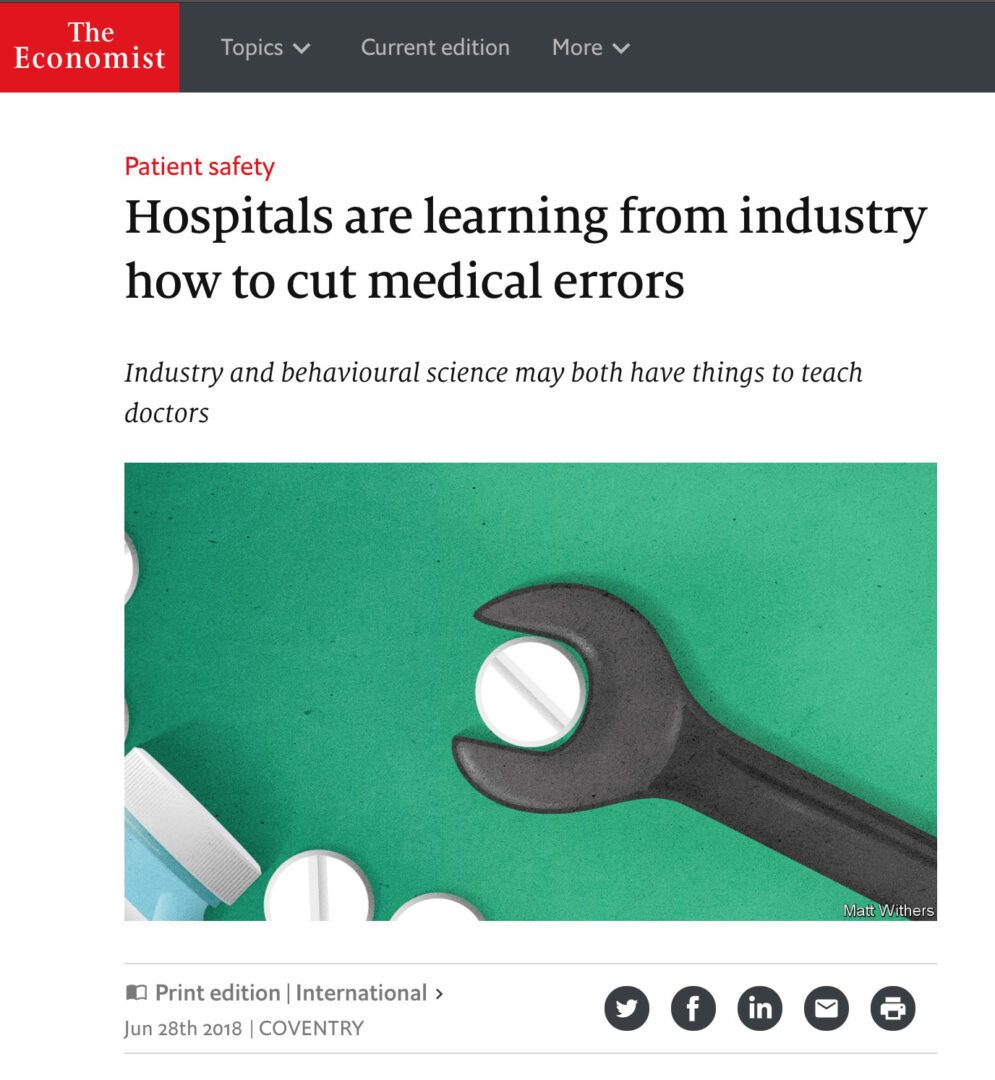
The article starts with the sad story of Mary McClinton, who died as a result of a process problem at Virginia Mason Medical Center in 2004.
“In response, Virginia Mason committed itself to improving safety. It used an unlikely model: the Toyota Production System (TPS), the Japanese carmaker's “lean” manufacturing techniques. Nearly every part of the hospital, from radiology to recruitment, was analysed and standardised. Staff were trained to raise safety concerns. Today Virginia Mason prides itself on its safety record–and sells its take on Toyota to hospitals across the world.”
I hope they aren't just standardizing. Hopefully, they are also helping to create a culture of continuous improvement. Part of that, as the article says, is creating an environment where staff members are free to speak up about risks, as the reports of errors and risks will increase before things are fixed.
The article also discusses the estimates about ham and death caused by medical error. Even if the estimates of 250,000 American deaths a year are “probably an exaggeration”:
“…a study in 2017 by the OECD estimated that 10% of patients are harmed at some point during their stay in hospital. It also found that unintended or unnecessary harm in a medical setting is the 14th leading cause of ill health globally–a burden akin to malaria.”
The article talks about lessons learned from aviation and industry.
“Lean” is one of the popular industrial-management theories taken from manufacturing. It suggests that hospitals should study a patient's “flow” through the building much as a car is monitored through the production line. That way bottlenecks and other inefficiencies can be spotted. In addition, Virginia Mason, for example, uses a policy of “stop the line”–ie, any member of staff is encouraged to halt a procedure deemed unsafe. It also has genchi genbutsu, or “go and see for yourself”, a standardised way for executives to visit wards and speak to staff about safety risks.
As Toyota would say, Lean and TPS are about flow and quality. Too many hospitals make the mistake of only looking at cost or efficiency.
Again, from The Economist:
“A literature review published in 2016 found that just 19 of 207 articles on the effects of “lean” methodologies were peer-reviewed and had quantifiable results. These found no link between lean methods and health outcomes.“
Except now there IS some research showing a link between Lean and healthcare quality outcomes, published by Stephen Shortell and the team at the CLEAR center at UC-Berkeley. I recently recorded a podcast with Prof. Shortell that I will publish soon.
“Use of Lean and Related Transformational Performance Improvement Systems in Hospitals in the United States: Results From a National Survey“
Shortell said that the article will hopefully be freely available soon.
Check out my podcast with him about this research:
Here is a slide from his presentation at the recent Lean Healthcare Transformation Summit:
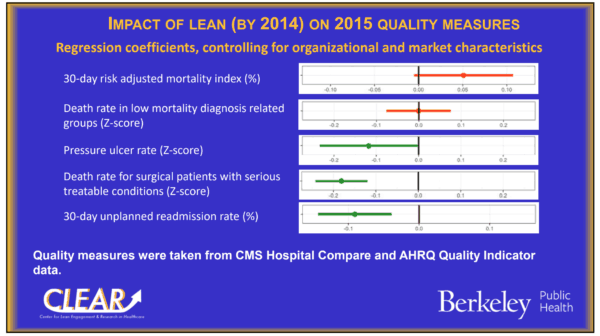
He summarized:
“Encouraging results–hospitals doing lean have better cost and quality performance on key indicators than those not doing LEAN”
What This Means for Executives: The Work Is Not Done
Media recognition of Lean healthcare is not evidence of success–it's a reminder of unfinished responsibility. If preventable harm still occurs, then learning is incomplete. Period.
For executives, the question is not whether Lean has been adopted, branded, or standardized. The question is whether leaders are still creating conditions where problems are surfaced, uncomfortable data is acted upon, and improvement continues after early wins fade.
Too many organizations confuse visibility with progress. Standardization without continuous learning becomes rigidity. Celebrated systems quietly decay. And safety plateaus are mistaken for excellence.
Lean healthcare still matters because the outcomes demand it. Until harm is rare, voices are consistently heard, and improvement is demonstrably ongoing, leadership cannot credibly claim success. This is not a historical achievement–it is an active obligation.