
Why “See, Solve, Share” Needs a Missing Step Before Solve
tl;dr: Steve Spear's “See, Solve, Share” model assumes people will raise problems, but in most organizations, fear and futility keep them quiet — which is why the model works better as “See, Share, Solve, Share,” with psychological safety as the precondition that makes the rest possible.
I love Steve Spear‘s emphasis on a Toyota-based Lean model of:
“See, Solve, Share”
See problems, solve problems, and share what worked as countermeasures. That's the ideal, and it's powerful where it exists.
At Toyota, and companies like it, there's an understanding that speaking up about problems leads to a constructive response from leaders.
That's not always true at other companies that are starting or attempting their “Lean Journey.”
The Psychological Safety that might be taken for granted at Toyota must be actively cultivated in a company before continuous improvement can really take root, let alone take off.
I think the model could also be stated as:
“See, Share, Solve, Share”
Because we cannot solve a problem that isn't shared.
Often, the assumption seems to be, “We need to help employees see problems and waste.”
Oh, they see the problems. Or at least most of them.
I think the necessary starting point needs to be, “We need to help employees feel safe to speak up and share problems.”
Or we could say:
“See, Speak Up, Solve, Share.”
What are your thoughts and experiences related to this? Please post a comment below or join the LinkedIn discussion on this topic.
Maria Mentzer, who works with Spear, wrote:
“I love the added share/speak up after see! It appropriately emphasizes the power of a collective see-solve-share learning & improvement dynamic depends on collectively seeing problems. Collectively seeing can only be realized if people share what they see, which requires an environment that appreciates such sharing and management systems that helps make the sharing easier across the organization. None of that will happen until people are treated in such a way that it is safe, encouraged, and even celebrated to be raising ones hand when one don't have the answer. Rather than, like most of us are trained to do from an early age, raising our hands only when we have the answer.”
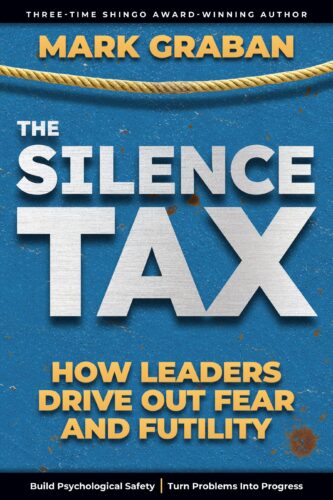
The Silence Tax: read a free sample or pre-order
My new book, The Silence Tax: How Leaders Drive Out Fear and Futility, is about why people stay quiet at work and what leaders can do about both causes. It comes out February 9, 2027. The Kindle edition is available for pre-order now.
Pre-order on KindleGet the free sampleEarly edition on Leanpub





[…] Do We Want One other Share within the See, Remedy, Share Mannequin of Steady Enchancment? – Mark Graban explains why the mannequin ought to be “See, Share, Remedy, Share” for psychological security to talking up about issues. […]