
Andy Sheppard, Lean, Change Management & More

My guest for Episode #276 is a Lean consultant (although he might not prefer that term) and an author, A J (Andy) Sheppard.
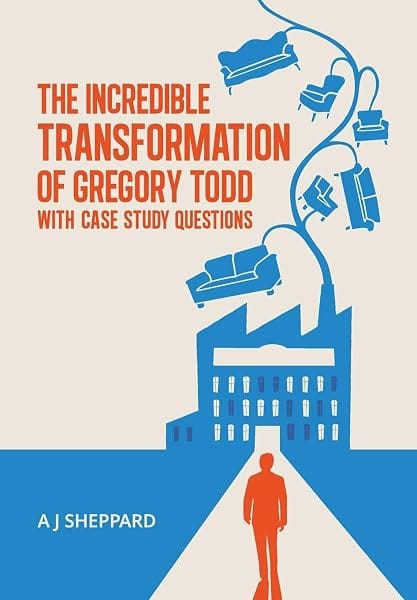
The Incredible Transformation of Gregory Todd
by Andy Sheppard
A business novel about leading change and Lean transformation.
Andy is the author of The Incredible Transformation of Gregory Todd: A Novel about Leadership and Managing Change. He also contributed a chapter to my Practicing Lean book project. You can download the PDF of his chapter here and I hope you’ll consider buying the book (it’s for a good cause).
From his bio: “He is a coach for leaders of change. His core expertise is helping workforces to quickly achieve systematic change in practice. A former McKinsey & Company consultant, he has now spent eighteen years working out this art of transformation in diverse industrial environments across the USA, Europe and Asia. He also continues to draw from prior experience of navigating change in corporate environments and experiencing it on shop floors.
Further information about Andy can be found on www.ajsheppard.com. Andy is also happy to take any follow-up questions about leading change on his Goodreads Author Page.” I hope you enjoy the conversation, which touches on Lean, change management, the need to balance empathy and urgency, and more.
Streaming Player (Run Time 42:40)

For a link to this episode, refer people to www.leanblog.org/276.
Topics and Links for this Episode:
- How did you get introduced to Lean?
- What are the three questions a leader needs to ask to transform an operation?
- What are some of the common pitfalls?
- Tell us about your book – The Incredible Transformation of Gregory Todd… why do deliberately not call it a “lean book”?
For earlier episodes of my podcast, visit the main Podcast page, which includes information on how to subscribe via RSS, through Android apps, or via Apple Podcasts. You can also subscribe and listen via Stitcher. Please leave us a review and rating!
Thanks for listening!
Podcast Summary
You can also read and download this 3-page PDF summary of the podcast:

Follow the Lean Blog Interviews podcast
Since 2006, I’ve been talking with leaders, authors, and practitioners about how Lean thinking works in the real world, in healthcare, manufacturing, and beyond. Follow the show so you don’t miss new episodes.
Full Episode Summary
This summary was originally published as a PDF in March 2017. The text below is from that PDF.
Jump to a section:
- Empathy and Urgency
- Learning and Un-Learning
- Terminology and Misconception
- Gregory Todd and Other Works
- Practicing Lean
Iwas delighted to welcome A J (Andy) Sheppard as my guest for the 276th episode of the Lean Blog Podcast. Andy is the author of The Incredible Transformation of Gregory Todd: A Novel about Leadership and Managing Change. When he’s not writing (including his chapter for my book Practicing Lean), Andy is a coach for leaders of change.
In our interview, Andy described himself as a manufacturing man or, as he says to his American friends, “a plant guy,” because he loves manufacturing plants. Just like my guest in episode 271, Isaac Mitchell, Andy began his career on the shop floor of a local industrial unit when he was a teenager. The largest takeaway from working on the shop floor he gained was empathy.
Empathy and Urgency
“I think probably the two biggest qualities that you need to blend to manage change are empathy and urgency. You need to be able to put yourself in somebody else’s point of view, in order to be able to communicate properly to them and to understand their concerns, and to draw out what they have to offer,” Andy explained. “And yes, I can certainly relate to what it’s like to be on the shop floor and not really understand the bigger picture.”
Andy went on to become a manufacturing engineer. After some time working for a large company as an engineer, he made the switch to management consulting.
“It’s there that I discovered a radical approach to changing an entire operation very quickly, in fact I was shocked to discover such a thing. And 18 years later, I still practice that approach. I now work independently and I would probably describe myself as a leadership coach because most of my time is spent helping leaders to lead their organization through a transformation process.”
Learning and Un-Learning
Later in our conversation, I asked Andy to talk about the challenges of coaching leaders, who often have years of accumulated habits and ways of operating, to move from an understanding of the concepts, to embrace Lean principles and operating with respect.
Andy explained that as well as learning, leaders need to constantly un-learn because if they are not careful they can let themselves become less prepared to listen and be taught. This is what happened to Andy early in his consulting career when he thought he already knew quite a lot about Lean and change management. For him, learning was reignited when he saw the results the expert was getting.
“I was going into my first engagement with this consulting company, and we were promising transformation, but to be honest I would have been happy if we could have delivered maybe 10- 15 percent improvement. What I actually found myself caught up in, under the leadership of this expert that had been brought in, was that suddenly we really were transforming this pretty small manufacturing company,” Andy said. “Within four months, we’d reduced the company from two separate facilities into one facility, we doubled productivity, lead time had collapsed from two months to two days, and I couldn’t believe we’d achieved so much so quickly. If you’d told me beforehand we could have done it, I would not have believed it.”
During this consulting engagement, Andy was shown both what to do, a systematic approach, and how to do it, a model of change with a very simple four phase (diagnose, design, implement, and refine) process that brings everyone along on a shared process toward redesigning a value stream.
Terminology and Misconception
This is of course a much different approach than the tool-based Lean approach, or Lean As Mistakenly Explained (LAME) approach as I dubbed it, which Andy warns about and works with people to prevent.
“In fact, I prefer not to use the word Lean because often it feeds in to people’s ideas about a tools-based Lean, and a lot of people have ideas about what Lean is, and what Lean isn’t. In fact, most companies I’ve worked for nowadays think they’ve already done Lean. So, it’s not particularly helpful then trying to advise people on Lean,” Andy said. “I think it’s also a responsibility of Lean practitioners not to promote jargon.”
Andy said that when an organization says they want to implement Lean, it is important for the organization to drill down to why they want to do so, because unless they really know the problems they want to solve in their business, they’re not going to solve those problems very well. Essentially, all they’re doing is importing a solution, which isn’t the best approach.
Andy explained that while he’s not concerned with using the term Lean in places like the Lean Blog Podcast, where it’s assumed that listeners are tuning in because they believe in Lean, but cautious outside because come across so many people who don’t understand it and don’t want to feed into those misconceptions.
Another term Andy said that he avoids is change management.
“I hate the term change management,” Andy said. “A lot of managers, they use the term change management and they assume that their role as a manager is to manage change. Well obviously, that’s part of it, change does need to be managed very carefully, but managers also need to change. Otherwise, managers assume that change is something that’s required from everybody else. In fact, managers need to change as much as anybody else, probably more than other people because it’s their thinking that’s shaped the organization already. One of the biggest problems in change management, or I prefer to use the term change leadership, is that people tend to focus on what can be seen.”
When this happens, Andy explained, leaders don’t stop to think about the things that are unseen but that have influence like the incentive systems, management culture, employment contract and intervention incentives. If you change an operating practice, but not the incentive systems, then it’s not going to work well or be sustained.
“A lot of the time, people are a part of a culture and they can’t see the way in which that’s driving negative things and actually restraining their overall potential even though they’re thinking that it’s one of their strengths.” He said.
Gregory Todd and Other Works
To wrap up our conversation I asked Andy about his book, The Incredible Transformation of Gregory Todd: A Novel about Leadership and Managing Change, and why it was not titled as a Lean book.
“I didn’t want it to be branded as a Lean novel because the main people that I want to reach are leaders of organizations, and probably they’re the people that have the most preconceived notions about what Lean is and whether they’ve already done it,” Andy said tongue-in-cheek. “What I’ve tried to do in this book is to give people a flavor of what it’s really like to lead change so that hopefully it will resonate with anyone that’s been through a change process or even considered going through a lifelike change process.”
Andy wrote the book as a novel both because it conveys that unique flavor that textbooks can’t, and because, as he spoke about earlier, he was influenced by being shown how to lead change and hope that by showing people the same way in his book, including some of the pitfalls that need to be avoided, he can help the lessons resonate with readers as well.
So far, Andy has been encouraged by the response, and is often told by readers that the story resonated with them. At the time of this interview, Andy was working on a follow-up book titled How to Lead Change.
“The idea is to have a series of pithy lessons, in terms of the questions we’ve been talking about, so knowing what to change, how to change, and who should be changing and how should they be behaving. I’m developing that at the moment and hoping it will be ready this autumn.”
The book will be available on Amazon and in bookstores, but if you’re interested in learning more you can visit www.ajsheppard.com. Andy is also happy to take any follow-up questions about leading change on his Goodreads Author Page.
Practicing Lean
If you can’t wait, you can also read some material from Andy in my book Practicing Lean, a book about our Lean journeys, which you can find at www.practicinglean.com. Andy is one of the 16 contributors from across the United States, Canada, and the United Kingdom who shared their first-hand stories about learning, failing, and getting better at leading Lean transformation efforts in the book. All proceeds of the sale of Practicing Lean are donated to the non-profit Louise H. Batz Patient Safety Foundation.