“You’re the Time Study Man”: Taylorism, Lean, and Respect for Nurses
TL;DR: Being mistaken for a “time study man” reveals how often Lean is confused with Taylorist observation and speed-up tactics. True Lean in healthcare partners with nurses to reduce waste and improve care–without blame, stopwatches, or fear of layoffs.
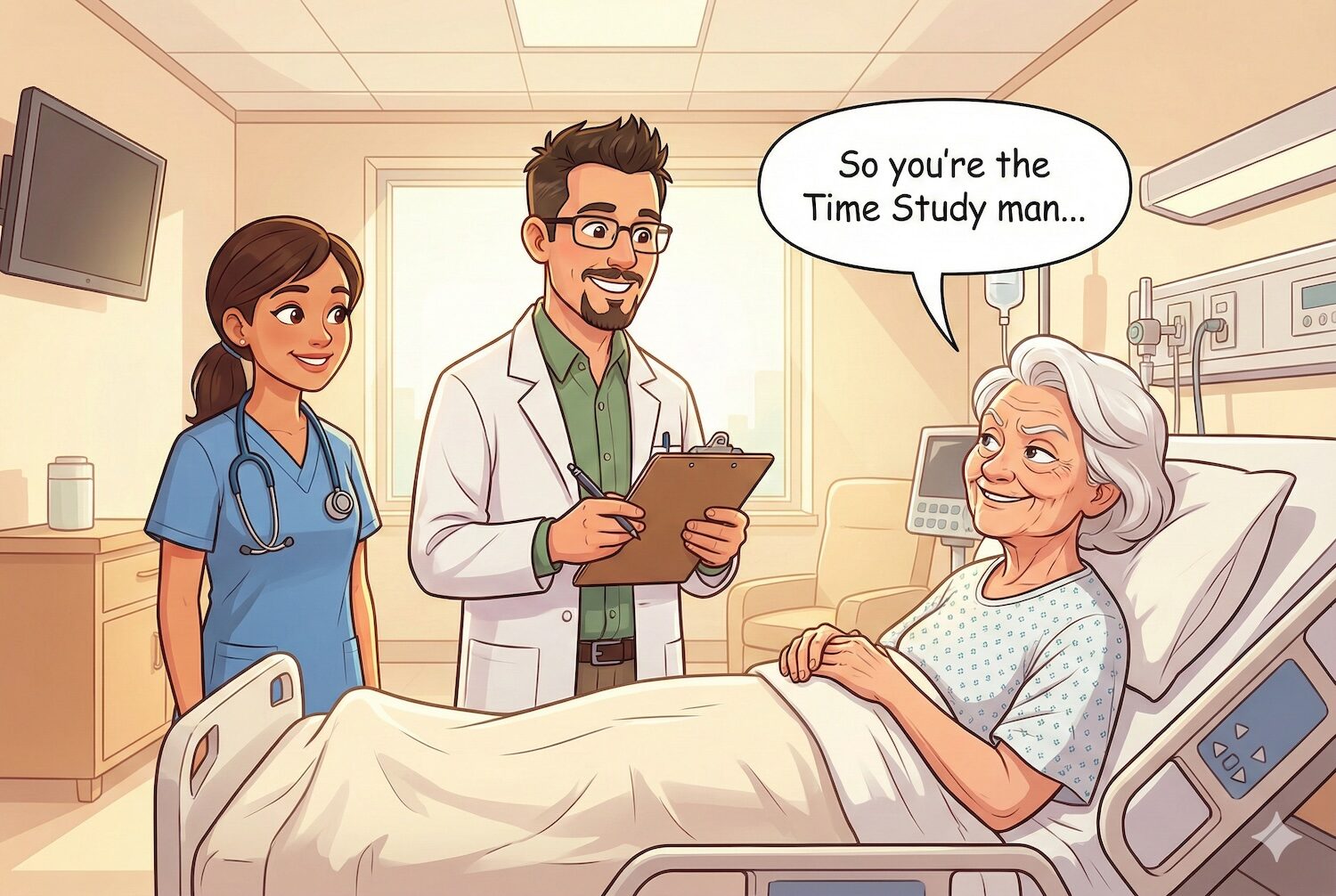
I have a funny story from earlier this week. I was doing some process observation with nurses at a hospital, helping them identify waste and possible Lean improvements. We entered a room and the nurse introduced me quickly to the patient. I was carrying my notepad, but no stopwatch or anything.
The elderly lady says, “So you're the Time Study man…” with a knowing smile.
I thought, wow what a wonderful antiquated term. It's the stereotype of the industrial engineer. When I changed my major to I.E., my dad's friend (an Electrical Engineer like my dad) asked,
“How's your stopwatch training going?”
As this old 1950's article from Time Magazine (amazingly available online) describes, the Time Study Man wasn't exactly a friend of the workers. Time studies, in a traditional sense, were very Taylorist in nature. The educated engineer stands over the working man, timing him and thinking of ways to “speed him up” (sorry for the non-inclusive gender terms, this is the 1950's after all). It was a conflict between the worker and the management, with the Time Study Man caught in the middle.
It might have looked more like this:

From “Time Study Man” to Partner in Improvement
That stereotype still lingers–but it misses what Lean improvement is actually meant to be.
Of course, the Lean approach is different. This is about partnering up with employees to identify waste. Making their job easier also helps improve service and care for the patients. In the context of a “No Layoffs Due to Lean” promise, finding improvements isn't going to lead to job losses. Instead, it frees up time to do a good job and to spend more time with patients, instead of being rushed. Lean isn't only about doing the value-added work faster, it's about reducing non-value-added work and eliminating delays.
Back to the patient's question… how did I answer?
So, as I described briefly, with a smile,
“Well, sort of… but we're working together to find ways to provide you better care.”
Was it awkward to have me following along? Sure, somewhat. But, management had done a very good job of explaining what this was about and what it wasn't. It's not about nurses running faster. It's about avoiding the need to walk (or run) by improving the process and eliminating all of the types of waste (which are present in the hospital workplace, to be sure).
I didn't ask if she had been a “Rosie the Riveter” era factory worker–and if that's how she knew the phrase.
Such things were perhaps commonly known, even in the 1950s, as the Time article says:
“Such cooperation is the best evidence that the time study creates few problems if the company uses competent technicians who carefully and repeatedly explain what they are doing, and include in any job evaluation such human factors as fatigue and boredom. An atmosphere of good labor relations is also a big help; although the International Union of Electrical Workers refused to permit Westinghouse's time study, it raised no objection to a similar study at G.E. Where a union suspects that the time study is being used by management to cut pay or fire workers, the stopwatch will always make trouble. But properly used, the time study is a tool that can not only cut costs and hike production, but boost both workers' wages and company profits.”
Observation Isn't the Problem — How We Use It Is
The real lesson of the “Time Study Man” isn't that observation is bad–it's that intent, context, and respect matter. When improvement is done to people, it creates fear, resistance, and fragile results; when it's done with people, it builds trust, capability, and lasting change. Lean, at its best, acknowledges human limits, invites those closest to the work to improve it, and replaces outdated stereotypes with shared problem-solving. The difference isn't the notebook or the stopwatch–it's whether the system is designed to learn or to blame.
Related Posts