

Lean Manufacturing in China: Opportunities and Challenges – Featuring Jim Womack
Update 12/17: Click here for part 2 of the Womack podcast.

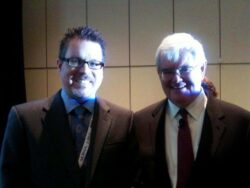
LeanBlog Podcast #12 brings us a special guest, James P. Womack of the Lean Enterprise Institute, the author of many books, including the classic (published 10 years ago) Lean Thinking and the more recent Lean Solutions.
We ended up talking for about 40 minutes, so I'm going to split the discussion into two podcasts. In this first part, we focus more on China's adoption (or lack of adoption) of lean practices. In the second episode, Jim discusses general trends in China and those considering doing business there.
Fresh from recent trips to China, Jim shares his firsthand observations on the country's rapid industrial transformation. He discusses the massive transition Chinese manufacturers are attempting to make–moving from inefficient, state-planned mass production to becoming globally competitive enterprises. Jim notes that while many Chinese companies are investing heavily in capital equipment and capacity, they often struggle with the “hard part” of the equation: adopting modern Lean management practices.
Jim offers a candid assessment of the cultural dynamics at play, debunking the myth that Lean is inherently tied to specific national cultures. He highlights the irony of an American expert traveling to China to teach local managers how to emulate Japanese practices from Toyota City–a necessity due to historical tensions in the region. The conversation explores the prevalence of traditional command-and-control management styles in China, where workers often wait for instructions rather than engaging in the proactive problem-solving and continuous improvement (Kaizen) that characterize true Lean organizations.
Finally, the discussion turns to the future of Chinese manufacturing amidst rising wage pressures and labor shortages. Jim cautions that while automation is increasing in sectors like chip manufacturing, simply buying technology is often a tempting but ineffective substitute for developing management capability. He observes that while executive wages on the coast are skyrocketing, true employee engagement in process improvement remains rare. Womack concludes that the journey from low-wage mass production to a sophisticated Lean enterprise is a long road that requires a fundamental shift in mindset rather than just new machinery.
A complete list of Jim's books.
Automated Transcript (Likely to Contain Defects)
Mark Graban: Hi, this is Mark Graban from the Lean Blog. This is episode number 12, December 4th, 2006. We'll jump right into it today. Our guest requires really no introduction for this audience: Jim Womack from the Lean Enterprise Institute. After some recent trips that he took to China, we decided we would talk about the state of Lean in China based on his observations and discussions.
One thing I will say about Jim's background–a lot of people know him as Dr. Jim Womack, but they don't realize that his PhD is not in engineering or business, as a lot of us might assume. His PhD is actually in Political Science from MIT back in 1982. His dissertation was on comparative industrial policy in the U.S., Germany, and Japan, which of course was a perfect lead-in to The Machine That Changed the World, and the rest is history. It's great to have him here today.
Jim, it's a real honor to have you with us today. I appreciate it.
Jim Womack: Well, thank you, Mark. I'm honored to be here.
Mark Graban: I was hoping our topic today could be the state of Lean in China. I understand you were over in China recently, so I was wondering if you could tell us about what you are seeing firsthand and what people are talking to you about in China.
Visits to China: Then and Now
Jim Womack: I've been going to China actually for a long time. I first went in 1984 on my honeymoon. My wife and I spent a month going all over, riding bicycles out in the country and having a generally good time. I went back after that to look at actual manufacturing operations. My wife made it pretty clear we were not going to do any factory tours on the honeymoon–I thought it was an okay idea, but I guess it wasn't.
In recent years, I've been going back once a year. We have a Lean Institute in China based in Shanghai. Therefore, I have a reason to go. When I go, I hate to go anywhere if I can't take a walk–let me do some gemba, please, and just see what's up. I've seen all kinds of things which, however, do not sum up to any kind of valid database on exactly what the state of manufacture is in China. It's all just snapshots.
Mark Graban: Sure.
Jim Womack: But what we do see, I think, is this: The Chinese have gone from being the world's biggest “not even mass producers.” When I first started looking at Chinese factories more than 20 years ago, they were staggering in their inefficiency. The whole point was job generation and control because your factory was also your home, the school for your kids, and your doctor. The whole system was set up as a control mechanism. The fact that they happened to be making a few tractors–well, so much the better.
From Job Creation to Global Competitiveness
Jim Womack: It is a tremendous transition for them to go from a centrally planned, “make the party man happy” stance (and by the way, create plenty of jobs) to the current stance where they are actually trying to be globally competitive in a serious way–not just a hot-house, cheap currency way.
However, they have a tremendous long history of doing everything the wrong way, and even “wronger” than those orthodox mass producers around here. So, it's a tremendous leap on the management side. Technology is easy; go buy some machines. Anybody can do that. Management is hard. From what I've seen, there is a real struggle to figure out what modern management–much less Lean management–actually is, and how you would go about doing it.
Except for the cheap wage, there really wouldn't be a whole lot that I should think people outside of China would be talking about in terms of fundamental manufacturing competence. But, of course, we do have the cheap wage, and so then that becomes the big issue.
Mark Graban: Talking about making that leap from massive waste to trying to run more like a business, I would imagine their introduction to modern management came primarily from non-Lean companies that entered China and brought management and business practices with them. Is that right?
Jim Womack: That's right. One channel is multinationals that come in to run things. The second channel is entrepreneurs. I went out this time to look at a pencil factory and met “Andre the Pencil King,” who was a foreign entrepreneur who is now the third-largest maker of pencils in the world. This guy is a lovely guy, but he doesn't really know anything about manufacturing; he is a financially oriented sort of fellow. So, those folks at the pencil factory are learning a fair bit about financial management, but it's not clear they're going to learn a whole lot about modern, best-practice operational management.
There are many conduits. Then, of course, the more forward-looking state enterprises and the more forward-looking entrepreneurs are out in the world looking around. They can buy the same books that we publish that anybody else can buy. They can read them and try to do something with them. So there are multiple learning paths.
It is interesting that, as a sort of Toyota-head, there really has not been any significant Toyota presence in China. Toyota has a couple of joint ventures, but there has not to this point been serious direct transmission of Lean methods via the Toyota mechanism the way we've certainly had in the States.
Observations on the Factory Floor
Mark Graban: When you walk the gemba at a Chinese factory, what evidence do you see firsthand of either Lean practices or Lean thinking in terms of how they're running their factories or managing people?
Jim Womack: Again, with very isolated exceptions, not much. You can go through plant after plant with just amazing forward spending on capital equipment. Just staggering amounts of machinery, in many cases doing nothing. You ask, “Why did you buy all this?” and the answer is, “Well, we've got big plans.”
That's interesting, but of course, most people in a more mature market economy don't buy capacity ahead of the market if they can help it. So, you're just scratching your head looking at all of this equipment sitting there.
Then you see management practices that are leftover from the old era. This was a command-and-control, top-down society. That goes all the way back to Mandarinism, where you basically wait to be told what to do. We know in a mature Lean system, the whole idea is that people at every level initiate activity, analyze the process, go through an A3 exercise, and ask, “What's the problem? What can we do about it?”
You really don't see that. Or at least I have not yet seen that. You see some very energetic, very high-level managers. But when you go out on the gemba, you have folks who are basically standing there asking to be told what to do.
On my last trip, I saw a particularly ludicrous thing: a moving assembly line that had no product. All the workers were at their workstations, and the line was cranking along. About every 10 minutes, something would come down the line for some of them to work on. In our world, most everybody would say, “Well, gee, if there is only something coming every 10 minutes, why don't we go somewhere and do something else?” Whereas these folks were quite earnestly standing there just in the event that something happened to come down the line.
There is a big, big transition here to go from an utterly orthodox, top-down, command-and-control management mentality to a proactive, “Gosh, there's a problem, let me see what I can do about it” mentality. That's going to take quite a while.
Mark Graban: You talk about that top-down command-and-control society. I'm sure that would be very familiar to a lot of people in American manufacturing–non-Lean, traditional management approaches would be very familiar.
When we talk about society or the culture, people in the United States for a long time made excuses that Lean is something particular to the Japanese culture, and we have all of our reasons why we can't do it here. A lot of people have gotten past that. Do you get a sense that there are similar excuses in China where they say, “This just doesn't fit with our culture”?
Cultural Barriers vs. Universal Management
Jim Womack: Well, of course, there is a long and really quite deep animosity between Japan and China. So, I find myself in the odd position of going to China to tell the Chinese that they should act like Japanese in Toyota City. It's probably easier to hear that from me than it is to hear that from a Japanese person from Toyota City. That is the way it is.
For those Americans who might be listening in, the degree of cultural division across East Asia is really quite striking. Look at Korea vs. Japan, the South vs. China, Japan vs. China, Vietnam vs. China. There really are a lot of mental barriers to learning. It is kind of funny how you go to the States to learn how to behave like Japanese in Toyota City, but that is, to a significant extent, what's actually happening.
Our China Institute is run by a wonderful Chinese-American, Marcus Chao, who was at Delphi China for many years and then decided to retire and take it on. Marcus, who is an American of Chinese origin speaking in Chinese, is giving straight lectures on exactly how Toyota would do things. It's really quite interesting to see this “across the world and back” transmission of knowledge in a way that then becomes acceptable so people can listen.
We were, on this side of the Pacific, just tied up in our underwear for quite a while thinking that the Toyota thing was “cultural.” And by that, we meant either Japanese or Toyota-specific. In my view, that's just a complete waste of time. It took quite a lot of proving at Georgetown and elsewhere to show, “No, wait a minute, this is a universal way to do things.” Just as mass production became a universal way. There are mass producers in China, in Russia, in America.
It's amazing how much time civilization wastes on the inability to confuse the origin of something from the essence. Typically, important essences are really not national cultural things, but rather mindsets that can be learned. Management is about embracing some sort of philosophy of management–you have to have one; pick one please–and since you've got a choice, why not pick the best?
Rising Wages and the Lure of Automation
Mark Graban: You could hope maybe that if modern management hadn't taken such deep roots in China, they could push those practices aside and adopt Lean. We hear already about how there are labor shortages in parts of the country and pressures pushing wages upward. Does that give them more hope then to look toward Lean? Or would they be tempted to look towards automation as being a panacea?
Jim Womack: The forward-looking folks realize: why put in place the wrong thing? There is a pretty widespread awareness that one should get bad habits out of the way; it's just hard to uproot them. So there is a generalized desire to go and immediately embrace the best management practices.
But by the way, buying all of that over-specified, over-capacitized machinery is part of their view of embracing modern management practices as well. So you can end up in some pretty odd destinations with your desire to embrace best practices.
There certainly is the widespread perception that people tell you, “Gosh, you know, we could be General Motors or we could be Toyota. Guess we should be Toyota. Why build a system that is basically in retreat everywhere and put it in place in our region?”
So there certainly is a desire amongst the more sophisticated senior management to do the right thing. But that's very different from knowing what the right thing is or how to do it. Those are the hard parts. The earnest desire to do the right thing–well, don't most of us have that most of the time? And yet, look what we do. They are no different from the rest of us in that regard.
There certainly is an intense desire to build absolutely cutting-edge, state-of-the-art businesses and not just to live off low wages. They certainly sense that this low-wage thing is time-limited. It's time-limited in two ways: either the domestic economy moves in a direction where you have much higher wages (and of course, they actually want that–they don't want to run a country where everybody works for peanuts and makes cheap products for Americans), or the trade environment changes.
They would love to run a country where everybody works for wages at the American level and still manages to export goods all over the world. But to do that, you have to be very sophisticated, and you have to have some intellectual property. You can't just be making commodities. So they realize that this has been a happy window that gave them a big leap and jump-started the whole economy, but that isn't going to last forever.
It can come to an end in two ways: wages, particularly on the coast, really do go up. Also, in the next recession, watch out with regard to trade management. The way the trading game works is that we have periods where we head toward more and more openness of trade; that tends to happen when economies are booming. Then when economies hit the wall, the first thing politicians in every country do is listen to locals who are losing their jobs and say, “Oh my gosh, we've got to keep the foreigners out.”
The Chinese aren't stupid. Anybody who has studied the history of trade knows that the next down-cycle is a time of great risk. They don't think naively that they can build a whole civilization based on selling cheap stuff to Americans. At some point, this train comes into the station, and you better hope there's another train going out, because that one probably is not going to be going any further.
Mark Graban: It will be interesting to see over time, regarding that excess capacity, looking at labor shortages or rising labor costs, would they be tempted to look towards automation as being a panacea?
Jim Womack: Look, just buying kits, including buying consultants, buying machines, buying whatever as a substitute for actually figuring out how to manage, is tempting to all managers at all places at all times. As I said recently, managers will try anything easy that doesn't work before they'll try anything hard that does. And the fact is that management is hard. Machinery is easy. You get a catalog and you buy yourself some machinery.
So sure, there might be some temptation as wages go up to automate. Goodness gracious, we've seen Toyota do a lot of automation over a long period of time. But the fact is that one of the rules of the world is that as labor becomes ever more expensive, you do try to work harder and harder at saying, “Gosh, how can we just do this with less labor with no more capital?” And then at some point, there are situations where capital makes sense.
Do I expect there to be a big boom in automation in China soon? The answer is: Well, sure, for chip making. Just in the nature of it, if you've been in a fab, well, it's totally automated. You can't see what they're working on. I don't think you or I are going to be much use with tweezers. So therefore, depending on what you're doing, there's going to be a lot of automation.
I was just in a fab in China which was just kind of amazing–must have been a billion dollars worth of kit and, as far as I could tell, no order book. Again, just scratching your head about who thought this up.
But anyway, over the long term, sure, there's going to be more automation in China. But look, we're now at a point where–and some of this is a little bit of dreaming on–people are reporting that wages are rising on the coast. Well, for the commodity stuff, you get on the bus and you go inland. They still got about 700 million people who are out there on the farm not doing a whole lot. So I think it'd be a little bit naive to think that wages are suddenly going to rise to an American standard in a short period of time.
Even in this country, there's still a wage gradient between North and South in the United States. It's been there for 200 years. So it's going to take a while before you get wage equilibrium.
On the other hand, where the price is really going up, which is kind of interesting, is management. It used to be you could go to China and hire a factory manager, teach him a little bit, and he was happy to run your factory for $5,000 a year. Now that factory manager says, “Well gee, don't I get $100,000 a year? Because that's what you pay this expat.” It's interesting that the people you talk to on the coast in China say that what is really zooming is manager wages. As you move inland, it's more problematic whether you can find cheap management; certainly, you can find cheap labor.
Mark Graban: Just one question to wrap up, thinking about quality and the pursuit of perfection. How much of that is entering the manufacturing world in China? Have you talked to anybody where they have Kaizen events or really try to empower employees?
Jim Womack: You'd have to look a long ways to find very much. It's very, very early days. There is such a leap from “no factory” to “a factory.” You go into a room full of people who previously were walking along behind a two-wheeled, hand-controlled tractor and now suddenly are factory workers. To jump from that to “Anybody want to do some Kaizen? How's about Six Sigma anybody?”–this is a big, big leap.
I think you would have to run your search party night and day for quite a while before you found much in the way of improvement activities that are actually directly engaging employees.
When I was at a state-owned industry last year looking at the plant, they asked what I thought. I said, “Well, here's what I saw. I saw a staggering number of people directly involved in production and producing very little. And I saw nobody at all involved in improving the process.”
I kept asking, “Do you have improvement teams? Where are the industrial engineers?” This plant, which was making goods for military vehicles, looked like it had been there for 40 years and looked like nothing had changed in 40 years. Except there was just constant fiddling–none of the equipment would run and they had the techs just kind of clambering all over it doing breakdown maintenance.
You say, “Gee, you know, this is really the state of nature I'm looking at.” That's a big, big leap from there to a world where everybody thinks part of their job is to improve and you have scheduled periodic improvement activities. That's a different world. And I think you won't find too many operations at this point that are in that world.
More Information
If you have feedback on the podcast, or any questions for my guests or me, you can email me at leanpodcast@gmail.com, or you can call and leave a voicemail by calling the “Lean Line” at (817) 372-5682 or contact me via Skype ID “mgraban”. Please give your location and your first name. Any comments (email or voicemail) might be used in follow-ups to the podcast.
Visit the main LeanBlog Podcast page with all previous episodes.






[…] at MIT in 1998, I heard Jim Womack tell a story about getting “fired” by Boeing as a consultant, leading him to start the […]